Amanda Kovattana

Middle-aged musings in interesting times

Monday, January 27, 2025

The Influencer

“How did we get all these Chinese people?” I asked my farm partner, Clasina, when I landed in Northern Thailand a few days before our scheduled ten-day building workshop on our farm, Lost Boots. So named because Clasina lost a boot in the mud while attempting to install a pipe on the pond's bank. The locals called it the farm next to the crematorium. The Thais feared ghosts, so they were likely happy to have us own the property that hosted the crematorium. During the first build, we ran a homemade extension cord through the forest to one of the bathrooms at the crematorium so we could have power. Now we had solar power so we didn’t need to.

“Yidan,” Clasina said in answer to my question about the 9 workshop participants from China, “the Chinese influencer who did the video tour of Maggi’s house.” Maggi was our workshop teacher, a 77-year-old English woman with considerable natural building experience who had created a zero-carbon footprint home for herself. This house was the crowning achievement of her building career incorporating a self-regulating interior temperature, a rain catchment system, skylights made of car windshields, and a pair of revolving air vents that topped the two domes of her roof giving it a circus tent appearance. The house was in Chiang Dao, a resort area in the mountains 90 minutes from Lost Boots. 

Maggi operated a B&B in another part of Chiang Dao with a spectacular mountain view. Guests stayed in the many roundhouses she built on land she purchased. She sold the enterprise before building her final home on land she leases from a Thai friend Noot, who came to help us build. We also welcomed back our lesbian couple, Gege and Aleks. They, too, had found us last year through Yidan’s videos.

I wondered if, Yidan, did videos like the Asian woman who built a tea house from scratch and then served tea to her mother. It was so charming a concept and so captivating to watch her build with just hand tools that it went viral. (Later I found out her videos were supported by an entire crew of professionals.)

Clasina rented some serious tent pop-ups for the lecture and presentation that Maggi, an innovator of tropical natural building techniques, would present. In addition, we had Grant a gay man from New Zealand who met Clasina at a permaculture conference. Permaculture was a philosophy that encompassed sustainable agriculture focused on food forests. His last professional role was as the headmaster and director of an international school in Thailand. Upon their arrival, he gave our camper guests a tour and orientation of the onsite details, which included protocols for the use of the bucket flush toilets, bucket showers, individual solar lanterns, and tent set-up. 

Clasina’s husband Panya and our hired cook, Oy, were our onsite camp and kitchen support. A familiar helper came for the day to help with meals and clean-up as well as building. Drinking and cooking water, in reusable heavy-duty plastic bottles, was delivered by the case. Water for the bucket baths pumped up from where it sits, in the canal around the original rice field. Pumped with solar power to the gravity feed tank placed on the hill above the newly built shower stalls. The water was filtered before entering the tank and warmed by the sun.

At our introductory presentation, we asked the participants to tell us of their building experience. There was the usual range from none at all to having already built various tiny houses and cob houses. They expressed a desire for simplicity, for community with like-minded permaculture practitioners, and a recognition that the rapid urbanization of Asia was not for them. Some brought friends with them who wanted to do something different away from being online. 

One woman, living in Shanghai, came to get away from the stress of urban living. I later learned that she had a start-up business in public health and wanted to build a health and wellness center using natural building techniques. Her enterprise catered to companies who wanted to relieve the stress and unhappiness of their employees. This was an idea she adopted from a Mayo Clinic’s model. The Chinese government, who were now concerned with the stress level and unhappiness of their urban workers, were giving out grants to any enterprise that aimed to alleviate this stress and she had gotten enough money to hire 30 employees. Her phone cover was embossed with the message in Chinese and English “The Cause of Communism Needs Me”. That did give me pause. Was this more user-friendly communism doing better than any of our top-heavy non-profit organizations to alleviate social problems?

Another city dweller, one of the young men, tutored English as a second language mostly to students wishing to enter universities overseas, but not to the States, but to the UK. He served as an interpreter for his friend who had little English and also offered his talents to others in the group. It was a beautiful thing to watch this cooperation. It made me feel like I was in a Chinese movie but without subtitles.

Last year we held our build for women only so a man (whose Chinese name was Fafa so we didn’t know if man or woman) had to be turned away and wait a year. Now he was here going by the name Leo. Many of the Chinese participants had adopted Western names to better navigate this Englishness of the West. The English tutor had taken the name Ethan (in admiration of Ethan Hawk an actor) and dyed his hair blond. They were thirty-something, and so eager to help when asked to unload cases of water. As befitting Asian culture I felt their deference to their elders and to group harmony except when it came to food which they helped themselves to with little awareness of how much there was and if everyone would get a share Clasina complained to me. She soon corrected them on that matter.

On the second day, we were joined by Andrea, a German friend of Maggi’s, who had just bought land in the area and would be embarking on her own building journey.  

After the breakfast presentation, we proceeded to give our first hands-on learning task which was a demonstration of roof thatching which we did on the bamboo structure of the loo. Since I had done this task before I spent the time talking to the Chinese influencer on the surrounding grassy ground. She was in her early thirties as were most of our participants. 

She had arrived, at breakfast, in her white pick-up truck with the name of her farm on the side door with a painting of a bear figure on a scooter. I immediately noted the dog and cat riding with her. She was wearing white pants with cowboy-height brown boots and a brown flight jacket over a white camisole. I loved that she was so styling. She had come to document the build for her channel, carrying a tiny drone camera illegal in the States for privacy reasons. She also used a full-size single-lens reflex camera much like I had once carried. The dog was with her, now, quietly sitting in her lap. 

Yidan was from a rural village in China I would learn. Her mother had been a traveling seamstress who tailored clothes for the villagers before off-the-rack clothing became available much as was the case in Thailand when I was a child. She, and her generation, had witnessed all the changes to China, in a couple of decades, that I witnessed over the last 50 years among the Southeast Asian Tiger nations.

I asked her why she had left China. She told me that Chinese men preferred their women to be no taller than 165 centimeters while she was 173 centimeters so her chances of finding a mate in China were diminished. I remembered I had met a Japanese woman with the same dilemma. Most Chinese were not eager to embrace an off-grid lifestyle, I gathered when she told me that the participants that had come to join us were rare in the population. Just like my Western friends who could not live without a flush toilet, I thought.

Her English was perfect and I quickly realized her understanding of the world, in terms of globalization trends inspiring an off-grid approach to her lifestyle, very much paralleled mine. She was doing with her video blogging, what I was doing with my writing, telling stories of inspiration from her DIY projects on her own homestead in Thailand while, at the same time, acting as an inter-cultural translator to her Chinese audience.

I was wearing my handmade Roman sandals hoping to spark conversation around them. Before I left home I had re-soled them with nails to avoid using toxic glues. I explained this to Yidan and how I kept replacing the soles and the uppers because the leather insole had taken on the shape of my feet and felt so good to wear. She totally understood how leather can do that. Grant, spotting the turquoise laces in my sandals, began to riff with Yidan about how I could market my re-solable shoes at a bespoke price while offering different colored inserts and shoelaces as an ongoing income. I laughed at this business-centered feature of my money-savvy Asian compatriots. 

Yidan, was herself, a sharp entrepreneur and had asked for her cut for every participant she brought to our workshop. We charged them a fee of 750 Euros for the privilege of learning from us as we used their labor to help us build. I could see we were being offered the opportunity to collaborate with Yidan and I listened eagerly as she told us how Chinese parents were willing to pay handsomely for their children to get off their screens, and travel to another country to play in the mud and experience nature. I had been discussing this same problem of children and screens with mothers in my women’s group back home. How fun it would be to be the provider of a nature school experience.

Yidan was able to tell me in fifteen minutes all I wanted to know about China. What did their government tell them about the United States I asked. Oh the US is evil, she said. Same with ours I replied; it made me uncomfortable how much Americans were suspicious of China. As we wound down our conversation we were joined by, Andrea, our German expat whose English was halting but serviceable. The three of us spoke of the increasing polarization in each of our countries between Left and Right and Yidon quietly spoke the ethos of all of us as she suggested that the real work to heal our global alienation was to make bridges between groups. Hear, hear my next-generation mirror image. 

Over the ten days the more I learned and observed about our Chinese team the more they reminded me of Americans. No longer were they the ugly Chinese, of the previous generation of tourists, who had descended on Thailand in tour groups to stay in the large hotels that were built on the outskirts of Chiangmai occupying the town as if it was their own Disneyland. An American friend had told me she was physically pushed off a path by a woman from such a tour. 

No, these thirty-something Chinese were quieter and savvier. They liked American movies and music. They wore our brands, Columbia jackets, hoodies, sweat pants with stripes up the leg, t-shirts with English words on them, and a Chinese typeface that looked like English words. Gege had the exact same pair of black Hoka's as I was wearing. “We’re twinsies, “ I said pushing up against her shoe with mine. Her girlfriend Aleks came forward to translate. “She got those shoes because of you,” she said loud enough for all to hear gesturing towards me. Awww. They were probably made in China anyway. We had even both bought them second-hand from equivalent online platforms. This internet generation put China on the rise. They reminded me of Americans in the ’90s when we were still free to speak and share ideas and fashion, before cultural appropriation and the compelled speech of diversity, equity, and inclusion silenced and divided us. The ’90s was the golden age of my American Life.

The women were also competitive in a friendly way inviting others to show their skills and being willing to laugh at themselves if they weren’t up to it. I, too, was inspired to show off my skills whether it was with kung fu moves stretching in the morning or with dance moves around the campfire in the evenings.

One morning I came to sit by the rocket stove, next to Leo who was talking to Grant about his favorite music. “Tell Amanda what your favorite song is,” Grant said to Leo. “Imagine,” he said. “John Lennon”, Grant said.“John Lennon’s Imagine?” I repeated dumbstruck. This was just so poignant given the jostling of our respective world power nations, it made me want to cry as I recalled the lyrics. 

Imagine all the people sharing all the world. You may say I’m a dreamer, but I’m not the only one. 

Now when I hear China mentioned in the news I will picture Leo learning English from an app that showed the lyrics of songs in both Chinese and English as he had shown me. Indeed all these young people I met would flesh out my thoughts of China.

Four of the Chinese girls had already left China and were living in Thailand, one working for a Thai radio station, and one for an American NGO for the environment. We met a couple of their husbands. One couple lived on a sailboat off the coast of Krabi, one of Thailand’s islands. They might be rare birds among the Chinese population, but that population was just one generation from all the practical survival skills of rural living.

Our American kids were no longer competitive with the world I thought. They needed to get off the grid, get grounded, and dispense with these narcissistic messages of identity, brain diagnosis, and food allergies. It was getting harder to work with Americans on our teams. I wasn’t ready to run away yet. I knew I would go back home to California and try to talk sense into our runaway progressivism which was running us aground with bad ideas that didn’t work. What else could I do?


Labels: , , , ,

Friday, August 02, 2019

A Lease of Affection


Further adventures with a tiny farm in Northern Thailand.

A Pond To Begin With

In May Clasina and her husband Panya planned a three day weekend to Mae Taeng to oversee the work of a bulldozer man. With this act she had begun to realize our dream of a farmhouse, a pond and a food forest. She had researched extensively on youtube how to make a pond that would best support aquaculture providing shelter at the edges on narrow ledges (about 2 feet wide) for spawning fish, eels and frogs. All food sources of local people in the area. When I asked my cook in Bangkok if she had ever tried the regional frog dish, she said yes, but she really preferred chicken. Heh. The pond was the same size as the footprint of the house so was quite large and deep. I was overwhelmed by the size of it when I first saw it, but realized that once it was full of water it would be just right.

The digging of the pond also provided earth to level the slope to make a flat spot upon which we would build the house. Seeing that she would be short of soil she had even enlarged a pond on the next door neighbor’s land so as to be able to use that soil too. Clasina then invited our potential building teacher Maggie to visit the land. We had already interested many of our mud hut sisters in coming to help build it as soon as this coming winter, but Maggie pointed out that the land needed to settle for at least a season in order to create a firm base upon which to build. This I felt gave us a little breathing room, though Clasina had been eager to start. 

The farm project was a respite for me from American politics (as well as Brexit) and the precarious feeling of the social contract threatening to tear apart at the seams world wide. The Thai news cycle no longer covered such overseas drama. So as not to give the populace any ideas most likely. Thailand was not, however, going to escape the impact of climate change. Though I arrived in what should be the middle of monsoon season, the rains had been scarce this year. A true monsoon season would offer rain every day, but not a drop had I seen. 

Thus having a pond was a good idea to lessen the impact of these periods of drought. It had been foremost on Clasina’s mind. Both ponds were filled by the aqueduct that ran between our lands bringing water direct from the reservoir upstream though government whimsy might close off the aqueduct for maintenance with little notice. The pond would build in resilience to our farm project.

These government built aqueducts fed much of the plots in the region. When the damn—the Mae Ngat dam— was built 30 years ago the displaced farmers were offered plots of land on the periphery of the Sri Lanna National Park. Our farm was one of these plots one kilometer away from the reservoir which was now also a vacation destination complete with floating bungalows. I felt privileged to have land on the edge of a national park. This as Clasina had pointed out would ensure there would be trees bordering our food forest to support our stewardship of the land.


The Lease of Affection

As before our first stop was at the land office for one final formality which was to sign a lease. A lease is what gave Clasina legitimacy on the land—the right to work on it and live on it. A lease also protected me, as my friends and relatives immediately wanted to warn me. By Thai law a squatter who had managed to live on your land for ten years without a lease had earned the right to take possession of it. 

“But I want to leave it to her when I die,” I said. 

“Well don’t tell them that or you will end up dead,” they told me. 

“Too late,” I said wondering what kind of narrative my Thai peers were living in that made them so distrustful. 

The government also wanted to get involved when a lease was signed for if there were payments to be made they wanted their cut. A lease of 30 years or more required government oversight. I preferred that the government not be involved so thought a 15 year lease would be adequate. Thirty years was, after all, the rest of my life. What if Clasina wasn’t able to develop the land as she hoped? Surely we needed to specify for such contingencies, but contingencies tended to spawn more contingencies. How complex would this lease need to be? All I wanted was to be included in the development decisions. I also did not want to be accountable for any business liabilities Clasina might create. I felt overwhelmed by such complexities.

The lease also had to be in Thai so we could not write our own; we would have to find one or hire a lawyer at some expense. My boy cousin had a banana farm that he leased out to tenant farmers so I asked for a copy of his lease. When Clasina got it translated she was taken aback. The lease gave the owner the power to evict the tenants with very little notice for almost no reason plus even the slightest improvements to the land had to be closely approved by the owner. That sounded like the feudal lord that my cousin would make himself out to be. It was how those of my class status operated. I agreed that it was too draconian for our purposes. 

So Clasina asked a business man she knew for advice and he offered a lease that was much more fair to both parties. It was a 30 year lease. A longer lease made her feel better about all the time she was going to be investing she told me. There had been cases of farmers putting in all the work to develop the property only to have the owner come in and say they were going to be evicted because the owner’s family now wanted to live on the land and were going to take it from there as far as farming it. It wasn’t me she was worried about, she told me, it was my relatives should I die and they came to claim my property. I could well see her point. This was exactly what happened to gay couples before marriage equality.

I agreed to the 30 year lease if she would figure out how to do all the paperwork to keep the government happy regarding taxes on payments that I was not even going to collect. What would such paperwork even look like? 
Clasina decided to ask the land office for help with these questions. So on our last trip to Mae Taeng we were relieved to learn that the land office itself had a variety of leases we could use and she had taken them home to study in the interim. 

We also learned that the government did not require that payments be made for a lease to be viable. Such a lease was called a “lease of affection”. “Affection” being the closest word for translation that Clasina could come up with. I was comforted that such a patronage relationship was common in Thailand. That it was common for an owner to want a tenant to be able to make a living from the land while keeping it from being reclaimed by the jungle. This lease did indeed express the relationship I had in mind. I wanted no false intentions to stand in the way of the universe helping us with our farm project. 

I also worried about making a Thai will which would would require a lawyer to navigate. Could we just add a clause to the lease that would leave the land to her upon my passing? 

We told our story to a clerk and were handed up the chain of command until we got to the man who could answer this question. I had met him before when I came to buy the land. He pointed out that even if the land was left to Clasina she wouldn’t be able to take possession of it because she didn’t have a Thai I.D. card. This was a bureaucratic technicality that continued to frustrate Clasina since she had long ago had the right to one with her marriage to a Thai and was still waiting for her application to be processed. The man then suggested that we sign a lease that would give her the right to the land for her entire lifetime. We had now gone from a lease of affection to until death do us part. I was liking this. It was very Gay.

“What are you two to each other,” the man asked us. 

“We are friends together,” I replied in Thai. This was indeed unusual I could see. Family being the usual basis of such patronage. He then asked me if I was single and if I had any children. Perhaps to make sure I had no one else who might object to me entering into such an agreement. Yes I was an unencumbered free agent creating a relationship not often seen outside of family. Not an unusual idea in my life thus far.

It did not take long for the lease to be prepared nor did it cost very much. Before I signed it he asked me to tell him what was now growing on the land just to confirm that I actually knew the land in question. Then he repeated the terms of the lease to make sure I knew what I was signing since it was clear I couldn’t read the document. And he explained that if we want to dissolve the lease we both had to come to this office to do so. Good enough. We signed all the signatures needed. As we walked out the door I told Clasina I felt like we should open a bottle of champagne. 

We went to use the bathroom around the corner of the building. When Clasina came out  of the stall she wanted to give me a hug. 

“I just wanted to acknowledge what a great opportunity this is,” she said hugging me warmly.

“I’m glad you’re up to it,” I said. For I did indeed feel fortunate to have found such a farm partner who was already putting heart and soul into this project while I did nothing more than watch (and give moral support). This entire process having firmed up our trust in each other.


Farm Chores

My role as watcher and not yet a doer would be further enforced the next day when I twisted my ankle walking down the embankment of our new pond in my new rocker sole shoes prescribed by a doctor to cure my toe joint pain. A humiliating event in itself for a shoe maker. A pair of slip on shoes that I had made and worn all winter was I believe the cause of it. They were too loose around the ankle causing my toe to flex with every step to hold the shoe on. This leading to degeneration of the cartilage around the joint from the overwork. (Or it could just be aging, but I was loath to accept such a thing.) At any rate the doc had promised that if I kept the toe from flexing by wearing stiff soled lace up shoes it would heal so I had bought myself the recommended shoes and was dutifully wearing them when I decided to walk down the back of the embankment of our new pond. Which was steep and the ground did not give though it looked soft. And the shoes ran away with me and I tried to outrun them, but my left foot rolled outward. As I felt the pain of my ankle rolling over I fell to the other knee to save it and safely rolled onto my back.

By the time Clasina and the three men with us turned around to see what happened I was on my back like a bug with my feet waving in the air. 

“Well that’s quite a pose,” she said wising to save my pride. I lay there assessing the damage until one of the men came down to give me a hand and I gingerly stood up and determined that I had not broken my ankle and could walk. 

The reason for the three men was that one of them was a farm consultant for the making of Swales. Swales are a classic permaculture technique to direct water through the land by means of curved ditches. The man had come recommended by our friends at Pun Pun (center for self reliance) and another man had driven him to our farm by motorbike. The third man was the caretaker from the farm next door who was interested in all that was going on at ours and would also help out if paid. So all of us were standing on the embankment listening to the consultant talk about water moving through the pond into the field below via a pipe that Clasina had installed through the wall of the pond. After listening long enough to get the gist of it, I decided to walk down into the field below rather than make my way past everyone standing on the embankment. (Would that I had just been a little more patient or assertive, but such was my character.) By the end of the consultation Clasina had learned enough to confirm that her plans were sound and the consultant refused to take any money. He just wanted to know the outcome. Then off he went with his driver while Clasina went to get ice from the village restaurant to ice my now swollen ankle. (The ice helped considerably and I would recover in time to travel home a week later.)

On the final day of our stay Clasina wanted to plant three coconut trees on the banks of the pond. (She and Panya had already planted several banana trees below the embankment of the pond.) She put on her farmers overalls which she had had custom tailored as there were none to be found to fit her. I was impressed by this sartorial commitment and had made note of them when I first worked with her at the adobe building workshop. She completed the outfit with a pair of blue boots and an elegant straw hat with black hatband she had bought at the train station. While she was off buying the plants and a piece of pipe to extend the pond outlet, I finished a drawing of the proposed house which she had urged me to do so I could draw my own room on our floor plan and add my ideas for the kitchen. Then she came back to get me so I could document her planting of the trees. Once at the farm I grabbed a bamboo pole to help me walk. (I used this pole all the way to Bangkok noting that it seemed to stigmatize me as an upcountry peasant, but I was not one to care.)

I made my way to the shade of the remaining Longan fruit tree on the bank of the pond. After planting the trees Clasina then went to the water’s edge halfway inside the pond’s cavity to fetch some water. As I watched her attempt to fill a plastic bag with water and turn around to leave she fell upon her hands for her feet wouldn’t move. She was firmly stuck in the mud and laughing at her predicament. The only way she could free herself was by leaving the boots in the mud which she did. I made my way down to look and it was clear that the boots were indeed stuck. The two boot tops looking like the nostrils of a pig emerging from the mud. 

The next attempt to install a pipe to extend the pond outlet to the surface (so we could fill the pond) didn’t go much better and the pipe slipped into the depths of the pond. 

“Well at least no one will attempt to steal it,” Clasina said and we called it a day leaving pipe and boots where the pond had claimed them. Nothing could be done until a future trip.


A Name For The Farm

A few days later back in Bangkok Clasina came to visit me resting my ankle up on a pillow. She wanted to settle on the name for our farm. We had been searching for one since the day we bought the farm and though several sounded feasible they didn’t really stick or some like “Food Forest Farm”  and nearly everything else so obvious was taken. Clasina suggested Green Joy Farms and I offered Wild Sprout Farms and those both sounded good at first, but didn’t past muster with others and didn’t translate well to Thai. 

“Maybe we should have a competition to name the farm,” Clasina suggested.

“Then people will just want to call it the Amanda and Clasina farm,” I said which made me think of our recent adventures and an idea struck me. 

“I know, we can call it Lost Boots Farm.” We both burst out laughing. Certainly no one would have that name already. Plus it was an intriguing name that promised a story behind it. Objects were popular and boots were an easy concept to grasp. We decided to try it out. A notable graphic designer on my FB feed gave it a heart. It was also the first name that Panya responded favorably to she reported. The word for boots was the same in Thai and this somehow incorporated a Thai English sensibility. Thai people like being able to recognize English words. I could see it had a lot of energy behind it which was important for further inspiration. Clasina asked if I was ok with it. Of course I was ok with it. I had thought of it after all. I also liked my other suggestions, but it didn’t really matter as long as the name had staying power. Soon Clasina had a subtitle “Feel the earth under your feet”. “That’s especially for you,” she said. Now we had a message too. 

The night before I left a storm with thunder and lightening brought rain and filled the air with freshness. Rain in Thai culture is considered a blessing and I did indeed feel blessed. 

(Pictures of our adventures on the farm posted at https://www.flickr.com/photos/earthworm/.)


Labels: , , ,

Saturday, May 05, 2007

Naked Ears and Other Portals

Some decades ago I was in Manhattan doing the usual tourist things like waiting in line for a couple of hours to access a famous landmark. It happened to be the Empire State building. As I walked out of the elevator and approached the wall marking the perimeter of the observation deck, I heard music coming over the wall. It was the harmony of a church choir and the sound seemed to rise so that the choir appeared to be invisible, but present all around me. The sensation was so palpable that I beckoned to my companions and asked them to listen with me.

"Do you hear that music?", I asked them and just as the words left my mouth, the sound fell apart like shards of broken glass falling from a darkened window to reveal the traffic noise and horns honking on the street below. It wasn't music at all; it was just me and the ears I came in with. So I just stood in awe of this experience of hearing New York City singing to me out of the raw sounds of taxi cabs and horns honking. I felt like an impressionistic artist. Artists are, after all, tuned to their own peculiarities of perception.


Recently after a year of reading an impressive list of books on all the many ways the planet and humankind was essentially doomed unless we did X, and that X never seemed very convincing, I came to the conclusion that I had reached a dead end; one that seemed to have the fingerprints of patriarchy all over it. Surely this can't be it? I kept asking myself. Surely this is not the end of my journey to save the planet and humankind? How did I manage to acquire the plotline of a comic book superhero anyway?

As I was coming to this conclusion a voice I could not see nor lay a physical claim to, much like the choir singing to me from the gutteral sounds of New York City, delivered a message to me from that same city, via e-mail. It made me stop short at its audaciousness. "Because", she said, "you realize that Henry IS the end of civilzation, even if not consciously." Henry was a code name for cluelessness, for straight men, for a one dimensional consciousness, for the partriarchy. It would take me longer to explain my connection to this young woman, than the notion that angels were serenading me from the heavens. The story is itself a journey of intertwining perceptions, overheard/seen conversations, and a shared obsession; a journey peculiar to this new and perhaps not so new ( if you are under 30) mode of human interaction taking place via the internet.

Last week at a national conference in Minneapolis that I attended, with 860 other organizers, I had an appointment to meet Claire, a colleague who was going to facilitate a panel on which I was to speak. As I joined her on the couch, in the lobby of the hotel, she introduced me to a woman who told me she had seen my shoe covers on the net.


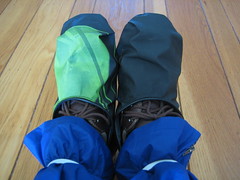
"My shoe covers?" I said incredulous, though I knew exactly what she meant. I had proudly posted pictures of a pair of shoe covers, for cycling in the rain, that I had made from a vinyl briefcase—a conference giveaway discarded by a client. She had been Googling for a pattern to make a bag and when my posting had come up, had taken the time to look at my creation. She recognized my name. This was even more surprising because the shoe covers were on my photo blog, under my pseudonymn Earthworm. She had taken the trouble to discover my actual identity and remember it, which was why we were having this serendipitous moment in Minneapolis. Suddenly I felt that much closer to all my net contacts.

As with the singing from an unseen place, it was my ears that got me so deeply involved in the net in the first place.

I am hard of hearing. Have been at least since fifth grade when I arrived in this technologically rich country and was routinely tested at school. No cause was found for my hearing loss, other than the hereditary example of my great Auntie Jessie who wore one of those clunky hearing aids, the size of a pack of cigarettes, strapped to her brassiere. And though my hearing loss didn't hinder me much, it did leave some lasting marks on the way I related to people.

I annoyed my friends a lot by repeating back to them what I thought they had said, usually with an absurd twist to any possible meaning. I met someone else who did this, too, only he made everything into sexual inuendos. As a result he got laid more than I did, but I was funnier.

I live in a world of fluid meaning. I often experienced two sets of responses, one for what I thought I heard and one for what was actually said. I liked the possibilities. I grew fond of ambiguity. I was also able to ignore a lot, but I could also be a "good" listener.

"You have such an open face," said a business colleague to me once, catching herself in a candid moment. "I felt compelled to tell you my whole life, just now." I was probably just staring earnestly at her as though to hang on every word, lip reading as it were. It took all my concentration.

Through my twenties, so much of my focus was taken up with discerning what was being said (plus looking for the cultural clues I needed to place myself in proper context), that I didn't bother to say much in return. Not that I didn't have plenty to say, I just kept it to myself and spent much of my life writing copiously in my journal in search of the underlying subtext and truth of the interactions I had experienced through the day.

When e-mail came along, this writing practice burst through on the keyboard and I found myself revealing things to people that I had never offered anyone before. My e-mails became essays, which led to my putting up a blog site because I was writing about my electric car and I just had to post pictures of this eye-popping visual. This I did through the photo-hosting site, flickr, because I wasn't geek enough to blog photos without the help of their interface.

Flickr, like the famous MySpace phenomena, had users who interacted with each other (a dynamic now given the term "Web 2.0", but I like my term — interbloggactic — better). Because of the photographs flickerati took of their own corner of the world, the site had a much more slice-of-life perspective that was largely free of pop culture, but full of talented photographers, subversive cartoonists, artists using salvaged materials, eclectic tool collectors, activist-bicyclists, foodies and animal lovers.


That strangers would actually look at pictures I took as I went about my life was a mystery of curiosity. When they left comments admiring a photo I'd taken, I was so startled I had to adjust to this new public interaction. It was just a little eery. Having not grown up with the Internet, I felt as though I had entered into a land of made up, invisible friends who only existed in my picture brain.

Soon I had collected contacts with similar values and interests, from all over the world. Two years rolled by and I had posted over 600 pictures all with carefully chosen titles and captions which were becoming longer and longer as the site became my behind-the-scenes studio, to test ideas out on my flickr friends who, if they were inspired, would leave appreciative comments, tips and practical solutions for projects I was undergoing.

This photo interface on flickr tapped into a creative space that was different from words. When I accidentally summoned Claire's blog while typing in another address, I found a clue to this otherness in her discussion of the book "The Alphabet and the Goddess". Written words, the book explained, developed the linear, conceptual, aggressive, patriarchal side of the brain while pictures and picture making were the realm of the goddess—the creative, intuitive, holistic side of the brain. No wonder I felt so nurtured on flickr.

I did enter other online interactions, prompted by having become smitten with a TV character, okay, a deaf, lesbian, sculptor who inspired in me a new deaf pride that I couldn't quite lay a claim to, but she was so cool (and hot), I couldn't help myself. Before her appearance, I would not have offered information about my hearing "disability" and unless you were close enough to see my hearing aids, which I don't wear all the time, anyway, you would never have known this about me, and I would never have discovered what an interesting portal my ears were. Or gotten the message from my New York based blogger (whose primary blog existence was to discuss this TV show), prompting me to realize that I had chased my superhero plotline to a patriarchal dead end, which left me repeatedly asking the question, was civilization an act of hubris?

Was literature, art and music merely an act of ego that had allowed us to justify exploiting and abusing our land base for our greater glory?

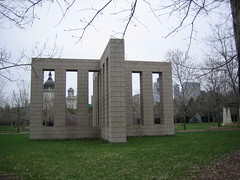
So there I was in the middle of the Minneapolis Sculpture Garden, thinking maybe the key to our salvation was not in techno-solutions to counter our impact on the planet, but really was (as had been suggested before) in changing the stories we told ourselves. And what better way to blow our narrative minds than with the visual arts? For it was with this boundary pushing, myth-making, questioning of authority, evocative, provocative portal of artmaking, that we had a chance to explode the old paradigm.


Three days earlier, my moved-to-Minnesota, art professor friend, Christine, had taken me to see a community art project called "Rain Garden", that she and her students had created. I was dumbstruck. Holly mother of the Goddess! I was looking at a textbook, dug-into-the-ground, water-harvesting system that permaculture gardeners were now trying to revive as an eco solution to drought. And it was sculptural and visually interesting, due to the salvaged antique curbstones that had been used to shore up the swales. Here under the name of Art with a capital A, supported and funded by grants and the blessing of the University of Minnesota was a land based, irrigation system transformed into living sculpture.

"Does this project have a website?" I asked Christine because I just had to bring this concept, of art reframing eco-solutions, to the attention of well, everyone. It did not. For Christine, the finished art was the record of her artistic journey and vision. Her paintings and projects were her means of communicating her experience. That's the thing with a work of "fine" art; it is a site specific, physical manifestation usually experienced in the hallowed halls of museums. And as I spent the week visiting museum after museum in this wonderfully accessible city, I kept thinking "I need to explore more about how we/I can more readily access and use art as a means to rejuvinate my/our heroic journey".


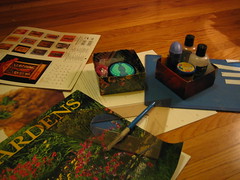
On the last day of conference, I gave my presentation on the Simple and Sustainable panel. And because I had lost interest in talking about the importance of being more Green (there didn't seem to be any point due to my conundrum with the existence of civilization), I had planned my talk around the making of cardboard and paper drawer organizers to offer an alternative to buying more plastic. At the podium I folded, for the forty organizers present, an origami box from a picture page of a discarded wall calendar, all the while talking about the perils of plastic littering the ocean. When I had folded down the last flap of the box, I held it up triumphantly.

"There," I said admiring it, "Organizer as Artisan". My delighted audience broke into a nice round of applause.

Labels: , , , ,

Earthworm. Get yours at bighugelabs.com