Amanda Kovattana

Middle-aged musings in interesting times

Friday, May 17, 2019

International Day Against Homophobia, Transphobia and Biphobia


Remarks for #IDAHOT #IDAHOBIT

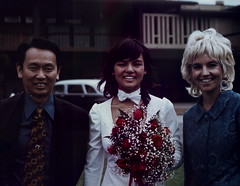
This portrait from the early ‘90s is a rare capture of my butch lesbian persona. Thank-you Warren Hukill. I would show this side of me more often, but the butch lesbian isn’t given a rightful place in Western (European) society; too challenging to the status quo of male power with such a solid example of female autonomy. It is a persona I mute here in the American suburbs because I can. I am privileged with such flexibility. I mute it so people can better relate to me and offer me a friendly reception that doesn’t have to focus on what they perceive to be my sexual orientation. (Instead they focus on how to handle my racial presentation.)

I also mute it to keep the discomfort of straight and straight passing women in my company to a minimum. And I play with the edge of this acceptance constantly. I believe I have these borders dialed in so I can gauge exactly where they are. You likely do too, but not so consciously. I know this because in the past when I asked the question “How do you feel when you are mistaken for a lesbian?” I got the most revealing responses from an adamant “I’m never mistaken for a lesbian” (from a woman with dyke haircut #1) to “I would be less suspected if you hadn’t just come out in the local newspaper. I am after all the one in this office with short hair who plays sports.”

What to me is annoying homophobia (as opposed to dangerous) is the fear of guilt by association. The internalized homophobia of those who fear being seen with me. That to be seen with a butch lesbian is to cast doubt on one’s own status as straight. I am pleased (no utterly delighted) to report though that I have more recently met straight woman who were proud to be mistaken for lesbians whether in my company or not. Because after all what could be cooler than the autonomy, strength and beauty of two women together?

This entry was greatly informed by my reading of the book Transgender Warriors: Making History From Joan of Arc to Ru Paul by Leslie Feinberg which I review on my flickr book review platform here.

After posting my butch picture and the above short entry to FB, Warren tagged me in another image from that era that I'd never seen before or even have any memory of making. Warren preferred his female nudes to display breasts so that's what he printed, but I had chosen to suppress mine with a clasped hands pose that reflects my boy spirit.

The most striking feature about the photo though is that face and those eyes— the beauty of that face cannot be denied. I recognized this beauty at the time to be a gift especially of my Thai heritage. I had in my '20s played it butch with short haircuts but because I lived in the States it just wasn't butch enough in the sense it would have been recognized in Thailand in the Tom world. In the States it just read as American lesbian which was a ghetto that couldn't accommodate my multi-ethnicity at the time so in order to claim the Thai part of me I grew my hair long and lived with a femme presentation.

And attracted bi identified women who were attracted to exotic beauty (as opposed to lesbians searching for someone they could relate to inside the lesbian culture.) I could relate to being bisexual because it shared similar border crossing territory of being bicultural so I could make it work.

But now I am single and intending to remain so which opens up more territory to explore as a person with a visual message to impart rather than as a woman wishing to attract another. I do not have to stay within the boundaries demarcated by someone else's idea of attractive. My territory has become more geographically determined by the local on-the-street vibe and global on social media with our image making tools.

Labels: , , , , , , ,

Monday, July 22, 2013

Race Matters In America: What I've Learned So Far

Here in this post Zimmerman world it has suddenly become okay, if not in fact, necessary to address racism. I venture a perspective from my own particular niche of racial privilege. 


Race Matters In America: What I've Learned So Far

When I came to the US in 1968 (on Labor Day) America appeared to be enjoying a state of progressiveness that infected the whole culture with a vibrancy and newness. And in this context of progressiveness I thought this country of mixed races had this whole race thing solved.

In fifth grade, which was where I entered this conversation, I noted and appreciated the respect being shown by my white teacher during the lessons on black culture. And as I read the story put before me about George Washington Carver learning to read, I also learned something of the plight of black people in America. For in this story black children born into slavery were denied an education, but George Washington Carver had figured out how to get the white boys to teach him the alphabet, by boasting to them that he already knew it. And when they demanded that he recite it, he was counting on them to correct him and that was how he got it right in the end. He did not mind being humiliated in the meantime. This was a lesson I would carry with me for it was quite often that I would find myself in the same position of not knowing something everyone else took for granted. And if you didn't mind being totally clueless and possibly humiliated by those who were in the know, you could learn what you needed to know. This was a big help. Could be of help now.

I don't recall learning to be afraid of black men. My white mother was a fan of Sidney Poitier and the movie Guess Who's Coming To Dinner was used as a teaching point for me since she too had had to introduce her parents to a fiancé who was a man of color. In contrast my Thai father learned to speak in what I would come to recognize as racist terms. He chiefly complained about Mexicans and how inferior they were as fellow immigrants. I disliked his rants because I did not have a Ph.D. like him and my mother implied that I was lazy about just as often. (To insure that I would I live up to my potential, I was sent to private schools where the attention of teachers in small classes would keep me forever anxious about making something of myself.)

At my private high school I was required to read The Invisible Man by Ralph Ellison. I did not understand this book at all. The sense of irony was beyond me possibly because I did not realize how being invisible was problematic and I was taking for granted my own invisibility. I better understood Black Like Me which my mother owned. (I also did not understand Crime and Punishment because basically Western thought was still foreign to me, but I didn't know it at the time.) 

I did, however, speak with a British accent identical to my mother's and this was encouraged in my anglophile prep school. (She had actually upgraded her accent from her provincial Yorkshire one when she moved closer to London as a teen.) Post high school the accent gave me another layer of privilege because people listened to me when I talked and assumed I was unusually intelligent or highly educated. I am neither nor am I good at math. I've tried to make up for it with reading. It also helped that I had three different cultural perspectives to choose from, one of which was openly based on class privilege. It gave me more room to observe and understand biases.


Confessions of a Model Minority

And so I came to hold that odd position complicit with white America. I am a model minority. More to the point I am a collectible much like a piece of exotic art. Or as my ex-lover, a horsewoman, put it "I wanted you like I wanted an arabian horse I saw passing by." I had by then acquired a head swiveling beauty that made watching me walk through a room a source of entertainment especially since I was oblivious to the attentions of the men turning to look at me. Beauty brought me social privilege though I was aware that my particular brand of beauty was objectified in a fetishistic way that didn't include being introduced to mom. Not that I'm complaining. On balance my list of privileges, benefits and access to life enhancing experiences amounted to more than your average white person might enjoy. And though I had experienced numerous incidents of stereotyping and inquisition demanding I explain myself, it would be unseemly for me to complain of racism because of this.

I know I tried once and I am still amused and disheartened by the response of my all white, women's writer's group. "Is this an anti-white polemic?" was the first comment. (Love that high brow literary label.) Then several tried to justify, reframe or blame me for all the incidents of prejudice I had described. And I rewrote that poem until all that they were teaching me was included in the rewrite. I had brought up the topic because I thought it might help to add my voice to the issue if I showed my personal experiences of it. I expected them to give me the benefit of the doubt since they had known me for nearly 10 years and it cut me to the quick that they didn't believe me and were defending the perpetrators. The ordeal was so unloving and unsupportive, I knew I would never bring up the topic again. Perhaps they were right, I had too much privilege to complain. And that is how I was silenced because until I figured out some other way to talk about race I couldn't impart what I knew.

While researching this essay, I came across a blog, explaining racism in America written by a black person under a pseudonym that confirmed some of what I knew. It was there that I learned that it is the purpose of the model minority to prove that whites are not the primary beneficiaries of this system of white supremacy in America. That minorities of all races (and white people raised poor) who succeed socially and economically prove that it can be done through hard work, good behavior, dressing and speaking for success and making education a priority. 

But the entire yardstick is an illusion because the benefits afforded both middle class whites and model minorities are superficial compared to the positions of prestige commanded by the uber rich who control the country—the 1% who are invisible to most of America and who have no intention of letting anyone else in. This fully admitted by my ruling-class, horse-loving ex-lover. 


The Invention of White People

The whole idea of white people was invented during the time of slavery to separate the interests of white people who were indentured servants from those of black slaves. I learned this from a black author in her book Learning To Be White which I borrowed from a client (white) who teaches seminars to white people on white privilege. The owning class feared that black slaves and white servants, observed to be fraternizing together, would combine resources and form a rebellion so it became necessary to persuade white people that they were a separate class with privileges based on their race. 

Beginning in Virginia in 1670 (and later adopted by other states) it became illegal for free Negros and Indians to own Christians i.e. "white" servants. From 1680 on it became legal for white Christians including servants to give a slave 30 lashes. Then in 1705 it became illegal to strip a white servant naked in order to beat him. That same year property was confiscated from black slaves and sold by church wardens to poor whites. Masters were also required to pay their white servants at the end of their indentureship with money, clothing, corn, a gun and 50 acres of land. In 1723 free Negroes lost the right to vote, right to bear arms and right to bear witness. Interracial marriage was also made illegal in 1691 although an attempt was made to repeal the law in 1699. And so on until a caste system had been created based on race.

This historical construction of the rights of "white" people convinced me that being white was a construct and the slipperier a construct it was, the more it undermined white people's confidence that they were good enough or white enough to make it in America. European immigrants were also taught to discard their home culture as quickly as possible to avoid discrimination. The behavior of former slaves were used as an example of what not to do. (Which might be why white Americans felt justified in complaining about Black English which struck me as an interesting dialect of American culture that should be preserved.)

As an immigrant I was engaged in conversation by white people who wanted me to agree with their complaints about minorities and other immigrants. It irked me that the same white people who extended themselves to me would not also extend that welcome to everyone. It unmasked my role as a token minority; that I was making them look good in a way that aided and abetted the embedded white supremacy agenda of the culture. I was particularly annoyed by the complaint about the poor English of immigrants because it usually turned out that they themselves had never learned another language. Not having to learn another language in American schools enforces the hegemony of the United States, reduces compassion and increases xenophobia, but it was clearly not my place as an immigrant to complain about the country that was allowing me such access to opportunity and advantages. I already knew that if I initiated a criticism about America the standard response would be "So why do you stay here?"

While I could see that the American system favored whites (and model minorities), white people did not to want to talk about it. We were supposed to be over this whole race thing; it was best to claim color blindness. This is supposed to insure that we would all be treated equally. And though I could see that it was well intentioned it nevertheless infuriated me. Why are you asking me to erase my entire heritage and everything that has informed me thus far? I wanted to know. I consulted my client who taught white privilege. "It is part of white guilt", she said. I consulted Lenore, my white shamanic counselor and civil rights activist. "So they don't have to look at their own privilege," she said as if it were obvious. 


Border Crossing Check Points

Which brings me to another aspect of white supremacy in America. Keeping the races apart. I live in one of the most diverse and cosmopolitan areas of the country where people of numerous nations have shown up to offer their educated skill set to the corporate mother ships of technological innovation here in Silicon Valley. But on the weekends this Star Trek composite of races working together disappear while I find myself among white people. To further study this question of being not white in America I borrowed from Lenore's list and friended several informative posters on Facebook who were black and hoped they would accept my friend request; all did.


The bulk of my experience with black people comes from my travels as a writer 20 years ago. I and whatever other minority writers could be rounded up were invited to publish our stories in anthologies about our lesbian experience and contribute to the need to reflect diversity. We were bridge people. People of color who have made it our work to offer our life stories in order to create a literary culture that is more reflective of the diversity of experience in America (also true of white lesbians). And part of that package was to offer ourselves socially to hold and defend not only our own experiences, but all the cultural turf we might represent in the larger context of white America, a role that requires a certain diplomatic skill set and a willingness to defend a perspective (or multiple of perspectives given that there is never just one to represent).


One such writer was often invited to the parties of a white ally I know. Margaret Sloan Hunter was one of the early editors of Ms. magazine. And because I was usually the only other person of color at these parties (besides her lover), she would recruit me as a POC comrade. Once she invited me to one of her parties along with all the white girls. And so it was that I found myself in an apartment in Oakland hiding out in the kitchen because my white ex lover (the horsewoman) was holding court in the living room with her new (white) lover (and all the other white girls plus our host).

In the kitchen were two black women with whom I tried to converse, but I soon realized that I was not getting anywhere. They were not answering any of my questions just looking at me quizzically. These were not bridge people; they were seeking safe space in the home of a black lesbian community leader and I had just invaded it. Had sat down uninvited like I owned the place. Might I be flirting with them? Hard to tell given my usual oblique, provocative style of engagement. With my English accent, unplaceable nation of origin and non regulation long hair, I was a dangerously unattached cultural discrepancy.

I did have a white date I had invited to accompany me that day, but she didn't show up having not realized the critical role she was to play to legitimize my presence. Five minutes later I felt compelled to leave entirely, my record for shortest attendance at a party.


Beginning The Healing

The worse thing about George Zimmerman's acquittal for the murder of Trayvon Martin I was realizing for myself the day after the verdict was that he was not white. He was half Jewish with a Latina mother. Whatever psychological pathology he harbored, he needed to hunt black men in the name of protecting the rights of (white) property owners. He was a living example to me that the division of the races was working and that broke me heart. 

The verdict also eroded my confidence. Suddenly we were a divided nation on a topic I knew to be full of land mines. I first had to ask myself—is this my issue? Do I have a right to participate? What do I say as a bridge person? It was not until the half dozen white allies on my Facebook page showed up expressing their grief and disgust at the verdict that I could venture a statement that it was hard to believe this was now a country where it was okay to kill children as a pre-emptive strike. May it be that we just hit bottom, I added.

The day after the verdict I drove to Marin Country for a shamanic workshop where I was the only non-white person in this 18 person workshop. Not unusual for a group so small. No one mentioned the verdict and a woman from Florida was not wanting to talk to me when we were the only ones left to debrief an exercise. Nor did I ask her what she thought about the verdict to protect her from her own shame. 

The workshop was on creativity and it was proving to be a struggle for me as a creative person, but then the definition was opened up and we were asked to make a journey to ask a helping spirit to help us with a community issue. 

"What can I do in ordinary reality to heal racism in America?" I asked. "Writing is your strength" said my grandmother spirit as I was afraid she would. I couldn't even find the door to this topic. In the next journey I asked her to show herself to me as a black woman. She did as I asked, her white hair exchanged for black corn row braids falling to her shoulder. She looked at me with a warm smile. I took her hands in mine across her kitchen table, lacing our fingers together so I could look at the hues of our skin against each other. And then I was in her lap as she wrapped her arms around me and held me. And I asked her how I could bridge the gap between me and black women. (Black men are already happy to talk to me.) "Make eye contact", she said, "offer a welcoming expression, make them visible. Read the literature of black women". (In Asia people do not look at each other straight on quite like people do here. It is too confrontational.) All these ideas I had thought of myself, but it gave me confidence to hear a loving black woman say it. 

When the journey was over, a British woman came over to debrief the exercise. Her eyes widened as I told her how I had asked my guide to show herself as a black woman and when I told her the advice I got, her interest grew and I saw we had both been healed a little bit. 

In the week following I learned of the tumblr blog called We Are Not Trayvon Martin where white people were talking about their white privilege and I saw that we could all participate in this storytelling. Finally the system of white supremacy was being exposed. It reminded me of that other storytelling healing meme called "It Gets Better".

This weekend I made eye contact with a young black woman sitting at a table at the Chipotle restaurant in Palo Alto; she smiled back. On my morning dog walk in my mostly white neighborhood, a white woman jogging by in the customary black spandex, cheerfully said hello to me. I was so taken aback at my sudden visibility I knew it had to be a Trayvon Martin effect. I smiled and said 'hi' back. Then it happened again as I rounded the corner; another woman I had talked to once about a lost dog hailed me from across the street and asked me how I was. I felt more like I belonged in this neighborhood than I have since I moved here 18 years ago. It reminded me that this is a country where people believe that an individual can make a difference. It gave me hope that America would overcome this. 

Labels: , , ,

Sunday, September 06, 2009

Return to Asia Part II: The Riddle of Singapore

After our book launch in Kuala Lumpur, my publisher, Raja, invited us to meet his family at a local Indian restaurant. His sister Gowri, in a peach sari, stood to welcome us as we entered the Bombay Palace restaurant comfortably situated in an old house. We were introduced to his mother who greeted us with the prayer hands held to the face as we do in Thailand. She was dressed in a blue sari and looked about as stern as my grandmother had been. We were soon joined by Han and his father, an economist and long time friend of Raja's.

Conversation drifted from organizational business and social theory to occasional reference to popular movies. My mother was enjoying herself immensely, stimulated by references to cities she had visited and a shared English education, while I fended for myself. Meena, another sister and author, had already been compelled to correct me on the ranking of California as the 8th largest economy in the world, not third. Tut, tut.


I asked Raja what we should see in Singapore. We would not have a book launch in Singapore this time around, but my mother and I still wanted to see it since it was so close. Friends and relatives in Thailand had always told me Singapore was boring (and expensive), but friends in the States rhapsodized about the little city state as one would over San Francisco. Raja wrote down a list of things we shouldn't miss.
The first notable difference about Singapore was that the water was drinkable from the tap. I pointed to the sign over a drinking fountain at the airport upon our arrival. While still in KL, I had caught my mother filling her water bottle from the tap and suspected that it was no more safe to drink than the water in Thailand.

"Even in this luxury hotel?" she asked.

"It's all an illusion," I answered. If Malaysia was anything like the rest of South East Asia, I knew that development had prioritized exports for world trade and disregarded civic niceties. Plus corporate bottling lobbies would probably make sure the water remained unsafe (or if, as in Thailand, the situation improved no one knew about it). I suggested my mother call the front desk.

"Yes you can drink after boiling for ten minutes," said the operator hanging up abruptly.

Singapore was going to be an easy city, I sensed, and upon reaching the hotel promptly crashed. I was sleep deprived from the excitement of preparing for my book launch and we hadn't eaten a proper lunch that day. I could hardly navigate my way out the hotel door to find food and had become brisk and cranky. Luckily a whole block of restaurants awaited us just around the corner. My mother picked one and shepherded me into a seat for pizza and Pellegrino. Pellegrino, she decided, would be her drink of choice in Asia. She also sensed the ease of Singapore and immediately wanted to live there stimulated by the mix of cultures and the stylish blending of old colonial charm with modern amenities.

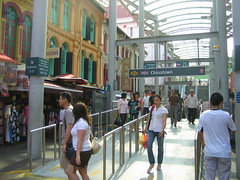
Refreshed, we set out the next day to explore. The Singaporeans were very friendly and eager to show off their English, which was the language of business, although most spoke Chinese or Malay at home. (The Chinese are the majority of the population with an Indian and Malay minority.) A Chinese lady going to church showed us which bus to catch and what coins to use and soon we were on a double-decker bus headed into the Indian part of town.

After walking briefly we came to Mustafa's, a huge department store which Raja had mentioned because it was crammed with goods that ordinary people actually buy. I was confident that we would escape designer label boutiques and catch a glimpse of real people.


I was immediately dazzled by the fabric section, which overwhelmed even my mother, stacked as it was to the ceiling with batik and saris. I picked out several sarongs before heading to other floors. The luggage department was bigger than any I'd ever seen and I offered my mother my professional services, as an organizer, to help her pick-out a travel handbag and carry-on. The ones she had traveled with so far were clearly inadequate and seeing her rummage through them looking for things was driving me crazy. (I had already offered to take charge of her passport and boarding pass as my travel shirt was basically a filing cabinet.)

It did not take us long to find a knock-off designer suitcase with wheels in an adorable size, then a smart looking purse that had pockets for every item. I showed her how to dangle the leash of her camera outside of the zippered compartment for easy access. Then we headed for the department of international chocolates.

We rolled around the rest of the city filling the little case with our purchases from the tourist bazaars in Chinatown. My map was worn to shreds by the end of the day, but I managed to get us to the riverside by the late afternoon where we enjoyed a delightful (but expensive) pedicab ride from an old guy who described to us all the notable monuments in brisk English before taking us to the famous Raffles hotel.


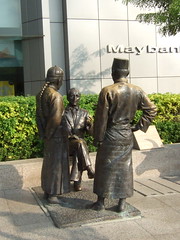
The charming statues that were distributed along the riverbank depicted scenes from the early days of colonization. I was struck by one showing a white man seated and pontificating to two men standing, one a Chinese man with a queue and the other a Malay in his pill box hat and sarong. The white man was identified by his name and was a Scotsman. He was described as mediating between the other two who were only identified by race. There was a smugness to this scene of a white man telling brown people how to behave that irked me just as there was a smugness to Singapore in all its tidiness.

I could see what my Asian based friends meant when they said that the city lacked sex appeal. Singapore felt more like an arranged marriage between the British sense of orderliness and the Asian entrepreneurial exuberance.

I had had some experience of this British directed sensibility. My book had been produced by an award-winning design firm, based in Singapore. The art director, Andrew, was a personable Englishman who charmed me immediately by complementing me on my writing ability. Our conference calls were accompanied by a staff of Chinese sounding names, women mostly who rarely spoke. We were getting along swimmingly until the day we set out to discuss what scenes of the book should be illustrated.

The most dramatic part of the book involved a séance with a homemade Quijia board, which was how my mother had described it. The game also had a Thai name which translates roughly to Spirit of the Glass in which a spirit is summoned and questions are asked. It was a pivotal scene and, I felt, an obvious one to illustrate. As I described the event Andrew stopped me and said that, as a Christian, he objected to the use of the occult and he wouldn't want to subject his staff, some of whom were Muslim, to having to work with such material either. Nor did he recommend that his clients use any symbols that might be found objectionable by religious groups.

I was so stunned by the raising of religious issues in a business context, not to mention an artistic one, I felt out of my depth to defend myself. I had no feel for what it was like to live with such clear divisions of ethnic and religious boundaries. If the way to maintain peace in Malaysia was to carefully erase anything that might offend, then I would have to live with it. In the end, the illustration we settled on was a lie. It substituted the homemade letters and glass for a table flying over the heads of the participants. This never actually occurred (though it did seem to capture the spirit of the event).

The discussion raised an obvious question for me. How did such easily offended religious people, including this art director, feel about an author who was openly gay? No one on the design committee seemed to care about that or any text I penned as long as the graphics weren't controversial, so I never brought it up.

When I was interviewed, by the two reporters in KL, I did wonder if an openly gay author was unusual in Malaysia if less so in Singapore. When the piece came out in the Sun, it pointedly mentioned my homosexuality as one of the skeletons in my family closet, even though my book had almost no gay content and what was there was about identity and was hardly a revelation.

"It makes the book seem racier than it is," commented Han when he sent me the article.

I chuckled the whole way through reading it feeling a bit scandalized myself seeing how I looked in the context of Asia. I had been sensationalized into a passionate truth-telling, lesbian doomer, describing how being gay was the source of my motivation to write freely while nothing at all was mentioned about my quest to understand my biracial and cultural heritage—the real motivation for my writing the book. The reporter did seem to admire my determination to be my own person so I forgave him missing the story of the book.

The Muslim presence in KL and Singapore, graphically illustrated by the head to toe black burkah, did speak volumes about the choices some Malaysian women had made regarding freedom of expression. The reporter had picked out the most "American" aspects of my life from my non-academic career as a professional organizer and handywoman to my desire to be "free of societies expectations" by coming out so young as a gay person. In the context of the goal of Asian people to blend into the identity of the group, preferably at the highest status possible, my quest to tell all, despite possibly bringing shame to my family, would be as exotic as their burkahs were to me. My quest to understand cultural differences and learn where I belonged in the world was not nearly as compelling even as a person of a mixed marriage.

Our taxi driver to the airport was eager to expound on how there was no racism in Singapore because they had all gone to school together. I had heard the same from a Chinese friend from high school now living in Singapore.


Walking through the city I could see why it would be such a pleasure for my American friends doing business here. All the rules were cut and dry and well enforced. Much effort had been put into a homogenous and well-run infrastructure. Civic life and public space blended seamlessly into private enterprise. Plus Singapore was considered one of the safest cities in Asia.
Economic stability for the majority, I felt, was the key to such civility. Journalists, eager to pinpoint ethnic violence inspired by religious fundamentalism, all but ignore details of economic injustice. I had learned to be suspicious of any headline calling attention to ethnic strife. If the journalist had any integrity at all, deep in his article I would find references to a factory closure causing a strike that pitted one group against another or government mismanagement leading to one ethnicity being favored over another.

Singapore had attempted to raise all boats with government subsidized housing wiping out old neighborhoods that might be considered poor. Gone with them were the old communities in favor of high-rise "pigeon hole" apartments.

The emphasis on public civility has been made famous by the caning incident. There were even tourist T-shirts sharing the joke along the lines of "I went to Singapore and all I got was a lousy caning".

When I came upon a sign forbidding the riding of a bicycle through a pedestrian underpass with a fine of 1,000 Singapore dollars I understood the effectiveness of stiff punishment. It made me nervous that I might inadvertently trigger some fine, jaywalking or something. I was happy to be returning to the relative chaos of Bangkok. There was something a little too perfect about Singapore.


Singapore set an example that Bangkok seemed to aspire to. The new underground train in Bangkok was exactly the same design as the one in Singapore and I saw signs promising stiff fines for smoking in restaurants and drinking alcohol in the civil registry office, but somehow those prohibitions seemed appropriate. Bangkok needed a few more restrictions while Singapore gave me the sense that nothing unexpected could be allowed to happen.
That, perhaps, was it's missing sex appeal.

Labels: , , ,

Friday, April 06, 2007

Mixed Like Me


Quick, name a movie depicting interracial marriage. You wouldn't have to think hard to come up with "Guess Who's Coming To Dinner". Okay now name a movie depicting a character who is biracial, a child of such an interracial marriage. Can't think of any? Neither can I (unless you count Buckaroo Banzai which was a serious disappointment to me in that arena).

Jennifer Beals, a biracial actress, persuaded the creators of the television show, "The L Word" (in which she plays a leading role), to make her character biracial, possibly the first biracial character on TV since Spock in Star Trek. (And as important as an art loving, biracial, lesbian in power suits has become to me, I wouldn't want to diminish the territory that Spock defined.)

Jennifer made the case that "if we do not tell these stories it gives the impression that the stories are not worth telling". Yes, in terms of the dominant culture, it sure feels that way. But if it was just about what was worth telling it would have been done already. Television is a voracious medium of novelty, anything to keep you from changing channels. I think Jennifer knew that the stakes were higher than that because to tell a story about being biracial means talking about race (and that is exactly what The L Word proceeded to do).

On the liberal end of the spectrum (which is the only end that will really allow me to exist) the story of a mixed identity is a non-starter. We ignore it in a race blind way as if that is the proper liberal thing to do. I mean, what is the story here? Making a choice? Either race is fine. End of story. You are, after all, the product of a mixed marriage, the very proof that people of different races can love each other and make a family together.

And therein lies the paradox in which I find myself. It is as if I signed a pact, at birth, to represent the liberal ideal of two races coming together in the best of human possibilities. It just makes you want to burst into a chorus of "I'd like to teach the world to sing in perfect harmony". (And, yes, I did totally love that Coke ad as a teenager because of what it represented, until I realized, much later, that Coke was, well, the evil empire of globalization, intent on converting every last human into a soda consuming entity, blah, blah, blah, and the world into plastic bottles, blah, stealing water rights, polluting rivers, blah, blah, and I will still drink it out of nostalgia, but only in Thailand, because it still comes in glass bottles there.)

The first time I tried to write about my racial experiences in the US as a foreign national, I included all the weird assumptions, false stereotypes, annoying sexual fetishes and two incidents of confrontational opinion making by white people that might be characterized as racist. My all white, women's writing group responded with such a chorus of emotional reactions that I was dumbfounded.

"Is this an anti-white polemic?" asked the first to comment. Well no, that was not my intention. Does a poem about experiencing race related incidents necessarily mean I'm anti-white?

"Did your roommate really say that? Surely, she didn't mean it that way?" I had been in this group for ten years and now they were questioning my observations as a writer?

And finally the reframing. "That wasn't about race; he was just being a jerk."

I couldn't figure out why it was not okay with them for me to describe my experiences with race. This was the same group that had listened, with complete open-minded respect, to my explicit tale of a love triangle with two other women. Weren't stories about race a part of the American literary heritage? Somehow I had betrayed them at a base level. I had broken the pact of my birthright by bringing up race. I was angry. After all, it's not as if I can pass for white—or can I?

The first time I learned that a white person could actually talk to just the white side of me and ignore all traces of my bicultural, biracial background, we were in the middle of a conversation about reincarnation.

"Surely you don't believe in reincarnation?" she said, which immediately made me want to upset her whole apple cart of normalcy.

"Well I do come from a country where 99% of the population believes in reincarnation," I said referring to my home in Thailand.

"Oh, but I think of you as British," she answered. Dang. She had me there. I was up against the ropes of my own identity construct. I had no ready comeback. My English accent had neatly eliminated my Asian heritage, my olive skin, my Thai eyes. This is the balancing act of a multi-cultural existence. The balance point is determined by the one looking at you. If they insist on looking from so oblique and extreme a point of view, they can make my alien-to-them side vanish, just like that. It is their concession to me. One I had cultivated.

I had chosen to balance my Asian face with my British mother's tongue. I made this choice to keep my English accent, in fifth grade, to inform my American classmates that, though I be foreign, I did have a country. One they knew about-England. They had never heard of Thailand and I was tired of trying to tell them where it was, because this being 1968, the only way I found to tell them was by talking about Vietnam. (And to be associated with a war zone of American imperialism was a whole 'nother frightening can of worms that my ten-year-old self could hardly comprehend, which was exactly why I would spend the rest my life trying to comprehend it.)

Out of the Vietnam conflict came the Children of the Dust, the offspring of GI's and Vietnamese women, left to the streets, scorned and abandoned. But the biracial children of my childhood were from a world of privilege. We were the children of educated Thai men who had found for themselves, European brides. My mother started a club for them called "The International Wives of Thais". They gave parties, and it was there that I met the other children. I already understood that we were natural translators between our two cultures. There were maybe twenty of us in this select group of special agents and it felt as if we might have a unique purpose in life. And then we were scattered to the winds.

Recently, by the grace of the Google goddess, a long lost friend found my blog and contacted me. Veronica and I have known each other since 6th grade. We were the only non-white kids in our class. She was/is the only close black friend I've had. When we drifted apart I sorely missed her perspective for it was she who taught me how to balance race in America, how to make space for yourself without rejecting the dominant culture. She told me, when we met for breakfast, that she couldn't understand why, when she went to college, all the black kids would sit together at the cafeteria separate from the white kids. You're asking me, I was thinking?

"I guess I'm just bicultural," she said after describing the parties she gave where friends of all colors would hang together at her house. But her black friends only had black friends over. Race was not an easy border to cross from either side, I could see. She hadn't expected it to be that way. Her parents had raised her in that Martin Luther King vision of race without borders. It had not prepared her for what she would encounter after our sheltered private school experience.

"I had no idea how much my parents liked you," she told me, when we met again for lunch at Taxis. She had told them of our reunion. As kids we had spent many a Saturday ice-skating at the local rink. I had made her parents laugh with my imitations of Flip Wilson, my twelve-year-old's version of race without borders.

I asked Veronica what the deal was with Barak Obama. Was the black community really concerned that he wasn't black enough? "He's black to me," she said, "he's married to a black woman, his children are black; if I saw him walking down the street I would see a black man".

"So what was all that about him not being accepted by the black community?" I asked.

"Sometimes when white people write stuff on the behalf of black people they don't get it right", she explained. Hah. Just another divisive diversion of the dominant culture, we concluded. But for a moment there it had seemed as if we might have some insight into the role of biracial people. But nobody had bothered to celebrate the gift of perspective that a biracial politician would bring to a culturally diverse nation.

"Do you think he has a chance?" I asked about Barak Obama running for president.

"Amanda", she said, in a don't-be-naive tone, "this is America".

"Oh yeah, right," I concurred, "Not that kind of chance." We were silent a minute over the regressive politics of our time. A waitperson came up to ask if we needed anything. That was the second waitperson who had come by and this was a no service restaurant. She smiled at us in a genuine way and I reflected a moment on what Veronica and I looked like together—an Asian woman with a black woman. It was so rare this pairing. Never am I am more invisible than when I pass black women in the street. In Oakland where the Asian community borders on the black community, the races ignore each other; a palpable schism hangs in the air.

When I was in Brazil with my now ex-lover, a young Brazilian couple came up to her and asked her if there was much racism in America. "No," she had said. I walked over to her just as they left. "What did they want to know?" I asked her. She told me and when I heard what her answer had been, I was outraged. "You said no? Heck, if they wanted to know about racism why were they asking a white person?" I exclaimed. She shrugged. But they would not have asked me because I was not the dominant race; in fact I looked Brazilian. Brazil is filled with mixed races—Japanese, German, black, all sorts of mixes. They may have just been asking her because they wanted a white North American to affirm for them the American dream. The one where immigrants of all nations and races can come to America and be accepted into the upwardly mobile success train.

The waitresses at Taxi's were also from south of the border, Mexico most likely. I suddenly had the feeling that Veronica and I were representing a tableaux that was magnetic in its attraction to those who longed for such affirmation; that in this Promised Land, there was a surrendering of racial differences; that we did mix it up and represent a nation of harmonious collaboration. White people, too, wanted this from me. I was blessed in that sense.

I had spent much of my life in a vacuum of cultural isolation, not quite fitting anywhere, whether it be the gay community, the Asian community, the immigrant community, the women's community or the bohemian community. I was constantly having to explain myself and feeling that my friends would never begin to understand where I was coming from. At any moment I might have to defend one group from another. I identified with subcultures I didn't even belong to.

As I worked to integrate all the different parts of me by telling my own story, I found that I had been dealt a remarkable hand. I had so many avenues by which people could enter into my world. I was a human jukebox of special interests groups. Just punch up one of my many eclectic topics. Sometimes, on a good day, I can play three or four.

A white man gave me a ride to my car the other day, after a moving job. He was dressed on the conservative side, but he reached for my hand to shake and I looked for an opening. By the end of the ride I knew his brother was marrying an Indian woman, his sister was a bike messenger and he himself was gay (though he never said so). I was hitting home runs with every topic. (My colleague on the job told me I had utterly charmed him and if he gave me a job I was to cut her in on it.)

Jennifer Beals, in her acceptance speech for an award from the Gay and Lesbian Alliance Against Defamation, spoke of how the culture we live in gives us the narratives for our own lives-through media mostly. There were few such narratives for me when I came to this country. I had to look really hard, going back to the Native American "two spirited people" to piece together a place and a purpose for a gender bending, border crossing lesbian. And now the story has gotten bigger than I ever imagined it could be and, oddly enough, more want to be part of it than not.

Labels: , , ,

Earthworm. Get yours at bighugelabs.com