Amanda Kovattana

Middle-aged musings in interesting times

Thursday, May 02, 2013

The Play's The Thing


Story telling meets audience resulting in a rich discussion of race and gender, visceral reactions to segregation and the need for seeing our mixed race experiences reflected on the screen. The backstory performance of American Ubuntu, presented in Oakland. 


A Play Is Born

The kernel of the idea, when Lenore took on the gig at Joyce Gordon Gallery, was to offer the audience an experience of racial segregation. And we didn't warn them ahead of time. That was the surprise audience participation part of it. What they did know was that this was a story of a high school romance set in the '70s with an interracial component—a bold confident black girl pursues a shy sensitive white boy that she has noticed watching her for some time. 

And because no tickets were being sold it was hard to know if anyone would even come, save for friends and family. But all who signed up to help produce this show were committed to see it through.

When I came to the project, six weeks ago there was neither a script nor actors, just a conversation with Eric the gallery curator to present a live performance in a segregated environment. On top of it Lenore was going to be away for two weeks. I was not accustomed to this approach, this diving into the deep end to sink or swim. But I was intrigued by it. And as Lenore posted to her Facebook page "you can only create fantastically when you're willing to fail spectacularly".


Labor of Love

A community derived grassroots production has a lot of room for participation and for some reason I needed to prove myself to an artist with a big vision. Possibly because all of my visions had gotten so small they were hardly worth doing. But also because working with someone on a project with high stakes and a deadline is a very good way to get to know who they are. 

When I arrived at the gallery the week before the performance I had my eighteen tables ready to go. And two helpers to put them together with me. Eighteen tables have 72 legs. Seventy two legs that I wrapped with rubber bands and masking tape to make them friction fit into the pre-drilled holes. It worked without too much difficulty especially once I figured out to wax them so they would slide into the holes better. Seventy-two pieces multiplied by all these procedures takes a while. Nearly thirty hours went into these tables with their many legs. It kept me connected to the project and made me feel like a genius when I had worked through all the design problems.

I loved seeing them in the space, a bit quirky and cartoonish with their legs slightly askew. All of them different and you could still tell they were doors since I had left them unpainted. (I liked for people to be able to see things transformed into new things; it breaks the consumer mindset.) And though not robust they were light and easy to move. The holes where the doorknobs had been we used for cup holders. As we put them around the room, it became clear that the tables were the set; they delineated the space into an environment that would hold all the action and the audience too. I was proud to have made such a significant contribution. And rewarded by the look of appreciation in Lenore's eyes for all I was doing.


Down To The Wire

I built them while Lenore was away at Hedgebrook working on the script. (Hedgebrook is a women's writer's retreat on Whidbey Island.) When she returned two weeks later she still had no actors; the actors she originally had in mind were booked that weekend and though they said they would help find others they had not done so (possibly distracted by Spring break). Lenore was asking me if I knew anyone. I had one tiny lead to a boy actor which turned out to be a dead end. Time was ticking down. She would have to go to the mat to find them herself. Ten days before the show date she was able to meet the drama teacher at Berkeley High to let her audition students there. And finally she had her actors.

When Hannah walked into the gallery Lenore introduced us and told me she was playing Will, the boy lead. I was surprised especially since she was wearing a skirt. (She had just come from a memorial, Lenore told me later.) Boy actors had been hard to come by in my day and that apparently had not changed. Hannah had come to the audition wanting to do Will's part. And in fact, there had been a boy actor there too, but he just refused to get who Will was, argued with Lenore about how things should be done, wasn't getting the meaning of the play and generally sounded like a jerk, while Hannah nailed the part of Will from the beginning. Though her girl's voice did at times interject a layer of lesbian subtext to the mix messing with my mind.

When Taylor, who was playing the part of Sharon, the young black woman, arrived, the two got right down to rehearsing their lines. Taylor was just right for the part, pretty and sassy, but sincere and heartfelt. I stayed for the entire rehearsal because Lenore was going to let me be one of the videographers and I took the opportunity to practice. Her friend Scott would shoot with his camera on the other side of the room. The more experienced person she wanted on the job was already booked. Nothing like having the decks cleared of competition to feel needed. And there were more props to be made. I volunteered to make a stand for the confederate flag that Will's father displays at his house and a sign for the restaurant where the young lovers are refused service. This gave me more fun stuff to do until the play date.


An Audience Is Ready

By the time the actors came to rehearse the morning of the show, they had really bloomed into their roles. Will embodied his epiphany of his racist white heritage in a touching way that was honest without being self flagellating. While Sharon as a young woman filled with ideas she picked up from progressive parents, was full of confidence and smitten enough with this white boy to bridge whatever social barriers came between them and forgive his whiteness.

The 30 minute show partly acted, partly read in prose form gave more backstory to the movie than most movies have front story. The greeters were prepped as we awaited an audience. They would be the ones who told people where they could sit so they would be segregated by race. One was an African American man, Antonio, who had been the model for the Black Panther character in the poster. Another, Rabia, was a soft spoken African American muslim woman whose words were so carefully chosen it gave her a  calm elegance and the third, Ignacio, was an immigrant from Columbia with a friendly open face. 

Soon the gallery was filled to capacity, mostly with people of color, mostly black. As it happened I had chosen to be the videographer on the colored side of the room. The effect of being immersed amidst a majority of people of color flooded me with the realization that I spend a lot of time being white. By this I mean I forgive with regularity the exclusion of my experience; I don't mention these observations to anyone and I make excuses to myself for people's ignorance. 

Even though I was not a member of the African American community I shared the hyper vigilance of living in a white man's world. Of knowing that at any given time something will come out of nowhere and remind you that you are the other, that you are excluded from an assumed privilege. And how this can feel like an attack so you have to learn to fight back. But what was more draining was that in such a world, your impact is largely ignored, your chance to influence the world deemed irrelevant while the concerns of the majority in power—of white men— are the center of the discussion. Standing on the colored side of the room there was comfort in being seen in numbers too large to ignore.


A Story In Common

This was an audience who had come to hear their story told. And once the performance started they hung on every word, hardly making a sound as each line spoken revealed a path well traveled by those who live intimately with mixed race issues. What prompted this young couple's interest in each other? What did Sharon's mother say when she found out? How did Will come to terms with his alienation from his dad's racist perspective? How would they handle how the outside world greeted their love?

In many ways this story was mine too both in the element of forbidden love and in the mixed race aspect of it. My parents mixed marriage had been notably unusual wherever we lived and when they divorced somehow my identify took twice as much to explain. I am touched whenever color lines are crossed, made whole again. To love across the color line (or any divide) is to appreciate what is different from your own point of view and respect that perspective as if it were your own. It forever changed you. I identified with Sharon's strength and confidence expressing her sexuality and her ideas. And with Will for I also had a father who's conservative politics and alienating social opinions I had to separate myself from.

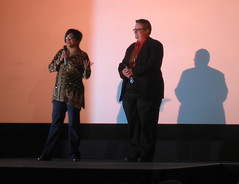
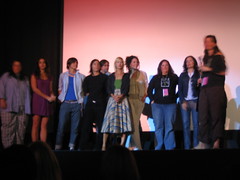
After the performance was over all were silent until Lenore and crew clapped to prompt the audience that the play had ended. We then moved the tables out of the space and invited the audience to form a circle with their chairs and integrate themselves again. No one left as people often do when an event threatens to become touchy feely. Everyone had questions, wanted to know what this was about. And about the movie that would be made from this story.

Lenore asked the first question—did people think this couple would stay together? A range of answers all from the black audience members, some generous to the romance some fearful of the social pressures against it. But one question hung in the air. An older black woman sitting next to me asked the question. What was it that prompted Lenore, a white woman from Iowa, to take on this story? This had also been my burning question when I came to learn of the project. Lenore explained that she had been a part of a mixed family by adoption of a Native American brother; through him she learned how different the world treated him. Thus she had been an activist for civil rights from the age of fourteen. And she had also had interracial relationships, she said. This seemed to be her ticket into the club, for the black woman also shared that she had had a relationship with a white man in her youth, a Jew. (My first lover had also been a Jew; Jews seemed to be the entry level white lover for people all across the board for both people of color and white Christians curious about the Other.)

Lenore also asked how people felt sitting in the segregated spaces. Again an articulate response from a black woman explaining that it was part of the black experience to be segregated often purposefully for protection and support so there was no sting to it, but she herself wanted to know how the experience had been for the white people who were told they couldn't sit where they wanted to. Several white women shared their discomfort at being separated from people of color, for being denied the unified family feeling of oneness that they had come to the show to support. While a young mixed race woman shared that she was given the choice of sitting in either section, but had stayed on the colored side. Was there any benefit to sitting on the white side in this scenario, I wondered? Apparently not. 

People also shared their responses to the characters whether they believed them or not, whether what the characters said rang true. Much discussion about whether the aggressiveness of the young woman in the relationship was a stereotype of black women. (It was not one I was familiar with stuck as I was with the stereotype of Thai women being assumed to embody the loose morality of the sex trade we're so famous for.) The only discussion for Will's role was why the part had been played by a young woman rather than a guy, but people agreed that Will's sweetness had been successfully expressed by Hannah. The success of the play was that it was a story about how race divides us, but Lenore had told it in such a way that everyone could empathize with everybody. 

She explained how this back story related to her movie, but she hardly needed to for everyone was already eager to see it, had made the leap from the play to the movie. The movie itself was a post 9/11 political and spiritual thriller with Will now an FBI agent haunted by the memory of Sharon. He goes in search of her and discovers that she is no longer with us, but she has left a legacy of forward thinking ideas which have led to the creation of a utopian vision of Ubuntu, a village looking very much like an eco village with its adobe houses and farmed fields. (Ubuntu means I am what I am because of who we all are.) The movie's heroine is Sharon's daughter, a healer seen in the poster with her shamanic panther drum. Part of the drama was a battle over water rights.

There were so many elements of this movie that I could relate to. Others would too, but does the existence of an audience drive the forces that get movies made? It had for the gay community, but this movie was bigger, more ambitious with a budget of 5 million. It was an idea that encompassed many threads, many communities. It offered so much that needed be addressed. Our audience would have stayed long past our allotted time sharing their insights. In fact more people had come in just to see what was going on. But we had to send them home.

A black man helped me take down the sets and the job was done quickly. I had introduced myself to and talked to more black men and women than I've probably met my entire life. Antonio had told me about his martial arts training and asked about mine. Rabia had shared with us her experiences of dating a white man in her youth in Ohio. And while looking at a portrait painted by a Thai woman of Tiger Woods displayed on the wall of the gallery, Eric the curator and I discussed the various cultures who claimed Tiger. He shared with me his trip to Thailand and how he had a Thai girlfriend there. (Had I had more time I would have asked how he had been received in Thailand for it was not so long ago that Thai text books taught their people that the African race was inferior in intellect.) Through these brief interactions and shared stories I felt enriched for having discovered this world of people so aware of the issues of moving between cultures. 

Lenore had worked hard to bring this show together and had overcome all the obstacles. Whatever perfection she had sought, she had let go with grace, celebrating what we had accomplished each step of the way as a new achievement. She would frame this event as a success bringing the movie closer to reality and would soon look at where it could go next.

As one of my writing group members once said, trying to get published is like throwing popcorn at the moon. But that didn't discourage us from the attempt. Or having fun trying. This performance event was an uncommon bid to attract a producer, but it had ignited further interest in the movie. And the homegrown phenomenon of it beckoned for more such events—for an ubuntu village of its own. Whatever the fate of the movie, what it was already was a happening that brought people together in multiple moments of unification and healing, not to mention all the fun we had. And for that I was satisfied and grateful.

Labels: , , , , , ,

Monday, April 15, 2013

Eighteen Tables For Two


In which I relive my past as a movie theaters projectionist, renew my interest in filmmaking and vie to become a part of my shamanic counselor's movie project.


I Am A Camera

We can see now, that having lost the confidence and wherewithal of my ten year old self only to then loose the passion and faith in life that my 19 year old had achieved, there was little left of me to fend through my twenties. Just a nihilistic, romanticized posing, shored up by a suit of black leather standing in black steel toe motorcycle boots (with the requisite motorcycle to go with it). 

Shortly after I dropped out of College V, I worked as a projectionist at several movie theaters in Palo Alto. It was more than a job, it was how I was saving my hollow, soul-less, sorry ass self. 

"At least I'm not a heroin addict," I told myself. I had successfully failed all the expectations of my fancy prep school (funded by two frugal working parents and a partial scholarship the school had offered me). The high academic standards (three and four hours a night of homework plus weekend essays) had trained me to meet the goals of teachers who took a personal interest in me. College had been without such structure and my nihilistic peers, having taught me to scoff at passion in anything, had helped in my unraveling. All my equity in advanced placement credit was used up in unfinished classes. I needed a reboot.

I went home and lived with my dad. If I avoided asking my parents for money I felt I could start from scratch to shape my own life, find for myself what interested me. I did not trust my writing to the ethnocentric (and homophobic) literary culture I had encountered so I turned to art. Working nights at the movie theater funded my art supplies and tuition. 

Movies had informed me how life could be lived. I was still in high school when I saw Bob Fosse's Cabaret with its hint of easy bisexuality and tawdry, ominous picture of pre-war Berlin. "Divine decadence," said Sally Bowles waving her green fingernails and giving me my mantra for my youth. While Fosse's Lenny Bruce movie offered me my first scene of women touching each other, naked torsos beautifully shot in black and white. (The disgusted reaction of the audience informing me how such acts would be received.) Thus it was to the movies I returned to feel whole, to feel anything at all. At the movies I could live somebody else's life, house the characters in my body and feel their emotional unfolding. That high lasting for about a week before the effect wore off. 

The first theatre manager who hired me (and dated me) was a screenwriter. He taught me how to look at film from the writer's point of view, how to pick out why the filmmaker had made certain choices. As projectionists, we could watch our favorite scenes over and over. Midnight Express played then at our second run theater. I learned how suspense was created. How much the music and sound mattered so that only a closed door could be shown. What made a love scene unfold. The script said no to the homoerotic love scene, but the filmmaker said yes with the lighting and  the beauty of the two men together thus revealing the truth of the book. This was my film school. My dreams had tracking shots in them. 

I caught myself one day deep into my movie addiction. Walking down University Avenue, my eye tracking down the sidewalk like an establishing shot, I felt a momentary wonder at the 3 D ness of it all. "Reality is just like a movie you can walk in," I thought to myself then laughed at my own topsy turvy observation. But it was not a wake up call to return to reality for I could not imagine a future beyond the age of thirty.

Over the next five years I was a projectionist and manager of the Biograph, the Aquarius, the Bijou and the Festival Cinema. I sold concessions for The Palo Alto Square when China Syndrome opened 12 days before Three Mile Island had a near meltdown. (Life imitates art! Every show a sell out that week.) I also did graphics for The New Varsity calendar. 

All but the Palo Alto Square were within blocks of each other on and off University Avenue. Most showing one flavor or another of independent films, retro films, second run films, foreign films and the occasional left over block buster i.e. The Blues Brothers and Coal Miners Daughter. It was glorious; a renaissance era for movie theaters and we didn't even know it. Although I did refer to the Varsity as the center of the known Universe, my Universe because that's where I would go after closing to talk to my friend Tim, a fellow UCSC dropout, who tended bar there.

Nearly all my life long friends would come out of this period. I was happiest if every possible day could be spent in a movie theatre (especially the awkward, terrible holidays after my parent's divorce). Between working full-time and spending my days off going to see movies via the free pass system for theatre employees, I managed to achieve this goal. I loved nothing better than to stand outside a movie theatre under the marquee lights anticipating a new film.  

Piano Lessons

There was one other thing that I did during that time. I paid for piano lessons so I could imagine Ingrid Bergman sitting down next to me and saying, in that voice filled with longing, "Play it, Sam, play As Time Goes By". Hopeless romantic that I was. Instead I sat in the presence of a nurturing mother figure, a white woman who lived with a black man she wasn't married to and seemed to understand that I was queer without asking. I rode my motorcycle up to her house every week, zipped off my black leather suit down to my preppie LL Bean pinstripe shirt and blue jeans and she never made a comment about my appearance (except for telling me off for wearing jeans and sneakers at her annual piano recital). She grew up on a farm in the midwest, told me how she shrunk her Levi's by sitting in the watering trough and letting them dry on her. She married the first man who would take our out of there.

Once I came in at the end of another student's lesson. She was speaking sternly to this boy and I sensed that he must have said something derogatory about me (probably involving the word dyke) and that she was defending me. I was getting a lot more than piano lessons I realized. Someone, an adult and authority figure was defending my right to be. 

I did learn to play As Time Goes By as well as a simplified version of Gershwin's Rhapsody In Blue which was the opening music to Manhattan in which Meryl Streep plays a lesbian and the very young Mariel Hemingway slept with Woody Allen and defined love. "We care about each other. Your concerns are my concerns; we have great sex."  Tim and I joked that it was all true for us only we didn't have sex at all (having already been there.)

Sitting in the ticket booth watching the night life go by was my idea of being in the world. The lobby was my living room. Evenings filled with film buff friends standing around playing games of movie trivia. The walls of the lobby decorated with movie posters. Lots of time on our hands spent staring at those movie posters subconsciously looking forward to the promise of yet another new film experience.


American Ubuntu

The week I met Lenore for the training for the Solstice ceremony, she was in the middle of running a kickstarter campaign for her movie American Ubuntu. Ubuntu is a Zulu word meaning I am what I am because of who we all are. The name itself speaking to community and she was asking each of us in her virtual community to contribute "as we found it in our hearts to do so".

I had never contributed to a movie fundraiser before though there had been several friends in my life making movies. I wanted to discourage them from such a Quixotic quest. All the filmmakers I knew were broke. At college V it was great fun being in their films. They were the nicest people I met, but because of their penniless example I did not even consider studying filmmaking myself; it was hard enough keeping film in my camera as a still photographer. So I never gave money to my friends' movies. But Lenore's movie had a poster. This made it half way to being real. All those years of lobby posters, of the promise of coming attractions kicking in.

The American Ubuntu poster was confrontational, gripping and provocative with a blockbustery air about it. A movie with a big story to tell embodied in the details and lives of its characters. A girl holding a drum, a man in a black beret, a man with an FBI badge. Only one of them white. The smoking twin towers in the background on the left; a pastoral scene of hand built adobe houses on the right. The people positioned in an interrelating triangle of strangers, a tiny smiling disembodied face in the center.  I could read it left to right. Conflict, political intrigue, racial tension, spiritual mediator heroine, a mystery from the past, post-apocalyptic resolution. The shamanic drum pulling me into the story. That part I knew something about, at least. And it had a panther on it. Definitely an independent film. In fact it was just the sort of film that would show at the Aquarius theater, the one remaining theater of my projectionist past. 

I knew that if I gave any money I would step closer to wanting to see this film get made, be drawn to get on board in a hands on way, perhaps. I thought about it for a while before I submitted my usual donation amount of $30. The campaign was a cliff hanger winning half the required $30,000 in the last twenty-four hours. This was exciting and significant in itself for it meant that a critical mass of people were on board with the film's story and wanted to see it made.

Detention

Three weeks later, after the solstice ceremony I entered Lenore's office as a client. As I walked in I wondered how many years it would take to spring myself from this change in status — five? However, long it took I would work through it I told myself. I had come seeking community, but now I felt I was in detention, possibly blacklisted from all future ceremonies of any sort. 

In the therapy contrived convention of our times, entering into a consulting relationship with someone who sits in the therapist's chair somehow removed you from life. It was not allowed that the two worlds would cross, the one inside the consulting room and the lived world outside of it. But this was different; a shamanic counselor was part of the community. And before long she invited her community to help her. She was going to do a stage production of the back story of her movie. I wrote in the Facebook comments of the announcement offering my help.

When I next saw her a few days later, it was her turn to look apprehensive. After I gave my report about how the integration of my soul parts was going, she asked what I wanted to do with the energy the returning soul parts had brought back with them.

"I want to do something collaborative," I said immediately, "in fact I want to work on your movie project if you'll let me," I added pleading my case. "Otherwise I'm trapped in this office—in this box," I said looking at the ceiling. I had not made myself into the world's most useful house elf for nothing. I listed off my skills.

She said okay we could discuss it. A shamanic counselor did not follow the model of therapy, she told me, but more the model of the ministry. And it was in the realm of the ministry for clergy people to mingle with their congregation outside of the functions of the church,  join them for tea perhaps. (Pictures of meeting the vicar came to mind. I was photographed with him at my grandparents' church in England when I was eight.) But we would not discuss her project on my time, she directed, marking the boundaries of this new layer of complexity.

"I want us to do this consciously," she said.

"Yes," I agreed. This was exactly the kind of border crossing I was used to making, slipping from one paradigm to another, from one defined role to another, one culture, one language, one class to another. I looked forward to the challenge. 


Eighteen Tables For Two

And so we walked outside after my session to the coffee shop next door. She bought us cups of tea because you always feed your crew, she said, and asked me to pick a table. Thus settling the customs of this new relationship, we sat down and she began to tell me what her back story required. It was to be performed at Joyce Gordon Gallery in Oakland, a theatre in the round experience. The story of young love in Kentucky in the '70s. A bold sixteen year old black girl venturing across the aisle—across the color line—to talk to a white boy. The white boy responding and treating her with such politeness and respect that I was won over by him as I listened to her describe the scene. Respect. How rare that word was in America. And to bring up race in our culture even more rare. (I know because I tried writing about it once and have the scars still from what I learned from the attempt.)

What Lenore was committed to do in a little over a month with almost no resources and no actors found yet, defied normal expectations. This just made it more intriguing to me, not to mention what she was attempting to do with a live audience to create an experience of racism (and healing with elements of shamanic ceremony). I was used to overwhelming impossible situations. Used to listening to the grand picture of what a client wanted to have happen. And then attempting to make it happen because I had been summoned to hold the space for this vision. And it was not just with practical skills that I could offer help. There was a part of my mind that took up watch at the perimeter of the vision and guided the energy to make it happen. Lenore needed videographers, stage hands, sets, props, refreshments, chairs and tables. Eighteen tables in fact to create a schoolroom. Two people sitting at each desk. Three rows of three on either side of an aisle.

I offered my skills as a videographer. She wanted the performance documented with two cameras, but the shooter had to have the skill of a photojournalist able to make a story from whatever was going on with a hand held camera. Very high standards indeed. She herself had been a photojournalist in her past. My experience was with tripod work on equipment that was now obsolete. But I had other skills. Memories of my teen years at the Palo Alto Children's Theatre and school plays coming back to remind me of the excitement of putting on a show. Theater production was where I had first wielded a hammer building sets. 

We did not decide anything at that meeting. She advised us to sleep on it. Then she let me take the initiative. So I wrote her two days later offering my continuing commitment. She wrote back that she would love to have me work on the project. Indeed love was what would fuel this venture. That was the fun part about crushes. How many different ways would love inspire? Transform? How many new things would be undertaken? I was happy now. My mind could be set into motion. 

I kept thinking about those tables. All eighteen of them. And then it came to me how I could get them for free. I could cut them from the hollow core doors that recently arrived, given to me by a contractor who knew how much I liked to make things out of doors. I had more than I could comfortably store. I worked out the details in my head late into the night, thinking about what could be used for legs and how to attach them. I wrote Lenore that I could get tables for free. I did not tell her I was going to make them for fear that she would say no, she didn't want me to go to so much trouble. But she didn't. Instead she asked me if I would be mad at her if this performance didn't come together quite as envisioned and the tables ended up not being used. 

"Well we would have them for another time," I said optimistically, casting into the future a series of events.

Then she told me that when someone makes something it sends energy out into the universe that compels the forces of creation to work in your favor. Well, now we were talking magic. And to be the maker of such magic was empowering. I was on. Suddenly it became exactly the project I needed to pull the stale energy of illness from my life. I cleared off my cluttered workshop bench in a matter of minutes and fixed tools that had been broken for years. What seemed overwhelming before was easily dispatched. I got stuff done in twice the speed and was focused enough to keep track of things I habitually spaced out about. By the end of the week I had a table assembled to show Lenore. I set it in the sun room to photograph.

"I'm going through my Zohar Dance phase," I told Catherine in explanation. Zohar was a non-profit that Catherine had spent a great deal of time helping out, enamored of the lead dancer. I had gone on many of the video shoots she had done for them.

I asked Lenore to tell me the make and model of the video camera she would be borrowing so I could study the manual. I was imagining a hefty professional level piece of equipment costing thousands. It turned out to be a consumer model that could be found used for a couple hundred off e-bay. As I researched it I learned that the Canon Vixia was a camera used by film students; just the mere association with film students was enough to ignite my lust. With digital technology, filmmaking was a medium now well within reach.

I bid on the camera and won it. Then one thing led to another in rapid sequence. I found a night course in videomaking that was happening during Spring Break when my martial arts school was closed. How perfect was that? It was taught at the Midpeninsula Community Media Center which turned out to be a terrific mentoring resource with equipment to loan out and its own cable channel. 

Two weeks later the table making project was nearing completion. And I had learned enough from my crash course to make my student video—a four minute movie about creative reuse, making —guess what?— tables from doors. You can see it on youtube.  (And I still had time to cook, entertain a house guest and help a client move.) Unbelievable. I impressed even myself.

But I was only one part of the elephant. How the rest of the performance was coming together was still a mystery to me, but coming together it would. Join me and see for yourself how it turns out. Cross borders. Be a part of the story. Sunday, April 28th at 3 p.m. at Joyce Gordon Gallery in Oakland. It's free. 

Labels: , , , ,

Monday, July 02, 2007

Family Entertainment

"May I speak to the lady of the house?" the caller requested.

As I tried to come up with a witty comeback like "Sorry, there are no ladies here" or "I'm the housedyke will that suffice?", she repeated the question.

"Can I help you?" I said cheerfully, suddenly curious as to what campy consumer item or concern a telemarketer might want to communicate to the "lady of the house".

She asked if I would take a survey about the entertainment industry. This was a subject dear to my heart, given my five-year stint as a projectionist at local movie theatres of the independent art film variety.

"Do you feel that there are sufficient numbers of family movies today?"

"Sure," I said.

"Do you feel that there are television shows appropriate for family entertainment?" Hmm. That was different. Television was the heart and hearth of American discourse. I smelled a rat and it wasn't Ratatouille.

"By family entertainment do you mean shows that exclude family members who are gay?" I asked nonchalantly.

This clearly flustered her as she read me the clause about how the survey taker was not expected to reveal their opinions about what constituted family entertainment. The name of the group began to ring a bell. Yes, it was one of those creepy Christian media watch foundations, intent on erasing gay characters from public view. I told her I knew what they were up to and wanted nothing to do with them. She seemed relieved to end the call while I felt a small triumph in having implied that her group was actually anti-family.

I had long understood the power of media images. My coming out years had not only been a wasteland of invisibility on many levels, but nothing could quite duplicate the twisted feeling of being heart-poundingly aroused by a rare glimpse of a kiss between two women, and then having one of them unceremoniously dispatched by a felled tree as the other was "rescued" by a man. This was the plot of The Fox, staring Sandy Dennis and Keir Dullea (who also played the lone astronaut in 2001: A Space Odyssey, released the same year). I felt as though my own passions had been summarily choked off.

Equally damaging was my viewing of Lenny, as audience members audibly voiced their disgust saying "eeeww", as Valerie Perrine stroked the bare breast of another woman. I was sixteen at the time. I understood, in that moment, that it was my desires they were judging and was offended, but also forewarned. I saw The Fox after college, on the retro art house circuit; the two together were it for images of lesbian sexuality, until the '80s. Had it not been for a late night viewing of the 1966 movie The Group, during my senior year of high school, in which Candice Bergen wears a fetching bowler hat and is seen arriving at a party with a stern German woman in a suit, I would not have known how deliciously, subversive a lesbian identity could be.

Thus it is my generation and older who tend to be loyal to the annual gay film festival, as we make up for those damaging years with queer positive films. Were the Christian groups to evolve from their fetishizing of the gay community as the denizen of perverted flesh, they would be surprised at how family oriented "gay entertainment" has become.

How about a Bollywood inspired romantic comedy, complete with a closing dance number, involving the entire family, celebrating their lesbian daughter's coming out kiss? Nina's Heavenly Delights offered exactly that, plus a startling mix of Indian culture fused to a Scottish locale, from British director Pratibha Parmar. Indians in kilts with Scottish accents! This director had wowed us before and the Castro Theater, where her film was being screened, was sold out.


At the Q & A afterwards, one woman asked why there was no love scene after the kiss scene. (After all, we still wanted our pound of perverted flesh.) The director sighed.

"That's what we have The L Word for," she said. Then went on to explain that she had taken the film to India to show to a mixed audience and it had been very well received as it had been in England, too. Though she didn't spell it out, her intention had been to give us back our families by telling a story that would not alienate the family members she hoped would watch the film. While at the same time the supportive characters in the film, especially the mother reflected real life positive experiences.

Supportive mothers turned out to be an enduring thread in the 10 programs we saw over the eleven days of the festival. In the short My First Time Driving, a mother congratulates herself for guessing that her teen daughter is gay, then finally allows her to borrow the family car to take her girlfriend on a date. Equally satisfying was Kali Mama staring a folksy, sari clad Indian mother who sets out to seek justice when her gay son is beaten up by a much bigger Anglo classmate. Her ferocious physical response to the bully's mouthing back at her had us cheering.

Even Internet identities are interrupted by motherly figures, as grandma inadvertently shows her face on the porn site of a web cam girl in the Chinese/Taiwanese film Spider Lilies. The seemingly naive gamine carries on provocative relationships with unseen viewers, inciting them to pay for more, while offline, the object of her love, tattoos designs on the skin of those looking for identities. (This Friday night show was not sold out. "I guess tattooed Asian girls aren't in this year," I commented to Catherine.) It was a visually arresting film. I was particularly enamored of the tattoo artist with her long hair tied impatiently into a ponytail and her stylish jackets and pants.

Most poignant was the documentary Red Without Blue in which a pair of twins both turn out to be gay, but one twin decides to change sex as well. At first the mother (who also comes out as a lesbian) refuses to accept either of them as family, but then comes around. The remaining brother also has adjustments to make. The film captured emotional revelations about gender and family that stayed with me.

Meanwhile, in a screwball comedy of unexpected outcomes, Out At The Wedding, turns our fears of family rejection on its head as the heroine dodges valiantly to avoid telling her family the truth. Comedy is hard to pull off and I feared that I would find the mix-ups endlessly annoying, so was pleasantly surprised by this fun romp filled with sassy one-liners and up-ended stereotypes.

A mother's acceptance of her teen daughter's identity is progressively integrated into the movie Itty Bitty Titty Committee, during preparations for a sibling's wedding, with the line "I've read the lesbian handbook from cover to cover and it says nothing about no make-up".

If anything the gay community was far more interested in the power of love to unite families than the Christian community could hope to compel by driving us out of their vision of family entertainment. And though a few shorts and docs were devoted to holding our own in the face of the Christian Right, we had largely moved on. Queer film makers were not only intent on telling stories of healing family relationships, but of love bridging far more challenging cultural divides as showcased by The Bubble in which a Palestinian and an Israeli are lovers.


The festival itself provided us with the village atmosphere to renew our queer family ties. The hours I spent waiting in line were not wasted as I people watched from my perch sitting on the footboard of my folding scooter. (To insure a place early in line, I commuted by express train up the Peninsula, scootered the five blocks to Market Street, hopped on the T Line of the Muni Metro and was in my spot an hour and a quarter before showtime, waiting for Catherine who would bring dinner on her way from work.)

On the final night, with the multiple lines wrapping around the block in both directions depending on what level of membership you could afford or not, a friend spotted me from the Gold line and shouted o out "Ben is here" as she followed her line into the theater. Ben was my recently discovered lesbian cousin from Thailand whom I had never met. Just then an Asian woman walked by in the opposite direction.


"Are you Ben," I asked.

"No," she said, giving me a friendly, scrutinizing look before hurrying off.

"You can't ask every Asian woman who walks by if they're Ben," Catherine commented. Why not, there were only a handful on the whole street, surely we were all related. After all, we had just celebrated Catherine's birthday at a nearby restaurant where another birthday party was being celebrated at the next table. Not only did one of our friends know people at that table, but one of their party was the ex-lover of another friend in our group.

As it turned out, the Asian dyke did indeed know Ben and when she got inside the theater, delivered the message that someone was looking for her. The first friend came to find me and took me to meet her. Ben happened to be visiting from Bangkok that week with her girlfriend. She was equally pleased to see me, having met my father just before returning to Thailand six years ago. We had time to get acquainted before the organist ended his repertoire with the traditional refrain of "San Francisco Open Your Golden Gate"....

The closing night film stepped right past the usual feel good queer identity films of year's past, with the message attempted by Itty Bitty Titty Committee, a story of 20 something, radical feminists who installed political art and defaced property with spray painted slogans. The audience seemed a tad confused by this criminal behavior.


During the Q & A, a man asked the director if she was aware that her film might prompt young people to blow things up. Another viewer objected to the numerous images of characters smoking cigarettes onscreen. My how parental we had become. There were also questions about the cheating in a long-term relationship.

No one asked about the motivations for the politics of the film. It was almost as if we had forgotten we ever had politics bigger than gay rights. The feminist sentiments expressed in the movie were right out of the '70s and included my own objections to marriage as a patriarchal construct. In the modern context of the film, it all seemed hopelessly outdated. We're they making fun of us? I wondered, or did young lesbians still dissect the patriarchy as part of their queer identification process?

The director was just a decade younger than me. These were the issues that had been part of her coming of age, she explained, but having become disillusioned by the whole scene, she decided to make a feminist fable. Thus the unlikely successful outcome of the climax and a happy ending for all.

One friend thought it entertaining, but ultimately pointless and stupid, while another agreed with me that the politics needed to include the degradation of the planet to update it. Still many of us saw a glimmer of a much-needed return to radical political thought. Not so much to blow things up, but to inspire a larger vision of change. It was good enough. Good enough to sustain me for the year.

Labels: , , , ,

Earthworm. Get yours at bighugelabs.com