"May I speak to the lady of the house?" the caller requested.
As I tried to come up with a witty comeback like "Sorry, there are no ladies here" or "I'm the housedyke will that suffice?", she repeated the question.
"Can I help you?" I said cheerfully, suddenly curious as to what campy consumer item or concern a telemarketer might want to communicate to the "lady of the house".
She asked if I would take a survey about the entertainment industry. This was a subject dear to my heart, given my five-year stint as a projectionist at local movie theatres of the independent art film variety.
"Do you feel that there are sufficient numbers of family movies today?"
"Sure," I said.
"Do you feel that there are television shows appropriate for family entertainment?" Hmm. That was different. Television was the heart and hearth of American discourse. I smelled a rat and it wasn't
Ratatouille.
"By family entertainment do you mean shows that exclude family members who are gay?" I asked nonchalantly.
This clearly flustered her as she read me the clause about how the survey taker was not expected to reveal their opinions about what constituted family entertainment. The name of the group began to ring a bell. Yes, it was one of those creepy Christian media watch foundations, intent on erasing gay characters from public view. I told her I knew what they were up to and wanted nothing to do with them. She seemed relieved to end the call while I felt a small triumph in having implied that her group was actually anti-family.
I had long understood the power of media images. My coming out years had not only been a wasteland of invisibility on many levels, but nothing could quite duplicate the twisted feeling of being heart-poundingly aroused by a rare glimpse of a kiss between two women, and then having one of them unceremoniously dispatched by a felled tree as the other was "rescued" by a man. This was the plot of
The Fox, staring Sandy Dennis and Keir Dullea (who also played the lone astronaut in
2001: A Space Odyssey, released the same year). I felt as though my own passions had been summarily choked off.
Equally damaging was my viewing of
Lenny, as audience members audibly voiced their disgust saying "eeeww", as Valerie Perrine stroked the bare breast of another woman. I was sixteen at the time. I understood, in that moment, that it was my desires they were judging and was offended, but also forewarned. I saw
The Fox after college, on the retro art house circuit; the two together were it for images of lesbian sexuality, until the '80s. Had it not been for a late night viewing of the 1966 movie
The Group, during my senior year of high school, in which Candice Bergen wears a fetching bowler hat and is seen arriving at a party with a stern German woman in a suit, I would not have known how deliciously, subversive a lesbian identity could be.
Thus it is my generation and older who tend to be loyal to the annual gay film festival, as we make up for those damaging years with queer positive films. Were the Christian groups to evolve from their fetishizing of the gay community as the denizen of perverted flesh, they would be surprised at how family oriented "gay entertainment" has become.
How about a Bollywood inspired romantic comedy, complete with a closing dance number, involving the entire family, celebrating their lesbian daughter's coming out kiss?
Nina's Heavenly Delights offered exactly that, plus a startling mix of Indian culture fused to a Scottish locale, from British director Pratibha Parmar. Indians in kilts with Scottish accents! This director had wowed us before and the Castro Theater, where her film was being screened, was sold out.
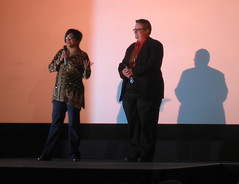
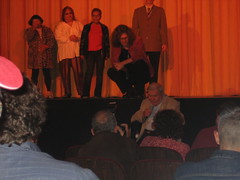
At the Q & A afterwards, one woman asked why there was no love scene after the kiss scene. (After all, we still wanted our pound of perverted flesh.) The director sighed.
"That's what we have
The L Word for," she said. Then went on to explain that she had taken the film to India to show to a mixed audience and it had been very well received as it had been in England, too. Though she didn't spell it out, her intention had been to give us back our families by telling a story that would not alienate the family members she hoped would watch the film. While at the same time the supportive characters in the film, especially the mother reflected real life positive experiences.
Supportive mothers turned out to be an enduring thread in the 10 programs we saw over the eleven days of the festival. In the short
My First Time Driving, a mother congratulates herself for guessing that her teen daughter is gay, then finally allows her to borrow the family car to take her girlfriend on a date. Equally satisfying was Kali Mama staring a folksy, sari clad Indian mother who sets out to seek justice when her gay son is beaten up by a much bigger Anglo classmate. Her ferocious physical response to the bully's mouthing back at her had us cheering.
Even Internet identities are interrupted by motherly figures, as grandma inadvertently shows her face on the porn site of a web cam girl in the Chinese/Taiwanese film
Spider Lilies. The seemingly naive gamine carries on provocative relationships with unseen viewers, inciting them to pay for more, while offline, the object of her love, tattoos designs on the skin of those looking for identities. (This Friday night show was not sold out. "I guess tattooed Asian girls aren't in this year," I commented to Catherine.) It was a visually arresting film. I was particularly enamored of the tattoo artist with her long hair tied impatiently into a ponytail and her stylish jackets and pants.
Most poignant was the documentary
Red Without Blue in which a pair of twins both turn out to be gay, but one twin decides to change sex as well. At first the mother (who also comes out as a lesbian) refuses to accept either of them as family, but then comes around. The remaining brother also has adjustments to make. The film captured emotional revelations about gender and family that stayed with me.
Meanwhile, in a screwball comedy of unexpected outcomes,
Out At The Wedding, turns our fears of family rejection on its head as the heroine dodges valiantly to avoid telling her family the truth. Comedy is hard to pull off and I feared that I would find the mix-ups endlessly annoying, so was pleasantly surprised by this fun romp filled with sassy one-liners and up-ended stereotypes.
A mother's acceptance of her teen daughter's identity is progressively integrated into the movie
Itty Bitty Titty Committee, during preparations for a sibling's wedding, with the line "I've read the lesbian handbook from cover to cover and it says nothing about no make-up".
If anything the gay community was far more interested in the power of love to unite families than the Christian community could hope to compel by driving us out of their vision of family entertainment. And though a few shorts and docs were devoted to holding our own in the face of the Christian Right, we had largely moved on. Queer film makers were not only intent on telling stories of healing family relationships, but of love bridging far more challenging cultural divides as showcased by
The Bubble in which a Palestinian and an Israeli are lovers.
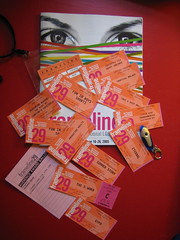
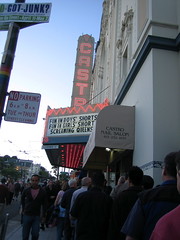
The festival itself provided us with the village atmosphere to renew our queer family ties. The hours I spent waiting in line were not wasted as I people watched from my perch sitting on the footboard of my folding scooter. (To insure a place early in line, I commuted by express train up the Peninsula, scootered the five blocks to Market Street, hopped on the T Line of the Muni Metro and was in my spot an hour and a quarter before showtime, waiting for Catherine who would bring dinner on her way from work.)
On the final night, with the multiple lines wrapping around the block in both directions depending on what level of membership you could afford or not, a friend spotted me from the Gold line and shouted o out "Ben is here" as she followed her line into the theater. Ben was my recently discovered lesbian cousin from Thailand whom I had never met. Just then an Asian woman walked by in the opposite direction.
"Are you Ben," I asked.
"No," she said, giving me a friendly, scrutinizing look before hurrying off.
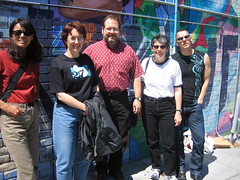
"You can't ask every Asian woman who walks by if they're Ben," Catherine commented. Why not, there were only a handful on the whole street, surely we were all related. After all, we had just celebrated Catherine's birthday at a nearby restaurant where another birthday party was being celebrated at the next table. Not only did one of our friends know people at that table, but one of their party was the ex-lover of another friend in our group.
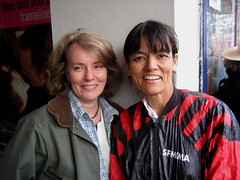
As it turned out, the Asian dyke did indeed know Ben and when she got inside the theater, delivered the message that someone was looking for her. The first friend came to find me and took me to meet her. Ben happened to be visiting from Bangkok that week with her girlfriend. She was equally pleased to see me, having met my father just before returning to Thailand six years ago. We had time to get acquainted before the organist ended his repertoire with the traditional refrain of "San Francisco Open Your Golden Gate"....
The closing night film stepped right past the usual feel good queer identity films of year's past, with the message attempted by
Itty Bitty Titty Committee, a story of 20 something, radical feminists who installed political art and defaced property with spray painted slogans. The audience seemed a tad confused by this criminal behavior.
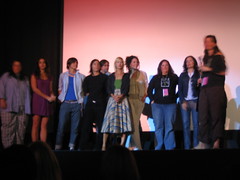
During the Q & A, a man asked the director if she was aware that her film might prompt young people to blow things up. Another viewer objected to the numerous images of characters smoking cigarettes onscreen. My how parental we had become. There were also questions about the cheating in a long-term relationship.
No one asked about the motivations for the politics of the film. It was almost as if we had forgotten we ever had politics bigger than gay rights. The feminist sentiments expressed in the movie were right out of the '70s and included my own objections to marriage as a patriarchal construct. In the modern context of the film, it all seemed hopelessly outdated. We're they making fun of us? I wondered, or did young lesbians still dissect the patriarchy as part of their queer identification process?
The director was just a decade younger than me. These were the issues that had been part of her coming of age, she explained, but having become disillusioned by the whole scene, she decided to make a feminist fable. Thus the unlikely successful outcome of the climax and a happy ending for all.
One friend thought it entertaining, but ultimately pointless and stupid, while another agreed with me that the politics needed to include the degradation of the planet to update it. Still many of us saw a glimmer of a much-needed return to radical political thought. Not so much to blow things up, but to inspire a larger vision of change. It was good enough. Good enough to sustain me for the year.
Labels: film festival, Frameline, Itty Bitty Titty Committee, movies, Queer
 This is as trans as it gets in Amandaland. This would usually be the opening weekend of Frameline, the LGBTQ film festival. So here’s a homemade queer image. It is a recreation of a scene from “Bound” which I saw at Frameline in 1996 with a sold out house. I also created it to hold down the space for a particular niche—that of the masculine woman. It is a niche I’ve been enjoying as a member of an FB group where proud butches come to show off their suits and their haircuts hosted by the Black lesbian owner of the clothing design company Haute Butch.