My partner Catherine asked me to marry her the day of gay pride, three days after the ruling came down allowing the quest for marriage equality to proceed. I said yes, but after so many years of being against marriage as an institution I have to write myself a 3,000 word attitude adjustment.
What Cost Marriage Equality?
The gay and lesbian community won a huge victory this week. With no help from me. (Unless you count being publicly open about being in a long term relationship with the woman I love.) When it became clear a decade or more ago that the gay community was going to run with the marriage equality issue I looked upon it much as I did the issue of gays in the military. That this was a niche issue relevant to the few rather than the many and I decamped. I no longer called myself a gay activist. (I became a climate change activist.)
In the late '80s I chose the political identity of lesbian over bisexual because I realized that the straight people I worked with and came out to needed an unambiguous identity in order to address their questions to me about being gay. (The idea that everyone had a fluid sexuality, I quickly realized was too difficult to explain.) As a gay activist I lived the phrase made popular by the feminists of the '70s that the personal was political. And in the '90s I wrote about my lesbian household as a columnist in the relatively conservative arena of a weekly newspaper in Palo Alto.
My last point of contact as an activist for the gay community was as a panelist going into high schools (including my own) to talk about the trials of being a lonely, frightened gay kid whose future seemed severely curtailed. The reactions of parents to my appearance began with "I get it about the gay kids, but why does my kid have to be exposed to that lifestyle". Umm, no not getting it at all. Who, after all, was likely to do the bullying?
I often spoke alongside speakers from PFLAG (Parents and Friends of Lesbian and Gays). This group was of immense emotional support to the gay community in the days when parents were just as likely to disown their gay children. The emotional outpouring as PFLAG marched in the Gay Liberation parades of the '70s onward did much to heal this wound. The support offered to parents was equally important. When kids came out to parents, parents typically went into the closet tearfully grieving what was essentially the death of a heterosexual child.
With the fight for gay marriage, the issue polarized the nation much like the abortion issue continues to do so. We made the Christian Right stronger by giving them a unifying enemy. Christian leaders admitted that homophobia and the fear of homosexuals brought more money into their fundraising campaigns than any other issue and they continued to write those letters perpetuating the hatred. And the hate trickled down and was made personal in the dialogues of families of the Christian right and into the schools where they already had a foothold on school boards. The fear of gay marriage was translated directly into the fear that children as young as six would be forced to learn about homosexuality in school. (This was a gross misinterpretation. In actuality it would only be in the sex ed classes that homosexuality would be mentioned at all and only in passing as an acceptable condition.)
At the height of this power of the Christian Right it became popular among the teens of those families to be a "hater". It was something to be proud of. I saw in their ranks, t-shirts that said "I (heart) haters". And because of this turf war being waged in our schools I believe that the fight for gay marriage had a direct correlation with the increase in bullying and the rise in numbers of suicides among our most vulnerable population. A population very hard to help because they were under the age of consent and the fear of being labeled a child molester kept the gay community from reaching out to these teens.
When I came out in high school it was difficult to consider a gay identity when it was an emerging movement in the public eye, but it did not feel nearly as dire as what gay and questioning kids were reporting from their lives in the '90s going forward. I make this conclusion because the generation before me had a different experience than I did. The idea of a gay identity was so exotic in the '50s that there was no need to consider it at such a young age. The '50s being a time of chivalry and protection of those smaller and weaker than ourselves, those who were stronger protected the weaker as a point of honor. The bigger boys took under their wing their weaker (more effeminate) counterparts. And the message to the bullies was that bullying was for the weak of heart and the insecure.
Once out of high school, of course, it was a different thing altogether and those who found themselves in the gay lifestyle would have to fight the good fight that we came to know as the gay liberation movement. Meanwhile for those under the age of consent, the more homosexuality became visible as an identity the harder it was for kids to ignore this possible option and as their parents expressed their homophobia to the TV as mine did, so did homophobia grow in schools.
One Nuclear Family Can Ruin Your Whole Day
Since gays were largely unwelcome in their families of origin, the lesbians and gay men of the early gay community created their own version of family that was inclusive of their entire community. Marriage was considered an archaic institution in the Marxist days of lesbian feminism. And there was much experimentation as to what a family might be. It included polyamory, extended families and the raising of children within these extended families. Meanwhile the feminist movement fought to redefine marriage and raise women up from the status of property owned by men to having their own identity and equal economic rights within a marriage.
With the devastating years of the AIDS epidemic, the party gave way to a funeral and issues of inheritance of a dead partner's things came into play. The very real threat of a partner's family coming to claim all his/her belongings and the home you had built together was foremost in our minds and driven home by countless maudlin movies.
A woman who owns her own house is a dangerous proposition I concluded when my ex lover asked me to leave her house, my home of five years, in favor of the new lover who had moved in. Once I made my home in Catherine's house it did make a difference to me, when after many years of cohabitation, Catherine offered to set up a living trust guaranteeing my ownership of the house should she meet an untimely demise. It made a difference to have that piece of paper because, rather than being prepared to leave at any given time, I was more inclined to put my effort and money into our home.
Marriage from a legal standpoint, without all the sentimental and religious overlay is essentially a matter of property. It is no accident that the woman who sued DOMA (the Defense of Marriage Act) was a wealthy woman protecting her financial interests after her female companion died leaving her a sizable estate on which taxes were due to the tune of some $363,053 because her Canadian marriage to her spouse was not recognized on a federal level. With that amount at stake I would sue too.
The Taste of Victory
When the victories of DOMA and Prop 8 were announced there was an immense outpouring from my straight contacts on Facebook. It felt as if everyone had suddenly become PFLAG. Love was love, welcome to the American family. All this support and love moved me to reconsider my stance on gay marriage not just as a gay victory, but as a heterosexual victory. Marriage had been redefined by the presence of gay people into something cool and desirable. The struggle for gender equality within marriage would get a boost from those who have no gender inequality to consider. (There would still be inequalities related to education, money, class and possibly race, but at least these were gender neutral.)
This long fight for marriage equality (which is not over until every state has joined in) feels very much about privilege for some and not a lot about improving things for everyone. My health care has for many years hinged on Catherine's job and my status as her domestic partner. One of the insights of activists during the time of AIDS was that the gay community would see fit to use their alliance with other social justice movements and their growing political clout to mobilize for national health care. This was so threatening to the powers that be that during the Clinton era a bone was thrown to the LGBT community regarding gays in the military. In practical terms the "Don't Ask, Don't Tell" policy enforced a closeted existence. In the run up to discussing gays in the military it created a diversion that divided the queer community against itself and installed a false gay agenda. LGBT activists were forced to accept the DADT policy as a win for all. Not.
The marriage equality campaign has trained a generation of lesbian and gay activists to work hard to write themselves into what is basically a non-inclusive institution based on the property rights of white men. As mainstream a convention as you can get — one that does not include any benefits for those not married.
Speaking of a privilege every American should enjoy with few exceptions, the pinnacle accomplishment of the Civil Rights Movement, the Voting Rights Act was gutted the day before marriage equality peeled across the land. By the same Supreme Court. I did not see any sentiments expressed in the ranks of the privileged that we were all less American because of this. But the Voter ID laws that states are now allowed means that getting the required ID stipulated by these new laws costs money and time which translates to more poor people of color prevented from voting. (And trans people who may be accused of voter fraud because their ID does not match the gender they are presenting.)
No longer does the LGBT community identify with its most vulnerable, most disenfranchised members, but with its most privileged in what basically amounts to a trickle down promise. Now that we have our right to marry, goes the promise, we can get back to the rest of the gay agenda. Which was what exactly?
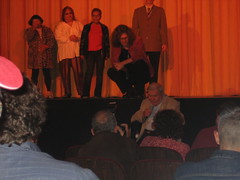
During the film festival my friend Dave and I watched as a representative of a short film about the age of consent attempted to remind the largely gay male audience of the vulnerability of not only gay youth, but all youth.
"As you celebrate this marriage equality win", he said, "please consider that in order to support our youth we need to lower the age of consent."
Yes that would certainly help. If young people had the right to make their own decisions about their sexual activity at least by the age of 15 as it is in Denmark, then they would have social services to turn to. The response of the audience was to literally shut him down. "Show the film," someone shouted. Followed by applause and then clapping in unison to drown him out.
"Don't you see?" their arrogance seemed to say, "we are mainstream now. We will never again be mistaken for child molesters. We will show by our fine status as married couples that it will get better for gay kids. But we will in no way help until they have made the harrowing passage to the legal age of consent." Meanwhile there were weddings to plan.
If anything had helped ease the passage of gay youth it was the entertainment industry which put more gay and lesbian teens in TV shows over the past few years than adult characters. There was also Brittany McMillan, a Canadian teen and self identified Christian straight girl who launched Spirit Day from her tiny tumbler blog in October of 2010. On that day we were to wear purple to show our support for LGBT teens who were victims of bullying. Over 1.6 million Facebook users signed up for the event which became highly visible as celebrities and TV anchors were seen wearing purple. I bought myself a purple ribbon that day and tied a bow around my pony tail to wear to my karate class. It was duly noted by my teen classmates and the head instructor gave quite a long talk after class about sticking up for your friends.
Occupy Marriage
Catherine had long ago become a proponent of marriage equality and felt it entirely unfair that there were some 1,049 benefits to marriage that were denied to us as domestic partners much of them with a financial impact. I had to agree with her that the benefits were substantial. I stopped arguing against the marriage equality campaign, but neither did I speak in support of it.
And now that marriage had been made available to us, the political was suddenly made personal. I knew it was only a matter of time before she was going to pop the question. The differences in our incomes made our tax returns substantial as a married entity and that compensated for the time I put into our household chores. I had also proven my worth as a partner in the year that I accompanied her all those many hours during her cancer treatment.
I began to view marriage much like I had viewed becoming a citizen of the United States. As a legal platform from which to both protect myself and occupy a nation whose policies and treatment of others I did not entirely agree with. We were already living in the state of marriage, we had our green card—we were registered domestic partners, but to really occupy this construct we would need a passport, a marriage license.

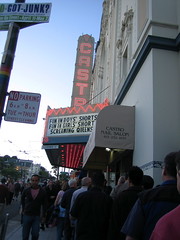
On the day of Pride, while all those celebrants of marriage marched in record breaking heat downtown we sat in the cool of the Castro Theater for our final four hours of queer films as is our custom. It was there that Catherine asked me to marry her. And I said yes. She was very happy and so excited about this news that over dinner she wanted to know how I would announce it. It hadn't occurred to me to go that far, but she was eager to make it public as soon as possible. It made her happy to celebrate our commitment to each other and have it acknowledged in the eyes of the world. It was an expression of her love for me.
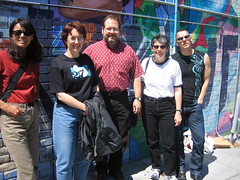
Forced to consider how we would play out this new status I knew it wouldn't be right to keep it secret after all I had said against marriage. This was too big an about face. And so I allowed that she could announce it in the most public way possible—on Facebook. She had taken a picture of me with her iPhone from across the table and when we got home posted it with her announcement. It was actually a nice picture (though we were not talking about the prospect of getting married at the time). Perhaps we could also do our wedding on Facebook. Okay maybe not.
I did attend a wedding once that informed me on the topic. It was a marriage of a middle aged straight couple, the bride a prominent environmental activists in our community. The wedding was held with a wildly dressed congregation of
Faithful Fools. And a woman in a clown's nose got up to protest the union on the grounds that love was dangerous because if people committed to taking care of each other it would lead to political unrest and possible attempts to stop global warming. And if marriage was performed as an act of community activism who could stop the power of love?
Okay, put that way I'm almost convinced. A relationship made stronger was a good base from which to love the world more. And the planet and all those we worked with and collaborated with for the good of all. It was also my hope that now that the queer community had attained this level of respectability that we would remember ourselves and become more wildly queer as an occupying force rather than behave as though we had succumbed to the sedate values of our captors. Yes this was a model I could expand upon to occupy marriage. Champagne anyone?
Labels: family, LGBT, marriage equality