Amanda Kovattana

Middle-aged musings in interesting times

Friday, January 25, 2019

Flashback Friday

While in Thailand I felt compelled to post this picture to remind me of the lineage that is lodged in the memory of this land that I called home. The photo was taken in the garden during a visit I made back in 1977. My boy cousin Thop sitting between my grandmother and his mother (my Aunty Ah Pahdt). Thop still lives here with his family as does Aun daughter of Prayoon the little girl in the lower left hand corner who is now the family cook. She was at the time of this picture the playmate of my girl cousin Pong on the right. Pong lives nearby at her in-laws household.

My grandmother bought this property in the 1930s and built her house here which still stands. She was born into the social class of Bangkok now known as Hi-So short for the English phrase ‘high society’. She spent her life working in jobs befitting her station. At one time for the prime minister in the capacity of receiving and taking care of foreign visitors i.e. Ladybird Johnson and the President. Also Queen Elizabeth and later Neil Armstrong.

She was a devout Buddhist and a philanthropist. She passed along to me her frugal values of living simply. Her original house was never remodeled, just added onto. She had only one child, a son she sent to college in England where he earned a Ph.D in engineering. She raised and educated Ah Pahdt (my father's half sister of another mother) who at the time of this picture was managing director of the alumium blind company started by my grandmother's second husband. It's complex this family you don't need to tell me. heh.

My grandmother's baby sister my Aunty Lily who also lived here was once the managing director of the Bangkok franchise of Polish Ocean Lines which was her husband’s business passed to her at his death. Aunty Lily had her own stylish 60s era house on their parent’s original land (now sold to Bayer Aspirin for its Bangkok headquarters). Aunty Lily lost her wealth to an embezzling manager in the company. Thus my grandmother invited her to come and live on our compound along with her loyal maid Weil and her family.

My grandmother housed the staff, invited them to bring their boyfriends/husbands and sometimes their elderly mothers to live here and helped educate their children. Prayoon's sister Saiyud also lived here while attending college and did my grandmother's bookkeeping.

My grandmother was a great lady in everyone's eyes and her memory remains vivid in all our minds. Late in life she received the title of Khun Ying from the late King Bhumibol.

I am the offspring of a college romance and shotgun marriage to an English lass majoring in psychology. I am called a Look Klueng, a child who is half—half Thai. I was brought back to this household when I was three until my mother migrated us to California when I was ten. My father would further complicate this family by marrying twice more.

At the time of this picture I am still in college and had the choice as I always had of where I would make my home. I was my grandmother’s only grandchild and she loved me to death. A bit too much for my independent spirit and I squirmed away for many years.

I would spend my queer life wandering around explaining myself to everyone who asked because in the West people did ask incessantly until I finally published my memoir “Diamonds In My Pocket”. The book also served to explain myself to myself and make me into a whole person.

I took this photo with my father's vintage Leica on a tripod using a long squeeze bulb gripped in my left hand. This technology already trailing edge as is my habit. We are assembled here on the wall bordering the patio of my grandmother's house.

Labels: , ,

Wednesday, April 03, 2013

Where The Wild Child Lives


In which I learn from my ten year old self, how to stay focused. How I made my first youtube video and how Catherine's illness changed my perspective.

To improve my Shamanic practice I was advised by my Grandmother Spirit to journey every day and write down questions. I was not a very questioning sort of person it turns out. There is an art to asking questions. Most big questions I didn't want to know the answers to; it required a different kind of mind. One that is concerned with shaping the future and I had been raised to allow things to unfold and to pounce when the opportunity presented itself. I wanted to learn to master the art of the question, but meanwhile I could just hang out.

My power animals were very affectionate when I came just to hang out. We moved languidly as if on vacation. On my first hanging out visit, Mongoose and I rode on Bear who made himself as big as an elephant and thus we sat on his back in an elephant chair much like the ones used on Thai elephants. We decided to visit Leopard. I told Mongoose I loved Leopard. "She is your heart", he said. 

We found Leopard sunning herself on her usual rock. She licked my face in greeting and I asked her what to do about Lenore. This was not actually a question on my list, but hey as long as we were hanging out I asked it as one would a friend.

After I wrote about my crush on Lenore I had sent her the link to the story along with all the other stories during those prolific few weeks when I was being reacquainted with my returning soul parts. I wanted to know if she minded being a part of my story. People do not always take kindly to being written about and I was prepared for this. Prepared to walk away. I had an entire flow chart in my head about how many ways I was prepared to walk away, but she gave me a big hug when I saw her next and told me how well I wrote. I did not expect her to follow the writing at all. I was so prepared to be rejected, I had to reorient myself to this warm reception and was not sure how to proceed; how to trust it. 

"Lenore will be there for you as long as you need her," Leopard said. "Stay open for what is offered," she added wisely. And so I let go of my second guessing mind. 

I asked Leopard if we could visit my 10 year old. We all walked down to the River and got in a small dinghy. The River drifted us downstream a little ways and stopped at the opposite bank beaching on a little spit of land bordered by some reeds. We jumped out and the 10 year old emerged from the reeds. She was eager to show us her house, a little round adobe house, whitewashed, with a single window and a thatched roof. I could build one myself from what I learned at a workshop in Northern Thailand. There was nothing inside.  

"It's round," she explained, "because it is more productive; it is the corners that are distracting and catch hold of extraneous stuff." I had to agree with that. Then she ran very fast around and around inside the house to demonstrate. We walked outside again and in the clearing next to the house was a little writing desk. She said she was the one who recorded everything and did the accounting. I had also been a very diligent diarist from the age of eight. I asked her what else kept her focused. She took from her pocket a sling shot with a carved wood handle and gum colored band. It was much like the ones I remembered from childhood. I had not dared own one for my mother was against weapons. I knew these slingshots to be lethal.

"I use it for target practice," she said pointing to the target on a tree 25 yards or so to the left of the camp. I looked at the circles of the red target. (It was much like the logo of the store of the same name.) And suddenly I felt I understood something about having goals and plans for action. It was a brief, but clear message for I was not given to goals or any kind of plans for myself though I admired it intensely in others. 

Before we left, the 10 year old also admitted that she hunted squirrels to eat. Such a wild child, I thought. I mused for a moment how this tale could be told from the point of view of the unincorporated 10 year old soul part hanging around for 44 years watching me live my life and waiting for an opportunity to join in—or not. I was reminded of Faulkner's The Sound and the Fury

I went to e-bay and looked for slingshots. There were lots and one was even from Thailand with a lovely green stained hardwood handle. I was the only one who bid on it. I sent the seller a picture of myself when I was ten. He/she wrote back in a Thai sort of English, a tender note of appreciation.


Slingshot Productions

Meanwhile I returned to my leadership obligations and prompted by my conference team, decided to make a video announcement about the conference and all the great speakers we were having. A quick look at similar videos made by colleagues and others showed that there was much room for improvement. This always inspired me, but my standards were already high. I also wanted it to be memorable and entertaining. I could not pull off a professional business attire thing as others would do, but Jim at ICD headquarters encouraged me to go with the same mountain climber costume schtick I had created for my introduction at our last conference and that was enough to set me off and running.

I had no equipment to speak of. Just my iPod touch. Kids were using it to make their movies so how hard could it be? The only thing needed, said the after school tutorial I found, was something to hold up the iPod. I looked around my room and my eye fell on the movie splicer I had unearthed from the basement for my soul retrieval ceremony. It was now sitting on my desk like a giant talisman. Heavy and sturdy, it had flaps to hold the 35 mm film down on a flat bed. I discovered that the flaps would hold the iPod upright and allow easy installation and removal for downloading. I set the splicer on a stack of books on my sewing table in my room. The repurposing of this old movie technology to support the new, pleased me with its poetic symmetry.

I did not have a backdrop of our conference location in the mountains of Denver as I envisioned, but I had a world map someone gave me. I pinned it to my louvered closet doors which looked so obviously like closet doors it added to the improvisational aspect, plus closets have much significance for organizers. Over the doors was a mask of a whiskered wild cat of some sort. It gave my set an explorer flavor and a spirit protector.

I wrote the piece, did some takes and realized I would have to memorize it so my eyes wouldn't be tracking back and forth reading the words on a page. It was also hard to remember where to look since the camera lens was the size of a pinhead. By the time I was able to remember everything in one take, I was exhausted and it showed. I asked Catherine's opinion. She had owned her own videography company and was a good resource. 

"It drags," she said. It was better before when I was animated, but full of mistakes. Well at least it's done I thought and went to bed. I had already spent most of the weekend on it. 

Done was better than perfect as we say to our clients, but these youtube things were forever, would be who you were after you were dead, as I found out when Hester died and that was what we had to remember her by—a lovely series of videos of her talking about being a professional organizer and how she approached various organizing problems. None of us had any idea she had made them, but she must have had help because they were so warm and personable; someone was on the other side of the camera. Too many videos had that dull look about them from people sitting in a room by themselves talking to their computer. 

When it came down to it I had my pride, people to impress. My friends, my colleagues, my organization, not to mention Lenore—a filmmaker herself—would all see this thing. And some of my internet friends had never heard me speak. At least I could be more lively. Two days later, I decided to try again.

By then I had memorized my two minute piece. To liven it up I added expressions for each of the topics we were offering; I moved the camera back to make room to move so it would be funnier. I had an opening shot and an exit and little bits with props. Now there was a premise, a story. The mountain climber hefting a packed rucksack, heading out the door then stopping to talk about where she was going and who should come with. I worked so hard on this thing it took a total of ten hours to get it right after over 40 plus takes. But at least I had made it look easy. To seem effortless was a good marker of artistic competence. Catherine gave it the thumbs up.

When the video was delivered to members in an e-blast, a colleague who had been a long time president of our much bigger umbrella organization sent me an e-mail. "Cute ICD Video. You're quite the actress, ha ha," he wrote. Awe thanks Barry. I had hit my mark with my first attempt, fulfilled my obligations to my colleagues and left my stamp on something. 

The vision of the target in the10 year old's camp kept appearing to me. The simplicity of the slingshot representing a few well chosen tools. I could feel the satisfying connection of target and slingshot coming together. How a vision pulled energy to it. How the role of projects worked to sharpen my skills and move my thinking forward.


The Harpist

Before Catherine's diagnosis my ongoing project was to make emergency off grid equipment and practice self sufficiency. This entertained me not because I had fantasies of being a survivalist although I did read their blogs and write for peak oil enthusiasts, but because the simplicity of off grid living reminded me of home. Or what was home before it embraced globalization and became the mega-tropolis Bangkok of high end shopping malls emmeshed in grid lock traffic. Sigh.

My interests covered all the bases—tiny hand built homes, small boats, rainwater irrigation techniques, co-housing, vegetable gardening, solar oven cooking and living without electricity. Not that we didn't have electricity fairly reliably on my family compound and we cooked with propane, but it was there amidst the water jars, the ponds and extensive garden backing up against empty lots of high grass where old things were allowed to rust and fall into ruin, that I played and appreciated a life of simple handmade things. I had kept up an equivalent interest in California where orchards had given way to high tech. Building furniture from scrap wood, sewing my own designs and making simple home cooked meals kept me connected to that other life.

A lot of that is still there within our family compound in Bangkok. Tucked away beyond the sterility of the formal parlors of the three Big Houses, in the core of the half acre property, the staff live in one-room apartments adjoining an open air kitchen. Surrounded by a courtyard full of tropical plants kept tidy with borders of upended beer bottles, it was charming and anachronistic. When I visited I hung out there talking to our cook who remembered me as a child and told me what was really going on in Bangkok. Because I had left Thailand at such a young age, I never really gave up my affinity for that back kitchen living that was so full of life and things to do.

When Catherine entered into what would be a nine month cancer treatment schedule, I took up residence with her in the high tech, disposable, single serving world of modern medicine. Assisted by teams of competent, cheerful nurses there was nothing do-it-yourself about it. I would have to make something else—art. I amassed a collection of origami dinosaurs, a dragon, fish, a kangaroo, a space shuttle, two dogs and several traditional Japanese cranes. I particularly enjoyed folding my origami models when the harpist trundled her harp into the infusion lab and sat playing for us. There was something about the symbiosis of making art with our hands that made both of us smile secretly at each other. She was otherwise rather dour and made little eye contact unless someone clapped.

And as I whiled away the afternoon watching the cancer patients sit patiently reading, I came to appreciate  the value of art, music and fiction. Once Catherine felt able to read, she chose those simple, charming stories of The No. 1 Ladies Detective Agency and I was grateful for their ability to comfort and amuse. From the point of view of illness as a personal episode of collapse, the power to entertain and relieve the mind of the angst at hand made the efforts of artists a form of life saving.

After Catherine's treatment was over, I  returned to my off grid projects, but I did not feel as compelled to tell myself the scenarios of technological collapse that supported the reason for my projects. It would always be a good idea to be self sufficient and handy and it would still be cool to have an off grid refrigerator, but the stories I wanted to tell now were very different.

Labels: , , , ,

Wednesday, March 05, 2008

Cultural Whiplash In Bangkok

"What about a book about earthen houses," I tentatively suggested to Raja and his wife, Nor, the managing director of Blue Toffee, the publishing house that is producing my book "Diamonds in My Pocket." We are in Raja's car which was actually a great place for a meeting, since he had a driver and we could fully concentrate on our conversation within the confines of the leather upholstery and cool filtered air of the sealed Beemer, despite being in the middle of rush hour traffic.

"Lot's of books in the States are about natural buildings," I explain thinking of glossy coffee table books full of photographs of strawbale cottages shot at sunrise, "they are very beautiful and people like to buy these books. Though not the same people who buy diamonds," I add turning to Nor. "That all right," she says in her characteristic short cut English with flat Thai accent, "different niche." Nor is in the middle of producing her third book in a series of books on gems; this one is a guide to picking out diamonds.
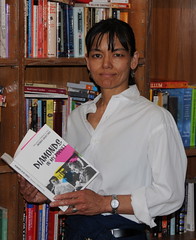

Yes, different niche, indeed; that's why my diamonds are in my pocket. The title of my book made Nor gasp when she first heard it. "Why in your pocket?" she had asked. I had been at a loss to explain. I was pleased that she got it now. I had been quite apprehensive about the status of my relationship with my cousin, Nor, before coming to Bangkok and was relieved to find that my somewhat harsh characterization of her, depicting her as a materialist conscious of every nuance of status, in my memoir, had not given her reason to distance me. On the contrary, as soon as I arrived at the newly refurbished condo turned office of this publishing enterprise that Raja had created following his retirement, I immediately felt welcomed into the Blue Toffee family as one of its authors; the talent as they say in the performing arts.

The sight of my book on display in Raja's office next to the three others that were currently on the Blue Toffee play list, gave me a feeling of stardom that I was not quite ready to grasp. There it was, a real book with my mother and three year old me looking out from the cover. It actually did make me want to pick it up and flip through it. Who was this fahrang woman with the Thai child? This would be a different book from the usual English language books about Thai prostitutes and the Western men ensnared by them or alternatively the truly unlucky who find themselves in a Thai prison, Midnight Express style, following a drug bust. Not since the 60s, it seemed, had anyone penned a book in English of normal life in Thailand (if anything can be said to be normal in this country of extreme contrasts).

In fact women writers, even from the Western hemisphere, were hard to find in this land that had inspired Conrad and Maugham and a handful of other Westerners who were well known enough to have suites named after them at the historical world class Oriental Hotel. I did find them though, on the internet, four years ago under the name Bangkok Women's Writers Group, listed under events in the Sukhumvit area, the trendy, up scale, ex pat district that happened to be where my family had a house. It was to a meeting with this group that I was going and Nor and Raja had offered to drop me off.

The group had just come out with an anthology called Bangkok Blondes of their collected writing. It was well received so far and had won some award for South East Asia. I wanted to show them a copy of my book (a mockup, the actual book was still in the queue waiting at the printshop, in Singapore) and probe them for tips on promoting the book. Serendipitously, they were meeting during the five days I was in Bangkok, at seven that night at a coffee shop nearby. Traffic had come to a standstill. I was only a few blocks away.

"It's seven already. I can get there faster if I walk," I announced to Nor and Raja. We had been in traffic for fourty minutes and had traveled about two miles. They agreed, though only fahrung (Westerners) actually get out and walk. That was okay with me. I was a fahrung with a niche. Under the Blue Toffee "lifestyle" brand I would be the sustainability expert. I was all over this niche, envisioning a new wardrobe of outfits. I was already wearing the classic farmer's pants made from ikat textiles. I had hemmed them shorter to a stylish knee length. My tailored white shirt with French cuffs, closed with my father's cuff links and accessorized with silver jewelry, made me presentable to Nor's stylist eye.

I opened the car door, nearly nailing a motorcyclist, then hastily pulled it closed again and looked behind to see a whole stream of motorcyclists with passengers streaming up the column of stopped traffic. Then one was merciful, seeing I was still trying to exit; he stopped and waited as I hopped out. I nodded my thanks to him, waving good-bye to Nor and Raja.

Cultural Whiplash In The Country

This entire trip was one of cultural whiplash I had not quite breached before and if I thought about it too much my head would explode. I had just spent two weeks in the flat, dry landscape of Isaan, in north eastern Thailand on a tour of sustainable projects that I had not known existed before my foray into the world of natural building. Searching for a workshop in cob building on the internet, four years ago, I had found Pun Pun farms near Chiengmai in Northern Thailand, but had not been able to join any of their building events. Still, because this group was in Thailand, I was very interested in their efforts and had kept an eye on them until I was finally able to come on this tour—their first road trip. Even so, I knew that breaking away from my family's Bangkok mindset would not be easy especially if they knew I was traveling alone.

"Driving at night is a no no," warned my friend G-up regarding my trip to Yasathorn, the meet-up point for the tour. (I had wanted G-up to come with me because of her interest in the environment, but she was held up at work.) To hear a city person talk of the country you would think that there were bands of robbers waiting by the side of the road with machetes to ambush busloads of tourists and wealthy Thais in sedans. I remembered a cautionary tale that had been told to me by my family when I was twenty. It involved a girl who wanted to join her friends at the beach at Pattaya, but her parents had said no; she took a taxi alone and ended up raped and dead.

In 1990 I traveled to the outback of Brazil with three other women. City people living in San Paulo warned us that there was nothing out in the Sertao, but snakes and bandits; they themselves had never been to that region. How curious, this psychological barrier between the modernized, educated citizens of urban third world cities and their poor country counterparts. Turned out that the sweetest people lived out in the Brazilian scrubland, visited only rarely by priests, and in one village an American woman who had stayed for two years, learned Portuguese from scratch and painted murals all over the room they had offered to her. "She was like a daughter of the town," the villagers mused nostalgically as they showed us her room.

To cross this barrier between first world city and third world country and to appease my anxious relatives, I would need protective camouflage. I summoned an American of my own, via group e-mail to those going on the tour. She arrived at my family compound, after dark, having traveled by bus from an ashram, a couple hours outside of Bangkok. She had neglected to bring the address and directions I had given her, but was eventually able to reach me by phone having gotten lost on the Sky Train.

As soon as she laid down her large framed, back pack on the teak parquet floor of my father's house and adjusted her waist length brown pony tail, I recognized her for the intrepid footloose youth that span the globe, post-college or between years. Irena was her name. Yes, she would do nicely. Cash strapped backpackers were not generally a target of roadside hijackings.


Early in the morning, my aunt's driver drove us in the family minivan to the bus station and bid us farewell. Ten hours later by air conditioned bus that had stopped at every podunk town, we arrived after dark in Yasathorn, having missed the pickup time of our tour by a couple of hours. We called and were instructed to find a taxi and make our way out to the farm. I did not tell Irena that two women out in the country at night was a "no no," although I was beginning to worry. I would just have to hang with her fearless American reality. I was, after all, armed with a black belt.

A motorcycle driver for hire, seeing that we had just got off the bus approached us. Realizing how far we wanted to go, he summoned for us another driver who had a pickup truck. This chap's scraggly beard and homeboy hat did not comfort me, but we got in nevertheless and headed out to our destination fourty minutes away, with me jammed up against the stick shift. There was no address. The driver seemed as nervous as me. We would just have to ask our way there or rather he wanted me to ask, to give validity to his being there—a strange man with a truck. At the first house where people were still out in the yard, I got out and described to them, with my ten year old Thai, the farmer who had a fahrung wife whose farm we were seeking. Ah yes, said the man, the place of the "Baan Din"—the earthen houses. This was promising, but still we did not find it and stopped at a hardware store where the owner kindly jumped on his scooter and bid us follow him. He led us to another house high up on stilts with a small yard.

"This isn't how I pictured it at all," said Irena when we pulled up, but we were not there yet. A woman came out for a discussion with the driver. I was not following the conversation and thought we were lost. Could we call them? I asked the driver who repeated my request to the family. A pause as the woman took out her cell phone. This comforting device in the middle of what still looked like pre-industrial Thailand made me want to laugh. She dialed a number and handed it to me. I spoke into it in English. A man's voice with a slight Thai accent gently told me in English, that we need only follow this woman's son and he would lead us there on his scooter.

When I saw the first distinctly un-Thai earthen house and a group with a blond person in it, milling about under fluorescent lighting, I knew we were there, wherever there might be. I had done it. I had escaped the pod lifestyle of Bangkok as it was lived from air-conditioned car to indoor shopping mall to air-conditioned condo. And this, I could be sure, was no ordinary tourist expedition with pre-planned elephant trek ending at a photo-op waterfall. This was a field study into the lives of real people not making a living from the tourist trade, a land that had once been teak forests, and was home to so many women currently in the sex trade. This was the story of a land in recovery from the Western selling of the Green Revolution of chemical agribusiness fame, followed by the economic roller coaster of globalization. Now it would be my story to tell too.

Labels: , , , ,

Earthworm. Get yours at bighugelabs.com