Amanda Kovattana

Middle-aged musings in interesting times

Friday, March 07, 2008

Last Economy Standing

Part two in a series of stories from my road trip in Thailand, participating in a study tour hosted by Pun Pun farms, to visit local examples of sustainable living in the Northeast and in Chiengmai.

"So how did you fall so far from the mainstream consumerist path?" I asked Irena on our long bus ride. She told me how she had, as a child, lived on a farm that her family had tried to start, but it was too hard to make a living farming organically.

"Oh so they were part of the back-to-the-land movement," I said. She agreed. We were talking second generation here. Her parents had already chosen an alternative to the consumerist lifestyle.

As I met others on the tour from the youngest college students, including Sasha who was doing her year abroad at Chiengmai University, to the gray haired man in the floral print pants, named Montaine, whom I quickly realized was gay, I would find that each had their own story of how they had veered from the consumerist lifestyle and now found themselves on a similar quest to heal the world through sustainable living practices. The tour was, after all, called simply the Sustainability Tour.

Since we had arrived so late, we got the last two sleeping spaces. I chose to settle on the back porch of one of the larger adobe houses where a pink mosquito net and futon mat awaited me. Martin who was sharing the space with me, reminded me that we had already chatted on the internet when I was searching for a traveling companion. I was comforted by this previous allegiance. He was from Belgium and was the only actual farmer among us. He invited me to share his roll of toilet paper.

At three in the morning I was woken by what sounded like an amplified band of street musicians singing a ballad. It was a mysterious sound that seemed to move as if on the back of a pickup truck, but never came any closer. Having changed time zones by 15 hours, I felt alert and awake and used the time to write. After an hour or so there was the sound of temple bells and then quiet. At dawn I looked through the twin arched windows of the adobe wall and saw the sun rising over a large lily covered pond.
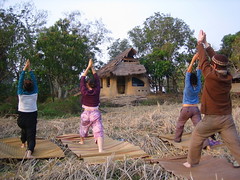
The house, I was staying in, was built along the back edge of a dry rice paddy. I picked my way over the cut brown stalks to the road and walked to the dining pavilion. Just beyond the pavilion, in another rice paddy, we would assemble on mats for a yoga session. This was definitely not Thai—this yoga, on mats, facing another earthen house. This one was more hobbit like with an assortment of asymmetrical windows and a shaggy thatched roof of long dry leaves. The roof was Thai—coconut palms possibly.


At the back corner of the field were Thai people milling about doing chores under a large tin roof, preparing breakfast for us I realized later. I felt them being amused by the funny postures we were assuming. Peggy, the American wife of Jo who owned the farm, was leading a brisk session followed by a brief meditation. Breakfast wasn't exactly Thai either—these boiled yams eaten in a bowl of blue gray soy milk, but eat it I did.

Martin stood beside me making coffee from hot water dispensed from a large insulated thermos. I asked what kind of farming he did. He said picturesquely, "I have man chicken and woman chicken on the same floor and they fertilize the egg, then I sell egg to the hatchery." At every farm we visited he would kneel at the edge of the rice paddy, pick up a handful of soil and sniff it. So I did the same. The soil in this dry landscape was nearly white and did not smell of much in the way of organic matter.

"It's so sandy," I commented to Peggy.

"It's terrible soil," she said laughing.

This is the soil of land cleared of trees. In the 50s, the government had feared that communist insurgents from nearby Laos and Vietnam were hiding in the forest so they had offered the locals titles to the forest land if they promised to clear it and cultivate it. Cash crops ensued and more land was cleared. And, of course, the teak trees were also a cash crop.

The Joys of Subsistent Farming

The region was so dry it only produced one crop of rice a year instead of three, just enough to feed the family with a little left over to sell. This was what we, in the West, call subsistent farming. Jo didn't seem to think there was anything wrong with that. The way he told it this was the land of abundance. Heck, you only had to work for two months of the year to bring the rice in and the rest of the time was your own, he told us. Compare that to 8 hours a day, seven days a week in the congestion and pollution of Bangkok just to make room and board. The land gave you everything you needed. It had taken him seven years to realize this and return to his 9 acre family farm.
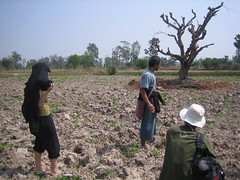

In one paddy he had a smorgasbord of vegetables and melons where the seeds had been simply broadcast and tilled into the earth as the cut rice plants were plowed under. This was his green manure crop. He didn't even have to water it because the water lay so close to the earth under that dry sandiness. Okay, if you say so, I thought. I looked at it skeptically, but I knew from my readings on permaculture that the soil was the best place to store water. All you had to do was dig a basin to catch it during the rainy season. These sunken paddies would flood then.

We walked along the dikes that separated one from another. Here and there would be tucked a pineapple plant or a skinny papaya tree. He did have, by the kitchen, what we would recognize as a vegetable garden with leafy greens, irrigated by blue plastic hoses and sprinkler heads. The water was pumped up from a small pond. This, he pointed out was not strictly adhering to the rules of permaculture as it was envisioned by the Australian who had first come up with the permaculture method.

Jo felt that these rules were too inflexible. It was much easier to catch water run-off if the pond was at the bottom of the land rather than at the top. It was true that he then couldn't use gravity to flow the water to where he needed it and had to use an electric pump, but his pond didn't need a liner which was expensive. And there were fish in his pond. They had arrived there during the rainy season as they jumped over the dikes of the rice paddy from other, bigger ponds. He fed the fish with a large mound of straw and cow dung at one side of the pond. As the fish pulled at the straw at the bottom, the mound would slowly slide further into the water. I marveled at this combination of natural phenomena and a little planning and was happy to eat the fried fish cooked up for us.

After hearing the story of Jo's return to the farm, we piled into the back of a large truck with parallel benches facing each other. A canvas roof covered the metal framework arching over the truck bed. This was typical transport for country folk. Middle class Thais in sedans would laugh when they saw all the farangs traveling country style. We hung on to the support posts and shouted our conversation over the noise of the wind and hum of the engine. After some hours we arrived in Ubon Ratchatani, near the Laotian border, where we picked up a couple of late comers. I liked them immediately. They had style and were from Vancouver. Xaaq with his rakish cap of his own design and Alicia who had on black Japanese fisherman's boots and was a hair stylist.

Waking Up From the Dream

We continued to our first stop at Suan Sang Fun an intentional community. The name translated meant "waking from dream". We were warmly greeted by Thais wearing blue farmer jackets and pants and were served a vegetarian lunch that I recognized as Thai plus some added unfamiliar dishes—a creamy corn and rice dish, a tofu paste with spring onions. After we ate we washed our own dishes in a line up of five wash basins; a system I would find everywhere we went.
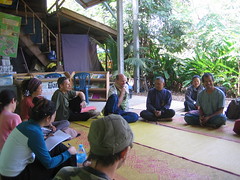

Assembling on the linoleum in the school area, we listened to a leader of the community speak. His name, Mai Horm, meant aromatic wood. He told us how the community operated by sharing everything and working together. Buddhism was their common bond and each individual was required to follow the five precepts of lay people (as opposed to 8 for monks). These are to refrain from killing, stealing, lying, having sex outside of a committed relationship and to abstain from addictive substances including coffee. Decisions were made by a committee with guidance from monks if no decision could be reached. There was a fund to care for the sick, provide clothes and buy land. Appropriate technology was emphasized and education should add to the knowledge base and pertain to local needs, not be about the Grand Canyon say. We laughed.


"We are fleeing capitalism," he told us as Jo translated, "because capitalism makes slaves of the poor." I am gratified that nobody even flinches at this anti-capitalist statement. No trickle down theorists here. He talks about how they picked simple clothing because it cut down on the social competition and money spent on adornment.

"When you stop competing with society you have more enjoyment of life," he said wisely. Their outfits are all navy blue and look like a regimented uniform. This crossed a line for me. I felt compelled to ask a question.

"People will say that this is communism with a Buddhist twist," I comment. "What is the argument against that?" I ask.

"Maybe they don't need one," says the comely, East Indian, biracial, woman, Jenell, sitting directly across from me. An American, she is a teacher of natural building techniques and has spent much time helping with building projects in Thailand. I look at her, but stand my ground. I need an answer. I haven't suffered the Domino Theory all these years not to ask the communist question. This was, after all, the reason given for the Vietnam War, to protect the whole of Southeast Asia from falling to communism. Jo translates my question.

"This is a voluntary system," said Mai Horm, "communism is a government system that forces people to conform via laws." I mull this over and decide that, because of the Buddhist precepts, this communal entity would not be read as a Marxist threat. The group is, however, associated with a larger movement, the Santi Asoke Buddhist sect founded some 30 years ago by a former popular singer from Bangkok who ordained as a monk. He established some new ideas about an economy based on meritism that did not go down well within the Thai temple system so he formed his own sect.

Last Economy Standing

Meritism is the system of earning brownie points to improve one's spiritual life and, as I learned as a child, to improve ones circumstances in the next life as well. The Santi Asoke group had a set of rules for business that was more gift economy than trade. One's first duty was to feed oneself and family, then the needy in the community. Only then was any surplus sold at below market prices. If a profit was made, it should not be too much. What cash was collected went into improving the community.
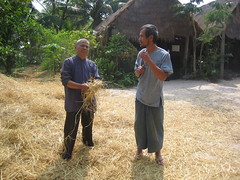

They also taught self sufficiency and gave workshops on organic farming and natural health care as well as how to ferment EM (effective microorganisms) for fertilizer and make shampoo and other products that could be sold. A jar full of holes was used to demonstrate what happens when you are trying to pay off debts and are still spending money. You simply aren't able to fill the jar no matter how much water you put in it.


After the economic collapse of 1997-99, those living under the Santi Asoke system were the only group thriving. This got the attention of the Thai government who sent their people to study this economic phenomena. Not wishing any more defaults on loans to farmers from the government supported Farmer's bank, they made it a contingency of any future loans that the recipient train with the Santi Asoke group. Chances were, after they learned the principles of self sufficiency, the farmer would decide he didn't need a loan. And if he still wanted one, his new knowledge was a better guarantee that he would pay off the loan. Since then 100,000 people have taken the training and a quiet movement to self sufficiency was slowly infusing the land.

Labels: , , , ,

Wednesday, March 05, 2008

Cultural Whiplash In Bangkok

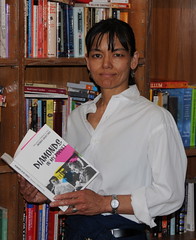
"What about a book about earthen houses," I tentatively suggested to Raja and his wife, Nor, the managing director of Blue Toffee, the publishing house that is producing my book "Diamonds in My Pocket." We are in Raja's car which was actually a great place for a meeting, since he had a driver and we could fully concentrate on our conversation within the confines of the leather upholstery and cool filtered air of the sealed Beemer, despite being in the middle of rush hour traffic.

"Lot's of books in the States are about natural buildings," I explain thinking of glossy coffee table books full of photographs of strawbale cottages shot at sunrise, "they are very beautiful and people like to buy these books. Though not the same people who buy diamonds," I add turning to Nor. "That all right," she says in her characteristic short cut English with flat Thai accent, "different niche." Nor is in the middle of producing her third book in a series of books on gems; this one is a guide to picking out diamonds.


Yes, different niche, indeed; that's why my diamonds are in my pocket. The title of my book made Nor gasp when she first heard it. "Why in your pocket?" she had asked. I had been at a loss to explain. I was pleased that she got it now. I had been quite apprehensive about the status of my relationship with my cousin, Nor, before coming to Bangkok and was relieved to find that my somewhat harsh characterization of her, depicting her as a materialist conscious of every nuance of status, in my memoir, had not given her reason to distance me. On the contrary, as soon as I arrived at the newly refurbished condo turned office of this publishing enterprise that Raja had created following his retirement, I immediately felt welcomed into the Blue Toffee family as one of its authors; the talent as they say in the performing arts.

The sight of my book on display in Raja's office next to the three others that were currently on the Blue Toffee play list, gave me a feeling of stardom that I was not quite ready to grasp. There it was, a real book with my mother and three year old me looking out from the cover. It actually did make me want to pick it up and flip through it. Who was this fahrang woman with the Thai child? This would be a different book from the usual English language books about Thai prostitutes and the Western men ensnared by them or alternatively the truly unlucky who find themselves in a Thai prison, Midnight Express style, following a drug bust. Not since the 60s, it seemed, had anyone penned a book in English of normal life in Thailand (if anything can be said to be normal in this country of extreme contrasts).

In fact women writers, even from the Western hemisphere, were hard to find in this land that had inspired Conrad and Maugham and a handful of other Westerners who were well known enough to have suites named after them at the historical world class Oriental Hotel. I did find them though, on the internet, four years ago under the name Bangkok Women's Writers Group, listed under events in the Sukhumvit area, the trendy, up scale, ex pat district that happened to be where my family had a house. It was to a meeting with this group that I was going and Nor and Raja had offered to drop me off.

The group had just come out with an anthology called Bangkok Blondes of their collected writing. It was well received so far and had won some award for South East Asia. I wanted to show them a copy of my book (a mockup, the actual book was still in the queue waiting at the printshop, in Singapore) and probe them for tips on promoting the book. Serendipitously, they were meeting during the five days I was in Bangkok, at seven that night at a coffee shop nearby. Traffic had come to a standstill. I was only a few blocks away.

"It's seven already. I can get there faster if I walk," I announced to Nor and Raja. We had been in traffic for fourty minutes and had traveled about two miles. They agreed, though only fahrung (Westerners) actually get out and walk. That was okay with me. I was a fahrung with a niche. Under the Blue Toffee "lifestyle" brand I would be the sustainability expert. I was all over this niche, envisioning a new wardrobe of outfits. I was already wearing the classic farmer's pants made from ikat textiles. I had hemmed them shorter to a stylish knee length. My tailored white shirt with French cuffs, closed with my father's cuff links and accessorized with silver jewelry, made me presentable to Nor's stylist eye.

I opened the car door, nearly nailing a motorcyclist, then hastily pulled it closed again and looked behind to see a whole stream of motorcyclists with passengers streaming up the column of stopped traffic. Then one was merciful, seeing I was still trying to exit; he stopped and waited as I hopped out. I nodded my thanks to him, waving good-bye to Nor and Raja.

Cultural Whiplash In The Country

This entire trip was one of cultural whiplash I had not quite breached before and if I thought about it too much my head would explode. I had just spent two weeks in the flat, dry landscape of Isaan, in north eastern Thailand on a tour of sustainable projects that I had not known existed before my foray into the world of natural building. Searching for a workshop in cob building on the internet, four years ago, I had found Pun Pun farms near Chiengmai in Northern Thailand, but had not been able to join any of their building events. Still, because this group was in Thailand, I was very interested in their efforts and had kept an eye on them until I was finally able to come on this tour—their first road trip. Even so, I knew that breaking away from my family's Bangkok mindset would not be easy especially if they knew I was traveling alone.

"Driving at night is a no no," warned my friend G-up regarding my trip to Yasathorn, the meet-up point for the tour. (I had wanted G-up to come with me because of her interest in the environment, but she was held up at work.) To hear a city person talk of the country you would think that there were bands of robbers waiting by the side of the road with machetes to ambush busloads of tourists and wealthy Thais in sedans. I remembered a cautionary tale that had been told to me by my family when I was twenty. It involved a girl who wanted to join her friends at the beach at Pattaya, but her parents had said no; she took a taxi alone and ended up raped and dead.

In 1990 I traveled to the outback of Brazil with three other women. City people living in San Paulo warned us that there was nothing out in the Sertao, but snakes and bandits; they themselves had never been to that region. How curious, this psychological barrier between the modernized, educated citizens of urban third world cities and their poor country counterparts. Turned out that the sweetest people lived out in the Brazilian scrubland, visited only rarely by priests, and in one village an American woman who had stayed for two years, learned Portuguese from scratch and painted murals all over the room they had offered to her. "She was like a daughter of the town," the villagers mused nostalgically as they showed us her room.

To cross this barrier between first world city and third world country and to appease my anxious relatives, I would need protective camouflage. I summoned an American of my own, via group e-mail to those going on the tour. She arrived at my family compound, after dark, having traveled by bus from an ashram, a couple hours outside of Bangkok. She had neglected to bring the address and directions I had given her, but was eventually able to reach me by phone having gotten lost on the Sky Train.

As soon as she laid down her large framed, back pack on the teak parquet floor of my father's house and adjusted her waist length brown pony tail, I recognized her for the intrepid footloose youth that span the globe, post-college or between years. Irena was her name. Yes, she would do nicely. Cash strapped backpackers were not generally a target of roadside hijackings.


Early in the morning, my aunt's driver drove us in the family minivan to the bus station and bid us farewell. Ten hours later by air conditioned bus that had stopped at every podunk town, we arrived after dark in Yasathorn, having missed the pickup time of our tour by a couple of hours. We called and were instructed to find a taxi and make our way out to the farm. I did not tell Irena that two women out in the country at night was a "no no," although I was beginning to worry. I would just have to hang with her fearless American reality. I was, after all, armed with a black belt.

A motorcycle driver for hire, seeing that we had just got off the bus approached us. Realizing how far we wanted to go, he summoned for us another driver who had a pickup truck. This chap's scraggly beard and homeboy hat did not comfort me, but we got in nevertheless and headed out to our destination fourty minutes away, with me jammed up against the stick shift. There was no address. The driver seemed as nervous as me. We would just have to ask our way there or rather he wanted me to ask, to give validity to his being there—a strange man with a truck. At the first house where people were still out in the yard, I got out and described to them, with my ten year old Thai, the farmer who had a fahrung wife whose farm we were seeking. Ah yes, said the man, the place of the "Baan Din"—the earthen houses. This was promising, but still we did not find it and stopped at a hardware store where the owner kindly jumped on his scooter and bid us follow him. He led us to another house high up on stilts with a small yard.

"This isn't how I pictured it at all," said Irena when we pulled up, but we were not there yet. A woman came out for a discussion with the driver. I was not following the conversation and thought we were lost. Could we call them? I asked the driver who repeated my request to the family. A pause as the woman took out her cell phone. This comforting device in the middle of what still looked like pre-industrial Thailand made me want to laugh. She dialed a number and handed it to me. I spoke into it in English. A man's voice with a slight Thai accent gently told me in English, that we need only follow this woman's son and he would lead us there on his scooter.

When I saw the first distinctly un-Thai earthen house and a group with a blond person in it, milling about under fluorescent lighting, I knew we were there, wherever there might be. I had done it. I had escaped the pod lifestyle of Bangkok as it was lived from air-conditioned car to indoor shopping mall to air-conditioned condo. And this, I could be sure, was no ordinary tourist expedition with pre-planned elephant trek ending at a photo-op waterfall. This was a field study into the lives of real people not making a living from the tourist trade, a land that had once been teak forests, and was home to so many women currently in the sex trade. This was the story of a land in recovery from the Western selling of the Green Revolution of chemical agribusiness fame, followed by the economic roller coaster of globalization. Now it would be my story to tell too.

Labels: , , , ,

Earthworm. Get yours at bighugelabs.com