Amanda Kovattana

Middle-aged musings in interesting times

Friday, July 22, 2016

It Takes A Village To Live Tiny

In early May after my return from Canada, Catherine told me that she felt our domestic arrangement had come to an end and it was now time for her to live alone. She asked that I move out by September. She said the same to her brother Steve. I was stunned and devastated. 

"Where shall I go? What shall I do?" I wanted to say in Scarlett O'Hara fashion.

"Frankly my dear I don't give a damn," said the the Bay Area housing crisis. I gave myself a month to wring my hands and absorb this shock. I had known my living situation was without a future in the sense that we were no longer in a committed relationship, but I had put my money on the mutually beneficial arrangement of my staying which had been going so well these last two years. That with all the care the two dogs demanded and the shared meals I made, the gardening and household chores I helped with she would want me to stay especially once she returned to working full-time. It was the only option I was willing to entertain because I had been enjoying a $700 rent for so long I would be hard put to afford a room in a house in the Bay Area. Most were double that. Perhaps I should have taken a different path I lamented.

I had been told by our therapist and others that legally I did have the right even in a domestic partnership to sue for half the value of the pooled assets accrued during our 20 years together. I hadn't wanted to do it. I feared that it could get ugly and destroy our friendship. I had opted to see what would unfold if I stayed. Barring her meeting someone else she wanted to live with this seemed like a reasonable expectation. But now Catherine felt this transition period was over. It was time for her to move on, she said. I made another plea on my behalf.

I mentioned that she had, at the time of our break-up, promised to buy me a tiny house on wheels. But when she researched online and saw figures close to $90,000, she said she didn't have the money and she did not foresee selling her house anytime soon (to free up cash). I didn't pursue it since she was allowing me to stay. Maybe something else would unfold I thought.  

"I'll buy you a tiny house," she said just like that as I recalled this discussion. This stopped me mid-argument. It had indeed been my dream to live in a tiny house one day even if I had to build it myself. A very big dream that I knew I would have to do alone for Catherine did not share this vision. The tiny house concept of self sufficient living embodied all the off-grid living ideas that I had been experimenting with for the last fifteen years. To actually live in one would allow me to fully realize my passion for this life. With Catherine's offer of the tiny house my grief and shock were arrested as I remembered the full potential of this vision. And they were not, after all, as expensive as she had anticipated given what I had in mind. A shell that was unfinished inside could be had for $25,000. I accepted her offer gratefully and immediately went to Craigslist to look for such a tiny house on wheels.


My Tiny Life Education

A year ago almost to the day, I had attended a two-day workshop where I had listened to a young woman teach a roomful of would be builders how to build and live in a tiny house on wheels. The workshop was given by the Tumbleweed company formed by the original creator of tiny houses to sell plans to would be builders. The tiny house that our workshop leader lived on was parked on a property out by the coast next to a horse paddock. That she was a cello player with a degree from a university in Europe fit right into my scenario of wealthy patronage hosting such a high end tiny house. The scenario evoked all my experience of negotiating class and racial boundaries in the Bay Area. This was an elitist solution I felt, a diminutive version of a high end house with all the material wants of a Western lifestyle. It changed very little about how one lived apart from having less room to live it in. And it would still require that you had a relationship with land to park it on which implied that you had enough social equity to find a host who would be willing to let you live on their land possibly illegally given city zoning. You could not even buy land and park the house on it because there were laws against "camping" on your land. There were also laws that prevented you building normal houses small enough to afford because most towns had square footage ordinances that prevented such tiny dwellings. Zoning was how the American landscape was divided into economic apartheid. Building the house on a trailer was a way to get around building codes. 

Still I loved the idea of living in such a compact, well designed space that I could custom fit to my own habits. It was an opportunity to design a lifestyle that would incorporate my ideas of how one would live using the least amount of resources possible. In fact I so wanted to experience such a space that I decided to design and build a mock tiny house just to see how it would feel. For this experiment I chose to build a loft in my mother's one car garage which was about the same size as a tiny house being 91/2 feet by 20 feet and was a separate building made of wood resembling a 1920's board and batten cabin. I had in fact already cut holes into the walls for windows when I was enrolled in a construction class a decade ago and wanted to practice my carpentry skills. By returning to this unfinished space for this project I was able to hone my tiny house building skills, practice installing electric lights and outlets, then finish the walls and paint them the white wash I so wanted to see over the OSB strand board I put up for the walls. 

The project not only improved my building skills it honed my mind to make decisions around all the details of living in a tiny space. Intellectually I was able to investigate practical aspects of spacial design, compact storage and how to make multi-use built-in features that would cleverly transform the function of the space. I experimented with salvage materials to see what could be used that might otherwise go to landfill. Bed pillows for instance made very good insulation for walls. Over a six month period of working a couple hours every other day, I put in 230 hours and the garage was transformed from a rat infested haphazard store room into a pleasant light filled studio space with ample storage in the loft I had designed. And all using wood I had saved over the years (and stored in same garage) and what I found on craigslist mostly for free. How I loved that humble building. And how I enjoyed improving the space and adding value to my mother's property. 


Ever Tinier

In considering what size of tiny house on wheels I would choose to buy I remembered something my cello playing instructor had said when I went to visit her tiny house at the bottom of the horse paddock. If she had to build it again she would go smaller, she said, because even in this small a house of 24ft by 8ft there was still plenty of room to accumulate excess stuff. And this included a boyfriend and two dogs. She would go to 18 feet she said. So when I went to craigslist that night to look for a tiny house I was looking for the smallest I could find. And there it was. It was beautiful being all shingled in cedar and having a red door. The photograph of it was so professionally done that it looked like a magazine cover. But it cost $32,500 and that was just too much I thought for an unfinished house. A few days later I looked again and there was a lengthy description telling the story of why this house had been built. 

Apparently two dads, John who sold things and Phil who was a professional roofer, had decided to build their families a vacation cabin. It was their plan to park it on a friend's land. They put into the project the highest quality materials they could find including high end windows and a wood floor. It was fully insulated and wired with electric outlets and wall sconce lights, but was otherwise empty inside. It had taken them a year and a half to build this much, by which time the friend had sold the land and their plans to use it were moot. As I read the description of the house I could feel the love they had poured into this project and how proud they were of it. The interior was lined with reclaimed salvaged redwood fence boards that gave the interior a soft variegated look. This fooled the eyed into thinking it was bigger than it was. The ladder to the loft was built from heavy beams from an old barn and was sturdy enough for a big man. It was small, only 6 feet wide inside and 14 feet long which was perfect because I wanted a narrow profile to better fit on a narrow piece of land. I had it in mind to park it at my mother's house next to the the beloved garage where I had been building the mock tiny house. 

To express my appreciation I wrote the seller a fan letter admiring the quality of the build. Then since such a letter seemed to warrant a reason for my writing it I explained that I could not buy it because my budget was only $23,000 or so. Ten minutes later John called me and said I could have it for $26,000. This was a considerable discount. I would get back to him, I said. I showed the ad to Catherine and she agreed to buy it if it was the one I wanted. And that Saturday I went to see it taking with me my new friend Tim, a carpenter I had met by chance just before I needed help to patch the leaky roof of my mother's garage.

To make sure I had a place to put this house, I had proposed to my mother that I park it on her property. She was not enthusiastic about the idea, but her boyfriend Bill had been more encouraging. "Think of the benefits of an onsite cat sitter," he said over dinner. When I showed her the glamorous pictures of the tiny house she clearly saw how lovely it was and urged me to buy it before someone else did. In terms of home ownership it was not very much money she noted. This was all the encouragement I needed.

Tim and I drove all the way to Hollister to see it. Once I laid eyes on the tiny house in person the height of it was a little scary. It was almost the height of a two story building, but I ignored that warning feeling for it was the height that made the inside bearable since there was so much space above your head. Tim asked Phil about the methods used to strengthen the walls. All was done to the highest standards. I felt confident to mover forward and put down a deposit of $1000 then set about preparing for the arrival of the tiny house in two weeks. I went home thinking I was well on my way to living my dream, but instead I spent a sleepless night wondering how such a high profile tiny house was going to be received in the neighborhood. For much as they seem so perfect a solution to homelessness, they were not legal to live in. It was legal to park them, just as an RV is legal to park on private property, but if you were living in it and the neighbors complained you could by local ordinance be evicted from your own house. 

To quell my anxiety I decided to ask the nearest neighbor who kept an eye on my mother's house, what she thought of such an endeavor. My mother, however preempted this meeting when she called me in the morning and told me she could not allow me to park the house on her property. It was just too evocative; it would soon attract the attention of the county officials. I had to agree that she was right and so I had to choose to either give up this dream (and my deposit) or pursue it in an aggressive manner unlike my usual low key approach. I never liked to ask for anything. 

I wrote up an ad on craigslist in search of a place to park and listed what I was willing to offer in terms of a little rent ($300-$600) and a lot of skills for home maintenance, gardening and care taking. I used the same beautiful picture of the house that had caught my eye. And I posted the link to the ad to Facebook and Twitter and the Yahoo group of my colleagues. People wrote back words of encouragement and ten of my friends  posted it to their pages asking their friends if they knew of a space. I did get some very nice responses both from friends of friends and strangers, but they were in the East Bay outside of my area and far away from clients which I was not prepared to do just yet. Still I felt enormously supported and loved it kept my heart open for a favorable response.

The purchase of this house with no land to put it on would render my dream an albatross that would cost me money to store it and be impossible to sell since few who have such cash are willing to live in a shoebox. 

I went away for the weekend to a house party where I got the opinion of all those present. My closest friends agreed that this could easily go sour, but one friend who had had many adventures in buying property encouraged me to go for it, because whatever happened I would end up owning something beautiful. I might end up leaving the Bay Area to live in it, but it might be worth it and if I left the country I could put everything I owned into it and still pay the same fee for storage as I would for my stuff alone and I would have something to come back to.

That night I picked up an e-mail from an acquaintance I knew from my Buddhist meditation center with whom I had done some solar oven demonstrations. She wrote me that she had a space in her backyard that might work. This was extremely encouraging. As soon as I got back from my house party I went to see her site. It was indeed feasible and well located being only ten minutes from my present home. I envisioned some fine collaborative eco projects in this garden for we had a shared eco sensibility. The space did, however need a lot of preparation in the trimming of bushes and moving of storage units. It was a tight space with sparse room around it. It was clear I would need a temporary place to park while I finished building the interior of the tiny house. 

There was another possibility that had been appearing in the back of my mind. Only a mile away from this site was my childhood home where there was a two car garage and a driveway down a cul-de-sac that would keep the tiny house hidden from view from the street. I could see myself working from my father's workshop using his tools and workbench. Could feel him helping me though he'd been gone now for 14 years and my stepmother had inherited the house.

My father had been a complex and difficult man given to rudeness and temper tantrums in my youth and a peculiar lack of understanding of human relationships, yet he was a brilliant engineer who had built his own computer in order to stay relevant to his work. He had had in all likelihood what we would now diagnose as Asperger's. The circumstances of his long illness with throat cancer that eventually led to his death had been trying to both me and my stepmother. I had not been very patient or diplomatic in my participation in his care while my stepmother had to contend with the brunt of his anxiety and non-compliance to his doctor's orders. I could not imagine myself asking her for any favors so estranged had we become. But as it happened I had recently spent some time with her and had had a chance to renew our acquaintance. 

While I was in Thailand for my mud hut building workshop I had been in Bangkok at the same time as she was, sharing the house my father built on the family compound which he had left to both of us. She was there with her boyfriend, a doctor who was charming and friendly to everyone in the household. So much so that all the difficulties of our family relationships seemed to fall away. He was warms towards me too. As I contemplated whether or not to ask her I realized that I had for so long put her in the roll of the heavy in my life as the figure who had usurped my inheritance, that she might welcome the opportunity to be my savior if I would only ask. 

Unfortunately I couldn't call her to explain to her the situation or even what a tiny house was because she and the doctor were in Germany on holiday. Time was ticking down so I wrote to her through Facebook explaining what I wanted to do. She didn't respond at first so I wrote again giving more details of my soon to be homeless status which could end up with me living in Bangkok in the house we shared. She wrote back with her cell phone and said to call her. She was sympathetic. Her only concern was that she would be able to get her car out of the garage and that the neighbors be informed. Neither was a problem so she said yes. I was so relieved. I had asked for help from so many people to get this house that I could truly say it takes a village to live tiny.


My Tiny Adventure Begins

The day the tiny house rolled into town, the neighbors came out to see the house as it pulled up and stopped on the side of the road.

"I love your tiny house," said a woman as she drove by.

"Pull it in here, I'll make room," said the neighbor across the way. The neighbor in front of my stepmother's house came out to network with my builders.


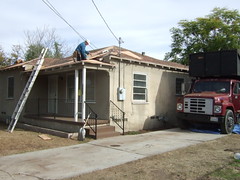
The two men had towed the tiny house all the way from Hollister. On the pickup towing it was a ladder strapped to the truck rack. This came in handy. The overhanging trees in the driveway did not clear the roof of the house adding to the drama of its arrival. The 20ft ladder was set up to allow Phil to climb on the roof and lift the branches out of the way while the truck was pulled forward. Then another difficult maneuver to back the house into position in the driveway. Once the house was leveled with the jacks at each corner it was done. All that was left was for me to hand over the cash.

When my stepmother returned she and the doctor welcomed me by inviting me to lunch when I came to work on the house. This offering of food was very Thai and made me feel right at home. It warmed my heart to feel so welcomed. I was eager to help with the chores she asked of me in return — hauling away things mostly, much of it my father's old books and papers. Her friends who came by admired the house in the driveway.

I was buoyed up by the reception to the tiny house. My tiny house. I was suddenly a celebrity with this cute unusual big thing. Thanks to the cable TV show Tiny House Nation and a few other similar shows, the phenomena of tiny houses had captured the American imagination. The compactness of such a lifestyle was a kind of antithesis to the horrors of excessive consumerism and collecting of stuff that had made the hoarding shows so popular. It solved the problems of mortgage debt and provided the mobility needed to follow job assignments. Viewers were charmed by the idea (though most did not want to live so small). There seemed to be no end to the cleverness that could be built into them. And now I was a part of this phenomena. An early adopter of a new innovation. Housing 2.0.

I marveled at how I had gone from homelessness to tiny house ownership in a mere three weeks. The tension in my relationship with Catherine evaporated too for I no longer had to be vigilant about a living situation that was forever poised to change. We would remain friends. I came to see that there are those in your life whose role it is to make sure you fulfill your destiny when you are too comfortable or too complacent to get around to it yourself. The tiny house was my destiny now. One that unfolded so effortlessly once I was committed to it that it elevated me to a new level of manifesting my life. The next few months would completely absorb and stimulate every cell of creativity I possessed. Ideas rolled out of my head and were manifested within the week with components that just seemed to turn up. I envisioned myself giving tiny house tours and tiny house dinner parties. 

To join in with the tiny house community I started a new blog to have a record of this new phase of my life and a blow by blow account of the build with photos. It's called "Tiny Red Desk: Living The Tiny Life". (I named it after the color of my writing desk). There you can join me for the tiny house journey.


Labels: , , , , , , , ,

Tuesday, June 21, 2011

Lost In San Bernardino

Over the weekend of May 21st, the date given for those who were to be raptured up to heaven, it was confirmed that one of my tenants had gone missing.

"I'm going in," Mike my manager in the front house told me after noting that there had been no activity in the back house for several days. Mike feared the worse; he'd known that our tenant was seriously depressed. Mike had checked on him recently, woken him up late one morning. Tenant came to the door rumpled, then started crying about something. So Mike took him out to breakfast, talked to him, but he remained in a funk.

My tenant impersonated Elvis. He sent me songs he'd recorded in his bedroom and called me every month to tell me when his check was coming. Told me how grateful he was that I had rented to him. Then a check bounced. His disability check had been stopped without him knowing it. He got it started again, but he was behind and short on cash two weeks into the next month.

I had rented to him because he was gainfully employed, but the long haul trucking job was hard on his back and when he got disability for a year, he took it as his chance to build up his act, doing gigs for a nightclub and parties here and there. He was in New York for a while visiting family and doing his act, which was why he missed his doctor's appointment, which was why they stopped the disability checks with no warning. Last I heard, he told me he was selling his motorbike and would send me the rent when he got the money for it.

His son, recently graduated from high school, lived with him. Soon a friend of his son's was sleeping on the couch. The two guys partied a great deal when Dad was gone. Neither appeared to have jobs. I liked my Elvis tenant immensely, but his son couldn't be bothered to impress me, nodded hello from the couch, shirtless. Father and son used to live in an apartment, but the apartment wouldn't allow the puppy his son brought home. He couldn't deny the son his dog he told me. Last time I visited four months ago, the one dog was now two. They had not informed me that she had had puppies—twice in fact we found out later.

I had called our Elvis for days, listened to his song impersonation that answered his phone and left messages to no avail. Mike entered the house, his heart racing, afraid he would find a body, a suicide. No one was there. He sent pictures. Clothes lay strewn about. Unwashed dishes on the dresser. The TV and couch gone. No vehicles, no dogs. Door left unlocked. A window broken. The place filthy. They had skipped. The money from the motorbike had been getaway money. Mike himself had bought it, in fact, (though he too owed us rent). I called again, left a message, joking about how he had been Raptured up; how I didn't think he was the Rapture type. How he had been like family and hadn't even said goodbye and we wanted to know what had happened to him. Please wouldn't he call and tell us? He did respond, but not to me. He was too ashamed. He called Mike, said he was sorry, he would pay what he owed, but he had moved to New York. He left a forwarding address in Yonkers.

Well I thought, maybe it was for the best. San Bernardino was not a good place in which to be depressed and his son's activities didn't make him the best neighbor. There had been an arrest for underaged drinking. San Bernardino had lost its luster for me too. Our property was likely underwater. Our new financial advisor seemed to be laughing at us, told us we were working too hard for what we were getting out of it, told us that the time to buy property was not when it was bottoming out, but when it was going up. You never knew with real estate if it would ever recover. He was likely right; the area continued to be hit hard by the recession. Was, in fact, the hardest hit area in the nation for foreclosures. At least we had cash flow as long as we had tenants.

The Road Less Perfect

When I first discovered San Bernardino in 2009, it had been a little Shangri-La like. A place that time had forgotten, where people were nice to each if you just got through the day. Those in the Bay Area had faced the recession with a determined competitive edge that increased the divide between the savvy and talented and those not quite up to snuff one way or the other. I was not sure yet which it would be for me. Talented I was; savvy not so much.

A colleague, whose talent lacked in education, but who was guided by determination, called me to tell me she could no longer find work as an organizer and would I like to join her at an inspiring seminar that would help us sell a miracle health cure? She had already signed up with this outfit, was convinced that it worked for all manner of ailments and was giving me the patter. I scanned the website she gave me and told her she was pushing vitamin supplements through a pyramid scheme. She e-mailed me asking me to just give it a chance. Geesh. Was this all that was left?

Entrepreneurs in the Bay Area retooled, marketed more aggressively, spruced up their offices and their online presence as they angled for business. This brought me work, but I was not doing the same retooling. I was sitting at home in a paralyzed funk; I hated marketing and was convinced that it wouldn't do much good anyway judging from my peers. As the work stopped I had just stumbled on San Bernardino. I jumped on those two little houses to stay busy. I happily drove the seven hours there to retreat to it, to get away from the competitive glut of talent looking for work. It wasn't hard to feel on top of my game in San Bernardino. My literacy skills and organizational ability were all it took to come in with the energy of a mover and shaker, someone who made things happen. Backed by the home equity loan, Catherine had taken out in response to the recession, I could attack the project of restoring this property with gusto, bringing in jobs to hungry vendors. Have a talent like Mike eager to show me what he could do. Have a place to try out my design skills.

Thus energized I would return to the Bay Area where I managed to stay in business as an organizer due chiefly to my skill working with hoarders. With all the hoarding shows on TV, hoarders were coming out of the closet (or their family were). It took a certain psychological perseverance to stick with hoarders, both because the work seemed as endless and futile as Sisyphus pushing his rock up that hill and because hoarders had so many questions that seemed to have nothing to do with anything. This confounded most of my peers eager to attack the mess. They ran out of things to say. But I loved nothing better than to answer questions. I had answers I could quote wholesale from all the books I had read explaining how the world worked. I could see how it all connected in my clients' minds and why they needed to know these things. I distilled for them these answers into little bite size packets that kept their interest in the tedious work at hand.

Because these were not the tidy perfectionist jobs typical of high end clients, I thought of myself as something of a slob. My car, for instance. Catherine called it a piece of junk. It was a 23 year old Honda Wagon with dings and green stuff growing on the weatherstripping, but it suited me. It didn't attract thieves or project an attitude. In childhood I had often been warned not to attract thieves. My relatives in Thailand had a taste for gemstones. My grandmother wanted to hand down to me beautiful heirloom pieces as soon as I was old enough to walk. My favorite was a pendent, a checkerboard grid with diamonds and sapphires alternatively dangling in each square. When I was a teenager, my aunt warned me not to wear the piece to the Sunday Market for fear that someone would pull it from my very neck. This alarmed me. I realized how much these nice things made me a target. I didn't want to be watched like that. It would disturb my ability to blend in, to be an observer. Life was easier unencumbered. As a biracial kid, I already stood out. I saved the pieces for special occasions. By day I would go undercover like a spy.

My Hobo Wagon was good cover. It was perpetually filled with client cast-offs going to Goodwill, recyclables to drop off, salvaged building material and tools. I kept the back seat covered with a painters drop cloth. The hatch back I propped up with a broom stick because I couldn't get the replacement strut. I taped the top of the back seat with fabric tape to keep the sun from blistering the fabric further. I worried about the crack on the tail light letting water in and rusting the body from the inside. When I started driving the 420 miles to San Bernardino, I feared that it was only a matter of time before it was scrap. Every time I returned something needed fixing. Last time it was a clutch job.

But I was comfortable in the car. It was the right size, not overwhelming like the bloaters on the road now. It drove like a compact car and could still carry a serious load. Fifteen bankers boxes for instance, eight foot lengths of lumber, a full sheet of plywood strapped to a luggage rack on the roof. It got 33 miles per gallon and I didn't need a footstool to get in it. I could see over the hood. The visibility to the side and back was better than any other car I'd driven.


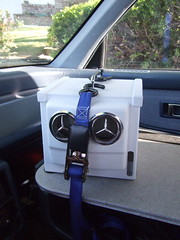
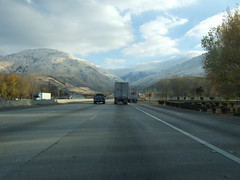
It did not, however, have air conditioning and the stretch of highway through the central valley, known as I-5, would be unbearable without one. I found an outfit online that made swamp coolers for cars. It plugged into the cigarette lighter. You filled it with water and a fan blew air across a damp filter. This was such an intriguing idea I had to buy one to test it out despite the $338 price tag. A little white box arrived. I strapped it to my portable car desk in the passenger seat and angled it to face me. It had dual vents like a pair of giant eyes. It looked like R2D2 sitting next to me. I named him Swampy. Swampy delivered a waft of cool humid air reminiscent of a San Francisco fog rolling in on a summer's day. It kept me just comfortable enough to bear the summer heat.

With the cooling problem solved, I grew even more fond of my eccentric car. But when the engine gave out on a local trip to Oakland three months later, I knew that judgement day had come. I managed to drive my car home on the overheating engine and then to my mechanics the next day. My same mechanic since 1984. I trusted his opinion. We would grow old together. He offered to look for a replacement used engine, but I had to decide soon.

I looked at all the options over the weekend. Other similar size wagons, the Toyota Matrix for instance, was still too new to afford at $7,000. Nostalgically, I looked for my Honda Wagon. I discovered the car had its own club, was being restored and souped up by enthusiasts because it was different they said, because it wasn't an SUV. One was available on Craigslist for $3,000 boasting a new paint job, perfect interior and though it had less mileage than the 230,000 miles on mine it was still high. Did I dare buy the exact same car? No one returned my call. I gave my mechanic the go ahead. In a week I had my car back. The engine he found, was so clean, it probably only had 50,000 miles on it he said. It was from a Honda CRX. It sounded different, younger, more energetic. It drove a little sportier got better mileage. And cost me only $1650 all told. This secret new engine under the hood bolstered my confidence. I tackled I-5 like a veteran.

Expedition Clean-Up


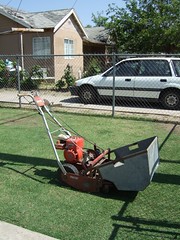
I rolled into our property to find Mike mowing the lawn. He was devoted to the yard, rolling it with a roller and trimming it to the smoothness of a putting green with his vintage rotary blade gas lawn mower. I had given up commenting that the high dessert was no place for a lawn. And somehow we had ended up paying for the entire water bill for both houses every month, but he did so much work keeping up the house that we didn't complain. The green expanse of fine grass did tidy up the place, making the homes look loved and cared for, an icon of retro suburban sensibilities, an American flag hanging over the garage.

I went into the empty back house. It didn't look too bad. Mike and his wife had already started the clean-up and cleared out the remaining clothes and furniture. There was just some touch up painting to do and the broken window in the back door to replace. It was a mystery why it was broken. It was plexiglass. Had someone lost their keys or just been drunk at a party. There was also a curtain missing, an even bigger mystery. Why would someone take a single curtain? Did they accidentally burn a hole in it?

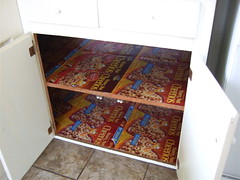
I had brought the paint for the kitchen cabinets and more cereal boxes with which to line shelves. The linseed oil paint I used on the cabinets was hardened now and had held up under scrubbing; I noted that a backplate under the knobs would cover where fingernails had nicked it (and we found some at the nearby Ace Hardware.) The cereal boxes made into shelf liners were mostly still good. I replaced the stained pieces. Mike commented that they had startled him. He'd never seen such a shelf liner pattern, but when he saw what they were he thought it was a good idea. The cardboard was nice and thick he said. He asked if he could have a flattened box to use as a surface on which to mix up some Bondo. The tenants' puppies had chewed on the corners of the baseboards leaving large ragged gaps. In half an hour Mike had applied the Bondo, shaped it and sanded it smooth. Bondo was a filler used for car repair. It dried too fast for me to work with it.


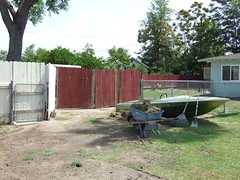
Mike fixed cars too and was fixing an old Saab he had seen in someone's yard, got it cheap. He already had a buyer wanting him to finish the restoration. He had a boat in the yard too, a fiberglass shell someone was giving away with a trailer. He only wanted the trailer. It seemed a waste to throw away the boat so he told me he had decided to drive it to his parents place in Lake Havasu, Arizona. They had no lawns at all, only rocks, so had developed a local culture of recycling large items into planters. This would be the first boat planter. I was amused.

In the evening I was invited to a chicken dinner Jennifer had cooked. Their son Addison, of the kidney transplant, returned from down the street where he had been visiting a neighbor kid. He was a very active boy now, going everywhere on his bike.

"He's a good kid," Jennifer told me when he went to his room. I agreed. I could see it in his face, his seriousness. I offered her my theory of how the trials of his kidney disfunction, the daily dialysis, the frequent doctor visits and medical procedures requiring careful compliance had built, in this boy, patience and perseverance. I imagined his future, saw him going the college route. At times our whole adventure in San Bernardino had come down to giving this boy a safe, stable place to live.

On Sunday I met a family that wanted to rent the house. Mike had told me about them. They had heard from their aunt across the street that the house was up for rent. How lucky was that? They had already filled out an application and were eager to move in right away as they were living at his mother's house. The application showed an income so small it was less than the rent. How was that going to work Catherine asked? Other sources of income were shown me including state assistance for the children. Together it would cover the rent with barely enough to live on. I listened to their hard luck story. He had had his own business, owned three trucks, had to sell them, go to work for his brother's landscaping business. He just got a job at a chain grocery store. They couldn't afford to stay at the townhouse where they were living even though the landlord brought down the rent. Credit not so good either, but he wanted to get it back again, buy his own house. He had goals, he assured me and would take good care of the property, landscape it even. Their small children needed a yard to play in.

"I don't know what happened to the economy," he lamented. I did not offer an explanation to this eager, hard working, immigrant family. Didn't want to tell him the middle had fallen out of the American Dream. I wanted to rent to them, got Catherine's okay when I called her later. He was so happy he came back late that night to put down his money. It was then that we realized there had been a miscommunication about the amount of rent. Mike had given a "guestimate" that was $100 to $200 lower than what we had been getting and they had hoped for the lower of the two, could, at most afford $850.

"No one is asking a thousand," he told me incredulous. I believed him, but I couldn't bring it down that much. Not just yet; I stayed up late making calculations to show Catherine; I asked the advice of the friend who sold us the property, asked about rents in the area. We were going on vacation before the next month rolled around. Chances were we wouldn't get the place rented until we got back, thus another month's delay. Less rent now would make up for a higher rent received later I was thinking. $850 sounded like a lot lower than what we were getting, but it would do. Everyone could live with it.

I packed the one curtain, sewed another when I got home. Mailed it. The family was already happily moved in by then. "They are very social," Jennifer reported. I was satisfied. Order had been restored in our little neighborhood.

Labels: , ,

Friday, March 26, 2010

A Renting We Go

In this saga and a half I conclude my venture into home renovation and landlording following the California real estate collapse.

While in Home Depot shopping for mini blinds and towel bars I get a call on my cell which was now dedicated to calls from potential renters. Our second house on our lot was nearly ready to go and I had timed the ads in the paper to coincide with my third solo trip to San Bernardino. There were three Home Depots near the property; I choose the one with the same layout as the one at home. It seemed to lessen the culture shock.

"Hi this is Joe," said the caller then paused as if he was beginning a long term relationship. He tells me his story. Most callers don't tell me a story; they just want to know how much and how big. The story is about how he had just moved back to California after a spell in Georgia where he was working on a job with his uncle and now he and his wife and three little kids were back living in his mother's house, but his mother wasn't going to be able to keep the house so they all had to move. The upshot of the story was that he was discovering that he was picky about the kind of house he was willing to live in and he was interested in my ad boasting that we had newly renovated. He promised to come by and see the place.


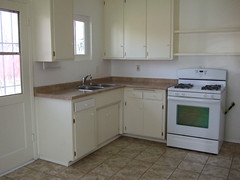
I wondered if my modest interior design choices for the little house would pass muster. The kitchen with its butter yellow cabinets, Formica counter top in caramel tones of faux stone and the floor tile of swirled mocha and pond scum green looked surprisingly okay. All the colors went together quite nicely against the bright white enamel walls; the floor tiles tying chromatically into the chocolate brown of the new carpets in the bedroom.

I had struggled to find window coverings that would span the over-wide ranch house windows of the living room and, after studying the Ikea catalog for two hours, had found the only ones that would do. Their top of the line Kvartal system was very modern looking and a marvel of Swedish engineering. The curtains I made by cutting in half pairs of Ikea drapes and piecing them together side by side. The kitchen windows sported a pair of Kvartal panels with a trendy curved design cut into the stiff white material.

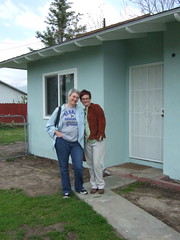
They looked quite nice from the outside, matching the white trim on the newly painted exterior which was now a minty blue green. The choice of color for each house had been a subject of much discussion with Catherine and photographing of houses while dog walking. In the end, to fit into the San Bernardino vernacular of neon yellow and terra cotta orange, I migrated from the tasteful palette of Bay Area earth tones to the color chart from the paint department targeting the Spanish speaking population.

Thus the house, transformed from vintage bubble gum pink to Aqua Tequila, was almost breathtaking in its cheerfulness, evoking beach houses and holidays in the Caribbean.

For the front house I chose a more traditional white with a dark teal trim. In part to impress Mike with something a bit more masculine that would evoke a grander house. He was, after all, going to live in it and be master of the lot, as my manager as well as contractor. I was pleased when he noted that the teal trim would go well with the mint green of the back house.

There was very little left to do once the curtains were ironed and hung up. Without an actual client it was hard to know quite how the space would be used. There were clues. Everywhere that an angled nail had been pounded into the woodwork, by a previous tenant, I put a hook; likewise the backs of bedroom doors. In the one bathroom I replaced a single towel bar with two and a ring. And in lieu of a hall closet two sets of hooks on the back of the front door.

And since I had time, I lined the shelves. The old vinyl had left sticky residue on the wood. But here I parted from the norm and went in search of an eco alternative. I didn't like the off-gassed chemical smell of vinyl, plus it was made of PVC, which was now considered toxic.


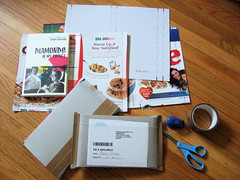
I turned to my collection of cereal boxes, which I had been using to construct book mailers. I lined the drawers of our new bathroom at home with sections of Raisin Bran and Cheerio boxes. Pleased with their resilient surface and op art affect, I took the boxes to San Bernardino and with my corporate size paper cutter, spent a fun evening trimming boxes and thumb-tacking them to the shelves.

My "picky" client, arrived in a white t-shirt, with a tattoo on his upper arm, carrying what looked like a man purse, but turned out to be a camera case. So he could show his wife the place, he told me. When he described to me the squalor that he had seen in the local rental housing market, I realized that new investors, having snapped up all these foreclosed properties, had simply left them in the condition that they had found them, putting them up for rent right away. Yuck, I thought, remembering the condition that we had found our houses in. We couldn't have lived with ourselves.

Joe was eager to rent our house, but as a self-employed carpenter, he didn't have an employer and with no current landlord the only rental history I could check was from two years ago. Plus his credit wasn't too good and he was "between bank accounts" he told me. I already had a contractor and was nervous about having both tenants relying on the same collapsed housing industry. Now, it was my turn to be picky. Still he was my only contender. I gave him an application.

Old Time Values

I walked to the front house where Mike was working on prepping the stucco and woodwork for painting.

"You know," he said, "I could just slap on the paint like most people would, but I want to do it right and patch this woodwork." He pointed his putty knife at the sill, which had a corner that was broken off and painted over.

"And these window panes need to be re-puttied", he added as I took in the cracked dried, up bits. "But it's going to take me a while." He was asking us for more time, but not more money; he had already bid the paint job and was putting in his own time for his own satisfaction.

"I know," I said, "it's exactly what I would do only I knew I'd have to live here for about six months."

One of the first things I had asked Mike, when I met him, was if he thought the sash windows could be saved. I had spent many hours searching the "This Old House" website reading about how original windows were what gave the house historical interest; they could be rebuilt with a few hand tools, even made energy efficient with storm windows.

In high rent areas like Pasadena, where I had stopped to visit a colleague, such historical elements had been kept in good repair. Down here in rent-it-cheap-ville they were being held together with silicone caulking and you were lucky if they opened. If a house was being flipped, out would go the old windows to be replaced with cheap vinyl sliders. Traditionalists claimed that vinyl windows had too many plastic parts inside that would soon break, not to mention that they were a factory manufactured product of the petroleum industry.

I marveled that I'd found a man who shared my values. On my first day back, this trip, he had pointed out the satellite dish on the roof that he had just installed.

"We got TV now," he said. TV? When would such a man have time to watch TV?

"I get the feeling you didn't miss it much," I said. He paused collecting his words.

"Well you know, we've been having Addison read to us at night," he said knowing this would be a choice I would appreciate. Ah, you gotta love these second-chance dads. I knew he had other sons. When we first met him, he told us, that he hadn't spent enough time with them because he was working too hard, thus his retirement from full-blown contractor to handyman.

Addison had found a friend from down the street. They came riding down the driveway on their bikes. (The day he arrived Addison was already over at the neighbors sharing his truck with the little boy there.) This friend was a bigger, white boy. They had come to bide the time while Addison underwent his daily home dialysis treatment.

Mike had shown me the equipment for it—a machine about the size of a tabletop copier plus stacks of boxes of plastic bags filled with saline solution. It was the same treatment we had administered to our cat for her kidney problems. Only Addison didn't get poked with a needle, he had a port in his belly.

I'm not usually taken by children with birth defects, those sappy, inspirational stories that make good copy for Sunday magazines; they make me long for ancient Rome where a baby born horribly wrong was exposed—left on a cold hilltop to die. But Addison impressed me. He had survived this far. Plus all that medical attention had made him adept at talking to adults; he had established a rapport with me right away. For a ten year old, he had a depth born of patience and an enthusiasm for physical activity that spoke of resilience. I admired his pluckiness.

An Auspicious Event

My phone rang as I was installing a paper towel holder in the back house.

"Do you have a weight limit on pets?" said a young female voice. What? Oh right, some landlords do, I remembered.

"Oh I see," I said, "you have a large dog. Or is it a pony?" This being my hotdog stand I could afford to joke. The girl laughed, said she had a Chow who was a sweetheart. When she showed up with her parents a tiny little dog peaked out from inside her jacket. The tour didn't take long.

"It's very basic, but that's what we want," said mom. Their house had just been foreclosed upon and an injury had put her husband, a tow truck driver, on disability thus the need to downsize on this diminished income. Their credit wasn't too good either.

"But we don't have any evictions though," the dad added.

We wrapped up in the garage and they talked about wanting to rent it.

"There's just one thing we want to be up front about," said dad, "we have three dogs and three cats". Oy. And we had new carpets.

"We'll find homes for our pets if we need to," said mom firmly. "We love them, but we need a home, first." I felt like I was coming to that pivotal scene in Sophie's Choice where Meryl Streep is asked to choose which of her two children she wanted to keep. I told them I had someone who wanted it already, but would let them know.

I walked back over to see Mike about a good time to take his family out to dinner.

"We might not be able to go," he said, "we just got a call from the hospital that they've got a kidney for Addison." I knew they'd been waiting since before Christmas.

"But I'm not getting my hopes up because this is the third time we've been called," he added. I remembered the last time they couldn't do it because Addison was catching a cold. The kidney was being screened to see if it was a match. I went on my errand for window blinds for the front house. When I came back Mike said it was a go.

My brain started to unravel at double speed. I popped off to Home Depot again to get a blind I thought I had forgotten, but I had actually misplaced it behind another one. Then I discovered I had left my binder somewhere, probably on the roof of my car to have it fall into the street. In fact every time I came down to San Bernardino, my mind started to unravel. The drama of my story took up too much brain space; I kept forgetting what I was doing and there was nothing in place to ground me as there was at home. Now I knew how my overwhelmed clients felt.


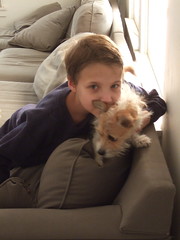
I had to have people there to keep me on task. And my people were vanishing, going on a mission. I succumbed and joined in the proceedings inside the front house. Mike was wolfing down his dinner and Jennifer was combing Addison's washed hair and packing. I asked Addison if I could get a picture of him with his dog, Cupcake. He sportingly obliged. He was as excited as if he were going on vacation.

At nightfall, Jennifer came home. (No family were allowed during shift changes.) She told me the kidney donor was a 24 year old who had died in childbirth.

"How 19th century," I said pausing to take this in.

"They said Addison would grow into the kidneys," she explained since I was part of the family now. I questioned her about her confidence in his doctor. I didn't want the kid to die on me now that I was invested. She had complete confidence in him; didn't seem worried at all.

I was so struck by my happening to be there for this momentous occasion that I felt somehow powerful as if I had brought them this good luck. I mean what were the chances that I would be there just when they got the kidney? Such is the hubris of a writer living inside a story. After a while, I felt like a bystander again and went back to lining shelves.

In the morning I got news that it had all gone well. Whew. He would come home in three weeks, then had to be kept germ free in isolation for three months, so no school. I packed my car and Mike and I settled up our accounts.

Build Your Own Family

In the days following, my work helping a hoarder client sort through ten-year-old copies of People magazine couldn't have seemed more meaningless. My mind was with a boy struggling to accept a major organ transplant. And I still had to rent the second house. The applicants I had were not quite right. They didn't really feel like they were part of the story.

Yet, this was my target market. Having positioned myself just to the sidelines of the foreclosure epicenter, I was poised to catch the falling middle class, complete with all their pets, amenity needs, oversize furniture and big appliances and yes, their shaky credit rating. Otherwise I was getting a lot of calls from people looking for the rock bottom price. Or they were young with much to learn about taking care of property. One man spoke only Spanish, but all I could say was "si, casa" and the price in English numbers. $1000 a month was too high for him. Low prices hovered around $750. Down the street a newly renovated house was selling for $45K. That was about what we had put in to renovate. Real estate gurus were telling their investors to flip not hold for there would soon be more bargains.

Though I was prepared to lower the rent, I thought I'd wait a bit. There were plenty of landlords lowering their rent steeply as the glut of foreclosed properties turned around and were up for rent again. Soon they'd be gone. We had put a lot of work into our houses. I wanted people who wanted a nice home over a cheap dump.

I called Mike. Told him that what I really wanted was for the tenants in the back house to be okay with him and right for the situation he had there. Would he interview these candidates? He was glad to. Called back, said Joe was probably not the right guy and besides he had let slip that he would move on soon; the second family with the 6 pets, he couldn't reach. Was that going to be it for the month?

I tried to think of ways to advertise. The population didn't seem to go much by Craigslist. A digital divide perhaps. I discovered Rent.com; none of the many houses I had seen for rent were even listed there. I posted ours. Three days and four leads later, a man called me up moments after I left him a message.

"Amanda, I want to rent your house, but I'm afraid you will have rented it before I even get to see it," he said as if we were best friends already. "My name is Italo, but everyone calls me Tally," he continued in a familiar drawl. I felt like I was listening to a character in a movie. Well no wonder— he was from the Bronx—an Italian. He went on to tell me how a friend had suggested he go onto Rent.com "and there you were, the only house in town". He liked the pictures of it, but he had to leave for two days for his work. The man had a job!

Yes, for UPS for 18 years. His wife had divorced him; he'd given her nearly everything, plus the house had an underwater mortgage and now the apartment complex where he was living was kicking him out because his 19-year-old son had brought home a dog.

He just wanted to get his life back together again, he told me. I hoped he wouldn't be put off by the seediness of the neighborhood. I e-mailed Mike and Jennifer telling them how nice he was.

He saw it, he liked it, his kid liked it. He didn't mind the seediness, after all he was from the Bronx. He knew that people looked out for each other in these poorer neighborhoods. He even remembered an outdoor clothes line same as the one out back. Mike had liked him so much he gave him a hug and told him he belonged there. By the end of the weekend Tally was wooing me with recordings of his impressions of Elvis, pictures included. If Catherine was okay with his obliterated credit rating it was a go.

"Let's give him a chance," she e-mailed me. I had gotten a terrific reference from his boss ("wish all my guys were like him") and his credit history was the norm now.

Finally, I could lay my story to rest. My new extended family had attained a harmonious configuration and the little homestead would give us all a chance for resurrection. Tally was so grateful he said I was an angel. Well I wouldn't go that far, but after just six months of this odyssey my story was closing with just the happy ending I had been looking for.

Labels: , , ,

Monday, January 11, 2010

The Town The Boom Forgot


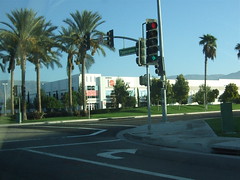
On the way to my claim in what is grandly known as the Inland Empire, I had ill timed my departure and was neatly waylaid by rush hour traffic swarming out of Los Angeles, hours of it. Looking for a bathroom I pulled off the 210 into a suburban shopping mall sporting all the usual chain stores. I picked Target and found one near the entrance.

This was the town of Upland. On our last trip we had been informed by a local, that Rancho Cuchamonga, the town next door, was the jewel of the Inland Empire. Newly spiffed out by the housing boom, this was the town that had perfected the art of upwardly mobile suburban living in brand new McMansions and all the amenities of convenience shopping. Naturally it held no appeal for me. As I fought my way out of the mall through Christmas shopping traffic, I was relieved to leave the bright lights behind for the town I had invested my hopes in. The town the boom had bypassed.

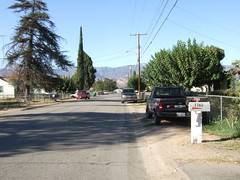
San Bernardino was known for riff raff and gang activity plus all the amenities of a poorer population—liquor stores, run down churches and paycheck cashing storefronts. As I pulled onto Waterman street, my heart rate went up for I was arriving alone after dark. All seemed calm. Turning off 9th street into my new neighborhood I was cheered by the many houses decorated with Christmas lights. I pulled up to our padlocked gate, let myself in and was further cheered by a night light our contractor had left on in the kitchen.

After locking the gate, then the iron security door, then the deadbolt, I surveyed the living room and was amused by a number of potted ferns in their black plastic nursery pots set out at the edges of the room, in the middle of which was a lone plastic patio chair and end table. Also left for me was an old space heater for the gas had not yet been turned on. I had been surprised to learn that this part of Southern California was as cold as it was 400 miles north, with every morning producing frost and a hankering for long underwear (which I had foreseen to pack.)


Pleased, I set up my plug-in kettle and a toaster oven and warmed up my all-organic TV dinner. Looking for something to do I took out a razor blade and set to scraping the latex paint off the vintage black tile of this original 1939 kitchen.

The beauty of a town that has been bypassed by the boom (apart from the original post war one that created these suburbs) is that no one has had any aspirations to improve on the existing housing stock. The draw for those who held investment property here was a rental market that could be managed on the cheap, for a population that had no where else to turn. The building boom in the neighboring towns had all but eliminated affordable rentals.

"I'm having a hard time picturing you as a landlord," said one of my colleagues used to perceiving me as a political leftist fighting to reverse development and save the planet. I, too, was adjusting to my new role as a land baron. An eco land baron for, with less than 1,000 square feet, my renters would automatically have a lighter footprint. And they would have to make do with the barest essentials in appliances, no dryer, tiny kitchens, retro one-fixture-per-room lighting and vintage décor. They would also have to endure my homemade organizational devices, experimental eco materials and a landscape that would never intentionally include a lawn. I was heady with the power of it.

Only a few of my friends understood why I might be charmed by a town of such bypassed prospects. Most ended the conversation as soon as I told them about the chain link fences or showed pictures of the houses we had bought. I tried to wow them, to no avail, with the statistic that a population of 200,000 could only support one Starbucks; that here was a town unspoiled by shopping malls and chain restaurants. I didn't get a chance to reveal how at peace I felt in it and how I had a curious desire to live there (but probably not in the searing heat of summer). Living small while protected by a grand mountain range, I felt contained and complete in this town.

The Stuff That Dreams Are Made Of

The locals however did not feel they had been bypassed, but that their time was still to come. The nearby air force base, having been decommissioned, was now designated an international airport complete with new 80 million dollar passenger terminal and signage. Everybody mentioned how the airport would make San Bernardino the new boom town. It was less than two miles from our property, but I was not worried. If you want to make a peak oil activist laugh just talk about your investment in air travel.

Said airport had yet to entice a single passenger airline despite lower landing fees. Airlines still looking for growth preferred to base themselves at the more established airport in Ontario, 25 miles away. Having also been bypassed by DHL, Federal Express and UPS, the only customers were second-string cargo planes and firefighting planes. But it did play a distinguishing role as a set for the film industry, the X-files and such.


The last time San Bernardino thrived was during the Cold War when the military bases were fully active. When the bases closed, shipping and warehousing for imported goods took up the slack. (80% of imported goods entering California come through the Inland Empire.) Already diminished by the recession, the shipping industry will likely suffer the same future as air travel as fuel costs rise. Once a fuel deprived de-globalization overcomes us, a resurgence of local manufacturing could fill the empty warehouses, contingent on existing rail transport and later perhaps sailing ships up and down the coast. There was still substantial agriculture in the area—a viable long term industry (drought permitting).

I did not bring up my analysis with local residents. Far be it for me to dash anyone's hopes, invested as they were in obsolete dreams. The recent housing boom wasn't based on industry at all, but was more a refurbishing, fueled by easy credit and the McMansion trend. Mike our contractor, described the housing development planned for downtown where several old residences had been condemned. The new development would have a man-made lake, he told me, impressed by the vision.

Of all the things to put in the dessert, I thought, but did not protest. I was lucky to have a man with extensive experience rehabbing. His Craigslist ad told of how he was retired, but loved what he did and that he needed money for his 10 year old boy who was awaiting a kidney transplant.

Also on hand to help was Mark, a friend from the Bay Area. Mark had bought, at the age of 23, his own house in a little town called Snowshoe, in Pennsylvania, where he had made a living as a handyman. Twenty years later the house had become more albatross than liberator so Mark set himself free by donating it to a local charity, driving off in his live-in van with iPhone. He arrived two days after I did.

I met Mark through my friend Dave who was my housemate at the time. Mark was in the habit of asking a new friend to cut his hair each time he was in need of a trim. I was next in line. Luckily it was very forgiving curly hair. I noted that it was a bit longer now. Looking dapper in his vintage thrift store clothing and brimmed hat, he had brought with him his iPod-driven homemade boom box and a stack of DVDs — independent films from the library that we watched on our laptops.

The Kindness of Strangers

On the first night, after a full days work, Mark persuaded me to walk down the street to find our dinner. I was dubious that we would find more than a liquor store, but we did eventually happen on a Thai restaurant in what looked like an old drive-in. The food wasn't bad; the décor improvised with travel posters and a TV tuned to the sports channel. On the wall was a flyer for a Thai real estate agent showing a house similar to one of ours for $80,000. (After what we spent to rehab our two houses we would come out a bit ahead of that.)

Despite the low budget decor of the town, I was reassured that the community was viable mostly because the people were so nice. Mark remarked on this too and we started asking ourselves if it wasn't so much that people were nice here, but that they were not so nice in the Bay Area. Perhaps the need to be a contender in the land of innovation had set the tone. Overwork and outsized expectations hung in the air; everyone needed to be a star to compete. In San Bernardino, just getting through the day was enough. Ordinariness seemed to foster kindness.

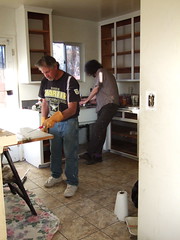
We spent much of the week on the project scraping away the sins of previous tenants—packing tape residue on the walls, countless nail holes, slopped on latex paint that melted when scrubbed, grease covered dust webs. Not to mention the negligence and outright incompetence of the previous owner. Apart from ignoring virtually all maintenance, his contribution as a tile layer was soon found out. The tile in the shower was so skimpily adhered, it only took 40 minutes to pull it off. And water was seeping so far under the windowsill in this shower it was wearing a hole through the wall.

We heard more about him from a passing neighbor who told Mark that the owner would come to the property stinking drunk and yell at his tenants. "At least you should pretend you're not drunk," the neighbor concluded. This amused Mark and me greatly—that allowances could be made if you at least pretended you weren't behaving badly.


No wonder the neighbors were smiling at us. We were bringing a hope of decency. The houses had been on the market for over a year. Just to have someone buy the property was a vote of confidence that the neighborhood was worth the effort and things were turning around.

Back To The Future

I hoped so, too, since we had to eventually pay for the work being done here, but the draw for me was more personal. In part nostalgia—an attempt to roll back time to a sensibility when lifestyles still seemed reasonable. According to US census data, the average house size in 1982 was 1,520 square feet. In 2002 it was 2,114 square feet. Human need did not grow larger houses; the conceptualizing of the family home as an investment vehicle did. And then, of course, increasing amounts of stuff made it seem necessary. All that turned out to be the downfall of more than just our economy. People's lives and communities changed too.

A neighborhood of small houses was manageable. I could see that neighbors looked out for each other. The kid next door thanked me for throwing his Frisbee back over the wall then stayed to chat. His playmate lived across the street. At 12, sitting atop the wall between us, he was master of his domain.

A complaint of one of my clients was that she had to drive her kids to their playmates; they were stranded otherwise. I also heard of a manager who described his new hires as suffering from a lifetime of scheduled playdates. Though bright, they lacked the ability to organize their teams to get things done. Isolated like this, kids had been deprived of the opportunity to manage their own lives and work out their own problems. Ah the irony of wealth.

In a community where home sizes were frozen at 1950 averages (983 sq. ft), I had a chance to envision a different future without having to undo the bloated built environment of a lifestyle seriously out of wack with what resources we had left. I wanted these small houses to be nice so the tenants would be happy living there and wouldn't associate small with grungy, broken down and poor. Rather they would be efficient, cozy and organized, easy to keep clean and with less space for junk to accumulate. Plus each yard had enough land for a substantial kitchen garden—a component of sustainable living. Working on these houses felt real for rather than creating a fantasy life to guide my pursuits, my play was now affecting a real environment, a real future.


On the last day, as I was packed ready to leave and the roof was being torn off on the front house, a young couple came by asking Mike if the houses were for rent. Word had got out. They told him the going rate for what they had looked at already. It was a couple hundred more than what we were asking. That was great news. We were keeping the rent at what it had been (which was probably all the previous owner could get for his wretchedness). With property values slipping so badly we had thought we would have to drop even that rent. Now we could feel good about cleaning up the place and still being under market. I was beginning to enjoy this future.

Labels: ,

Saturday, November 14, 2009

Land Ho!

Informed by the flip flopped perspective of Asia, I see a new purpose and direction as I re-asses the changed landscape at home following the economic meltdown in the wake of the housing bubble.

Meltdown Case Study

A client called me to refer me to a woman who desperately needed my help. We went to see her together since she was working with the lady through the social services agency where she was a volunteer. We found the door ajar, knocked and waited a good15 minutes. When she finally did come to the door she was gracious and willing, invited us in and introduced us to her bedridden husband in the back bedroom, then seated us in the living room to tell her story.

"We used to be millionaires, but now we're negative $1500," she didn't mind telling me. Her husband had made those millions investing in real estate. Now she was mad at him because he made one deal too many with no safety margins to protect what they needed to live on and, of course, their stocks were down too. And then he had hip surgery that went awry and when her son lost his job at Circuit City, said son decided it was a sign from God to give him the time to save his father. He moved into their two-bedroom condo to look after him then proceeded to order his mother to do his bidding. He was able to claim this role because he was liquidating his 401K to keep them afloat.

Since he had made himself scarce for this appointment with me, I knew there was little chance that he would agree to hire me to help his mother organize the many boxes in the shower that had to be put somewhere when he insisted that they close out one of their storage units.

Getting organized was not this family's biggest problem, I realized. They needed family therapy.

"Everyone just needs to be kinder to each other," I commented sympathetically. She nodded, grateful that I understood the situation.

I was seeing America's real estate meltdown, up close and personal, for this was just one example of many such stories of lost wealth, only instead of being on paper, as in the last boom/bust, now the losses were striking closer to home, at the home itself. For the home was the last asset to be played.

Inspired by the belief that housing prices could only go up, husbands had made deals that had taken them beyond a threshold normally considered safe. And just as with other bubbles, investors were refusing to call it quits because they had lost so much already and were blind to the new reality. Pride turned into bad judgment and humiliation turned into abuse of those closest to them. Wives, in turn, were mad at their husbands for not telling them they had hocked the house. Like Napoleon, refusing to retreat, these investors would play out this loosing battle until they ran out of resources.

My prospective client had been informed by social services that she had the option of putting her husband in a public subsidized nursing home, should caring for him become too much for her, but the state would take away all their assets leaving her with a $600 a month social security check to live on. Did she have any relatives who would take her in?

In this genteel lady's eyes, asking for such help was unthinkable. She had for so long been the generous one. She told us of her struggle to keep her faith and her love for her husband, rather than toss him to the state. All I could tell her was that if she felt that my help would insure her sanity, she would have to prevail upon her son to let her hire me.

When it was way past time to go, I let her give me a big hug for coming by. Then she pressed a handful of candy in my hands from a dish by the door. I knew I would never see her again unless I too became a volunteer.


Taking Stock

Transitions are all about changing one's roles, relationships, routines and assumptions I was to learn, the following week, at a talk given by a dynamic woman old enough to have seen a few. I was already looking at changing mine. My business-networking group booked speakers who were telling us to market harder, that the best would survive. I found this to be as useful as the report from Wall Street that the nation was experiencing a jobless recovery. I was not going to beat a dead horse with more marketing. If there were too few jobs for organizers maybe it was time to do something else. But it was also time to assess my own assumptions.

When I returned from my three-week trip to Asia my perspective sat on shifting ground. My last project had been to build a small boat, chiefly for recreational purposes, but also because I felt it might be a useful skill to have. When food shortages made fishing useful, a boat would be sought after, not to mention when the sea level rose. As a dedicated doomster, this was in keeping with doomster culture thinking. But after traveling, for three weeks by plane in the undeniable reality of Asia's urban pursuit of development, ten years after it's own economic collapse, this guiding principle of preparing for the end of the world as we know it seemed a trifle silly or at least ahead of itself.

Asia had experienced a temporary halting after their economic disaster and I was gratified to see proof of this on the outskirts of the city. Blocks upon blocks of empty condos stretched down what was supposed to have been a busy downtown center never realized. Not even the homeless wanted to squat in them without electricity to power air conditioners. Oddly enough, across the street, businesses continued, shop fronts were occupied and customers were going in and out. The end of the world had not managed to reach across the street. In the rest of the city things had definitely moved on.

There was no such thing as "the end of the world as we know it," I concluded. That implied an event forcing change that everyone agreed upon, much as we would respond (or not respond) to a hurricane. We could not even recognize the changes already upon us, so who exactly was going to name "the end of the world as we know it," in order to respond to it appropriately? We were still playing by the old rules.

The End of the World Postponed

I decided to abandon my preparations for the end of the world as inspired by thoughts of eco apocalypse. This left me somewhat at sea as to where to focus my life, and I was sifting through suggestions waiting for one to stick. My only requirement was that it would involve the help of others and would connect me to community. Even better, if it was a paying gig.

I considered writing another book—tales from the life of an organizer. I would try out the idea at my next conference with my organizing colleagues. I loved conferences—the extended family atmosphere of all of us living together in a hotel, eating every meal together discussing our adventures of that year and new ventures for the next.

Two weeks before conference an old friend from high school posted, to her Facebook wall, a real estate listing for a property in San Bernadino. Anne and her lover had left their careers as university professors and remade themselves into investment property gurus two years ago. Investment property, unlike the internet stocks I had lost my shirt on 8 years ago, still had brick and board value even after a bubble. San Bernardino was within driving distance of my conference hotel. Why not have a look?

The two met me at the airport. I had not seen Anne in 21 years; we had, in our college years, had quite an intense correspondence by mail, picked up again last year when she Googled me. It was enough of a history that I could trust her to help me with something I knew nothing about and didn't want to fathom i.e.: the bureaucratic legalese of owning property. I asked them how they had come to wrap their minds around the responsibilities involved. They told me of classes offered. Then Susan plunged in, set it up.

"It's not something you should over think," Anne said finally. This was comforting coming from Anne, an inveterate over thinker last I knew her.

Falling In Love Again


And thus I found myself in a not unfamiliar California town outside of LA looking at two houses on a lot with a mountain range behind it that made me feel a modicum of certainty I hadn't felt in a long time. I was sizing up the landscape the way I used to size up a potential lover. A minimum of criteria fulfilled, a pleasing arrangement of features, some homely aspects that hijacked outright beauty but introduced quirky interest and a stimulating element of risk and danger that would make the journey interesting and transformative.

And she was available; made available to me by a very low price ($100,000) and a line of credit, not mine, but Catherine's. Catherine, who thinks of these things, while I just try to get by day to day. She had long wanted us to strengthen our relationship by staking out an income producing future. She had taken out the line of credit because it seemed like a good idea in uncertain times. I had ignored the move. To me, borrowing money was not a viable solution; being debt free with savings was the way to go. Luckily we had been improving our communication skills with an intelligent therapist so could broach the topic without fear. When Catherine saw how interested I was in this property as a rental, she offered to help me. Borrowing to buy something that produced income did make sense to me.

I had experience with fixing up property and had managed property, of a similar low-income nature, for a client. Catherine was tenacious at follow through and had an appetite for financial strategy. It was the right time. And we would be smart about it, think things through, play to our strengths. She trusted my judgment. She was willing to put her money down just on my assessment alone. It would be my baby.

I had first been attracted to the property because of the two houses on a large lot, much like a compound in Thailand. And the houses were small with two bedrooms, not the super-sized, cathedral ceilinged houses, of the last decade that would soon prove an energy sucking liability. And though the location seemed quite rural, it had the one enviable municipal service in a suburb—a rail system. You could get to downtown LA in 90 minutes, 60 minutes to outlying industry.

We got out at a quiet street lined with cyclone fencing. The agent, in her high heels and black Lexus, was already there to meet us . Stepping over the threshold into the first house on the property, I stooped to touch the new ceramic tile floor, surprised that it was not vinyl. Otherwise, the stucco house was much the same as when it was built in 1939. It was, in fact, exactly the same vintage as one I had lived in with friends 20 years ago, where I had, in fact, last seen Anne. But I was not thinking about those years now. I was struck by how shabby the house was. It had been a long time since I had lived in a rental.

"Do people really like this," I asked Anne. "I mean I like it, but do other people?" Yeah they did, enough to want to live in it.


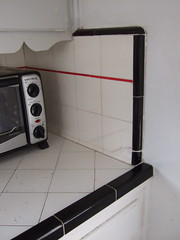
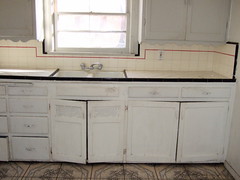
The small kitchen had the same tile on the counter as the one I had lived in only with cream tiles and a black border plus a thin line of red across the back. It was, I would later find out, a classic American Bungalow kitchen.

The second house had a kitchen with the metal edged Formica counters of the 40s. The wood cabinets would need painting. There was a drawer missing. This house, too, had a floor newly tiled, but otherwise no other improvements thus none of the improvements I had grown to despise. No garbage disposals to break down when it wasn't robbing the compost heap. No recessed lighting to vent heated air wastefully into the attic while swallowing up half the light of the bulb. No laminated particle board cabinets with overbuilt European hinges. No dishwasher. In fact no appliances at all, for they had gone missing along with the outdoor light fixtures.

It was, I could see, from the iron security gates on the doors, a moderately high crime area. That was the dangerous part though I did not see any young men cruising by in low riders that I had come to expect while driving through low rent areas in the Bay Area. There was no one on the street at all, just parked vans and pick-up trucks in better condition than the housing—a classic working class California neighborhood. The cyclone fencing was the homely part. The burned out lawn, awaiting my transformation to something more sustainable. Behind the town, the natural beauty of those majestic mountains crisp against a blue sky. That they would always be there comforted me.


I asked the questions Catherine had me write down. Were there any major repairs to be done such as a roof in need of replacement? Nope. Updated electrical? Check. Plumbing? Adequate. Industrial pollution. No. Was there graffiti? Well, only if you counted what was expertly riffed on the cement wall inside the garage. An ad hoc practice studio for a young gang member perhaps.

Was it likely that the property would be rented again? Yes.

It was something of a no brainer. We could improve it without even trying. The last time it had been sold it had been for nearly four times the price. Each house had more land than we had at our own house. The area had once been farmland. I told the agent to write it up. By evening I would be in love with my quirky, homely, beauty, eager to begin her transformation.

Labels: ,

Friday, January 30, 2009

Frugal is the New Black

I was disoriented by this new year. Something fundamental had changed, but it wasn't that we were bidding good-bye to an egregious regime and welcoming a nicer one to replace it; the new one would still answer to the same corporate captains of industry. All the dialogue was now about the economy and how to flog the consumer beast into pulling it back on track. But rather than taking a look at what the consumer might need, our leaders just added more debt burden to the corporate cart. And what with the job losses and homelessness, the consumer beast was on its knees showing its ribs. It made me want to call the humane society.

Slowly it came to me. I realized what it was when the number of home baked goods outnumbered the other Christmas doodads that were being given at Catherine's office. Whereas, before, people felt cheap about making gifts at home, now these do-it-yourselfers were cool. They possessed a skill that allowed them to transcend the money economy. Frugal was in. After 25 years I was back in style.


At my book party in November, in the course of telling the story of the long journey of bringing my book to publication, I showed off my homemade cereal box-book mailer that I had designed because bubble wrap is not recyclable and doesn't protect a book nearly as well. As I pointed out the aerodynamic design wedge that would push through a field of packages like a cowcatcher, my audience offered a murmur of appreciation both for the elegance of the design and the eco-frugality of it. I felt I had satisfied an underlying collective desire for a different sensibility. One that did not waste so much. One that evoked our creativity in useful ways apart from buying something.

My book mailer was an origami of reuse and craftsmanship. I noted that my audience was largely an older crowd, raised on thrifty standards of another time. Those who had laughed at my trash inspired ways had been younger, upwardly mobile, gadget intense consumers. Now they stumbled towards frugality. Cooking utensils, shoe repair, car repair. All were enjoying increased business.

In the baroque era of consumerism, houses were made disposable by the end result of the credit boom. These too big plywood palaces with their cathedral ceilings and theatrical lighting were made suddenly obsolete once people could no longer afford to live in them. Who would have thought that something so large and so expensive and so brand new would cease to serve its purpose? Developers started questioning their visions. Maybe we should build smaller they all seemed to realize at once.

Big visions have never been my forte. When the sky is the limit I want to go home to a one-room cabin. To ward off all the bigness I collected books on tiny houses. There is only one book on the subject thus a tiny collection expanded later with a book on houseboats, one on trailers, another on rustic shelters and one on teaching children to build houses. These I would browse periodically before going to bed.

A Journey of Questions

This new year brought another new feeling for me too, of having come to the end of a long string of questions. I'd spent so many years in hot pursuit of answers that I was suddenly at a standstill looking around wondering where I was headed or had I, in fact, arrived?

"You're like a snake that has been digesting a rat," said Catherine. Yes I was enjoying the satisfaction of a meal well digested. I hadn't known it was going to be such a big meal because I had started with the tail so I thought it was just a passing snack.

It began aptly enough at a restaurant. I was blowing out the birthday candle on my desert and afterwards the waiter asked me what I had wished for. "World peace," I said aping a Miss America earnestness. After wishing for world peace every birthday for several years running, I began to wonder what exactly it would take to achieve peace. Was it just that humans would always use violence against its own kind? If it was a question of human psychology then all we would need to do would be to have a giant consciousness raising to change our minds about choosing war as the default problem solver, but most people I knew were not warlike. If war was the default solution, what was the default problem?

I followed Frances Moore Lappé on her search, in "Diet For A Small Planet", to discover if it was possible to feed all the people on the earth. Because if everyone had enough to eat, then shear numbers alone wasn't the problem. Yes, she said, easily. In her second book, "Food First", she concluded that people had forgotten how to feed themselves because of colonialism, which had laid the groundwork for exploitation of peasant farmers, which was followed by a globalized market system that put the price of food out of reach for those not enrolled in a money earning situation.

Thus my first revelation; the growing of food was not intended to feed people at all. It was intended to make money by feeding grain (a low price commodity) to cattle, thus transforming it into a high price product. The same was true of a box of cereal—grain transformed through a bit of processing, but mostly packaging and marketing, into a seriously pricey product. This meant that poverty was systemic, but peasant farmers didn't mobilize to wage war. When the price of the commodity they grew went even lower due to cheaper product being grown elsewhere flooding the market, they just went to the city to find work and live in slums, while moneyed interest bought up their land. I adjusted my menu to eat lower on the food chain.

I was prompted to ask how a supposedly democratic system like capitalism was allowed to starve such a large number of people? And why did the socialist system, a supposedly people prioritized one also fail to feed its people? I was led to E.F. Schumacher's book "Small is Beautiful: Economics As If People Mattered", a Buddhist approach to economics. Large systems would inherently serve only those at the top who were too far away to see or rectify their mistakes and too stubborn in their ideology to admit it. This led me to the concept of appropriate technology and the search for small, adaptable, locally based systems, which led to my own personal pursuit of various homesteading skills.

As I researched appropriate technology, I questioned why we had to flush our waste (food for other life forms) down a toilet with perfectly good drinking water, which led me to read The Humanure Handbook to learn the history of human waste disposal and the benefits of making my own composting toilet system. I also took a workshop on how to create on site wastewater treatment systems. And thus I understood that centralized public utilities had been created for the public good, but at a cost to the ecosystem in water consumed and nutrients removed from the soil.

And while these systems provided convenience to the masses they were also a large source of income for the few. These few who had much to gain from centralized systems, I realized, were empire builders ie: Romans and aqueducts, Victorians and indoor plumbing—Queen Victoria ruling over the British Empire.

The Persian Gulf War prompted me to see that wars must be fought because empires need resources—oil, the quintessential resource of our time. The history of oil was even more illuminating than the history of agriculture, filling in many missing pieces. Oil wealth allowed a few Texans to buy political power on the state level, then on the national level. They taught the Arabs to do the same, established a cartel with them and voila international power. The cartel toppled the other oil rich mega power, the USSR, leaving the world with only one power headed for consumption of the world.


Empires rarely go backwards. There is no "we have enough power now thank-you"; there was only the pursuit of ever more of everything as if human potential could only be reached by consumption of large amounts of resources to display the grandness of our civilization—leave an eighth wonder of the world, some good ruins for future archeologists to marvel at. Such pursuits were financed by loans. Credit is the power tool of empire building. Credit made bankers happy because once a credit based money system had been established the money loaned was usually put back into a bank and could then be loaned out to more borrowers thus creating money out of thin air. This I found illustrated in a comic book you can order for free from the Federal Reserve.

The loans lined the pockets of bankers with interest money. Thus that which created loans was good for business and was to be encouraged. War was very good for business. In World War I, for instance, a single banking family had financed both sides of the conflict. The strategy became a common practice used to escalate war to prolong the flow of war profiteering. After all, if only one side was financed the other would quickly surrender for lack of funds. Thus is made clear the sin of usury.

The Fall

A credit based money system is a pyramid scheme that relies on growth and more resources being extracted to pay back loans. Loans increased the need to compete for resources. Inevitably resources run out.

Empires like Rome, it seemed, must fall. Collapse happens because top-heavy economies run out of resources. Top-heavy societies grow first on a surplus of food—the Mayans and their corn. A surplus of food allows parts of society to do other things besides grow food. Explore the glory of mankind for instance. Empire was an inverted pyramid balanced on the head of a farmer. Modern farming was now run on a single resource—oil.

Oil for tractors, pesticides and fertilizers, followed by transportation of food products. Two paths of my study, food and energy, had merged into a six-lane highway headed for collapse. Thus I had to ask what would it take to learn to be sustainable? Or was sustainable thinking impossible once empire was set into motion? After all to be sustainable ultimately meant not leaving any trace of yourself. Even collapse scholars were obsessed with saving human knowledge.

Humans obsessed with reaching the full potential of their glory, would likely see every step of expansion as progress until it was too late. Once the collapse becomes obvious empire wants to solve the problem with more expansion, better technology, bigger heads on Easter Island. All theoretically possible; it's the transition to the new technology that will do us in. To paraphrase Einstein, we cannot simultaneously grow while at the same time attempt to solve our growth problem. Defaulting on those loan contracts spells collapse for our economic system. We are forced by our own human created paradigm to continue. At least those of us invested in empire building, in big visions.

Small Is The New Big

Some of us have no such contracts. Some of us have been studying the art of becoming small. Some around me (but not me) even want to disappear taking their selves into the void of a Buddhist no self. As I concluded my journey in search of peace I found a comforting precedent explained in Michael Meade's book "The World Behind The World: Living At The End of Time". When the big vision fails, he pointed out, it is the folk tale, the stories of peasants that show the way to survival. These are the human stories of intuition, egalitarianism and collaboration to save the village. Every culture he pointed out has a Noah's ark tale when what's left of the world is put on a boat to avoid a flood that threatens to drown it. Boat? Houseboat? This too I had studied.

When the grand stories of civilization and empire are bankrupt, so to speak, we who are small, debt free and happy with what we have will prevail. My disorientation, following on the contentment of a meal well digested, had righted itself into the realization that my time had come. The understanding that came from this digestion was now fueling a tremendous surge of creativity. I could now prepare in earnest my ark. I had landed a contract to outfit four closets with shelves cut from discarded doors. I would create a new business niche in building from trash. In the face of dire economic news, I had never felt more optimistic.


Also posted at the energy bulletin

Labels: , , ,

Earthworm. Get yours at bighugelabs.com