Amanda Kovattana

Middle-aged musings in interesting times

Wednesday, October 16, 2013

Climbing To New Heights

In which I fulfill the role of conference chair for the Institute for Challenging Disorganization, pulling off an event more successful than my wildest expectations.


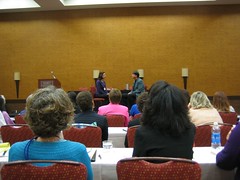
The conference chair's job is assumed to be over once the speakers are booked and all the arrangements made with the hotel to facilitate the smooth running of the program, but to me arriving in Denver two days before I was to appear at the podium for this annual conference of the Institute For Challenging Disorganization, I felt my job was only just beginning.

At the networking mixer the night before the program was to start, a handful of long time subscribers and board members thanked me for the quality of speakers that I had put together for the conference. They had come to this conclusion based on the write-ups and the bios of the speakers in the program. Our theme Climbing To New Heights inspired by our Denver location, had also helped. Their acknowledgement allowed me a measure of breathing space and I could relax a little. Later I would wonder what combination of luck or skill had helped me put together such a program.  

What for instance had allowed me to pick the speakers for programming with such confidence? "Beginner's luck," I had said to the board president when she first saw the line-up several months ago. 

It helped that I had no reputation to uphold so I did not feel I had something to prove. The board had already placed their confidence in me by asking me to take on this role. I could proceed with some calm based on my experience as program chair for my chapter meetings. I had made so many mistakes in my two year stint, I at least knew what didn't work. My predecessor Marci Katz had taught me how to approach and negotiate with potential speakers during my two years on the ICD conference committee. She left me a few leads and a sample of a letter to write to prospective speakers. Then she retired from the committee leaving me to it. 


It's lucky that I like to read, I thought. In the last decade I had read enough to answer most of my questions about how the world works in the political, sociological, psychological and spiritual arenas as well as in the practical realm of carpentry, plumbing and gardening. I liked ideas prompted by bio-mimicry and ecological systems. I liked how social science could be reframed with new theories and discoveries. I enjoyed new studies about how the brain worked and theories about how it could be retrained. I had also read enough inspirational material and entrepreneurial fluff to distinguish between an original thought and one borrowed and dumbed down to fit a particular marketing approach. 

For the conference I had gone in search of authors who had the educational background or personal experience to develop enough original thinking to fill a a book on a subject that might interest my colleagues. Which meant that I had to know my colleagues in the context of ICD. And having attended every conference since it's inception I felt that I did. It was the brain trust of the organizing profession as one colleague put it. Given all our past conferences and our monthly tele classes, we were well versed in the basics of hoarding research, ADHD, depression, bipolar disorder, brain damage and the practical impact of a slew of other diagnosis on people's ability to function. At our conferences we moved as one hearing all the same speakers and discussing them at the breaks together. We also did not live on theory alone; we wanted practical applications for the knowledge being given.


The Speakers


Speaker suggestions had come in from subscribers and committee members, but many of these speakers were too famous to afford or so popular they were already booked out. Many were also cribbed from other conferences and so had a professional veracity to them rooted in traditional therapy that were certain to be acceptable, but I found them less than fresh. 

From these suggestions, I picked two I thought were different in their focus. One was Lee Shuer who gave his presentation from a recovering hoarder's perspective and introduced the fairly new development of peer responders stepping up to help their fellow hoarders take the first step to recovery. I saw him speak at the Hoarder's conference put on by the San Francisco Mental Health Association. (My colleague Kim, sitting next to me prompted me to go after him.) There was also Dr. Suzanne Chabaud who was a clinical therapist focused on hoarding and lately on the impact of hoarding parents on children. She was eager to connect with organizers. Therapists so rarely acknowledged the role of professional organizers that I was intrigued. She had also appeared on 29 TV hoarding shows although that was not a venue that readily impressed us.

To fulfill CEU credits for our new certificate on aging, the committee agreed that we needed to find a speaker on dementia. It so happened that the San Francisco chapter had had a panel on aging at our own regional conference. I had not seen it so I asked the colleague who had moderated the panel, to recommend someone. Diane Judd and I had worked together on a conference once before. She also happened to be a dedicated ICD subscriber and was eager to bring us Laurie White, an expert on dementia, elevating her from panelist to presenter. Diane even invited her to lunch in her own home along with me and two other colleagues to make sure Laurie got to know our full professional scope. This made me feel lucky indeed and immensely supported by my own chapter members. 

The board also cut me some slack by agreeing with Kate, my board liaison, that it would be a good idea to have an Ask The Organizer panel so we could put our own people up on the podium to provide the increasing number of newcomers with opinions of veteran organizers. They also agreed to us having a gig we tried before at conference several years ago which was to have one of our own people moderate a case studies discussion. This had been the brainchild of my long time friend Denslow Brown so I was happy to facilitate a revived session with additional twists she wanted to add in.

For my own picks, I was inclined to take risks with material I found provocative. And so I had chosen three who pushed the envelope for me. One was Dr. Thomas Armstrong. His refreshing perspective on ADHD from the perspective of neurodiversity rather than the medical model of a disease to be treated captured my attention. I put him as our first presenter. He turned out to be a dynamic and practiced speaker who was quite funny about stepping outside of the mental illness model in a way that completely tickled my anti-authoritarian, anti-psychotherapy view of the world. In addition he also engaged us in exercises that would test for some of the nine intelligences he offered as part of the neurodiversity package. 

"Pick a partner," he said. "Now decide who will be A and who will be B".
 "I'll be B," I said to Kate sitting next to me. "You be A."
"Okay," she said.
"You're done," said Dr. Armstrong and we laughed having expected more to it. Then he pointed out the people skills needed to settle such a negotiation. Kate and I congratulated ourselves on the efficiency of our exchange. 

I easily failed the math intelligence, but there were others I had never seen listed as intelligences before and those included knowing oneself and the desire to find answers to existential questions—the big Meaning of Life questions. I instantly felt a great deal smarter having spent so much time on both. Plus he had mentioned shamans twice and shown a picture of an indigenous shaman as part of his point about how other civilizations worked with the messages of aberrant behavior and non ordinary psychic phenomena.

"One day I will bring shamanism to an ICD conference," I had said to Lenore, my shamanic counselor. 

"You already have," she said and I realized she meant me.

Another speaker choice from California had created a company in Marin County to give workshops on eliminating stress. His approach was just the right mix of science and a slight mystical component. I read his book Mystic Cool just to make sure. His graphics were clear and beautiful and we could all remember his point that you have 90 seconds to extinguish thoughts and judgements that might escalate your brain to full fledged fear. Fear being the heart of a disorganized brain, he said. To distract ourselves from the fear response of the reptile brain, he taught us to press a finger into the palm of the opposite hand, imagine it connecting to our heart, take a breath, then count to 3 and visualize the numbers in colors—red for 1, blue for 2 and green for 3. This he called the clear button.

And finally there was the highly animated and attractive professor of film I had so looked forward to meeting. I had inherited Melinda from my predecessor Marci based on the recommendation of another artist who had done a presentation on art and hoarding at a previous conference. Melinda lived in Boulder which was flooding just as we were coming up to the week of conference thus adding the suspense of natural disaster impeding her arrival. But arrive she did by bus less than two hours before she was to speak elegantly dressed in a shimmering vintage cocktail dress. The conference committee had been split about whether to invite her; the ones opposed felt her topic was too far removed from any practical application or knowledge. We would not however have to pay hotel or transportation costs to have her so I went ahead and booked her. She in turn tailored her talk on women collectors to the specifics that I emphasized would be helpful for us. Mainly how do collectors give up parts of their collection? She added her own. Could squalor be elevated to an art form?

Women she said tend to collect treasures that have stories attached to them. And given that women had not been able to legally own anything until quite recently, her point that women collected objects that reflect back to them their own identity made quite a lot of sense. She also mentioned the concept of having the right to gaze at an object; this right having been chiefly granted to men. Thus collections allowed women the right to gaze. As for the relinquishing of possessions this was akin to experiencing loss or death in some way. Thus death had to become part of collecting perhaps in a symbolic ritualistic way. For to live was to be willing to let go of something, to die over and over again. 

This admittedly was a little precious for some, but it did evoke the heavy emotional burden that many of our hoarding clients carried about their possessions. And her slides had numerous photos of famous hoards, pithy quotations and film references; it gave people a lot of entry points. And I made a friend. Melinda took one look at my white cowboy hat, lime green vest, purple pants and cowboy boots and decided that I too was a sympatico soul seeking to collect an identity that stretched into the realm of artistic expression.

The Outfit

I loved the limelight, but public speaking still terrified me. Given all the hardworking and highly credentialed colleagues who came to these conferences, I did not have a high enough opinion of myself to stand at the podium in "business attire" as it is worded and speak to our organization as a peer. I didn't' really get me in a business context. I had spoken to this group before at a previous conference as part of a panel and they had found me funny. I never knew quite why. I was just being myself. It was the same with my chapter meetings. Some combination of my English accent, my use of language and perhaps a certain racial and gender bending essence had created an unexpected personality. (One that warmed up with the attention of an audience especially an audience that was predominantly women). But it was not professional in the traditional sense. 

For what I was attempting to do as conference chair, I needed a role to play, part emcee, part ringmaster, part wrangler. A character who would hold the group together in celebration as they experienced the most important event of the organization. In short I wanted everyone to have a terrifically good time. And having a good time was one of the last remaining things a live event can offer in this day of online webinars, tele classes and copious free information, not to mention recordings of the conference onto CDs which could be listened to while driving and didn't require the expense of airfare and hotel fees.

We had recently changed the name of the organization and got a new logo so it had become popular to wear the ICD logo colors of purple orange and green. Many evenings I drew with the colors various designs for a vest. Eventually I decided to simplify it to a green vest with orange piping which would be a good way to play down the most difficult color—orange. When I found purple jeans on sale in the Macy's boys' department I knew it was confirmation for my design. To dress up the vest I searched for textured fabric and learned from a book, on decorative vests, that I could create texture with ribbons woven into a fabric. I had found ribbon to match the logo green. It took longer to track down the right width and buy up all that was available—five spools of ribbon—than it took to weave them. The orange covered buttons was the final touch. I also needed a light weight shirt to wear under it since it would likely be warm. I had a pair of cool-to-the-touch, silky, white farmers pants from Thailand wide enough to cut up and sew into a pirate style shirt so I did that.

And since Colorado was the heart of cowboy country I longed to bring my two toned Tony Lama boots. Which naturally meant a hat which I happened to find a week before conference. But I could not fully embrace this iconoclastic Cowboy symbol until I had brought in a Native American piece to it as well (to reclaim the damage done by the Cowboys). That I did with the two braids in my hair that I had been wearing of late and my hair pipe choker I had made as a teenager. These Native American touches also evoked the intuitive shamanic work I had been doing with my spirit guides. I had brought my shamanic rattle for the purpose  of calling them in to help me. (It was given to me by a friend who got it at a climate change event in the Brazilian Amazon.) All this brought up that crazy making topic of cultural appropriation of minority symbols. Was it exploitive? 

While in Denver I visited the Denver Art Museum with my pals and stayed longer so I could see the Native American collection which occupied an entire floor. I took in the "spirit shirts" of painted and beaded fringed buckskin and read the description of how Native Americans used clothing and artistic expression to draw power for ceremony or hunting events. I too was creating a spirit outfit to help me step into my full power. I also saw the military jackets from Victorian era uniforms that had been given as gifts; the recipients had incorporated into these samples of the white man's power clothing, their own decoration. This cross pollination gave me a more fluid definition of cultural exchange. I was borrowing two elements from American cultural symbology to help me make a business event my own even though none of it was part of my own heritage. It was pushing the envelope, but I was willing to risk claiming it. 

I did however get the skin test for explosive residue as I traveled through SFO with my white cowboy hat. An Asian cowgirl carrying a backpacker's soft sided luggage on a vintage luggage cart was just way too suspicious.

From The Podium

I memorized my opening remarks wondering if any of it would be funny. Just before I left my room, I thought of something absurd to say. I went on stage, I introduced myself and showed off my outfit. It was cautiously admired (but simultaneously complements were tweeted). I told them it took me 7 weeks to design it because all the details of conference had been so well worked out that all that was left for me to do was to guild the lily. This was not a common enough phrase to be funny, but the character that I continued to bring out at the podium was indeed something of a ring master. The language of hyperbole fell from my lips. 

"It is my great pleasure to stand before this august body of intellectual and intuitive boldness," I said seeing in their faces the sense that I was trying to woo them. "You inspire me," I declared. Did they believe me? No I was clearly trying to flatter them. "This shirt used to be a pair of pants," I pointed out holding up an arm. The room burst into laughter. Yes that was an unexpected juxtaposition. The fun could begin. The rest of the conference was a matter of getting people on stage to introduce the speakers. I was merely the tour guide. But there was a piece of the action I could still claim. It was left to me to thank each speaker after each presentation and I was able to insert just a few words of summation into that space that took paying attention to what was their overall message. Most were simple enough to sum up, but there was one that defied definition.

"Thank-you Dr. Barlow for that fascinating intersection of stuff, art and death," I said widening my eyes as I tried to think of something more explanatory, but I was stumped and that got a laugh. Then I was free to do schtick. 

"This is your captain speaking. We have now gained a little time in our journey and as a result are ahead of schedule, but please come back in ten minutes anyway."

By the second day, still wearing the same outfit, I had nothing new to show off so I decided I must sing. This was bold of me considering that music was not one of my intelligences. But I had the microphone, hummed a note, looked at my buddies in the front row and sang that rousing little ditty from Singing In The Rain appropriate to the 8:30 am hour as people took their time coming in. 

"Good morning, Good mo-o-or-n-ing. We're so glad to have you back. Good morning, Good morning to you…." "Now you know why I don't do musical comedy," I quipped, but they seemed to appreciate it. 

The first speaker Dr. Chabaud brought with her a guest, a poised younger woman who turned out to be of equal interest being an adult child of hoarding parents, but she wasn't scheduled to speak. Marci came up to me at the break and suggested I try to fit her in any way. This is the sort of in-the-moment challenge that gets thrown into the lap of the designated driver. So I figured out the logistics with the help of Jim who headed our management company and announced that we would have her speak during the lunch hour and answer questions that had come up with her introduction. We were having a box lunch so it worked out perfectly.

Coming into the home stretch we had to make a room change just before closing. These logistics took up so much of my bandwidth I could hardly think in the case studies session, but I was so in the groove by then that nearly everything I said was funny. I did get my closing remarks in and thanked everyone I could think of (remembering late that night that I had forgotten to thank the 40 or so volunteers who were running around taking photographs and handing off microphones). But finally I could hand off the role of program chair to the next year's person along with the hat which looked great on her and would be just as fitting in Nashville, our next conference city. 

"And whatever you do don't say what a hard act to follow," I had told her beforehand (because that's what everyone says when I do schtick with a costume). She nodded saying "We'll just go with the positive, then". "Yes" I said. We were after all members of the same team.

And when it was her turn at the podium she simply said "Didn't she do a great job" as I hopped off the stage. When I looked up again everyone was standing up applauding. They were giving me a standing ovation! I was so dumbstruck my jaw dropped open. (This was one of those finishes that you just want to live over and over until you figure out why it worked.) The new chair turned on a music video she put together to drum up interest for Nashville; Jim came to the front of the stage in his orange polo shirt and did the wave to the music getting everyone to join in. It was indeed a celebratory finish.

When I got home I drove around for a week in silence, laughing at my own jokes and hearing in my head bits and pieces of things speakers had said. I had stepped into my power. Where do I go from here? I wondered.

Labels: , , , , , , , , , , ,

Tuesday, June 21, 2011

Lost In San Bernardino

Over the weekend of May 21st, the date given for those who were to be raptured up to heaven, it was confirmed that one of my tenants had gone missing.

"I'm going in," Mike my manager in the front house told me after noting that there had been no activity in the back house for several days. Mike feared the worse; he'd known that our tenant was seriously depressed. Mike had checked on him recently, woken him up late one morning. Tenant came to the door rumpled, then started crying about something. So Mike took him out to breakfast, talked to him, but he remained in a funk.

My tenant impersonated Elvis. He sent me songs he'd recorded in his bedroom and called me every month to tell me when his check was coming. Told me how grateful he was that I had rented to him. Then a check bounced. His disability check had been stopped without him knowing it. He got it started again, but he was behind and short on cash two weeks into the next month.

I had rented to him because he was gainfully employed, but the long haul trucking job was hard on his back and when he got disability for a year, he took it as his chance to build up his act, doing gigs for a nightclub and parties here and there. He was in New York for a while visiting family and doing his act, which was why he missed his doctor's appointment, which was why they stopped the disability checks with no warning. Last I heard, he told me he was selling his motorbike and would send me the rent when he got the money for it.

His son, recently graduated from high school, lived with him. Soon a friend of his son's was sleeping on the couch. The two guys partied a great deal when Dad was gone. Neither appeared to have jobs. I liked my Elvis tenant immensely, but his son couldn't be bothered to impress me, nodded hello from the couch, shirtless. Father and son used to live in an apartment, but the apartment wouldn't allow the puppy his son brought home. He couldn't deny the son his dog he told me. Last time I visited four months ago, the one dog was now two. They had not informed me that she had had puppies—twice in fact we found out later.

I had called our Elvis for days, listened to his song impersonation that answered his phone and left messages to no avail. Mike entered the house, his heart racing, afraid he would find a body, a suicide. No one was there. He sent pictures. Clothes lay strewn about. Unwashed dishes on the dresser. The TV and couch gone. No vehicles, no dogs. Door left unlocked. A window broken. The place filthy. They had skipped. The money from the motorbike had been getaway money. Mike himself had bought it, in fact, (though he too owed us rent). I called again, left a message, joking about how he had been Raptured up; how I didn't think he was the Rapture type. How he had been like family and hadn't even said goodbye and we wanted to know what had happened to him. Please wouldn't he call and tell us? He did respond, but not to me. He was too ashamed. He called Mike, said he was sorry, he would pay what he owed, but he had moved to New York. He left a forwarding address in Yonkers.

Well I thought, maybe it was for the best. San Bernardino was not a good place in which to be depressed and his son's activities didn't make him the best neighbor. There had been an arrest for underaged drinking. San Bernardino had lost its luster for me too. Our property was likely underwater. Our new financial advisor seemed to be laughing at us, told us we were working too hard for what we were getting out of it, told us that the time to buy property was not when it was bottoming out, but when it was going up. You never knew with real estate if it would ever recover. He was likely right; the area continued to be hit hard by the recession. Was, in fact, the hardest hit area in the nation for foreclosures. At least we had cash flow as long as we had tenants.

The Road Less Perfect

When I first discovered San Bernardino in 2009, it had been a little Shangri-La like. A place that time had forgotten, where people were nice to each if you just got through the day. Those in the Bay Area had faced the recession with a determined competitive edge that increased the divide between the savvy and talented and those not quite up to snuff one way or the other. I was not sure yet which it would be for me. Talented I was; savvy not so much.

A colleague, whose talent lacked in education, but who was guided by determination, called me to tell me she could no longer find work as an organizer and would I like to join her at an inspiring seminar that would help us sell a miracle health cure? She had already signed up with this outfit, was convinced that it worked for all manner of ailments and was giving me the patter. I scanned the website she gave me and told her she was pushing vitamin supplements through a pyramid scheme. She e-mailed me asking me to just give it a chance. Geesh. Was this all that was left?

Entrepreneurs in the Bay Area retooled, marketed more aggressively, spruced up their offices and their online presence as they angled for business. This brought me work, but I was not doing the same retooling. I was sitting at home in a paralyzed funk; I hated marketing and was convinced that it wouldn't do much good anyway judging from my peers. As the work stopped I had just stumbled on San Bernardino. I jumped on those two little houses to stay busy. I happily drove the seven hours there to retreat to it, to get away from the competitive glut of talent looking for work. It wasn't hard to feel on top of my game in San Bernardino. My literacy skills and organizational ability were all it took to come in with the energy of a mover and shaker, someone who made things happen. Backed by the home equity loan, Catherine had taken out in response to the recession, I could attack the project of restoring this property with gusto, bringing in jobs to hungry vendors. Have a talent like Mike eager to show me what he could do. Have a place to try out my design skills.

Thus energized I would return to the Bay Area where I managed to stay in business as an organizer due chiefly to my skill working with hoarders. With all the hoarding shows on TV, hoarders were coming out of the closet (or their family were). It took a certain psychological perseverance to stick with hoarders, both because the work seemed as endless and futile as Sisyphus pushing his rock up that hill and because hoarders had so many questions that seemed to have nothing to do with anything. This confounded most of my peers eager to attack the mess. They ran out of things to say. But I loved nothing better than to answer questions. I had answers I could quote wholesale from all the books I had read explaining how the world worked. I could see how it all connected in my clients' minds and why they needed to know these things. I distilled for them these answers into little bite size packets that kept their interest in the tedious work at hand.

Because these were not the tidy perfectionist jobs typical of high end clients, I thought of myself as something of a slob. My car, for instance. Catherine called it a piece of junk. It was a 23 year old Honda Wagon with dings and green stuff growing on the weatherstripping, but it suited me. It didn't attract thieves or project an attitude. In childhood I had often been warned not to attract thieves. My relatives in Thailand had a taste for gemstones. My grandmother wanted to hand down to me beautiful heirloom pieces as soon as I was old enough to walk. My favorite was a pendent, a checkerboard grid with diamonds and sapphires alternatively dangling in each square. When I was a teenager, my aunt warned me not to wear the piece to the Sunday Market for fear that someone would pull it from my very neck. This alarmed me. I realized how much these nice things made me a target. I didn't want to be watched like that. It would disturb my ability to blend in, to be an observer. Life was easier unencumbered. As a biracial kid, I already stood out. I saved the pieces for special occasions. By day I would go undercover like a spy.

My Hobo Wagon was good cover. It was perpetually filled with client cast-offs going to Goodwill, recyclables to drop off, salvaged building material and tools. I kept the back seat covered with a painters drop cloth. The hatch back I propped up with a broom stick because I couldn't get the replacement strut. I taped the top of the back seat with fabric tape to keep the sun from blistering the fabric further. I worried about the crack on the tail light letting water in and rusting the body from the inside. When I started driving the 420 miles to San Bernardino, I feared that it was only a matter of time before it was scrap. Every time I returned something needed fixing. Last time it was a clutch job.

But I was comfortable in the car. It was the right size, not overwhelming like the bloaters on the road now. It drove like a compact car and could still carry a serious load. Fifteen bankers boxes for instance, eight foot lengths of lumber, a full sheet of plywood strapped to a luggage rack on the roof. It got 33 miles per gallon and I didn't need a footstool to get in it. I could see over the hood. The visibility to the side and back was better than any other car I'd driven.


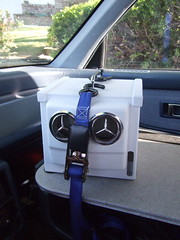
It did not, however, have air conditioning and the stretch of highway through the central valley, known as I-5, would be unbearable without one. I found an outfit online that made swamp coolers for cars. It plugged into the cigarette lighter. You filled it with water and a fan blew air across a damp filter. This was such an intriguing idea I had to buy one to test it out despite the $338 price tag. A little white box arrived. I strapped it to my portable car desk in the passenger seat and angled it to face me. It had dual vents like a pair of giant eyes. It looked like R2D2 sitting next to me. I named him Swampy. Swampy delivered a waft of cool humid air reminiscent of a San Francisco fog rolling in on a summer's day. It kept me just comfortable enough to bear the summer heat.

With the cooling problem solved, I grew even more fond of my eccentric car. But when the engine gave out on a local trip to Oakland three months later, I knew that judgement day had come. I managed to drive my car home on the overheating engine and then to my mechanics the next day. My same mechanic since 1984. I trusted his opinion. We would grow old together. He offered to look for a replacement used engine, but I had to decide soon.

I looked at all the options over the weekend. Other similar size wagons, the Toyota Matrix for instance, was still too new to afford at $7,000. Nostalgically, I looked for my Honda Wagon. I discovered the car had its own club, was being restored and souped up by enthusiasts because it was different they said, because it wasn't an SUV. One was available on Craigslist for $3,000 boasting a new paint job, perfect interior and though it had less mileage than the 230,000 miles on mine it was still high. Did I dare buy the exact same car? No one returned my call. I gave my mechanic the go ahead. In a week I had my car back. The engine he found, was so clean, it probably only had 50,000 miles on it he said. It was from a Honda CRX. It sounded different, younger, more energetic. It drove a little sportier got better mileage. And cost me only $1650 all told. This secret new engine under the hood bolstered my confidence. I tackled I-5 like a veteran.

Expedition Clean-Up


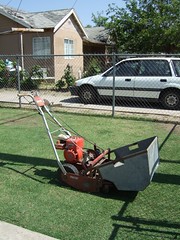
I rolled into our property to find Mike mowing the lawn. He was devoted to the yard, rolling it with a roller and trimming it to the smoothness of a putting green with his vintage rotary blade gas lawn mower. I had given up commenting that the high dessert was no place for a lawn. And somehow we had ended up paying for the entire water bill for both houses every month, but he did so much work keeping up the house that we didn't complain. The green expanse of fine grass did tidy up the place, making the homes look loved and cared for, an icon of retro suburban sensibilities, an American flag hanging over the garage.

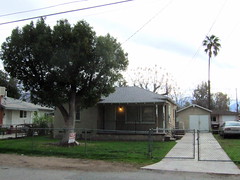
I went into the empty back house. It didn't look too bad. Mike and his wife had already started the clean-up and cleared out the remaining clothes and furniture. There was just some touch up painting to do and the broken window in the back door to replace. It was a mystery why it was broken. It was plexiglass. Had someone lost their keys or just been drunk at a party. There was also a curtain missing, an even bigger mystery. Why would someone take a single curtain? Did they accidentally burn a hole in it?

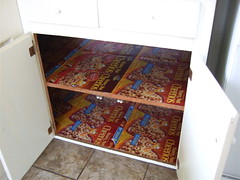
I had brought the paint for the kitchen cabinets and more cereal boxes with which to line shelves. The linseed oil paint I used on the cabinets was hardened now and had held up under scrubbing; I noted that a backplate under the knobs would cover where fingernails had nicked it (and we found some at the nearby Ace Hardware.) The cereal boxes made into shelf liners were mostly still good. I replaced the stained pieces. Mike commented that they had startled him. He'd never seen such a shelf liner pattern, but when he saw what they were he thought it was a good idea. The cardboard was nice and thick he said. He asked if he could have a flattened box to use as a surface on which to mix up some Bondo. The tenants' puppies had chewed on the corners of the baseboards leaving large ragged gaps. In half an hour Mike had applied the Bondo, shaped it and sanded it smooth. Bondo was a filler used for car repair. It dried too fast for me to work with it.


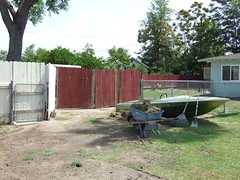
Mike fixed cars too and was fixing an old Saab he had seen in someone's yard, got it cheap. He already had a buyer wanting him to finish the restoration. He had a boat in the yard too, a fiberglass shell someone was giving away with a trailer. He only wanted the trailer. It seemed a waste to throw away the boat so he told me he had decided to drive it to his parents place in Lake Havasu, Arizona. They had no lawns at all, only rocks, so had developed a local culture of recycling large items into planters. This would be the first boat planter. I was amused.

In the evening I was invited to a chicken dinner Jennifer had cooked. Their son Addison, of the kidney transplant, returned from down the street where he had been visiting a neighbor kid. He was a very active boy now, going everywhere on his bike.

"He's a good kid," Jennifer told me when he went to his room. I agreed. I could see it in his face, his seriousness. I offered her my theory of how the trials of his kidney disfunction, the daily dialysis, the frequent doctor visits and medical procedures requiring careful compliance had built, in this boy, patience and perseverance. I imagined his future, saw him going the college route. At times our whole adventure in San Bernardino had come down to giving this boy a safe, stable place to live.

On Sunday I met a family that wanted to rent the house. Mike had told me about them. They had heard from their aunt across the street that the house was up for rent. How lucky was that? They had already filled out an application and were eager to move in right away as they were living at his mother's house. The application showed an income so small it was less than the rent. How was that going to work Catherine asked? Other sources of income were shown me including state assistance for the children. Together it would cover the rent with barely enough to live on. I listened to their hard luck story. He had had his own business, owned three trucks, had to sell them, go to work for his brother's landscaping business. He just got a job at a chain grocery store. They couldn't afford to stay at the townhouse where they were living even though the landlord brought down the rent. Credit not so good either, but he wanted to get it back again, buy his own house. He had goals, he assured me and would take good care of the property, landscape it even. Their small children needed a yard to play in.

"I don't know what happened to the economy," he lamented. I did not offer an explanation to this eager, hard working, immigrant family. Didn't want to tell him the middle had fallen out of the American Dream. I wanted to rent to them, got Catherine's okay when I called her later. He was so happy he came back late that night to put down his money. It was then that we realized there had been a miscommunication about the amount of rent. Mike had given a "guestimate" that was $100 to $200 lower than what we had been getting and they had hoped for the lower of the two, could, at most afford $850.

"No one is asking a thousand," he told me incredulous. I believed him, but I couldn't bring it down that much. Not just yet; I stayed up late making calculations to show Catherine; I asked the advice of the friend who sold us the property, asked about rents in the area. We were going on vacation before the next month rolled around. Chances were we wouldn't get the place rented until we got back, thus another month's delay. Less rent now would make up for a higher rent received later I was thinking. $850 sounded like a lot lower than what we were getting, but it would do. Everyone could live with it.

I packed the one curtain, sewed another when I got home. Mailed it. The family was already happily moved in by then. "They are very social," Jennifer reported. I was satisfied. Order had been restored in our little neighborhood.

Labels: , ,

Monday, October 11, 2010

An ADD Thing Happened On The Way To The NSGCD Conference

Recently I received a call from a young woman looking for an organizer for her parents who were hoarders. I took the job and it turned out to be a good fit. When I realized that I had been referred by two other organizers (who were already booked), I asked the daughter where she had found them. Like most of the younger generation she had done an Internet search and had come across the database of the National Study Group on Chronic Disorganization, the NSGCD, an organization I had joined at its inception nearly ten years ago. I called them up to find out why I wasn't listed in the database.

"Your membership hasn't been paid up since 2003", I was told.

"What?" I was stunned. Could I seriously be so disorganized that I didn't even realize I was no longer a member of an organization that was so vital to my development as a professional organizer? In fact I had, only a few weeks before been a speaker on a panel recommending the educational benefits of the organization. True, I did belong to four other organizations that required yearly dues and it was easy to lose track, but the irony of this particular oversight kept coming up in my mind, rubber stamped with the label ADD (Attention Deficit Disorder).


No one in the organization had once questioned my status, despite my having attended the annual conference every year professing to be a long-standing member. This I attributed to my ability to project such confidence that people assumed I knew what I was doing. After all I hung out with the upper echelon of leadership. But maybe that was because I was raised to rub elbows with royalty, I mused, thinking of my Thai grandmother. (Though, of course, one is not actually allowed to touch Thai royalty.)

When the NSGCD was still a special interest group within the National Association of Professional Organizers (NAPO), I was rooming with Judith Kohlberg at the annual conference. She had founded the NSGCD to talk about these interesting clients.

"I'm the rebel in the outfit," she informed me.

At the time, organizers were intent on setting up systems and training clients to use them. Judith was suggesting that disorganized clients see the world differently and needed different systems they would be more inclined to use. She coined the term chronic disorganization to describe clients who did not claim a medical diagnosis.

This alternative approach appealed to me. I, too, would be a rebel organizer and learn from my clients. A few years later the study group was formalized into its own entity holding an annual conference to train organizers on how to work with different brain styles. In the meantime time another of my leadership angels, Denslow Brown (originally introduced to me by a mutual friend), had undertaken in-depth testing to confirm that she did indeed have ADD. She began to give workshops on what systems best worked with this learning style.

This additional information was tricky. When I first learned about ADD, I recognized that I could easily claim many of the symptoms, but as soon as l embraced the diagnosis it just allowed me to fall apart altogether. Better to continue to perform as expected and take the heat for the usual mistakes that came from getting distracted. It was only recently that I realized that I simply performed better under a certain amount of stress because it focused my mind. And the advantage of ADD is that this hyper-focus will deliver. The rest of the time I was held together by coping techniques devised from experience. Having a roommate at conference, for instance, helped tremendously.

Kim Anker-Paddon, my conference roommate, for the last several years, always booked the hotel room long in advance. For this I was immensely grateful. It was hard enough for me to book my flight since dates unnerved me, due to frequent crossing of the international dateline. I had more than once had to rebook flights because I hadn't calculated correctly when I was supposed to be somewhere.

Kim joined NAPO when I was program chair of our local chapter meetings. At the time I was convinced that professional organizers took themselves far too seriously especially regarding our image as business people, thus I was intent on imbuing every meeting with a certain level of theatrics, which usually required that I design a costume for the event pertaining to the topic of the evening. Thus when we had a speaker on finances I made a vest covered with coins and wore a bowler hat in the tradition of British bankers. And when the topic was marketing I made a headpiece with letters cut from blue cardboard so that on one side of my head the letters WWW appeared and on the other side the letters COM. (Having a website was very cutting edge at the time.) My colleagues loved this little bit of entertainment. They were a very forgiving audience and laughed at all my jokes; this endeared them to me for life.

Kim was without a roommate because she was afraid of keeping a colleague awake with her snoring, but I persuaded her that that wouldn't be a problem since I was hard of hearing. Besides we shared a common perspective, having lived outside of the US as children, and we would need this support when traveling to the middle of the country. This time it was Texas, but luckily Austin, Texas, which I had heard more resembled a suburb of San Francisco and bore very little relation to the home state of the Bush family.

When I told Kim how I'd discovered I had failed to pay my membership since 2003 and would have to fess up to my ADD even though it hadn't really been a problem before, she explained that ADD was a continuum. Some were worse off than others. She was well versed on the subject as she had a brother and a daughter with ADD and had certified as an ADD specialist. That was another thing I had neglected to do, but now that I had moved into performance mode, I was going to jump in with both feet and do two levels of certification in the space of a few weeks. This would get me listed higher up on the database.

"You'll want to do the certificate on hoarding too", Kim told me when I announced my plans. It was being offered for the first time. I signed up for two exams because you couldn't get the hoarding certificate without first getting one on chronic disorganization. I had long ago read the books for the first so prior to conference managed to read three and two halves of the five required books for the second. I was confident that I would perform my way through both exams if I just managed to get there.


An hour before the exam I got dressed and sat looking apprehensively at the sun setting over our splendid view of Austin from our hotel room, while Kim did some last minute review. Getting places on time made me nervous. The previous month I had, as usual, been perfectly punctual to a client's house only to find that I was at the wrong house. I had mixed up addresses with another new client. (Fortunately the second client was used to disorganization and didn't give it a second thought when I showed up half an hour later.)

Not many organizers purposely seek out what we loosely call the CD population—the chronically disorganized. Organizers, on the whole, liked to see results and working with the CD population took patience as far as visible results were concerned, especially with hoarders. Often my colleagues were puzzled by those afflicted with chronic disorganization, but even more so by their ambiguity about getting things done. As one organizer put it, "They are so illogical."

"But that's why they are so interesting," Kim said when I relayed this sentiment. Exactly.

My hyper organized colleagues were more ambitious than I was, eventually gravitating towards mega projects involving moving large households, or estate jobs (liquidating the households of dead people), or setting up complex business filing systems, or various event-planning jobs with non-negotiable deadlines. These jobs paid better, filled up a workweek nicely and tended to follow schedules according to carefully laid out plans. Plus they had less chance of a cancellation.

The NSGCD attracted organizers who were process oriented as well as results oriented. Plenty had relatives with ADD or hoarding issues (or were secretly disorganized themselves). Psych majors turned professional organizers and a handful of psychologists, collaborating with organizers, rounded out the group. Mental health specialists were often engaged as speakers.

Not too long ago a handful of psychologist discovered hoarders and left the sanctity of their offices to enter the "field" to categorize and label extreme cases for which they then devised "treatments". We at the NSGCD eagerly listened and watched as the research evolved. These clinicians borrowed liberally from our organizing techniques, then proceeded to apply cognitive therapy techniques as they talked to their subjects about their stuff. They wrote papers and entered a new diagnosis in the DSM, the guide to pathologizing the known universe of the human experience.

I happily absorbed all the new information and just as happily ignored it when working with clients. It was not my responsibility to diagnose clients and the corresponding treatments only added to my brain clutter; I feared it would impair my ability to listen, not only to my clients, but my intuition. (If a client volunteered a diagnosis that was different. My learning could then provide that vocabulary too and we could discuss it openly).

One psychologist, on a panel at conference, complained that our lack of training could make clients worse. With OCD (Obsessive Compulsive Disorder) cases, for instance, when we enabled their perfectionist compulsions. But we were often the first responders for these clients; and if they didn't like what we were doing out we'd go and along with us a possibility of improvement.

I did have an OCD client, but once she came to trust me I rather enjoyed torturing her by theatrically destroying valueless things she wanted to hang onto. After I stomped down a pile of empty Kleenex boxes, she asked why I had to smash them (which would prevent her from retrieving them once put in the recycle bin). "I have to have some fun on this job," I told her. I didn't get a laugh, but I did get acceptance.

My clients were not extreme hardcore cases; they just wanted to get organized. Many kept me coming back because I was an adept conversationalist able to both field and introduce topics to pique their interest. Like them, I was in search of the larger meaning of everything (no topic was taboo from politics to God). And somehow, as we talked, whether it was a little or a lot, while working through their stuff, the larger meaning of everything also managed to prioritize and clear a room. (It helped that I was a speed paper sorter and adept at visualizing space. Plus I had figured out how to set-up my environment to save my butt rather than sabotage it.)

I put a lot of stock in this conversational glue. It generated energy, put the mundane tasks in perspective, side stepped a lot of emotional issues and bonded us as a team. But it was not something I could teach in a workshop. Nor could it be formalized as a treatment. And that is the difference between an entrepreneur and a clinical practitioner. We get to try anything we think will work; we can set boundaries wherever we see fit and because we are paid directly by clients we are driven to learn—quickly. By definition we defy any consistency of standards. It is our hard won experience that develops us and we start with incredibly diverse abilities and skill sets.

Just putting all these organizers in a room created a rapid-fire exchange of ideas, opinionated personal dynamics, a myriad of brain styles coupled with a high level of confidence and a broad spectrum of belief systems. If there was anything we were willing to agree on it was that all our meetings be run on time. It was downright intimidating—which just brought out the best in me.

Kim and I got up to take our exam(s). She asked my fashion advice.

"Which shoes should I wear red or black?"

We would both pass easily and spend the rest of conference heatedly examining all the new information, each speaker and what it all meant. We stretched each other.

"Curtains opened or closed?" she asked when she returned to the room to find the drapes partially closed on one side. (I was blocking neon light from a building.)

"Is that the only option?" I teased. "What if the window was actually only that big?

"Oh all right," she conceded.

Labels: , , , , ,

Friday, March 26, 2010

A Renting We Go

In this saga and a half I conclude my venture into home renovation and landlording following the California real estate collapse.

While in Home Depot shopping for mini blinds and towel bars I get a call on my cell which was now dedicated to calls from potential renters. Our second house on our lot was nearly ready to go and I had timed the ads in the paper to coincide with my third solo trip to San Bernardino. There were three Home Depots near the property; I choose the one with the same layout as the one at home. It seemed to lessen the culture shock.

"Hi this is Joe," said the caller then paused as if he was beginning a long term relationship. He tells me his story. Most callers don't tell me a story; they just want to know how much and how big. The story is about how he had just moved back to California after a spell in Georgia where he was working on a job with his uncle and now he and his wife and three little kids were back living in his mother's house, but his mother wasn't going to be able to keep the house so they all had to move. The upshot of the story was that he was discovering that he was picky about the kind of house he was willing to live in and he was interested in my ad boasting that we had newly renovated. He promised to come by and see the place.


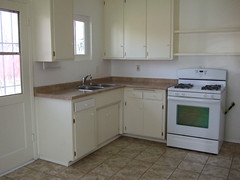
I wondered if my modest interior design choices for the little house would pass muster. The kitchen with its butter yellow cabinets, Formica counter top in caramel tones of faux stone and the floor tile of swirled mocha and pond scum green looked surprisingly okay. All the colors went together quite nicely against the bright white enamel walls; the floor tiles tying chromatically into the chocolate brown of the new carpets in the bedroom.

I had struggled to find window coverings that would span the over-wide ranch house windows of the living room and, after studying the Ikea catalog for two hours, had found the only ones that would do. Their top of the line Kvartal system was very modern looking and a marvel of Swedish engineering. The curtains I made by cutting in half pairs of Ikea drapes and piecing them together side by side. The kitchen windows sported a pair of Kvartal panels with a trendy curved design cut into the stiff white material.

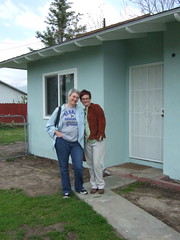
They looked quite nice from the outside, matching the white trim on the newly painted exterior which was now a minty blue green. The choice of color for each house had been a subject of much discussion with Catherine and photographing of houses while dog walking. In the end, to fit into the San Bernardino vernacular of neon yellow and terra cotta orange, I migrated from the tasteful palette of Bay Area earth tones to the color chart from the paint department targeting the Spanish speaking population.

Thus the house, transformed from vintage bubble gum pink to Aqua Tequila, was almost breathtaking in its cheerfulness, evoking beach houses and holidays in the Caribbean.

For the front house I chose a more traditional white with a dark teal trim. In part to impress Mike with something a bit more masculine that would evoke a grander house. He was, after all, going to live in it and be master of the lot, as my manager as well as contractor. I was pleased when he noted that the teal trim would go well with the mint green of the back house.

There was very little left to do once the curtains were ironed and hung up. Without an actual client it was hard to know quite how the space would be used. There were clues. Everywhere that an angled nail had been pounded into the woodwork, by a previous tenant, I put a hook; likewise the backs of bedroom doors. In the one bathroom I replaced a single towel bar with two and a ring. And in lieu of a hall closet two sets of hooks on the back of the front door.

And since I had time, I lined the shelves. The old vinyl had left sticky residue on the wood. But here I parted from the norm and went in search of an eco alternative. I didn't like the off-gassed chemical smell of vinyl, plus it was made of PVC, which was now considered toxic.


I turned to my collection of cereal boxes, which I had been using to construct book mailers. I lined the drawers of our new bathroom at home with sections of Raisin Bran and Cheerio boxes. Pleased with their resilient surface and op art affect, I took the boxes to San Bernardino and with my corporate size paper cutter, spent a fun evening trimming boxes and thumb-tacking them to the shelves.

My "picky" client, arrived in a white t-shirt, with a tattoo on his upper arm, carrying what looked like a man purse, but turned out to be a camera case. So he could show his wife the place, he told me. When he described to me the squalor that he had seen in the local rental housing market, I realized that new investors, having snapped up all these foreclosed properties, had simply left them in the condition that they had found them, putting them up for rent right away. Yuck, I thought, remembering the condition that we had found our houses in. We couldn't have lived with ourselves.

Joe was eager to rent our house, but as a self-employed carpenter, he didn't have an employer and with no current landlord the only rental history I could check was from two years ago. Plus his credit wasn't too good and he was "between bank accounts" he told me. I already had a contractor and was nervous about having both tenants relying on the same collapsed housing industry. Now, it was my turn to be picky. Still he was my only contender. I gave him an application.

Old Time Values

I walked to the front house where Mike was working on prepping the stucco and woodwork for painting.

"You know," he said, "I could just slap on the paint like most people would, but I want to do it right and patch this woodwork." He pointed his putty knife at the sill, which had a corner that was broken off and painted over.

"And these window panes need to be re-puttied", he added as I took in the cracked dried, up bits. "But it's going to take me a while." He was asking us for more time, but not more money; he had already bid the paint job and was putting in his own time for his own satisfaction.

"I know," I said, "it's exactly what I would do only I knew I'd have to live here for about six months."

One of the first things I had asked Mike, when I met him, was if he thought the sash windows could be saved. I had spent many hours searching the "This Old House" website reading about how original windows were what gave the house historical interest; they could be rebuilt with a few hand tools, even made energy efficient with storm windows.

In high rent areas like Pasadena, where I had stopped to visit a colleague, such historical elements had been kept in good repair. Down here in rent-it-cheap-ville they were being held together with silicone caulking and you were lucky if they opened. If a house was being flipped, out would go the old windows to be replaced with cheap vinyl sliders. Traditionalists claimed that vinyl windows had too many plastic parts inside that would soon break, not to mention that they were a factory manufactured product of the petroleum industry.

I marveled that I'd found a man who shared my values. On my first day back, this trip, he had pointed out the satellite dish on the roof that he had just installed.

"We got TV now," he said. TV? When would such a man have time to watch TV?

"I get the feeling you didn't miss it much," I said. He paused collecting his words.

"Well you know, we've been having Addison read to us at night," he said knowing this would be a choice I would appreciate. Ah, you gotta love these second-chance dads. I knew he had other sons. When we first met him, he told us, that he hadn't spent enough time with them because he was working too hard, thus his retirement from full-blown contractor to handyman.

Addison had found a friend from down the street. They came riding down the driveway on their bikes. (The day he arrived Addison was already over at the neighbors sharing his truck with the little boy there.) This friend was a bigger, white boy. They had come to bide the time while Addison underwent his daily home dialysis treatment.

Mike had shown me the equipment for it—a machine about the size of a tabletop copier plus stacks of boxes of plastic bags filled with saline solution. It was the same treatment we had administered to our cat for her kidney problems. Only Addison didn't get poked with a needle, he had a port in his belly.

I'm not usually taken by children with birth defects, those sappy, inspirational stories that make good copy for Sunday magazines; they make me long for ancient Rome where a baby born horribly wrong was exposed—left on a cold hilltop to die. But Addison impressed me. He had survived this far. Plus all that medical attention had made him adept at talking to adults; he had established a rapport with me right away. For a ten year old, he had a depth born of patience and an enthusiasm for physical activity that spoke of resilience. I admired his pluckiness.

An Auspicious Event

My phone rang as I was installing a paper towel holder in the back house.

"Do you have a weight limit on pets?" said a young female voice. What? Oh right, some landlords do, I remembered.

"Oh I see," I said, "you have a large dog. Or is it a pony?" This being my hotdog stand I could afford to joke. The girl laughed, said she had a Chow who was a sweetheart. When she showed up with her parents a tiny little dog peaked out from inside her jacket. The tour didn't take long.

"It's very basic, but that's what we want," said mom. Their house had just been foreclosed upon and an injury had put her husband, a tow truck driver, on disability thus the need to downsize on this diminished income. Their credit wasn't too good either.

"But we don't have any evictions though," the dad added.

We wrapped up in the garage and they talked about wanting to rent it.

"There's just one thing we want to be up front about," said dad, "we have three dogs and three cats". Oy. And we had new carpets.

"We'll find homes for our pets if we need to," said mom firmly. "We love them, but we need a home, first." I felt like I was coming to that pivotal scene in Sophie's Choice where Meryl Streep is asked to choose which of her two children she wanted to keep. I told them I had someone who wanted it already, but would let them know.

I walked back over to see Mike about a good time to take his family out to dinner.

"We might not be able to go," he said, "we just got a call from the hospital that they've got a kidney for Addison." I knew they'd been waiting since before Christmas.

"But I'm not getting my hopes up because this is the third time we've been called," he added. I remembered the last time they couldn't do it because Addison was catching a cold. The kidney was being screened to see if it was a match. I went on my errand for window blinds for the front house. When I came back Mike said it was a go.

My brain started to unravel at double speed. I popped off to Home Depot again to get a blind I thought I had forgotten, but I had actually misplaced it behind another one. Then I discovered I had left my binder somewhere, probably on the roof of my car to have it fall into the street. In fact every time I came down to San Bernardino, my mind started to unravel. The drama of my story took up too much brain space; I kept forgetting what I was doing and there was nothing in place to ground me as there was at home. Now I knew how my overwhelmed clients felt.


I had to have people there to keep me on task. And my people were vanishing, going on a mission. I succumbed and joined in the proceedings inside the front house. Mike was wolfing down his dinner and Jennifer was combing Addison's washed hair and packing. I asked Addison if I could get a picture of him with his dog, Cupcake. He sportingly obliged. He was as excited as if he were going on vacation.

At nightfall, Jennifer came home. (No family were allowed during shift changes.) She told me the kidney donor was a 24 year old who had died in childbirth.

"How 19th century," I said pausing to take this in.

"They said Addison would grow into the kidneys," she explained since I was part of the family now. I questioned her about her confidence in his doctor. I didn't want the kid to die on me now that I was invested. She had complete confidence in him; didn't seem worried at all.

I was so struck by my happening to be there for this momentous occasion that I felt somehow powerful as if I had brought them this good luck. I mean what were the chances that I would be there just when they got the kidney? Such is the hubris of a writer living inside a story. After a while, I felt like a bystander again and went back to lining shelves.

In the morning I got news that it had all gone well. Whew. He would come home in three weeks, then had to be kept germ free in isolation for three months, so no school. I packed my car and Mike and I settled up our accounts.

Build Your Own Family

In the days following, my work helping a hoarder client sort through ten-year-old copies of People magazine couldn't have seemed more meaningless. My mind was with a boy struggling to accept a major organ transplant. And I still had to rent the second house. The applicants I had were not quite right. They didn't really feel like they were part of the story.

Yet, this was my target market. Having positioned myself just to the sidelines of the foreclosure epicenter, I was poised to catch the falling middle class, complete with all their pets, amenity needs, oversize furniture and big appliances and yes, their shaky credit rating. Otherwise I was getting a lot of calls from people looking for the rock bottom price. Or they were young with much to learn about taking care of property. One man spoke only Spanish, but all I could say was "si, casa" and the price in English numbers. $1000 a month was too high for him. Low prices hovered around $750. Down the street a newly renovated house was selling for $45K. That was about what we had put in to renovate. Real estate gurus were telling their investors to flip not hold for there would soon be more bargains.

Though I was prepared to lower the rent, I thought I'd wait a bit. There were plenty of landlords lowering their rent steeply as the glut of foreclosed properties turned around and were up for rent again. Soon they'd be gone. We had put a lot of work into our houses. I wanted people who wanted a nice home over a cheap dump.

I called Mike. Told him that what I really wanted was for the tenants in the back house to be okay with him and right for the situation he had there. Would he interview these candidates? He was glad to. Called back, said Joe was probably not the right guy and besides he had let slip that he would move on soon; the second family with the 6 pets, he couldn't reach. Was that going to be it for the month?

I tried to think of ways to advertise. The population didn't seem to go much by Craigslist. A digital divide perhaps. I discovered Rent.com; none of the many houses I had seen for rent were even listed there. I posted ours. Three days and four leads later, a man called me up moments after I left him a message.

"Amanda, I want to rent your house, but I'm afraid you will have rented it before I even get to see it," he said as if we were best friends already. "My name is Italo, but everyone calls me Tally," he continued in a familiar drawl. I felt like I was listening to a character in a movie. Well no wonder— he was from the Bronx—an Italian. He went on to tell me how a friend had suggested he go onto Rent.com "and there you were, the only house in town". He liked the pictures of it, but he had to leave for two days for his work. The man had a job!

Yes, for UPS for 18 years. His wife had divorced him; he'd given her nearly everything, plus the house had an underwater mortgage and now the apartment complex where he was living was kicking him out because his 19-year-old son had brought home a dog.

He just wanted to get his life back together again, he told me. I hoped he wouldn't be put off by the seediness of the neighborhood. I e-mailed Mike and Jennifer telling them how nice he was.

He saw it, he liked it, his kid liked it. He didn't mind the seediness, after all he was from the Bronx. He knew that people looked out for each other in these poorer neighborhoods. He even remembered an outdoor clothes line same as the one out back. Mike had liked him so much he gave him a hug and told him he belonged there. By the end of the weekend Tally was wooing me with recordings of his impressions of Elvis, pictures included. If Catherine was okay with his obliterated credit rating it was a go.

"Let's give him a chance," she e-mailed me. I had gotten a terrific reference from his boss ("wish all my guys were like him") and his credit history was the norm now.

Finally, I could lay my story to rest. My new extended family had attained a harmonious configuration and the little homestead would give us all a chance for resurrection. Tally was so grateful he said I was an angel. Well I wouldn't go that far, but after just six months of this odyssey my story was closing with just the happy ending I had been looking for.

Labels: , , ,

Wednesday, February 17, 2010

Tale of Two Houses

The kitchen cabinets I had so carefully painted with low emission, all natural ingredient, linseed oil paint were changing color from off white to a pale yellow. That wouldn't be so bad except that it clashed with the Rustoleum paint that Mike had used to paint the doors. That paint was drying to the color of a dolphin skin grey. While the walls were a high gloss bright white latex that just emphasized the difference.


I had not wanted to ask Mike to use the linseed oil paint. This paint was an experiment I had only intended to subject myself to and so far had proven to have a few hurdles. For one thing it took forever to dry. At least 24 hours at the optimum temperature of 74°. And if you ordered the wrong color, as I was beginning to think I had, or needed more, you had to wait over a week for it to be mailed from New York because the paint was manufactured by a family owned company in Sweden and only one American company handled it. That's what too much Internet searching will do to you.

We had both agreed that oil paint was the way to go on woodwork for durability, but the law had phased out oil based house paints leaving only paints formulated for metal readily available. Rustoleum was what Home Depot stocked. (Contractors have also taken to spraying cabinets with automobile paints Mike told me.)

I despaired at the whole project. Part of the point of cleaning up these houses was to make things look consistent. I took a walk around the block to clear my head, but only noticed the many inconsistencies in the neighborhood, walls half repaired, different materials used, broken fences, junk furnishings. My project was just reflecting the general mélange. Where was the charm that had first attracted me? Was I being sucked into the undertow of delaminating suburbia?

Then I saw something that reminded me that this neighborhood had more in common with Mexico than American suburbia. Lying in the yard of one of the more run down houses was a full size piebald pig, fast asleep while a pit bull looked at me from the porch. The occupants would very likely eat the pig using some old family recipe that was not from a celebrity chef at Chez Panisse as happened in Farm City (the latest locavore book by a protégé of Micheal Pollan, who was keeping livestock in an empty lot next to her Oakland apartment). These San Bernardino pig owners would probably never suspect that growing your own meat was the latest hot trend of the eco food movement.

My perspective thus adjusted, I returned to the house and set about to paint the doors to match the cabinets. I was soon joined by Mike's assistant, Rudy, a short bald man with a goatee and his much taller, large son. Mike had found Rudy in the mix of Mexican laborers looking for work outside of Home Depot. He told me he'd gone through a few before he found someone who had the work ethics he was looking for. Rudy was our recycler, I discovered, when I asked why the old aluminum framed windows had not been taken away. He would take the scrap to sell Mike told me. How familiar to my own third world neighborhood ways.

An hour later Mike showed up looking his usual buoyant self, but with his entire family in tow. I had met his wife, Jennifer, once briefly. She wasn't looking her best this morning. In fact she looked like she'd been in a fight and was teary eyed. His son, of whom I'd heard a great deal about on account of his impending kidney transplant, had his arm wrapped around his mother and looked quite forlorn. I didn't want to ask what was up in case I was prying into some family dispute I wasn't supposed to notice. We exchanged pleasantries and when I looked puzzled, Mike said he needed to talk to me.

"We want to rent one of your houses," he said.

"Really, which one?" I asked, conversationally.

"The front one," he said. He then told me they had just had a run in with the owner of the house where they were currently renting two rooms and needed to move out right away. The man had hit his son in a moment that had gone beyond rough housing and then he socked Jennifer in the eye. Mike had called the police to file a report and told the man and his wife that they were moving out. His wife did admit that her husband had a tendency to go off. It was at this point that I realized I had entered a reality quite unfamiliar to my own. At least I could offer one that was more congenial. They had, I remembered, just moved from another house because it was going into foreclosure, so probably hadn't even unpacked.

The front house was in no condition to live in, filled as it was with spackle dust and not yet painted. I was staying in the back house, now transformed from greasy pit to freshly painted, newly carpeted, brand new house. The new vinyl windows making it snug and quiet. The toilet wasn't hooked to water and the sink didn't have a drain, nor the bathroom a door, but it was quite habitable and there was a room going empty.

"You're welcome to stay here," I invited them, indicating the smaller empty room. "Or maybe you should stay in this room since you're bigger," I offered. The small one would be fine Mike said and I wondered if I sounded a little goofy.

"And I haven't met you," I said to his boy who brightened up a bit at being addressed. His name was Addison.

"You'll have roommates, now," Mike said in case I wasn't quite apprised of the situation. I nodded smiling. This whole house adventure was full of serendipitous outcomes, I told him and went outside to collect my wits and ponder my new role as landlord. Then I left Catherine a message apprising her of the situation. It was probably a good thing that Catherine had decided, at the last minute, not to come on this trip since we had our two dogs to manage and the house would have been quite full.

When I came back Addison asked me if I liked cats then brought his rather unnerved Persian cat over to meet me. I also met Mike's dog, a tiny Jack Russell Terrier named Cupcake. Thus properly equipped with a family for my compound living, I set about cutting and fitting closet poles so they would have a place to hang their clothes.

The next day was Saturday and I was alone in the house, which gave me a chance to concentrate on installing the shelves I had made for the kitchen. By evening a moving van rolled up to the garage and soon Rudy and his son were helping the family unload. They had volunteered their time to help them, Mike told me and I was duly impressed, but not entirely surprised that help was being offered. I tended to believe that people would help each other out when things got bad. Mike had also expressed his gratefulness to me for allowing his family to move in on such short notice. I did suspect that if I were to run a background check on my new tenants there would be a bankruptcy or some other red flag to consider, but having observed the high standard of his work and watching his integrity with his crew, I felt I knew Mike on his own terms and saw that he valued family, was knowledgeable about old houses, had the patience to explain things and wasn't at all patronizing. By the same token he knew me.


We took pains not to step on any toes conversationally, but he liked to tease me about my eco choices while I refrained from mentioning his smoking or his humongous late model truck. He brought me food, a Breakfast Jack from MacDonald's one morning, a sloppy joe he made on white bread in the evening. He reminded me of my father, offering sustenance on the one hand and challenges to my worldview on the other. My father, who had spent his career in the defense industry, took a perverse pleasure in teasing me about going to peace marches. If my dad was helping me from the grave, it would be just his sense of humor to send a man who was here to keep me in my place while offering practical knowledge and assistance that would have me in his debt. Nevertheless I valued Mike's opinion.

"I wouldn't worry about it," he would say calmly if I voiced concern about being able to rent the place. He offered simple solutions when I got overwhelmed and kept his word if it was important. I also knew his flaws— that he had a tendency to run late, was forgetful unless under stress, refused to get on a computer anymore, had had a head injury from falling off a roof, had retired after a heart attack during a big job in New York and was, by his own assessment, somewhat ADD, relying on his wife to keep his appointments together.

He was also an artist. He brought one of his oil paintings over one night the week Mark and I were working at the property. He thought it would add something to the place. Then said his wife wouldn't have it in the house so I could do what I wanted with it. The painting showed a Native American brave brandishing a tomahawk at the sky. I was charmed by it in a log cabin sort of way.

Throughout this adventure of two houses, I had the sense that I was in a parallel universe of fortuitous circumstances, guided by genuinely helpful people. Through a path of intuitive choices I was creating a narrative that was more fable than business anecdote. This cosmically guided sensibility had its own logic based on building authentic relationships that would be marred, I felt, by too much distrust and control. I was perhaps being naïve, but I was willing to offer my trust; if I was betrayed it would likely not be personal, but if it went well then I had increased my personal power and extended my family ties to strangers with the ultimate end of improving things for all of us. I asked Mike if he would be our property manager too. He was happy to. He didn't want anyone messing up the walls after all the work we put in. Later we would put it all in writing.

In the enterprise of renting property, the endeavor is generally considered one of the most potentially litigious in America. Many friends had warned me as much. The previous owner was, in fact, being sued by a friend of a recent tenant, who claimed she had injured herself after falling from the front porch which was devoid of a handrail. That she hadn't filed this suit until a year after the property was vacant was suspect enough. That she was asking hundreds of thousands because said injury did not allow her husband conjugal visits tipped it into the absurd. These legal shenanigans were expressions of human relationships gone awry, of desperate people protecting themselves in lieu of their human obligation to do the decent thing. That's what liability insurance was for.

Not that we had insurance—of any kind. Couldn't get it because there were so many houses going empty across the country and being vandalized that insurance companies would not write a policy for income property until you could show them a rental agreement and your tenants had moved in. Having no insurance made me quite nervous at first, but then it just became a part of this narrative of faith. Or was it fate? At any rate no one had disturbed the properties so far. There were so many dogs in the neighborhood that just walking down the street created a ruckus. Now the property would be occupied and this would certainly help. As Mike started up his gas mower to trim down the newly re-grown lawn, I realized that, soon, I would have to look for another project on which to direct my eco sensibilities.

Labels: , ,

Monday, January 11, 2010

The Town The Boom Forgot


On the way to my claim in what is grandly known as the Inland Empire, I had ill timed my departure and was neatly waylaid by rush hour traffic swarming out of Los Angeles, hours of it. Looking for a bathroom I pulled off the 210 into a suburban shopping mall sporting all the usual chain stores. I picked Target and found one near the entrance.

This was the town of Upland. On our last trip we had been informed by a local, that Rancho Cuchamonga, the town next door, was the jewel of the Inland Empire. Newly spiffed out by the housing boom, this was the town that had perfected the art of upwardly mobile suburban living in brand new McMansions and all the amenities of convenience shopping. Naturally it held no appeal for me. As I fought my way out of the mall through Christmas shopping traffic, I was relieved to leave the bright lights behind for the town I had invested my hopes in. The town the boom had bypassed.

San Bernardino was known for riff raff and gang activity plus all the amenities of a poorer population—liquor stores, run down churches and paycheck cashing storefronts. As I pulled onto Waterman street, my heart rate went up for I was arriving alone after dark. All seemed calm. Turning off 9th street into my new neighborhood I was cheered by the many houses decorated with Christmas lights. I pulled up to our padlocked gate, let myself in and was further cheered by a night light our contractor had left on in the kitchen.

After locking the gate, then the iron security door, then the deadbolt, I surveyed the living room and was amused by a number of potted ferns in their black plastic nursery pots set out at the edges of the room, in the middle of which was a lone plastic patio chair and end table. Also left for me was an old space heater for the gas had not yet been turned on. I had been surprised to learn that this part of Southern California was as cold as it was 400 miles north, with every morning producing frost and a hankering for long underwear (which I had foreseen to pack.)


Pleased, I set up my plug-in kettle and a toaster oven and warmed up my all-organic TV dinner. Looking for something to do I took out a razor blade and set to scraping the latex paint off the vintage black tile of this original 1939 kitchen.

The beauty of a town that has been bypassed by the boom (apart from the original post war one that created these suburbs) is that no one has had any aspirations to improve on the existing housing stock. The draw for those who held investment property here was a rental market that could be managed on the cheap, for a population that had no where else to turn. The building boom in the neighboring towns had all but eliminated affordable rentals.

"I'm having a hard time picturing you as a landlord," said one of my colleagues used to perceiving me as a political leftist fighting to reverse development and save the planet. I, too, was adjusting to my new role as a land baron. An eco land baron for, with less than 1,000 square feet, my renters would automatically have a lighter footprint. And they would have to make do with the barest essentials in appliances, no dryer, tiny kitchens, retro one-fixture-per-room lighting and vintage décor. They would also have to endure my homemade organizational devices, experimental eco materials and a landscape that would never intentionally include a lawn. I was heady with the power of it.

Only a few of my friends understood why I might be charmed by a town of such bypassed prospects. Most ended the conversation as soon as I told them about the chain link fences or showed pictures of the houses we had bought. I tried to wow them, to no avail, with the statistic that a population of 200,000 could only support one Starbucks; that here was a town unspoiled by shopping malls and chain restaurants. I didn't get a chance to reveal how at peace I felt in it and how I had a curious desire to live there (but probably not in the searing heat of summer). Living small while protected by a grand mountain range, I felt contained and complete in this town.

The Stuff That Dreams Are Made Of

The locals however did not feel they had been bypassed, but that their time was still to come. The nearby air force base, having been decommissioned, was now designated an international airport complete with new 80 million dollar passenger terminal and signage. Everybody mentioned how the airport would make San Bernardino the new boom town. It was less than two miles from our property, but I was not worried. If you want to make a peak oil activist laugh just talk about your investment in air travel.

Said airport had yet to entice a single passenger airline despite lower landing fees. Airlines still looking for growth preferred to base themselves at the more established airport in Ontario, 25 miles away. Having also been bypassed by DHL, Federal Express and UPS, the only customers were second-string cargo planes and firefighting planes. But it did play a distinguishing role as a set for the film industry, the X-files and such.


The last time San Bernardino thrived was during the Cold War when the military bases were fully active. When the bases closed, shipping and warehousing for imported goods took up the slack. (80% of imported goods entering California come through the Inland Empire.) Already diminished by the recession, the shipping industry will likely suffer the same future as air travel as fuel costs rise. Once a fuel deprived de-globalization overcomes us, a resurgence of local manufacturing could fill the empty warehouses, contingent on existing rail transport and later perhaps sailing ships up and down the coast. There was still substantial agriculture in the area—a viable long term industry (drought permitting).

I did not bring up my analysis with local residents. Far be it for me to dash anyone's hopes, invested as they were in obsolete dreams. The recent housing boom wasn't based on industry at all, but was more a refurbishing, fueled by easy credit and the McMansion trend. Mike our contractor, described the housing development planned for downtown where several old residences had been condemned. The new development would have a man-made lake, he told me, impressed by the vision.

Of all the things to put in the dessert, I thought, but did not protest. I was lucky to have a man with extensive experience rehabbing. His Craigslist ad told of how he was retired, but loved what he did and that he needed money for his 10 year old boy who was awaiting a kidney transplant.

Also on hand to help was Mark, a friend from the Bay Area. Mark had bought, at the age of 23, his own house in a little town called Snowshoe, in Pennsylvania, where he had made a living as a handyman. Twenty years later the house had become more albatross than liberator so Mark set himself free by donating it to a local charity, driving off in his live-in van with iPhone. He arrived two days after I did.

I met Mark through my friend Dave who was my housemate at the time. Mark was in the habit of asking a new friend to cut his hair each time he was in need of a trim. I was next in line. Luckily it was very forgiving curly hair. I noted that it was a bit longer now. Looking dapper in his vintage thrift store clothing and brimmed hat, he had brought with him his iPod-driven homemade boom box and a stack of DVDs — independent films from the library that we watched on our laptops.

The Kindness of Strangers

On the first night, after a full days work, Mark persuaded me to walk down the street to find our dinner. I was dubious that we would find more than a liquor store, but we did eventually happen on a Thai restaurant in what looked like an old drive-in. The food wasn't bad; the décor improvised with travel posters and a TV tuned to the sports channel. On the wall was a flyer for a Thai real estate agent showing a house similar to one of ours for $80,000. (After what we spent to rehab our two houses we would come out a bit ahead of that.)

Despite the low budget decor of the town, I was reassured that the community was viable mostly because the people were so nice. Mark remarked on this too and we started asking ourselves if it wasn't so much that people were nice here, but that they were not so nice in the Bay Area. Perhaps the need to be a contender in the land of innovation had set the tone. Overwork and outsized expectations hung in the air; everyone needed to be a star to compete. In San Bernardino, just getting through the day was enough. Ordinariness seemed to foster kindness.

We spent much of the week on the project scraping away the sins of previous tenants—packing tape residue on the walls, countless nail holes, slopped on latex paint that melted when scrubbed, grease covered dust webs. Not to mention the negligence and outright incompetence of the previous owner. Apart from ignoring virtually all maintenance, his contribution as a tile layer was soon found out. The tile in the shower was so skimpily adhered, it only took 40 minutes to pull it off. And water was seeping so far under the windowsill in this shower it was wearing a hole through the wall.

We heard more about him from a passing neighbor who told Mark that the owner would come to the property stinking drunk and yell at his tenants. "At least you should pretend you're not drunk," the neighbor concluded. This amused Mark and me greatly—that allowances could be made if you at least pretended you weren't behaving badly.


No wonder the neighbors were smiling at us. We were bringing a hope of decency. The houses had been on the market for over a year. Just to have someone buy the property was a vote of confidence that the neighborhood was worth the effort and things were turning around.

Back To The Future

I hoped so, too, since we had to eventually pay for the work being done here, but the draw for me was more personal. In part nostalgia—an attempt to roll back time to a sensibility when lifestyles still seemed reasonable. According to US census data, the average house size in 1982 was 1,520 square feet. In 2002 it was 2,114 square feet. Human need did not grow larger houses; the conceptualizing of the family home as an investment vehicle did. And then, of course, increasing amounts of stuff made it seem necessary. All that turned out to be the downfall of more than just our economy. People's lives and communities changed too.

A neighborhood of small houses was manageable. I could see that neighbors looked out for each other. The kid next door thanked me for throwing his Frisbee back over the wall then stayed to chat. His playmate lived across the street. At 12, sitting atop the wall between us, he was master of his domain.

A complaint of one of my clients was that she had to drive her kids to their playmates; they were stranded otherwise. I also heard of a manager who described his new hires as suffering from a lifetime of scheduled playdates. Though bright, they lacked the ability to organize their teams to get things done. Isolated like this, kids had been deprived of the opportunity to manage their own lives and work out their own problems. Ah the irony of wealth.

In a community where home sizes were frozen at 1950 averages (983 sq. ft), I had a chance to envision a different future without having to undo the bloated built environment of a lifestyle seriously out of wack with what resources we had left. I wanted these small houses to be nice so the tenants would be happy living there and wouldn't associate small with grungy, broken down and poor. Rather they would be efficient, cozy and organized, easy to keep clean and with less space for junk to accumulate. Plus each yard had enough land for a substantial kitchen garden—a component of sustainable living. Working on these houses felt real for rather than creating a fantasy life to guide my pursuits, my play was now affecting a real environment, a real future.


On the last day, as I was packed ready to leave and the roof was being torn off on the front house, a young couple came by asking Mike if the houses were for rent. Word had got out. They told him the going rate for what they had looked at already. It was a couple hundred more than what we were asking. That was great news. We were keeping the rent at what it had been (which was probably all the previous owner could get for his wretchedness). With property values slipping so badly we had thought we would have to drop even that rent. Now we could feel good about cleaning up the place and still being under market. I was beginning to enjoy this future.

Labels: ,

Earthworm. Get yours at bighugelabs.com