Climbing To New Heights
In which I fulfill the role of conference chair for the Institute for Challenging Disorganization, pulling off an event more successful than my wildest expectations.

The conference chair's job is assumed to be over once the speakers are booked and all the arrangements made with the hotel to facilitate the smooth running of the program, but to me arriving in Denver two days before I was to appear at the podium for this annual conference of the Institute For Challenging Disorganization, I felt my job was only just beginning.
At the networking mixer the night before the program was to start, a handful of long time subscribers and board members thanked me for the quality of speakers that I had put together for the conference. They had come to this conclusion based on the write-ups and the bios of the speakers in the program. Our theme Climbing To New Heights inspired by our Denver location, had also helped. Their acknowledgement allowed me a measure of breathing space and I could relax a little. Later I would wonder what combination of luck or skill had helped me put together such a program.
What for instance had allowed me to pick the speakers for programming with such confidence? "Beginner's luck," I had said to the board president when she first saw the line-up several months ago.
It helped that I had no reputation to uphold so I did not feel I had something to prove. The board had already placed their confidence in me by asking me to take on this role. I could proceed with some calm based on my experience as program chair for my chapter meetings. I had made so many mistakes in my two year stint, I at least knew what didn't work. My predecessor Marci Katz had taught me how to approach and negotiate with potential speakers during my two years on the ICD conference committee. She left me a few leads and a sample of a letter to write to prospective speakers. Then she retired from the committee leaving me to it.
It's lucky that I like to read, I thought. In the last decade I had read enough to answer most of my questions about how the world works in the political, sociological, psychological and spiritual arenas as well as in the practical realm of carpentry, plumbing and gardening. I liked ideas prompted by bio-mimicry and ecological systems. I liked how social science could be reframed with new theories and discoveries. I enjoyed new studies about how the brain worked and theories about how it could be retrained. I had also read enough inspirational material and entrepreneurial fluff to distinguish between an original thought and one borrowed and dumbed down to fit a particular marketing approach.
For the conference I had gone in search of authors who had the educational background or personal experience to develop enough original thinking to fill a a book on a subject that might interest my colleagues. Which meant that I had to know my colleagues in the context of ICD. And having attended every conference since it's inception I felt that I did. It was the brain trust of the organizing profession as one colleague put it. Given all our past conferences and our monthly tele classes, we were well versed in the basics of hoarding research, ADHD, depression, bipolar disorder, brain damage and the practical impact of a slew of other diagnosis on people's ability to function. At our conferences we moved as one hearing all the same speakers and discussing them at the breaks together. We also did not live on theory alone; we wanted practical applications for the knowledge being given.
The Speakers
Speaker suggestions had come in from subscribers and committee members, but many of these speakers were too famous to afford or so popular they were already booked out. Many were also cribbed from other conferences and so had a professional veracity to them rooted in traditional therapy that were certain to be acceptable, but I found them less than fresh.
From these suggestions, I picked two I thought were different in their focus. One was Lee Shuer who gave his presentation from a recovering hoarder's perspective and introduced the fairly new development of peer responders stepping up to help their fellow hoarders take the first step to recovery. I saw him speak at the Hoarder's conference put on by the San Francisco Mental Health Association. (My colleague Kim, sitting next to me prompted me to go after him.) There was also Dr. Suzanne Chabaud who was a clinical therapist focused on hoarding and lately on the impact of hoarding parents on children. She was eager to connect with organizers. Therapists so rarely acknowledged the role of professional organizers that I was intrigued. She had also appeared on 29 TV hoarding shows although that was not a venue that readily impressed us.
To fulfill CEU credits for our new certificate on aging, the committee agreed that we needed to find a speaker on dementia. It so happened that the San Francisco chapter had had a panel on aging at our own regional conference. I had not seen it so I asked the colleague who had moderated the panel, to recommend someone. Diane Judd and I had worked together on a conference once before. She also happened to be a dedicated ICD subscriber and was eager to bring us Laurie White, an expert on dementia, elevating her from panelist to presenter. Diane even invited her to lunch in her own home along with me and two other colleagues to make sure Laurie got to know our full professional scope. This made me feel lucky indeed and immensely supported by my own chapter members.
The board also cut me some slack by agreeing with Kate, my board liaison, that it would be a good idea to have an Ask The Organizer panel so we could put our own people up on the podium to provide the increasing number of newcomers with opinions of veteran organizers. They also agreed to us having a gig we tried before at conference several years ago which was to have one of our own people moderate a case studies discussion. This had been the brainchild of my long time friend Denslow Brown so I was happy to facilitate a revived session with additional twists she wanted to add in.
For my own picks, I was inclined to take risks with material I found provocative. And so I had chosen three who pushed the envelope for me. One was Dr. Thomas Armstrong. His refreshing perspective on ADHD from the perspective of neurodiversity rather than the medical model of a disease to be treated captured my attention. I put him as our first presenter. He turned out to be a dynamic and practiced speaker who was quite funny about stepping outside of the mental illness model in a way that completely tickled my anti-authoritarian, anti-psychotherapy view of the world. In addition he also engaged us in exercises that would test for some of the nine intelligences he offered as part of the neurodiversity package.
"Pick a partner," he said. "Now decide who will be A and who will be B".
"I'll be B," I said to Kate sitting next to me. "You be A."
"Okay," she said.
"You're done," said Dr. Armstrong and we laughed having expected more to it. Then he pointed out the people skills needed to settle such a negotiation. Kate and I congratulated ourselves on the efficiency of our exchange.
I easily failed the math intelligence, but there were others I had never seen listed as intelligences before and those included knowing oneself and the desire to find answers to existential questions—the big Meaning of Life questions. I instantly felt a great deal smarter having spent so much time on both. Plus he had mentioned shamans twice and shown a picture of an indigenous shaman as part of his point about how other civilizations worked with the messages of aberrant behavior and non ordinary psychic phenomena.
"One day I will bring shamanism to an ICD conference," I had said to Lenore, my shamanic counselor.
"You already have," she said and I realized she meant me.
Another speaker choice from California had created a company in Marin County to give workshops on eliminating stress. His approach was just the right mix of science and a slight mystical component. I read his book Mystic Cool just to make sure. His graphics were clear and beautiful and we could all remember his point that you have 90 seconds to extinguish thoughts and judgements that might escalate your brain to full fledged fear. Fear being the heart of a disorganized brain, he said. To distract ourselves from the fear response of the reptile brain, he taught us to press a finger into the palm of the opposite hand, imagine it connecting to our heart, take a breath, then count to 3 and visualize the numbers in colors—red for 1, blue for 2 and green for 3. This he called the clear button.
Women she said tend to collect treasures that have stories attached to them. And given that women had not been able to legally own anything until quite recently, her point that women collected objects that reflect back to them their own identity made quite a lot of sense. She also mentioned the concept of having the right to gaze at an object; this right having been chiefly granted to men. Thus collections allowed women the right to gaze. As for the relinquishing of possessions this was akin to experiencing loss or death in some way. Thus death had to become part of collecting perhaps in a symbolic ritualistic way. For to live was to be willing to let go of something, to die over and over again.
This admittedly was a little precious for some, but it did evoke the heavy emotional burden that many of our hoarding clients carried about their possessions. And her slides had numerous photos of famous hoards, pithy quotations and film references; it gave people a lot of entry points. And I made a friend. Melinda took one look at my white cowboy hat, lime green vest, purple pants and cowboy boots and decided that I too was a sympatico soul seeking to collect an identity that stretched into the realm of artistic expression.
The Outfit
I loved the limelight, but public speaking still terrified me. Given all the hardworking and highly credentialed colleagues who came to these conferences, I did not have a high enough opinion of myself to stand at the podium in "business attire" as it is worded and speak to our organization as a peer. I didn't' really get me in a business context. I had spoken to this group before at a previous conference as part of a panel and they had found me funny. I never knew quite why. I was just being myself. It was the same with my chapter meetings. Some combination of my English accent, my use of language and perhaps a certain racial and gender bending essence had created an unexpected personality. (One that warmed up with the attention of an audience especially an audience that was predominantly women). But it was not professional in the traditional sense.
For what I was attempting to do as conference chair, I needed a role to play, part emcee, part ringmaster, part wrangler. A character who would hold the group together in celebration as they experienced the most important event of the organization. In short I wanted everyone to have a terrifically good time. And having a good time was one of the last remaining things a live event can offer in this day of online webinars, tele classes and copious free information, not to mention recordings of the conference onto CDs which could be listened to while driving and didn't require the expense of airfare and hotel fees.
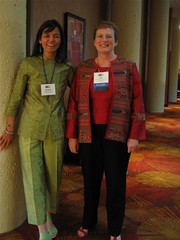
We had recently changed the name of the organization and got a new logo so it had become popular to wear the ICD logo colors of purple orange and green. Many evenings I drew with the colors various designs for a vest. Eventually I decided to simplify it to a green vest with orange piping which would be a good way to play down the most difficult color—orange. When I found purple jeans on sale in the Macy's boys' department I knew it was confirmation for my design. To dress up the vest I searched for textured fabric and learned from a book, on decorative vests, that I could create texture with ribbons woven into a fabric. I had found ribbon to match the logo green. It took longer to track down the right width and buy up all that was available—five spools of ribbon—than it took to weave them. The orange covered buttons was the final touch. I also needed a light weight shirt to wear under it since it would likely be warm. I had a pair of cool-to-the-touch, silky, white farmers pants from Thailand wide enough to cut up and sew into a pirate style shirt so I did that.
 And since Colorado was the heart of cowboy country I longed to bring my two toned Tony Lama boots. Which naturally meant a hat which I happened to find a week before conference. But I could not fully embrace this iconoclastic Cowboy symbol until I had brought in a Native American piece to it as well (to reclaim the damage done by the Cowboys). That I did with the two braids in my hair that I had been wearing of late and my hair pipe choker I had made as a teenager. These Native American touches also evoked the intuitive shamanic work I had been doing with my spirit guides. I had brought my shamanic rattle for the purpose of calling them in to help me. (It was given to me by a friend who got it at a climate change event in the Brazilian Amazon.) All this brought up that crazy making topic of cultural appropriation of minority symbols. Was it exploitive?
While in Denver I visited the Denver Art Museum with my pals and stayed longer so I could see the Native American collection which occupied an entire floor. I took in the "spirit shirts" of painted and beaded fringed buckskin and read the description of how Native Americans used clothing and artistic expression to draw power for ceremony or hunting events. I too was creating a spirit outfit to help me step into my full power. I also saw the military jackets from Victorian era uniforms that had been given as gifts; the recipients had incorporated into these samples of the white man's power clothing, their own decoration. This cross pollination gave me a more fluid definition of cultural exchange. I was borrowing two elements from American cultural symbology to help me make a business event my own even though none of it was part of my own heritage. It was pushing the envelope, but I was willing to risk claiming it.
I did however get the skin test for explosive residue as I traveled through SFO with my white cowboy hat. An Asian cowgirl carrying a backpacker's soft sided luggage on a vintage luggage cart was just way too suspicious.
From The Podium
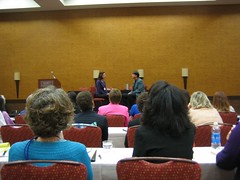
I memorized my opening remarks wondering if any of it would be funny. Just before I left my room, I thought of something absurd to say. I went on stage, I introduced myself and showed off my outfit. It was cautiously admired (but simultaneously complements were tweeted). I told them it took me 7 weeks to design it because all the details of conference had been so well worked out that all that was left for me to do was to guild the lily. This was not a common enough phrase to be funny, but the character that I continued to bring out at the podium was indeed something of a ring master. The language of hyperbole fell from my lips.
"It is my great pleasure to stand before this august body of intellectual and intuitive boldness," I said seeing in their faces the sense that I was trying to woo them. "You inspire me," I declared. Did they believe me? No I was clearly trying to flatter them. "This shirt used to be a pair of pants," I pointed out holding up an arm. The room burst into laughter. Yes that was an unexpected juxtaposition. The fun could begin. The rest of the conference was a matter of getting people on stage to introduce the speakers. I was merely the tour guide. But there was a piece of the action I could still claim. It was left to me to thank each speaker after each presentation and I was able to insert just a few words of summation into that space that took paying attention to what was their overall message. Most were simple enough to sum up, but there was one that defied definition.
"Thank-you Dr. Barlow for that fascinating intersection of stuff, art and death," I said widening my eyes as I tried to think of something more explanatory, but I was stumped and that got a laugh. Then I was free to do schtick.
"This is your captain speaking. We have now gained a little time in our journey and as a result are ahead of schedule, but please come back in ten minutes anyway."
By the second day, still wearing the same outfit, I had nothing new to show off so I decided I must sing. This was bold of me considering that music was not one of my intelligences. But I had the microphone, hummed a note, looked at my buddies in the front row and sang that rousing little ditty from Singing In The Rain appropriate to the 8:30 am hour as people took their time coming in.
"Good morning, Good mo-o-or-n-ing. We're so glad to have you back. Good morning, Good morning to you…." "Now you know why I don't do musical comedy," I quipped, but they seemed to appreciate it.
The first speaker Dr. Chabaud brought with her a guest, a poised younger woman who turned out to be of equal interest being an adult child of hoarding parents, but she wasn't scheduled to speak. Marci came up to me at the break and suggested I try to fit her in any way. This is the sort of in-the-moment challenge that gets thrown into the lap of the designated driver. So I figured out the logistics with the help of Jim who headed our management company and announced that we would have her speak during the lunch hour and answer questions that had come up with her introduction. We were having a box lunch so it worked out perfectly.
Coming into the home stretch we had to make a room change just before closing. These logistics took up so much of my bandwidth I could hardly think in the case studies session, but I was so in the groove by then that nearly everything I said was funny. I did get my closing remarks in and thanked everyone I could think of (remembering late that night that I had forgotten to thank the 40 or so volunteers who were running around taking photographs and handing off microphones). But finally I could hand off the role of program chair to the next year's person along with the hat which looked great on her and would be just as fitting in Nashville, our next conference city.
"And whatever you do don't say what a hard act to follow," I had told her beforehand (because that's what everyone says when I do schtick with a costume). She nodded saying "We'll just go with the positive, then". "Yes" I said. We were after all members of the same team.
And when it was her turn at the podium she simply said "Didn't she do a great job" as I hopped off the stage. When I looked up again everyone was standing up applauding. They were giving me a standing ovation! I was so dumbstruck my jaw dropped open. (This was one of those finishes that you just want to live over and over until you figure out why it worked.) The new chair turned on a music video she put together to drum up interest for Nashville; Jim came to the front of the stage in his orange polo shirt and did the wave to the music getting everyone to join in. It was indeed a celebratory finish.
When I got home I drove around for a week in silence, laughing at my own jokes and hearing in my head bits and pieces of things speakers had said. I had stepped into my power. Where do I go from here? I wondered.
Labels: ADHD, art, business, chronic disorganization, continuing education, fashion, leadership, livelihood, professional organizing, public speaking, social networking, speakers
posted by AK @ 2:03 PM
0 comments