Amanda Kovattana

Middle-aged musings in interesting times

Tuesday, March 05, 2013

The Kingdom of NAPO and the Intrepid Entrepreneurs


To seek leadership skills begs the question who is it that needs leading? This is the story of my love affair with an organization, my leadership journey there in and the bold energy of entrepreneurs.

The Intrepid

When I first went into business for myself I knew that I was fundamentally changing the way people came into my life. Through the energy of money I had made a pact with humanity that whomever was willing to pay for my services would have my complete attention and care. I would now experience money directly as an energy transference, appreciation for services rendered. I was stretched by this pact to accept requests from people I would normally avoid or who belonged to a group that made me uncomfortable. So as luck would have it, one of my first clients was a man, a psychiatrist. (I have since made my peace with psychotherapists, but at the time I found that the language of analysis so conflicted with my own story telling sensibilities that I was in constant turmoil with those who practiced it.)

The psychiatrist and I sat in is office at our first meeting and he laid at my feet wonderful metaphors about how his disorganization weighed him down like ten pound boots and he would be so grateful for help to overcome this lack he so clearly saw in himself. Over the year that I spent organizing his office, he ignored anything I suggested he might do to improve his situation. And in the end he blamed me for not fully supporting him (and his continuing habit of disorganization). I had made the mistake of thinking he actually wanted me to help him change his habits and our relationship would soon end. But for the duration he was a terrific reference. He would sing my praises to any prospect who needed an authority figure to vouch for my skills.

It is this willingness to engage with all comers not knowing the outcome that makes entrepreneurs my chosen tribe, especially organizers. Intrepid knights for hire. The term free lancer borrowed from the lance carried by those knights of yore traveling on horseback across the countryside. And so we too ventured forth. As organizers we walk into the homes of strangers knowing little more than what can be described over the phone. We do our work in environments that begin as unfamiliar territory. And in the early days of the profession we did it without credentials. All we had was our own self confidence and chutzpah. I marveled at how much could be made of so little. Unlike academia where it's best to know more than everyone else about a subject, an entrepreneur need only know more than the client.

I loved the energy of these intrepid women eager to take on whatever needed doing, taking you in with one assessing look. I could in a few minutes become so deeply engaged in conversation with a colleague that time was forgotten. Women would stand before me and tell me a stream of revelations most people were not even thinking about. We asked probing questions and practiced our elevator speeches with each other. 

We also raised the skill level of the profession by sharing information and teaching each other, creating workshops and conferences to do so. I owed a great deal of business acumen to my colleagues who challenged me to step up my professional image from bohemian sloppiness to creative consultant. We were drawn together by our shared value that environments be made functional and orderly, but also by an ethic of cooperation and honesty. Many a new organizer would come to a chapter meeting and feel overwhelmed by the sense of having found home among like minded people—a roomful of neatnicks. Some of us were not quite so neat, but I would not find that out until later.


The Kingdom of NAPO

The night I joined the San Francisco chapter of the National Association of Professional Organizers, the crown of leadership was being passed from one chapter president to another. The outgoing president happened to be a gay man, the incoming one—a straight woman. Thus in the passing of this mantle, a pair of women's shoes was also included. This was clearly an in joke. The shoes, it was explained, had been given the man at his inauguration by his predecessor (another woman) to gently remind him that he had large shoes to fill. 

This was clearly an arena of women in power. And it was easily observed that any gathering of NAPO members was 95% women. The kind of women that I feared most. The ones who commanded families, raised children, volunteered and in general represented a moral America that I had largely experienced as hostile to the immoral minority, i.e. queers, which is to say—me.

My only experience with organizations before this point typically filled a room with black leather jackets, at least two Mohawks and a group energy that would as soon break out into protests with boos and hisses as show its pleasure with the stamping of heavy boots on the floor. In short, at the prime age of 36, I had very little fraternity with women outside of the lesbian community. 

I had, luckily, already met the LGBT members of NAPO, including the chapter president. By lucky coincidence the annual conference, held the previous month had been in the Bay Area. So I was somewhat reassured that it would be safe enough to venture to a chapter meeting because I would at least have the company of a highly political, bisexual Jewish firecracker who was also a veteran organizer. (R.I.P. Hester dear) . 

NAPO-SFBA met at a hotel near the airport. The energy in the room that night was so electric it felt like a revival meeting. I was quite intimidated by it and did not stand up in front of the group when it was asked if any visitors were present. Nobody outed me as I lay low and assessed this new environment. 

I was simultaneously drawn to immediately join this cult-like entity and run for my life. As it happened there was a trade being offered that night. If a volunteer was willing to step up to the job of membership database management their membership fee would be waived. And so I volunteered.

The following year I traveled to Washington D.C. to once again attend the National Conference where I knew almost nobody in a room of some 450 women, but the incoming chapter president of NAPO-SFBA made a point to sit at my table at dinner and proceed to talk me into becoming the editor of the chapter newsletter. I happened to have both the desktop publishing skills and the writing skills needed to handle the job. 

This new leadership position went straight to my head and I proceeded to write editorials that both entertained and poked fun at our profession with very little attention paid to actual correction of typos and none at all paid to a business ethic. In no time I realized I had made quite a few enemies. Some of those I had slighted were women I admired and looked up to and I could not seem to ask forgiveness for I hadn't really done anything wrong.

Instead I opted to reveal my perceived role in this organization. I, who dared to make fools of the powerful, was at heart a court jester, a King Lear sort of fool. For this reveal I made a costume to wear to the end-of-the-year holiday party—a fool's costume in blue and purple satin complete with three pointed fool's hat with bells on each point. 

I made a business card to go with my outfit stating my title as Professional Fool in the Kingdom of NAPO, "practicing random acts of wit, wisdom and other foolishness for all occasions". I proceeded to hand out a card to every member to whom I felt I needed to make amends plus any other I wished to honor. And thus I charmed the most powerful women in the room into forgiveness and was, in turn, accepted as a contender. 

And as it happens with those who seek power, the day will come when that power is challenged. And I would learn that my heros were unable to adapt to this incoming challenge. And by taking their side I assisted in the splitting up of the chapter into factions. Much was discussed behind the backs of those involved until emotions were so high that my entire posse of heroes felt obliged to leave. And I found myself left to fend for myself where I felt so dismembered by the distrust of the opposing faction that I gave up my role as editor of the newsletter, a job I'd held for five years. 

From this I learned much about the politics of an organization and how to avoid going down this road in the first place. A year passed and to the credit of those whom I had perceived to be enemies I was given another job as chapter program chair which allowed me to facilitate what I really wanted to do in the first place which was to keep everyone from taking themselves so seriously. 

As program chair I was to get up in front of the 70 to 90 members who attended the monthly meetings and introduce speakers I had managed to find who would speak for free. The job had so much potential for theatre that I fully exploited the position with costumes and schtick dressed as everything from super woman to vintage head nurse. I raised the bar so high I could hardly get over it myself. But luckily I would again offend someone and have to quit.

Leadership, as realized in such an organization, was a creative endeavor supported by a shared idea of community. We wanted the party to continue and to do that we took turns to come up with a vision we could all get behind. Not all of my visions had been shared by others, but by taking these risks I had learned a lot about what did constitute good leadership and what would be controversial.


The Shire of ICD

Being predominantly perfectionists, the majority of organizers liked nothing better than to bring order to chaos, coming up with their own filing systems, labeling techniques, favorite products and assorted tips and tricks which they would later blog about. Some designed their own day planners, organizing software and executive management systems. There were, however, a few organizers who began to pay attention to  "problem" clients. These clients seemed to unravel back to chaos before their next appointment came around. Led by the innovative Judith Kohlberg, a sub organization of NAPO was formed called the National Study Group of Chronic Disorganization.

Over time the NSGCD put together information to educate colleagues about clients who seemed to resist every effort to organize them. We learned about right brain versus left brain thinking styles, visual learners, attention deficit disorder, obsessive compulsive disorder and the impact of earlier trauma on hoarders. These "red flag" clients were largely by-passed by the majority of organizers who deemed them "not ready". But there were a handful of us who were drawn to these interesting clients. Often we shared some of these tendencies ourselves or had relatives who did. We were also equally drawn to each other and so it was to this group that I gravitated and found home with the brainy nerds of the profession (as opposed to the ambitious product franchising types whose business model I found too daunting to follow).

The NSGCD grew and spawned a two day conference of its own, acquired international attention from organizers world wide and renamed itself the Institute Challenging Disorganization so as to streamline that mouth full of letters from five to three.

Last summer, Kim my long time conference roommate and a member of the board, told me that I was being considered for the role of conference chair of ICD. I was duly honored and intrigued. But why was I being considered, I asked her? I wasn't in any way an exemplary example of anything. She pointed out that I was already on the conference committee and I had all those years of experience as the program chair of my own chapter. Yes and I had learned a great deal about just how far you could push organizers in terms of presentable speaker material. 

I remembered fondly my creation of a character I named the Caterpillar of Perpetual Consumption. (Only Hester got the reference to famous nuns of queer culture.) I made the head of the caterpillar from a paper mache balloon which gave the microphone a hollow sort of voice when I preached to the audience about the virtues of overconsumption. I admonished them to buy more of everything, get things on sale, buy two for one always, drive across town and stock up because more really did mean More, was good for the economy and tax deductible to boot, not to mention patriotic. And anyone trying to preach otherwise was a subversive element operating in cleverly hidden terrorist cells and calling themselves agents of sustainable living. My amused colleagues thought this counter advocacy of everything we tried to discourage in our clients a hilarious take off on consumer culture.

The Caterpillar, of course, must transform into a Butterfly which was also part of my three minute performance. I was then able to explain the concept (introduced to me by biologist Elisabet Sahtouris) of caterpillar transformation as a metaphor for social change. How the Caterpillar would resist its impending transformation using its own antibodies to fight off the imaginal cells of the butterfly to which it would eventually succumb from exhaustion. These imaginal cells would then reorganize the molecules of the Caterpillar into an entirely new creature with an entirely different philosophy of living lightly on the earth. Thus we change agents who wanted to implement transformation need only align ourselves with the imaginal cells and eventually a whole new paradigm would fall into place. This idea appealed greatly to the ADD coaches in the room.


The Crown of Leadership

Inspired by this crown of leadership the ICD board had placed upon my head, I immediately set about to seek the kind of speakers I wanted to hear myself, though I had no particular plan as to how to do this. Wandering aimlessly one day I found myself at East West bookstore standing in front of a section marked Brain Plasticity (a favorite subject at the time). What better place to start a transformational change than through one's very ability to think. 

I perused every book in the section and wrote down the name of all the authors I thought might interest ICD members. And when I e-mailed them under the title of program chair offering a paid gig in Denver they magically responded. One author with a book on stress elimination was so intrigued by our mission to help those challenged by chronic disorganization that he dropped his usual fee of $7,000 to $2,100. Another author had a book celebrating ADHD as an example of brain neurodiversity. I knew this author would be well received given our ADHD certificate requirements and how we loved positive ways of viewing our clients. With two stellar speakers in hand I was confident that the fates were favoring me. I prepared myself for our 2012 conference where I would be announced as the next chair. 

I would naturally have to have a costume to express my eagerness to lead our merry band of intrepid organizers to Denver. Given the geography of the 2013 conference destination our theme was "climbing to new heights". I considered what I would have to do to board a plane to Chicago (which was mountain-less) with full climbing gear, possibly including an ice ax and crampons. 

After much study of vintage climbing photos I saw that all I really needed to gear up was a ten foot length of rope looped around my body and a vintage style canvas ruck sack which I already owned plus a natty hat. Thus outfitted I was read to run up on stage at the end of conference wearing lace up leather boots, a red canvas fishermans' smock tucked into into khaki knickers and a waxed cotton field hat. With my ruck sack slung over my shoulder and a compass in my hand, that was all I needed to convey the exploratory nature of our adventure together. I was also to find that the phrase "brain plasticity" was quite funny in such a context allowing me to roll in plenty of other jokes including one about ADD being a useful skill in mountain climbing. It raised the energy in the room from end of conference let-down to celebratory. I couldn't be happier to be on board.

By January I had filled the eight presentation spots and had a strong committee to support these efforts. If leadership was about fostering an atmosphere to bring out the best in everyone it was certainly bringing out the best in me. Our speaker topics included working with clients with dementia, peer counseling as a resource for hoarders, the impact of hoarding on family members and collecting as an art form from the perspective of a film professor (my personal favorite), plus an ask-the-organizer panel and a case study session. 

It was a program that brought new material to our core interests and would fulfill many certificate requirements; something to be proud of. I was amazed at how the whole thing had fallen into place with such grace. Everyone was pleased with it. So far so good. The conference wouldn't be until September leaving the whole summer to come up with ideas to enhance the conference experience itself and come up with ways to promote the event. It was for these challenges that I had asked for help.

The ICD conference "Climbing to New Heights" will be held at the Sheraton in downtown Denver on September 19-21, 2013. Online registration is now open.
http://www.challengingdisorganization.org/content/2013-conference-speakers

Labels: , , ,

Monday, April 16, 2012

The Making of a Closet Stylist

It was not until mid-morning on my first day working with the closet designer to the stars that I actually understood that there was a niche for closet stylists and that I, in fact, could fulfill that niche.

When I put my shingle out as a professional organizer, 17 years ago,  there were basically two markets, residential and business. Business organizers offered their clients systems that would increase efficiency and productivity, while residential organizers had clients who were, either, situationally overwhelmed or chronically overwhelmed. (There were enough chronically overwhelmed clients to create not only a niche, but a field unto itself spawning research into brain styles and a chart to categorize levels of clutter.)

Situationally overwhelmed clients included deaths in the family (stuff to be cleared out), marriages (two of everything), births (lots of new stuff), old age (downsizing of stuff), and moves (getting stuff from here to there). These niches were claimed by estate organizers, senior move managers and regular move coordinators. A sub category of moves included homes being remodeled (stuff moved out and back in again, but needing to be stored and accounted for in the interim). It is here that the niche of closet design fits in. But unlike those closet companies with glossy ads in freebie newspapers, who offer five designs and shoehorn your pick into your existing space in a day or two, Linda London LTD is a full service, high-end, company who will create architectural drawings, design spaces for every item you own, engage cabinet makers, stock up on your favorite sundries and then arrange everything in the new space in such a way that your aesthetic socks will be knocked off every time you open a drawer, a cupboard door or closet.

Being handy with power tools, I have offered my clients such custom closet installation services myself (minus the sundries shopping), but the comparison hardly bears mentioning. My clients have tiny closets in 1930's houses. Linda has reinvented the term closet. As one colleague described it, her closets have closets. Many of her clients' closets are the size of studio apartments.

Team Organizers

Those organizers who take on the responsibility of big jobs have my complete admiration. They also tend to be single with mortgages to pay. They fully admit to stress related health issues and are in danger of having no life. They also hire their fellow organizers. Thus it was that my colleague Kim asked me to join Linda London's crew on a job not far from my own house.

Kim, like me, specialized in chronic disorganization which essentially means we work with people most would call difficult, but we find to be interesting. She was referred, by a trusted masseuse and an old friend of Kim's, to a Big House client for a move job. This Big House client led to another where she met Linda who was doing the closet remodel. Linda's West Coast clients regularly flew her in from New York to follow the progress of the remodel.

She had a broad New York accent, a wonderful laugh and a tendency towards appreciative hyperbole that made working with her feel like a party. She also looked so much like Fran Lebowitz, the witty New York essayist, that I felt compelled to ask her, at lunch my first day, if people mentioned the resemblance.

"Only when I was younger," she said, nevertheless pleased at the reference.

Our job was to follow her around as she delegated tasks to each of us. The tasks were so simple I thought they were being delegated to the maid. "Turn these hangers over," she directed. And that's what we did for every single item of clothing that had been moved in on their old hangers. Custom hangers were part of Linda's package.

My colleague Priya, a calm and reassuring veteran organizer of big houses, helped me with the hangers in the Mrs' closet. I had not had a chance to get to know Priya, but by the end of the hangers I knew how she came to the US, what languages she spoke and her opinion of the film Slumdog Millionaire, particularly its depiction of India, her homeland. Her area of expertise was the kitchen and she was to win over the family's chef with her suggestions and organization.

We carefully spaced the hangers just so, being sure to keep the clothes in the exact same order as requested. Linda did ask the maid to arrange the ties in the Mister's closet, but she wasn't happy with the result and asked me to do it. I already knew what she was after and so I rearranged the ties in a pleasing chromatic order making sure the tips were hanging even. Four racks of ties—blue, red, green and miscellaneous. She was so pleased she gave me a hug.

"I did not go to art school for nothing," I said happy to please her so soon. Linda herself was completely self taught, guided by her passion for all things having to do with cabinetry and making things beautiful in them. With each job she took on more challenging assignments often learning the hard way how materials worked together or didn't. After years of challenging herself in this way she appeared to have no equal. Her meticulousness and her products were top of the line. On her jobs I learned, not only the family tree of hangers, but the hierarchy of drawer liners. The humble shelf paper raised to a pinnacle of luxury I never knew existed.

My clients ask for Contact Paper in those kitchy patterns that date a kitchen long before they wear out, but no such thing ever graced a Linda London job. The clear plastic liners with ridges favored by most organizers were allowed in the pool house or guest house and some kitchen cupboards. These I could cut for her (less a sixteenth of an inch for ease of fit), but shelves frequently used by the staff were lined with thick sheets of plexiglass, while those that would be touched by the owners themselves were glass half of an inch thick it looked like, their polished green edges a visible element of the design. Both plexi and glass were custom cut by a specialist and installed by him on the site, preferably before the shelves were filled and the client had moved in. Linda had also lined shelves with Corian stone and stainless steel she told us.

It was, however, the drawer liners that took my breath away. I'd never seen a custom fit box liner before. The tolerances between the drawer and the liner boxes were so intense that getting them into the drawer against the air pressure was a feat in itself. Linda took the measurements of each drawer, herself, once the cabinetry had been built. She had also counted and taken the measurement of every item the client put in their drawers in order to make the liners with divisions so each item (or group of items) had its own cubby, each piece of silverware its own slot. A specialist in another state then crafted these liners, covered them with ultrasuade or felt of specified color. (Fewer choices offered now with the recession, but you can still get deep purple). For the spa Linda preferred plexiglass liners, an even more unforgiving material. On this job one of the larger ultrasuade drawer liners didn't fit; a measurement mistake by the liner maker. This happened Linda said and told me the workmen took the mistakes home and used them as pet beds. I took this one home and made it into a bookcase.

The Big House Perspective

When Linda came to know me better for my eco salvaging ways, I amused her by telling her I lined my drawers with cereal boxes, specifically Raisin Bran because they were so cheerful in an op art sort of way. This passed muster because at least it had a look. Priya and Kim had both wondered how I, as an environmentalist, would react to these Big House lifestyles—the excessive carbon footprint of it.

"Ah well, I check my values at the door," I said, but I did admit to being sent over the edge by the floor to ceiling cupboard devoted to the storage of incandescent light bulbs. But then the next day I discovered that the house electrical supply was supported by a field of solar panels and that there was a green dumpster on site for all the cardboard boxes we unpacked. There was also a kitchen garden complete with deer proof fence, architecturally designed to match the house. I was happy to admire these considerable efforts. That I would otherwise judge struck me as hypocritical.

The Big House lifestyle was already a part of my own history, bringing up all the complications of extended family and house staff, private schools, great expectations, money and responsibility. If I reached back far enough I had my own Big House reference. It was the house of my great grandfather in Bangkok. I visited it throughout my childhood, but it was so big I was never able to form a complete floor plan in my head and in memory it is a series of disjointed rooms, a parlor, a huge rambling kitchen, adjoining staff quarters, a series of linked gardens full of hanging baskets of orchids and a terrifically large front lawn that later filled up with small houses built for grown children.

The grand front entrance of marble steps was the most prominent feature of the house; the first floor also paved in white marble paired with dark wood paneling. Stiff chairs of dark wood inlaid with mother of pearl graced the rooms. The second floor had a bedroom for each of the wives (nine accounted for on the family tree).

On the third floor was the shrine to the ancestors. The ashes of the ancestors kept in little drawers inside a very large Chinese armoire. The inside of the thick heavy doors carved with scenes depicting the activities of travelers as they proceeded down a road back and fourth across the door. I was so impressed with this armoire, when I was shown it at the age of fifteen, that my uncle asked me if I would like to take it home, just the door that is. This would not be the only time that I would be offered such exaggerated gifts and I came to see it as an affectionate test. The first part of the test I had passed by identifying the most expensive item in the room. The second part of the test I usually failed by looking horrified. There was too much attached to owning such an item. By refusing to take on such things I retained my freedom to be unencumbered not only by the lifestyle of such possessions, but by the family obligations that came with owning them. As a teen I embraced the song "I Got Plenty of Nothing" as an anthem (as sung by Barbra Streisand—irony of ironies).

One move-organizer told me that handling envy was one of the problems of finding organizers to work on their teams for Big House jobs. This startled me. Sure, everyone wants a little more wealth, but wealth on this scale had its own burdens. On a practical scale these houses were cumbersome to manage and required a full time staff. This took up way too much time, especially for the wives. Plus there was all that walking just to get from here to there. I was happy to enjoy the museum grade art and furnishings and still be able to walk away at the end of the day.

"The scale of these houses does something to people's minds," Kim said. This  prompted me to wonder what skill set one needed to work a Big House job. Perhaps it was like standing on the floor of Yosemite Valley. You first feel insignificant. Then you try to remember who you are. Many feel a need to prove themselves and give their full attention, ready with an opinion, but that can be exactly the wrong thing to do when what's required is to take up as little mental space as possible while doing simple things extremely well. Otherwise you risk becoming clutter yourself. Some wanted to prove themselves by working fast, but haste makes the house staff nervous because it increases the potential for damage and breakage. Unpacking and putting away the Bacarat glasses (priced at $350 a piece) is best done as a zen exercise. What was needed, I concluded, was a Big House perspective to find one's place in the scheme of things. What I needed, it soon became clear, was a new wardrobe.

Sartorial Answers

For jobs requiring opening boxes and cutting sheet material I liked to wear painter's pants because the pocket down the leg is perfect for a utility knife. But on these jobs there were often so many workers on the site that each trade had it's own uniform. Painters wore painter's pants, carpenters wore carpenter's pants, movers wore polo shirts with their company logo on them, gardeners wore white t-shirts, blue jeans and sometimes high visibility vests to avoid being run over by incoming traffic. Designers often wore black and anyone who went into the house had to wear booties over their shoes or change into white Crocs (those orthopedic, big hole foam clogs originally made for spas). Priya and I carried ours from house to house in blue nylon bags we happened to have on hand. In a Crocs house it was the job of the house manager to find you a pair.


In order to lose the painter's pants I had to find work pants that would actually cover my ass. The trend in women's pants had waistlines so low, they appeared to be designed to show off your thong underwear. And men's pants had dropped their smallest sizes with the advent of the hyper baggie look. So I turned to boy's sizes in school uniform pants. Dickies had them with a pocket down the pant leg just where I liked it. The wrinkle resistance and stain resistance didn't hurt either, plus the high polyester content slides well on floors. In black, charcoal and silver grey they would do nicely. The Dickies logo gave me a brand name that imbued me with a sense of pride and irony at being a member of the working class working with my hands, a category that had left my relatives horrified.

But what to do about shirts? The navy blue of my Thai farmer's shirts worked for awhile with all the pockets, then seemed too ethnic. Button down oxford shirts were fine, but in the world of designers they just seemed too square. The rest of my closet was filled with oversized men's shirts I had bought at Goodwill in the colors and designs that men found too effeminate, so had thrown them out early before they were much worn. I had been experimenting with different ways to resew them to fit. Shirt hacking I called it. I got bolder with the process and decided to get rid of the buttons. Buttoning up shirts took too long. I took off the too big collar and cuffs. I borrowed techniques from renaissance costuming and added ruffled cuffs. I was pleased with the results—a pirate shirt in corporate pinstripes! All in durable, easily pressed, recognizable fabrics. For five dollars and five hours a piece I could make a new shirt every week.

I was spurred on when Kim told me she had a job for me working with a client who had his own stylist—an assistant who picked out his clothes, shopped for them and laid them out so things would go together. She was said to be the confident of the client so very high up in the ranks. I was intimidated, but as I sewed I imagined becoming this stylist's most valuable player on the job, and looked forward to spending a great deal of time with men's shirts. I still felt that my true calling was to work with clients one-on-one, motivating and training them out of overwhelm, but I was grateful to have this work. The few times a year that such jobs came my way they were good money. (Everyone at these houses was so well paid that a culture of graciousness and uber politeness pervades.)

The room size closet this stylist and I would work in had a cove ceiling painted in an art deco style with bold geometric stripes in metallic colors; hidden lighting around the perimeter illuminated the design. When Kim brought me into the room, the stylist was telling the contractor where she wanted the belt racks. Like all the young women at this house, she wore skin tight fashion jeans, but with a V neck sweater that gave her a collegiate look. We waited until she was done, then Kim introduced me. She shook my hand warmly, then looked intently into my face and said she knew me from somewhere. I searched hers, but did not recognize it.

"I have no idea where from," I said for I was far from home, having come all the way to Los Angeles for the job. I wondered what it was about me that looked familiar. Was it my stylin' pill box hat (made in Nepal of fair trade hemp)? This was an outcome I hadn't expected, but any resemblance to a known person appeared to be a good thing in these parts. Meanwhile Kim was extolling my virtues as the most precise organizer of men's clothing. Who knew? I was in, I had a niche. I would go home a little richer despite myself.

Labels: ,

Friday, October 07, 2011

A Tale of Two Sculptures

At a recent conference with the Institute Challenging Disorganization, speakers offer insights on shopping that further explain my search for a cosmic connection. Hint: It's not shopping.

A Tale of Two Sculptures

While in Raleigh, North Carolina for a conference with the Institute Challenging Disorganization, I arrived a day early to take in the sights. Diane, a fellow organizer and historian, invited me to join a few other colleagues on a tour of the town. She had rented a car and scheduled a full itinerary.

My plane came in later than all the others, so I did a bit of my own research and found a public bus going into town that would allow me to catch up with my friends. And through the miracle of cell phones and good timing, I met them on the sidewalk just as they were walking up to the capital building which I had just had time to tour on my own. The group was headed for lunch at a local vegan restaurant discovered by Margaret, our organizing colleague and vegan blogger. (The presence of vegan dishes in any town is a good indication of how hip it is and Raleigh was very accommodating on that score.)


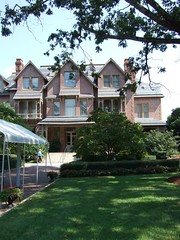
After lunch we headed to the Executive Mansion where we were to enjoy a tour that could only be had if reservations were made at least a week in advance. Since we were so well organized, courtesy of Diane, we were admitted as promised and were welcomed by ladies of a certain era, eager to show off the Southern charm of the mansion. The four rooms we were permitted to see were decorated in the lush manner of stately homes with pastel blue drapes and pale yellow wall paper. But at the top of the stairs, back lit by a tall window, stood a large, modern glass sculpture that looked about as out of place as the slab from 2001: A Space Odyssey.

It was of a translucent aqua glass; the top was rounded like a tombstone and there was a square hole in the middle of it on a rakish angle. A narrow space split the piece down the middle from the tilted opening to the floor. 

The docent took her time telling us about each of the rooms pointing out the high quality of the crystal chandeliers, the cut glass punch bowl, the needlepoint done by local ladies, the china engraved with the state seal and the portraits of all the wives who had lived at the mansion. So it was not until the end that Diane asked about the unmentioned sculpture at the top of the stairs.

"Well that's a very controversial piece," said our docent. "I don't really understand it," she added. She then brought over a lady of authority who told us everything she knew about it. It was a gift we learned. Obviously one of those awkward gifts from an important relative so had to be displayed. It was created by a Czech artist and was made from lead crystal. It was worth half a million dollars. The back was completely flat, she told us, as if this was a deception that should have rendered it half the price. And, as a clue as to its burden on them, she concluded that it took eight men to move it into position. So no putting it away when the important relative had gone. She remembered one more detail. It was not always blue. At night it turned to a deep grey. For the ladies, this last feature seemed to add further deception, but gave it a mysteriousness that hooked me. It made the sculpture seem alive. 


I thought no more of it until the next day when we toured the very modern North Carolina Museum of Art. This eco building had been a prison and was now remodeled with a climate controlling sheath that filled it with natural lighting and kept it cool, plus it had a water catchment system that emptied into a garden. It was at the cultural opposite end of the spectrum from the mansion downtown. Inside I perused the paintings in the modern collection and the found-art metal sculpture from South Africa, then came to a large, bottle green, glass sculpture the shape of a triangle. It had the same worked edge as the blue one at the mansion. Chipped like a flint arrowhead. Was this another piece by the same artist?

A museum docent helped me find the name of the artist. There were two artists and they were indeed Czech. She did not know about the one at the Executive Mansion so asked another woman on the staff who came over and told me it was a temporary exhibit. She seemed not to have been to the Executive Mansion, but when I described the blue glass sculpture she asked me if it was called Vestment. I didn't know. The name of the piece and the name of the artist was not given by the ladies at the Executive mansion.

"Did it look like a vest, a garment?" she asked. Well, yes, it could be a vest. This being modern art you never really know.

"I think I know it", she said and was satisfied. But I was not content for the story to end there.

"You really should go and ask for it. They wouldn't miss it," I told her. "They think it's controversial." That such a benign piece would be considered controversial seemed to startle her, but I could see that it was not her place to go across town to ask for a sculpture at the governor's mansion, however misplaced. 

I couldn't leave it alone though, and when I returned to the conference I told the story to a few friends. Margaret, seeing my passion for this story urged me to write to the newspaper suggesting that it should be moved to the more appropriate setting of the museum. But I was not looking for a project. I had done my job. In my mind the younger woman from the museum would venture to take a tour of the Executive Mansion so she could see for herself how misplaced the Vestment sculpture was. And then she might bring it to the attention of someone of higher authority who would eventually manage to have the statue gifted to the museum. 

I had done my part. I had made myself available as a messenger, a molecule of connection in the larger scheme of things. I was a part of something larger that may or may not be meant to happen. 

That night, I described to my conference roommate Kim, that when I was traveling through England over the summer, I had the sense that everywhere I went everything was happening exactly as it was supposed to happen and everyone I sat down next to was exactly the person I was supposed to have a conversation with. 

'I've had that happen," she said. But what was it?, I wondered. This sense of being a part of something, but not having to try very hard to make it work. For I wished to remain a cosmic slacker and appreciated things even more when they came easily. 

What is Shopping?

Last year at the same conference I had been fingered in one of the coaching surveys for possessing an anti-social element in my character. I was guilty of too much independence. I was not contributing to my community. 

"You might want to change that", said the coach who had offered the survey, "for you could be perceived as uncooperative". 

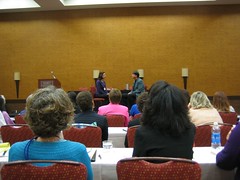
And so I found myself, while choosing a desert at lunch, saying something to the conference chair about the next conference which was on materialism. This prompted her to beg me to join the conference committee. And so we named the conference "Acquiring Minds: How We Think Act and Feel About Our Possessions". As a result of my participation and rather little effort on my part, an old friend of mine from a writing group I belonged to some 20 years ago, was going to speak on the topic of world cultural habits regarding shopping. And I would join her on the stage as part of an ad hoc international panel made up of our foreign organizers from the Netherlands, Australia, Canada and Japan, with me representing Thailand.

As I spoke, to the 140 conference attendees, of my shopping experiences in Bangkok, I felt myself describing a sort of shopping Shanghri La. I evoked visions of marble palaces filled with politely bowing, costumed staff welcoming customers into acres of the finest goods the world had to offer. (That is if you were looking for the latest status items from European designers and could pay the luxury tax.) Only the organizer from Japan could come close to such a customer oriented experience. Asia had fully grasped and exploited this ritual of modern materialism.

The next day, in keeping with the conference theme, a speaker, who was an expert on point of sales marketing, gave a humorous presentation on the tactics used in his profession to make the public buy more, especially of things they don't need. 

"Need is a four letter word," he told us. (If people only bought what they needed profits would stabilize, i.e. stagnate which was worse than death in a growth oriented capitalist system.) As I listened to him I realized that he was the high priest of this shopping religion.

"Mark it up, mark it down, move it out," he said making the sign of the cross in reference to his Catholic background. The phrase summed up his entire thesis. In-store marketing was designed to create an experience that made the shopper feel they were a part of something bigger, that they were having an interaction with a community, be it a brand or an event. The emphasis on novelty and change, competition with others, how you felt about your role in life and the perceived value of items when on sale or discounted, were all part of creating a dynamic setting that made you want to return to the store to see what was new. And that was the whole point. 

For the shopper's perspective we had a very special speaker, who swore us all to confidentiality as to her station in public life, then generously presented photos and details of her secret life as a compulsive shopper and hoarder. She was used to her cluttered house, she told us, because she did not see the excess of things in it. After all she could still move around. She swung her arms around to demonstrate. Take a picture and show it to your client she advised. A picture makes you see. And see we did, all the clutter sprawling across her living room to her kitchen.

She spoke of the thrills of ownership, of her delight in things. Her sense of power to be able to buy anything that caught her eye. How the bidding on e-bay made her ever more competitive. How easy it was to pick up the phone and buy what she saw on QVC (a TV shopping channel). How she had grown up poor and didn't have the pleasure of owning stuff. Shopping was an itch she had to scratch—a lot. But with the help of her professional organizer she had begun a program of reform and had devised a way to scratch that itch without actually buying anything. This was done by looking at catalogs. And here she acted out how she carefully circled the things she liked, folded down the corners of the page and set it aside. Then she diligently worked to give away what filled her house.

To be addicted to shopping is the acceptable addiction pointed out a third speaker. Our society and economic system wants us to buy more than we need. This speaker, a psychotherapist, had devised a treatment for compulsive buying disorder. It included an arduous, record keeping cure that involved writing down everything bought that day with the price. This daily "weigh-in" is then analyzed and each item ranked as to necessity. The money spent on unnecessary items is added up; the patient then sees how much money she has spent on what she didn't need. The patient is coached to change her conversation from "how can I use this attractive thing" to "do I really need this, how will I pay for it and where am I going to put it".

My hoarding clients bring home things they find left in bags and boxes on the sidewalk with signs marked "free", put there by their neighbors. The opportunity to rescue and possibly make use of free things (usually by giving them to someone else) gave these clients the same feelings of discovery, novelty, self-worth and interaction with a dynamic world.

"It was just there on the sidewalk like God had put it there for me to find," said one of my clients about a blue plastic box she had picked up that turned out to be just right for something she kept on her cluttered desk. (I forget what. Rubber bands maybe.)

Dancing With The Cosmos

Marketing experts aim to recreate that feeling of being in the right place at the right time, receiving if not a message from God, then at least an inspiration to buy. 

"Logic makes you shop, but emotions make you buy" said our guy in marketing. Whether free or paid for, the emphasis is on things. In a material world what is it that can replace things? My experience of everything happening exactly as it was supposed to happen, gave me an inkling. A series of experiences that are satisfying just as they are. A conversation with the cosmos. The universe answering in coincidences.

It was a coincidence that I had seen the two glass sculptures by Czech artists. No one else in the group had seen that. It spoke only to me. Perhaps, as an organizer, I simply wanted to put a like item with a like item. Or, on a psychological level, I had identified with the sculpture being trapped in the wrong culture and wanted to find it a more suitable home where it would be appreciated. Or on a cosmic level the sculpture was appealing to me to send a message. "Help me Amanda Kovattana, you are my only hope."

The psychotherapist, left us with a final thought. "You can never really get enough of what you don't need." 

When everything seems to happen exactly as it is supposed to happen you are content and do have all you need. But more than that. And I cannot seem to name it. There is a mystery involved, partly planned, partly luck. Co-creating with the universe is a popular way of putting it. All I can offer is that it won't clutter your house and it won't take eight men to move, but it will be dynamic, require a more subtle receptivity and the sense that the conversation is ongoing wherever you are.

Labels: , ,

Monday, October 11, 2010

An ADD Thing Happened On The Way To The NSGCD Conference

Recently I received a call from a young woman looking for an organizer for her parents who were hoarders. I took the job and it turned out to be a good fit. When I realized that I had been referred by two other organizers (who were already booked), I asked the daughter where she had found them. Like most of the younger generation she had done an Internet search and had come across the database of the National Study Group on Chronic Disorganization, the NSGCD, an organization I had joined at its inception nearly ten years ago. I called them up to find out why I wasn't listed in the database.

"Your membership hasn't been paid up since 2003", I was told.

"What?" I was stunned. Could I seriously be so disorganized that I didn't even realize I was no longer a member of an organization that was so vital to my development as a professional organizer? In fact I had, only a few weeks before been a speaker on a panel recommending the educational benefits of the organization. True, I did belong to four other organizations that required yearly dues and it was easy to lose track, but the irony of this particular oversight kept coming up in my mind, rubber stamped with the label ADD (Attention Deficit Disorder).


No one in the organization had once questioned my status, despite my having attended the annual conference every year professing to be a long-standing member. This I attributed to my ability to project such confidence that people assumed I knew what I was doing. After all I hung out with the upper echelon of leadership. But maybe that was because I was raised to rub elbows with royalty, I mused, thinking of my Thai grandmother. (Though, of course, one is not actually allowed to touch Thai royalty.)

When the NSGCD was still a special interest group within the National Association of Professional Organizers (NAPO), I was rooming with Judith Kohlberg at the annual conference. She had founded the NSGCD to talk about these interesting clients.

"I'm the rebel in the outfit," she informed me.

At the time, organizers were intent on setting up systems and training clients to use them. Judith was suggesting that disorganized clients see the world differently and needed different systems they would be more inclined to use. She coined the term chronic disorganization to describe clients who did not claim a medical diagnosis.

This alternative approach appealed to me. I, too, would be a rebel organizer and learn from my clients. A few years later the study group was formalized into its own entity holding an annual conference to train organizers on how to work with different brain styles. In the meantime time another of my leadership angels, Denslow Brown (originally introduced to me by a mutual friend), had undertaken in-depth testing to confirm that she did indeed have ADD. She began to give workshops on what systems best worked with this learning style.

This additional information was tricky. When I first learned about ADD, I recognized that I could easily claim many of the symptoms, but as soon as l embraced the diagnosis it just allowed me to fall apart altogether. Better to continue to perform as expected and take the heat for the usual mistakes that came from getting distracted. It was only recently that I realized that I simply performed better under a certain amount of stress because it focused my mind. And the advantage of ADD is that this hyper-focus will deliver. The rest of the time I was held together by coping techniques devised from experience. Having a roommate at conference, for instance, helped tremendously.

Kim Anker-Paddon, my conference roommate, for the last several years, always booked the hotel room long in advance. For this I was immensely grateful. It was hard enough for me to book my flight since dates unnerved me, due to frequent crossing of the international dateline. I had more than once had to rebook flights because I hadn't calculated correctly when I was supposed to be somewhere.

Kim joined NAPO when I was program chair of our local chapter meetings. At the time I was convinced that professional organizers took themselves far too seriously especially regarding our image as business people, thus I was intent on imbuing every meeting with a certain level of theatrics, which usually required that I design a costume for the event pertaining to the topic of the evening. Thus when we had a speaker on finances I made a vest covered with coins and wore a bowler hat in the tradition of British bankers. And when the topic was marketing I made a headpiece with letters cut from blue cardboard so that on one side of my head the letters WWW appeared and on the other side the letters COM. (Having a website was very cutting edge at the time.) My colleagues loved this little bit of entertainment. They were a very forgiving audience and laughed at all my jokes; this endeared them to me for life.

Kim was without a roommate because she was afraid of keeping a colleague awake with her snoring, but I persuaded her that that wouldn't be a problem since I was hard of hearing. Besides we shared a common perspective, having lived outside of the US as children, and we would need this support when traveling to the middle of the country. This time it was Texas, but luckily Austin, Texas, which I had heard more resembled a suburb of San Francisco and bore very little relation to the home state of the Bush family.

When I told Kim how I'd discovered I had failed to pay my membership since 2003 and would have to fess up to my ADD even though it hadn't really been a problem before, she explained that ADD was a continuum. Some were worse off than others. She was well versed on the subject as she had a brother and a daughter with ADD and had certified as an ADD specialist. That was another thing I had neglected to do, but now that I had moved into performance mode, I was going to jump in with both feet and do two levels of certification in the space of a few weeks. This would get me listed higher up on the database.

"You'll want to do the certificate on hoarding too", Kim told me when I announced my plans. It was being offered for the first time. I signed up for two exams because you couldn't get the hoarding certificate without first getting one on chronic disorganization. I had long ago read the books for the first so prior to conference managed to read three and two halves of the five required books for the second. I was confident that I would perform my way through both exams if I just managed to get there.


An hour before the exam I got dressed and sat looking apprehensively at the sun setting over our splendid view of Austin from our hotel room, while Kim did some last minute review. Getting places on time made me nervous. The previous month I had, as usual, been perfectly punctual to a client's house only to find that I was at the wrong house. I had mixed up addresses with another new client. (Fortunately the second client was used to disorganization and didn't give it a second thought when I showed up half an hour later.)

Not many organizers purposely seek out what we loosely call the CD population—the chronically disorganized. Organizers, on the whole, liked to see results and working with the CD population took patience as far as visible results were concerned, especially with hoarders. Often my colleagues were puzzled by those afflicted with chronic disorganization, but even more so by their ambiguity about getting things done. As one organizer put it, "They are so illogical."

"But that's why they are so interesting," Kim said when I relayed this sentiment. Exactly.

My hyper organized colleagues were more ambitious than I was, eventually gravitating towards mega projects involving moving large households, or estate jobs (liquidating the households of dead people), or setting up complex business filing systems, or various event-planning jobs with non-negotiable deadlines. These jobs paid better, filled up a workweek nicely and tended to follow schedules according to carefully laid out plans. Plus they had less chance of a cancellation.

The NSGCD attracted organizers who were process oriented as well as results oriented. Plenty had relatives with ADD or hoarding issues (or were secretly disorganized themselves). Psych majors turned professional organizers and a handful of psychologists, collaborating with organizers, rounded out the group. Mental health specialists were often engaged as speakers.

Not too long ago a handful of psychologist discovered hoarders and left the sanctity of their offices to enter the "field" to categorize and label extreme cases for which they then devised "treatments". We at the NSGCD eagerly listened and watched as the research evolved. These clinicians borrowed liberally from our organizing techniques, then proceeded to apply cognitive therapy techniques as they talked to their subjects about their stuff. They wrote papers and entered a new diagnosis in the DSM, the guide to pathologizing the known universe of the human experience.

I happily absorbed all the new information and just as happily ignored it when working with clients. It was not my responsibility to diagnose clients and the corresponding treatments only added to my brain clutter; I feared it would impair my ability to listen, not only to my clients, but my intuition. (If a client volunteered a diagnosis that was different. My learning could then provide that vocabulary too and we could discuss it openly).

One psychologist, on a panel at conference, complained that our lack of training could make clients worse. With OCD (Obsessive Compulsive Disorder) cases, for instance, when we enabled their perfectionist compulsions. But we were often the first responders for these clients; and if they didn't like what we were doing out we'd go and along with us a possibility of improvement.

I did have an OCD client, but once she came to trust me I rather enjoyed torturing her by theatrically destroying valueless things she wanted to hang onto. After I stomped down a pile of empty Kleenex boxes, she asked why I had to smash them (which would prevent her from retrieving them once put in the recycle bin). "I have to have some fun on this job," I told her. I didn't get a laugh, but I did get acceptance.

My clients were not extreme hardcore cases; they just wanted to get organized. Many kept me coming back because I was an adept conversationalist able to both field and introduce topics to pique their interest. Like them, I was in search of the larger meaning of everything (no topic was taboo from politics to God). And somehow, as we talked, whether it was a little or a lot, while working through their stuff, the larger meaning of everything also managed to prioritize and clear a room. (It helped that I was a speed paper sorter and adept at visualizing space. Plus I had figured out how to set-up my environment to save my butt rather than sabotage it.)

I put a lot of stock in this conversational glue. It generated energy, put the mundane tasks in perspective, side stepped a lot of emotional issues and bonded us as a team. But it was not something I could teach in a workshop. Nor could it be formalized as a treatment. And that is the difference between an entrepreneur and a clinical practitioner. We get to try anything we think will work; we can set boundaries wherever we see fit and because we are paid directly by clients we are driven to learn—quickly. By definition we defy any consistency of standards. It is our hard won experience that develops us and we start with incredibly diverse abilities and skill sets.

Just putting all these organizers in a room created a rapid-fire exchange of ideas, opinionated personal dynamics, a myriad of brain styles coupled with a high level of confidence and a broad spectrum of belief systems. If there was anything we were willing to agree on it was that all our meetings be run on time. It was downright intimidating—which just brought out the best in me.

Kim and I got up to take our exam(s). She asked my fashion advice.

"Which shoes should I wear red or black?"

We would both pass easily and spend the rest of conference heatedly examining all the new information, each speaker and what it all meant. We stretched each other.

"Curtains opened or closed?" she asked when she returned to the room to find the drapes partially closed on one side. (I was blocking neon light from a building.)

"Is that the only option?" I teased. "What if the window was actually only that big?

"Oh all right," she conceded.

Labels: , , , , ,

Earthworm. Get yours at bighugelabs.com