Amanda Kovattana

Middle-aged musings in interesting times

Friday, July 22, 2016

It Takes A Village To Live Tiny

In early May after my return from Canada, Catherine told me that she felt our domestic arrangement had come to an end and it was now time for her to live alone. She asked that I move out by September. She said the same to her brother Steve. I was stunned and devastated. 

"Where shall I go? What shall I do?" I wanted to say in Scarlett O'Hara fashion.

"Frankly my dear I don't give a damn," said the the Bay Area housing crisis. I gave myself a month to wring my hands and absorb this shock. I had known my living situation was without a future in the sense that we were no longer in a committed relationship, but I had put my money on the mutually beneficial arrangement of my staying which had been going so well these last two years. That with all the care the two dogs demanded and the shared meals I made, the gardening and household chores I helped with she would want me to stay especially once she returned to working full-time. It was the only option I was willing to entertain because I had been enjoying a $700 rent for so long I would be hard put to afford a room in a house in the Bay Area. Most were double that. Perhaps I should have taken a different path I lamented.

I had been told by our therapist and others that legally I did have the right even in a domestic partnership to sue for half the value of the pooled assets accrued during our 20 years together. I hadn't wanted to do it. I feared that it could get ugly and destroy our friendship. I had opted to see what would unfold if I stayed. Barring her meeting someone else she wanted to live with this seemed like a reasonable expectation. But now Catherine felt this transition period was over. It was time for her to move on, she said. I made another plea on my behalf.

I mentioned that she had, at the time of our break-up, promised to buy me a tiny house on wheels. But when she researched online and saw figures close to $90,000, she said she didn't have the money and she did not foresee selling her house anytime soon (to free up cash). I didn't pursue it since she was allowing me to stay. Maybe something else would unfold I thought.  

"I'll buy you a tiny house," she said just like that as I recalled this discussion. This stopped me mid-argument. It had indeed been my dream to live in a tiny house one day even if I had to build it myself. A very big dream that I knew I would have to do alone for Catherine did not share this vision. The tiny house concept of self sufficient living embodied all the off-grid living ideas that I had been experimenting with for the last fifteen years. To actually live in one would allow me to fully realize my passion for this life. With Catherine's offer of the tiny house my grief and shock were arrested as I remembered the full potential of this vision. And they were not, after all, as expensive as she had anticipated given what I had in mind. A shell that was unfinished inside could be had for $25,000. I accepted her offer gratefully and immediately went to Craigslist to look for such a tiny house on wheels.


My Tiny Life Education

A year ago almost to the day, I had attended a two-day workshop where I had listened to a young woman teach a roomful of would be builders how to build and live in a tiny house on wheels. The workshop was given by the Tumbleweed company formed by the original creator of tiny houses to sell plans to would be builders. The tiny house that our workshop leader lived on was parked on a property out by the coast next to a horse paddock. That she was a cello player with a degree from a university in Europe fit right into my scenario of wealthy patronage hosting such a high end tiny house. The scenario evoked all my experience of negotiating class and racial boundaries in the Bay Area. This was an elitist solution I felt, a diminutive version of a high end house with all the material wants of a Western lifestyle. It changed very little about how one lived apart from having less room to live it in. And it would still require that you had a relationship with land to park it on which implied that you had enough social equity to find a host who would be willing to let you live on their land possibly illegally given city zoning. You could not even buy land and park the house on it because there were laws against "camping" on your land. There were also laws that prevented you building normal houses small enough to afford because most towns had square footage ordinances that prevented such tiny dwellings. Zoning was how the American landscape was divided into economic apartheid. Building the house on a trailer was a way to get around building codes. 

Still I loved the idea of living in such a compact, well designed space that I could custom fit to my own habits. It was an opportunity to design a lifestyle that would incorporate my ideas of how one would live using the least amount of resources possible. In fact I so wanted to experience such a space that I decided to design and build a mock tiny house just to see how it would feel. For this experiment I chose to build a loft in my mother's one car garage which was about the same size as a tiny house being 91/2 feet by 20 feet and was a separate building made of wood resembling a 1920's board and batten cabin. I had in fact already cut holes into the walls for windows when I was enrolled in a construction class a decade ago and wanted to practice my carpentry skills. By returning to this unfinished space for this project I was able to hone my tiny house building skills, practice installing electric lights and outlets, then finish the walls and paint them the white wash I so wanted to see over the OSB strand board I put up for the walls. 

The project not only improved my building skills it honed my mind to make decisions around all the details of living in a tiny space. Intellectually I was able to investigate practical aspects of spacial design, compact storage and how to make multi-use built-in features that would cleverly transform the function of the space. I experimented with salvage materials to see what could be used that might otherwise go to landfill. Bed pillows for instance made very good insulation for walls. Over a six month period of working a couple hours every other day, I put in 230 hours and the garage was transformed from a rat infested haphazard store room into a pleasant light filled studio space with ample storage in the loft I had designed. And all using wood I had saved over the years (and stored in same garage) and what I found on craigslist mostly for free. How I loved that humble building. And how I enjoyed improving the space and adding value to my mother's property. 


Ever Tinier

In considering what size of tiny house on wheels I would choose to buy I remembered something my cello playing instructor had said when I went to visit her tiny house at the bottom of the horse paddock. If she had to build it again she would go smaller, she said, because even in this small a house of 24ft by 8ft there was still plenty of room to accumulate excess stuff. And this included a boyfriend and two dogs. She would go to 18 feet she said. So when I went to craigslist that night to look for a tiny house I was looking for the smallest I could find. And there it was. It was beautiful being all shingled in cedar and having a red door. The photograph of it was so professionally done that it looked like a magazine cover. But it cost $32,500 and that was just too much I thought for an unfinished house. A few days later I looked again and there was a lengthy description telling the story of why this house had been built. 

Apparently two dads, John who sold things and Phil who was a professional roofer, had decided to build their families a vacation cabin. It was their plan to park it on a friend's land. They put into the project the highest quality materials they could find including high end windows and a wood floor. It was fully insulated and wired with electric outlets and wall sconce lights, but was otherwise empty inside. It had taken them a year and a half to build this much, by which time the friend had sold the land and their plans to use it were moot. As I read the description of the house I could feel the love they had poured into this project and how proud they were of it. The interior was lined with reclaimed salvaged redwood fence boards that gave the interior a soft variegated look. This fooled the eyed into thinking it was bigger than it was. The ladder to the loft was built from heavy beams from an old barn and was sturdy enough for a big man. It was small, only 6 feet wide inside and 14 feet long which was perfect because I wanted a narrow profile to better fit on a narrow piece of land. I had it in mind to park it at my mother's house next to the the beloved garage where I had been building the mock tiny house. 

To express my appreciation I wrote the seller a fan letter admiring the quality of the build. Then since such a letter seemed to warrant a reason for my writing it I explained that I could not buy it because my budget was only $23,000 or so. Ten minutes later John called me and said I could have it for $26,000. This was a considerable discount. I would get back to him, I said. I showed the ad to Catherine and she agreed to buy it if it was the one I wanted. And that Saturday I went to see it taking with me my new friend Tim, a carpenter I had met by chance just before I needed help to patch the leaky roof of my mother's garage.

To make sure I had a place to put this house, I had proposed to my mother that I park it on her property. She was not enthusiastic about the idea, but her boyfriend Bill had been more encouraging. "Think of the benefits of an onsite cat sitter," he said over dinner. When I showed her the glamorous pictures of the tiny house she clearly saw how lovely it was and urged me to buy it before someone else did. In terms of home ownership it was not very much money she noted. This was all the encouragement I needed.

Tim and I drove all the way to Hollister to see it. Once I laid eyes on the tiny house in person the height of it was a little scary. It was almost the height of a two story building, but I ignored that warning feeling for it was the height that made the inside bearable since there was so much space above your head. Tim asked Phil about the methods used to strengthen the walls. All was done to the highest standards. I felt confident to mover forward and put down a deposit of $1000 then set about preparing for the arrival of the tiny house in two weeks. I went home thinking I was well on my way to living my dream, but instead I spent a sleepless night wondering how such a high profile tiny house was going to be received in the neighborhood. For much as they seem so perfect a solution to homelessness, they were not legal to live in. It was legal to park them, just as an RV is legal to park on private property, but if you were living in it and the neighbors complained you could by local ordinance be evicted from your own house. 

To quell my anxiety I decided to ask the nearest neighbor who kept an eye on my mother's house, what she thought of such an endeavor. My mother, however preempted this meeting when she called me in the morning and told me she could not allow me to park the house on her property. It was just too evocative; it would soon attract the attention of the county officials. I had to agree that she was right and so I had to choose to either give up this dream (and my deposit) or pursue it in an aggressive manner unlike my usual low key approach. I never liked to ask for anything. 

I wrote up an ad on craigslist in search of a place to park and listed what I was willing to offer in terms of a little rent ($300-$600) and a lot of skills for home maintenance, gardening and care taking. I used the same beautiful picture of the house that had caught my eye. And I posted the link to the ad to Facebook and Twitter and the Yahoo group of my colleagues. People wrote back words of encouragement and ten of my friends  posted it to their pages asking their friends if they knew of a space. I did get some very nice responses both from friends of friends and strangers, but they were in the East Bay outside of my area and far away from clients which I was not prepared to do just yet. Still I felt enormously supported and loved it kept my heart open for a favorable response.

The purchase of this house with no land to put it on would render my dream an albatross that would cost me money to store it and be impossible to sell since few who have such cash are willing to live in a shoebox. 

I went away for the weekend to a house party where I got the opinion of all those present. My closest friends agreed that this could easily go sour, but one friend who had had many adventures in buying property encouraged me to go for it, because whatever happened I would end up owning something beautiful. I might end up leaving the Bay Area to live in it, but it might be worth it and if I left the country I could put everything I owned into it and still pay the same fee for storage as I would for my stuff alone and I would have something to come back to.

That night I picked up an e-mail from an acquaintance I knew from my Buddhist meditation center with whom I had done some solar oven demonstrations. She wrote me that she had a space in her backyard that might work. This was extremely encouraging. As soon as I got back from my house party I went to see her site. It was indeed feasible and well located being only ten minutes from my present home. I envisioned some fine collaborative eco projects in this garden for we had a shared eco sensibility. The space did, however need a lot of preparation in the trimming of bushes and moving of storage units. It was a tight space with sparse room around it. It was clear I would need a temporary place to park while I finished building the interior of the tiny house. 

There was another possibility that had been appearing in the back of my mind. Only a mile away from this site was my childhood home where there was a two car garage and a driveway down a cul-de-sac that would keep the tiny house hidden from view from the street. I could see myself working from my father's workshop using his tools and workbench. Could feel him helping me though he'd been gone now for 14 years and my stepmother had inherited the house.

My father had been a complex and difficult man given to rudeness and temper tantrums in my youth and a peculiar lack of understanding of human relationships, yet he was a brilliant engineer who had built his own computer in order to stay relevant to his work. He had had in all likelihood what we would now diagnose as Asperger's. The circumstances of his long illness with throat cancer that eventually led to his death had been trying to both me and my stepmother. I had not been very patient or diplomatic in my participation in his care while my stepmother had to contend with the brunt of his anxiety and non-compliance to his doctor's orders. I could not imagine myself asking her for any favors so estranged had we become. But as it happened I had recently spent some time with her and had had a chance to renew our acquaintance. 

While I was in Thailand for my mud hut building workshop I had been in Bangkok at the same time as she was, sharing the house my father built on the family compound which he had left to both of us. She was there with her boyfriend, a doctor who was charming and friendly to everyone in the household. So much so that all the difficulties of our family relationships seemed to fall away. He was warms towards me too. As I contemplated whether or not to ask her I realized that I had for so long put her in the roll of the heavy in my life as the figure who had usurped my inheritance, that she might welcome the opportunity to be my savior if I would only ask. 

Unfortunately I couldn't call her to explain to her the situation or even what a tiny house was because she and the doctor were in Germany on holiday. Time was ticking down so I wrote to her through Facebook explaining what I wanted to do. She didn't respond at first so I wrote again giving more details of my soon to be homeless status which could end up with me living in Bangkok in the house we shared. She wrote back with her cell phone and said to call her. She was sympathetic. Her only concern was that she would be able to get her car out of the garage and that the neighbors be informed. Neither was a problem so she said yes. I was so relieved. I had asked for help from so many people to get this house that I could truly say it takes a village to live tiny.


My Tiny Adventure Begins

The day the tiny house rolled into town, the neighbors came out to see the house as it pulled up and stopped on the side of the road.

"I love your tiny house," said a woman as she drove by.

"Pull it in here, I'll make room," said the neighbor across the way. The neighbor in front of my stepmother's house came out to network with my builders.


The two men had towed the tiny house all the way from Hollister. On the pickup towing it was a ladder strapped to the truck rack. This came in handy. The overhanging trees in the driveway did not clear the roof of the house adding to the drama of its arrival. The 20ft ladder was set up to allow Phil to climb on the roof and lift the branches out of the way while the truck was pulled forward. Then another difficult maneuver to back the house into position in the driveway. Once the house was leveled with the jacks at each corner it was done. All that was left was for me to hand over the cash.

When my stepmother returned she and the doctor welcomed me by inviting me to lunch when I came to work on the house. This offering of food was very Thai and made me feel right at home. It warmed my heart to feel so welcomed. I was eager to help with the chores she asked of me in return — hauling away things mostly, much of it my father's old books and papers. Her friends who came by admired the house in the driveway.

I was buoyed up by the reception to the tiny house. My tiny house. I was suddenly a celebrity with this cute unusual big thing. Thanks to the cable TV show Tiny House Nation and a few other similar shows, the phenomena of tiny houses had captured the American imagination. The compactness of such a lifestyle was a kind of antithesis to the horrors of excessive consumerism and collecting of stuff that had made the hoarding shows so popular. It solved the problems of mortgage debt and provided the mobility needed to follow job assignments. Viewers were charmed by the idea (though most did not want to live so small). There seemed to be no end to the cleverness that could be built into them. And now I was a part of this phenomena. An early adopter of a new innovation. Housing 2.0.

I marveled at how I had gone from homelessness to tiny house ownership in a mere three weeks. The tension in my relationship with Catherine evaporated too for I no longer had to be vigilant about a living situation that was forever poised to change. We would remain friends. I came to see that there are those in your life whose role it is to make sure you fulfill your destiny when you are too comfortable or too complacent to get around to it yourself. The tiny house was my destiny now. One that unfolded so effortlessly once I was committed to it that it elevated me to a new level of manifesting my life. The next few months would completely absorb and stimulate every cell of creativity I possessed. Ideas rolled out of my head and were manifested within the week with components that just seemed to turn up. I envisioned myself giving tiny house tours and tiny house dinner parties. 

To join in with the tiny house community I started a new blog to have a record of this new phase of my life and a blow by blow account of the build with photos. It's called "Tiny Red Desk: Living The Tiny Life". (I named it after the color of my writing desk). There you can join me for the tiny house journey.


Labels: , , , , , , , ,

Thursday, April 10, 2014

The Mud Hut Building Cure


Details of my trip to Thailand, the political angst therein, my own life path at a crossroads and the all women mud hut building workshop I attended.

To The North

The only people who take the sleeper train to Chiang Mai are tourists, monks and government officials. This Victorian mode of transportation now ranking higher in charm and nostalgia than the faster deluxe motor coaches that ply the new highways or plane for those really in a hurry. I could think of no better way to travel than to be lulled to sleep in my own bunk with panorama window overlooking the rice paddies after enjoying a meal brought to me from the restaurant car. 

On this leg of my journey to Northern Thailand I shared my compartment with a young Czech woman traveling alone. We had so much in common regarding off grid living that I was soon showing her pictures of my homemade composting toilet I kept on my iPod. These days I seemed to have more in common with young people than my own peers. It is the young who realize that our modern Western way of life is no longer tenable.

The women's adobe building workshop I was headed for would draw similar seekers of sustainable living solutions both Thai and foreign. I heard of the workshop through Pun Pun Farms a sustainable outfit I had discovered through the international earthen building network Kleiwerks six years ago. I had already taken an adobe workshop from Peggy and Jo her Thai farmer husband who had brought adobe building techniques to Thailand after viewing the pueblos of Arizona. This cross pollination of interracial couples fit right in with my own world view. Together with the International Women's Partnership for Peace and Justice we would build a house for another non-profit that served to support ethnic minorities students. What I used to know as hill tribe people. Still marginalized by not being granted full Thai citizenship they were also teased by fellow students for their accents and tribal background. And, being far away from home, lacked a supportive living arrangement. It was the aim of this organization to offer such support and thus the house we would build.

In Chieng Mai under the clock tower I was to meet my ride. Beneath the clock two woman sitting at a coffee shop table looked at me expectantly and that was how I met Jeab whose house we would be building. The other woman Nuch, also Thai, was a workshop participant too. Soon we were joined by Tanya, a Russian living in Bangkok and Susanna who arrived by tuk tuk dressed in the traditional clothing of  her home in Malaysia—a tunic over pantaloons—which she would also wear while building topped with a wide brimmed army hat. 

We jumped into the back of one of the ubiquitous red pick-up truck taxis of Chieng Mai and were on our way. Along the way we picked up more Thai women—Noi who had a compassionate face and was retired and Pom a young woman accompanied by her mother who sported a natty pork pie hat. Mother only stayed with us for a day or two, but Pom would throw herself into this workshop with a notable work ethic. Building a mud house was on her "bucket list" she told me later. I soon learned that Susanna was an avid bird watcher as well as a writer. While our Russian companion merely laughed at every question I asked her before finally offering that she was an architect. She would also sleep a great deal. She had not been able to sleep in Bangkok, she said during a meeting at the halfway point of our workshop. Indeed she would soon move to Chieng Mai.

Amidst the Rice Paddies


An hour outside of the city we arrived at a small farm of rice paddies with a humble wooden house on stilts such as my grandmother had lived in, but not quite as big. On the edge of the first rice paddy were two tiny wooden houses built in modified Thai style which appeared to be quite new. It was there that we were to stay and being the first to arrive we had our pick. Without discussion Susanna, Tanya and I settled ourselves in one house and three of the Thai women took the other. The remaining guests would stay in the two houses at the adjoining farm and have a bit of a walk to their meals everyday. 

The farms had been bought by rich Thais from Bangkok, Jeab told me. The flood of 2011 had prompted many city folk to think of investing in both an out-of-town getaway house and a source of organic rice. Now these new houses were no longer occupied as the city people became busy again and did not find time to come so far north. Jeab had arranged with the owners to rent the houses for the duration. She and her crew of Karen hill tribe students had spent many hours cleaning and setting up beds in preparation for our arrival.

Late that afternoon we had our first meeting to learn everyone's name and a little of their story. There was  Lek and I-tim (ice cream in Thai) who were an adorable mother daughter team from the south of Thailand and wore matching outfits everyday. Nodoka from Japan who said this was the nearest mud house building workshop she could find. Sonya from Hong Kong who was a weekend farmer. Ard, a farmer's daughter from Thailand living in the UK and married to a Kiwi. Khin and Wawa two Burmese women. Rung a yoga teacher from Bangkok who would hold our early morning yoga sessions. Non a documentary photo curator living in Chieng Mai. Knot whose good English she attributed to her love of American movies. The quiet but thoughtful Puk. Eh a writer and teacher who taught a class in local self reliance. Lisa an American woman from Chatanooga living in Bangkok and Molly from Sonoma, California whose parents had grown up in Bangkok. We were joined by three Karen girls Om, Pao Chah and Pegk who wore matching brimmed hats of a floral print and our teachers Peggy, Lisa from Scotland who was married to a Karen and spoke a smattering of border languages including Burmese, Jeab, Ginger and her French girlfriend Laetitia. Many of the paying participants spoke of wanting to work with their hands. So immersed were they in modern jobs.

Each morning we would rise for yoga, followed by breakfast, work on the house until lunch, then resume at 2 p.m. after the midday heat. (Later we had to forego yoga in favor of working during the cool part of the day and take a longer lunch.) The first day we learned to make bricks from mud and rice husks with a little sand added mixing it all together in mud pits with our feet. There were already 3,000 bricks ready to go that had been made by Jeab's students so we lost no time making bricks. And were soon laying the first course right on the cement foundation using the mud mortar from the mud pit. Bricks were passed along in a fireman's brigade and mud was carried in sturdy rubber buckets. We all helped each other.

Someone spotted a snake; I saw it too and we chased it into the bamboo grove by the stream. And I realized that I had lost my childhood fear of snakes. That dread that gripped and paralyzed me. Later I remembered the integration work I had done with my soul retrieval. In returning to the land of my childhood in this visceral mud covered way I could now truly inhabit my adult life.

On the second day of wall building, Khin the Burmese woman suggested that I stand on the oil drums to get to the top of
the wall and she would hand me bricks. "I am fat," she said by way of explanation and so I climbed up onto the barrel. On another occasion I worked with Wawa who gamely placed the bricks while I felt compelled to coach her on her technique. And as we worked together we got to know each other.
There were no shirkers. Everyone showed up and did their part. Some with more talent than others, but nothing was so difficult that we couldn't do every part of it. And though I thought that I was working very slowly the walls were going up amazingly fast. At the end of every day we would take pictures of what was accomplished usually with a pair of women in the foreground doing a yoga pose. There was something very feminine about this choice of presentation. And no one had to care how they looked. At the end of the day we washed ourselves and the buckets in the stream using handfuls of straw as a scrubber and then went for a swim in the pond.

Random Angsts of Existence

The temperature got hotter as the week progressed and one day I came to a dead halt halfway down the path to the stream. The 100° heat had leached out every last thought I had and left me with a sort of existential blankness. What exactly was I doing with my life I had been wondering? What could I be doing with my life going forward? But nothing came to me.

Back home the recession had given my business such a pummeling that 2013 was my worse year yet even with the emerging recovery. And my relationship had essentially been stamped expired (though we would continue to make a companionable life together). While some of my long time friends were planning on leaving the Bay Area given that the high cost of living had squeezed out all but the moneyed elite of Silicon Valley. In this atmosphere my life had somehow run out of meaning and my contributions deemed monetarily trivial, nothing more than a series of antiquated analog hobbies i.e. dressmaking, carpentry, bicycle repair, gardening, storytelling in various mediums and now shoemaking. Skills geared towards an obsession with a post-industrialized society that never came. (I had attached myself to this peak oil narrative in order to feel useful until I figured out how to weather old age and die without lingering. Starvation being my choice.) 

Thailand, the country that had given me Buddhist serenity, pride as an uncolonized nation and resourceful self reliance, was in trouble. Some of my contacts in Bangkok used the term "failed nation" in reference to its possible futures. I had come to Thailand to figure out what would emerge from the now five months protests aimed to shut down Bangkok. But the Thais I met had no more clue than I did what would be the outcome. 

The State of Emergency status invoked in February, after some minor violence between opposing sides of the protest, had given me a nice discount on my plane ticket though and the plane from Taipei to Bangkok was only half full, mostly with young Thais. It had been a pleasant time to visit. The traffic in Bangkok was noticeably diminished and the streets devoid of tourists leaving the restaurants and shopping malls half empty. Without the distractions of business, the occupants had been left to themselves to think things over, but seemingly with no words with which to think. 

Graced with the longest ruling monarch in world history—a King so revered that he brought to mind the Dalai Lama—and a political profile largely influenced by royal patronage and marked by military coups, nothing in modern Thai history had prepared the people for the compromises and negotiations of self rule. All that was known was unity under a benevolent King with Buddhism as a moral compass. To be Thai was to be gracious and avoid conflict for karma had determined one's existence and nothing was really worth fighting over—until now. The Thais I knew felt threatened that the Shinawatra family in power  were vying to depose the King as a unifying figurehead while changing the laws to allow ever more concentrated power for the prime minister, currently the sister of Thaksin Shinawatra, who was self-exiled in Dubai to avoid corruption charges incurred during his term as prime minister. In their separate camps the ongoing rhetoric in Thailand was marked by the loud voices of extremists, divisive jokes and insults delivered to each other by a polarized populace favoring different cable TV stations. 

It was in fact not unlike what had become of democracy in America, but at least we had had two centuries of dialogue and history that had offered some sense of what was possible, some agency in this thing called democracy. And we also had state rule which could break down further into city ordinances. The banning of plastic bags from a city was enough to keep its citizens engaged in the democratic process. A process we learn at a young age in the electing of a class president in high school and in the decision making of after school committees. But not in Thailand where such lessons had not existed, at least not in my day, and centralization meant that every last policeman throughout the provinces reported to Bangkok, as did every other government official.


From an economic perspective I saw it as a struggle to transform what was essentially an economy of slavery to that of individual prosperity. For the price of rice on the global market had kept those in the provinces poor. So poor that they had essentially, until the last generation, remained peasants with little hope of upward mobility. This gap between poor peasant and the upwardly mobile city dweller had allowed Thaksin to earn the loyalty of the poor by offering progressive policies (badly executed and straining limited resources). With his ultimate goal being to concentrate power as prime minister so he could further privatize Thailand's resources for his own gain. I was reminded that this ongoing struggle with the pitfalls of democratic capitalism giving over so quickly to corpratocracy was happening all over the world. 

The Hand Made Future

In the heat of our workshop days, I stood on an oil drum looking out into the rice paddies and the hills beyond. All these thoughts of the future pushed to the edge of my mind leaving me with a vague feeling of existential angst. Eh, my building partner for the hour, looked up at me and asked cheerfully in English "What do you need? 

"I'm looking for the meaning of life," I told her. 

"Oh that you can find everywhere," she said with a smile as if it were in the very air we breathed. 

I would soon learn that Eh and I had more in common than I had thought possible—a sense that the solution lay in localized self-sufficiency, a desire to teach others, tarot cards and New Age spirituality. The world having gotten smaller she had just as much access to the same books and ideas as I did. I would continue to be surprised at what many of us had in common—a desire to experience a handmade life, an eco ethic of anti-materialism, a willingness to work together and get along with peoples of all nations. Each day we worked together, ate together and shared living space as we devoted our efforts to this single task of house building. 
Photo by Lisa Thom

By the second day the walls were finished and on the third we installed the doors wedging them in with a cob mixture of mud and straw. Once the windows were installed we could plaster the walls inside and out then apply an earthen paint. All in 8 1/2 days with few tools and the hands and feet of 30 women.

In the evening we would gather in the dining area under the main house where the wifi signal was and log onto Facebook. Facebook had become so ubiquitous that we were all thoroughly addicted, eager to post our updates for the day. It was the only thing about our little community that I questioned. Here we would work together all day, but at night we still wanted to trade comments with people back home. I missed the distance I could get by leaving home. I missed the long discussions I remembered from evenings at previous workshops and the visibility of books everyone was reading and how both created a group understanding of emerging new perspectives. That was only five years ago. 

By the middle of the workshop we had begun to friend each other on Facebook. And with all the tagging and posting pictures of each other, I no longer felt a need to report anything since my friends at home could see me happily posing with all my new mud covered friends. I could wait to report my experience and give it the perspective of time. This skill left largely undeveloped by so much breaking news reporting. Only Susanna with her feminist training and writer's mind could beat me to these bigger perspectives which she now applied to the story of the missing Malaysian airplane duly analyzing all the speculations and conspiracy theories in terms of our own wishful thinking. Some even checked their phones at the building site. When one of my Facebook contacts watching her stream came to realize that a childhood friend from Chatanooga was in fact attending the same workshop as I was I was duly photographed and posted as proof. This coincidence somehow leaving me unimpressed; so often did this happen these days. Facebook, which had been my life for two years, was now somehow an ersatz reality next to our daily immersion in mud. Mud that I spread over my skin instead of sunblock. "Clean dirt" I told Lisa from Chatanooga who did not like getting her feet dirty. Every day I washed the mud from my clothes and dried them on the line.

In the last two days of the workshop we adorned our building with feminine touches. Jeab pressed ceramic medallions into the walls—round tiles painted with floral motifs. In the front bedroom Knot and Rung created vines of cob plaster climbing the walls. And on the curved walls of the exterior Tanya, our Brutal Russian artist as she called herself in a photo caption, fashioned a full size tree out of rocks and colored tile that she labored over to the end when we had all packed our bags. 

In the wrap up at our last meeting it was obvious that people had been profoundly moved by the experience. Awed that we had managed to complete a viable house in so short a time for people we knew who would actually live in it. Wawa said she was surprised to discover her own strength and ability though she had never done such work. Lek commented that she was now confident that her daughter could look after herself in the world. Om, one of the Karen girls, thanked Molly for teaching them to swim. And Molly offered thanks to the earth and the pond, the cooks and everyone who had made the workshop possible. Nodoka was so overcome by emotion she could only offer a syllable then gave up. Khin mentioned that she had worried about her sick puppy at home, but had enjoyed learning to build. Tanya said that she was not normally impressed by non-professional architectural work, but in this case she was. Susanna spoke of how so many of us likely came to this workshop with unresolved problems and issues, but in this community experience together, we would likely go home and find some shift had happened. This prompted me to say that I had already benefited and been filled with hope for Thailand after seeing how so many from disparate classes and levels of experience and education had been able to work together in harmony. I had made many friends with my little dances during the break, my yearning in Thai for barbecued chicken and my confidence at building. 

When I got home to Bangkok I showed my Auntie Ah Pahdt the pictures of the house being built; she already knew of the
coolness offered inside an adobe building and she told me she had bought land in the very same province where the workshop had been. This seemed too serendipitous to be mere coincidence.

"Would you like me to build you a mud house?" I asked her ratherexcitedly. She didn't say anything but she did seem to hear me. My hands, already hardened by a lifetime of making things, were burnished like polished wood from the textured mud; my feet too had benefited. Mud hut building agreed with me. The weight of the bricks and the stickiness of the mud had worked its way into my tactile memory so firmly that I would think of the house as a part of me and I of it when I saw pictures of the roof being put on after we had left. The profound satisfaction of having done something real lingered with me. I could well imagine building more houses. 

Three days after I got home to California I had my Honda wagon loaded up with about ten boxes of books from a client job. Driving home in stop and go traffic I had to slam on the brakes as the SUV in front of me stopped at a light. But my car was so heavy it skidded into her bumper dislodging her muffler and leaving the hood of my car a mess. After we pulled over and exchanged information I wired her muffler back up for her, but I knew my car was toast. It was too old to be worth fixing though I had before gone to great lengths to keep it on the road as part of my frugal stubbornness even after Catherine had offered her Prius to me to drive (after she bought herself the new all electric Leaf). But curiously that little bump seemed to detach me from everything I thought of as my identity and my life. I saw clearly that all aspects of life were temporary and I would benefit from treading lightly. 

Just as Susanna had described I did feel a shift in my personal landscape. A restoration perhaps of the serenity and grace I had grown up with. Somehow the house that was now a part of me and my own labor on it in the climate of my childhood had cured me of an existential homelessness I had felt since I left Thailand at ten. I felt curiously light of being. It no longer seemed important what stories people were telling or the counter stories I told in self defense. My world had expanded and I was able to detach myself from the many narratives I had been wrestling with and replace it with a globe trotting, mud hut building sensibility that restored my self-value and opened up a miriad of possibilities. I returned immediately to my shoemaking and a little gardening. And soon missing my new friends I watched them on Facebook.

Photo by Jeab Sena

Labels: , , , , , , , ,

Wednesday, February 12, 2014

The Anarchist's Shoes

In which I learn why manufactured shoes are bad for you and how to make your own.

At Thanksgiving dinner the Anarchist was admiring the black ankle boot moccasins I was wearing with my sarong pants and I announced that I was going to make my own shoes. 

"I'd be very interested in how that goes", said the Anarchist who was a self designated non-conformist who had, during a discussion at one of our parties, announced that she was an anarchist. A term that fits well for this story. 

Her desire to join me in my shoe odyssey further intrigued me and she told me of her feet woes. How the combination of bunions and toes now curling up over her feet made it increasingly difficult to find footwear to fit. She didn't have good feet to begin with, she explained, but years of forcing them into heels and of being on her feet all day while working at a Hallmark store did them in. Only then did I realize that she always wore Ugg boots even in summer and now she could only wear the right boot of two pairs of Uggs. I showed her the work of a shoemaker who had blogged about making a pair of shoes for a woman with severely swollen feet. This gave us the confidence that we too could solve our shoe problems in the same manner.

I had my own reasons for wanting to make my own shoes. My daily dog walking was wearing out my shoes faster than at any time in my life. The soles of walking shoes did not seem to wear as well as they once did. I was shoe goo-ing them repeatedly (glue used to fix holes in tennis shoes). Then I read an article brought to my attention by a newsfeed I subscribe to called the Village Green Network which usually concerned itself with food and recipes for making something simple like laundry soap. 

The article was by a woman who had decided to make her own shoes because most shoes caused her pain on the long hikes she liked to take. She referenced another article that described how shoes compromise the natural gait of the foot. I was shocked and then not at all surprised. So often did a single assumption lead to misinformation never investigated. Shoes were still built on the same too narrow lasts as they had been for centuries under the belief that feet had to be supported. They were also too heavy, inflexible, reduced surface area of the foot and since they were drawn with a curve rather than on a straight axis forced the foot to an incorrect orientation.

The referenced article described how the footbed of shoes have an indentation under the ball of the foot designed into the shoe to make the foot look smaller. Sure enough I checked all my shoes and every one of them had that indentation built into the footbed. This slight dip compromised the natural arch of the foot especially when other areas of the footbed were compressed with wear. This combination put three important bones out of alignment. The reason arch support was needed turned out to be to raise these bones back into place. The turned up toes of shoes, the lack of flexibility in the sole, the stiffness of the uppers all interfered with the natural ability of the foot to grasp surface area, expand and move the body. 

The article also pointed out that you can tell by the wear pattern of your shoes that the natural gait was being compromised. I looked on the bottom of my shoes and sure enough all of them were worn down on the outside edge of the heels and on a spot in the middle of the ball of the foot as described. I thought it was because of my bowed legs causing my shoes not to land properly. I read the article several times before I could believe that shoes were not helping at all (apart from protecting the foot from pointed rocks) and were more likely reducing the foots flexibility and strength. Feet would be better off in a pair of moccasins the article concluded. 

Earlier in the year I had been similarly astounded by an article claiming that the brassiere seriously compromised the ability of the breasts to get rid of toxins and did not in fact keep a woman's breasts from sagging over time, but had compromised the muscle structure of the breasts to take care of this themselves. Given my personal minimalist topography I could happily give up the brassiere, but I could not do without shoes. Thus I embarked on my shoemaking education and found a book at the library with full color pictures that convinced me of what wonderfully colorful and interesting footwear I could make for myself. This led me to find the author online where I found the aforementioned blog about making shoes for swollen feet. She had also posted an article from the New York Times a bit more readable and less technical that said the same thing—shoes were bad for you.

I consulted my chiropractor and he told me about the body's remarkable ability to adapt. How bones that had been badly set would over time correct themselves. So feet would also adapt to shoes. And he himself would not be giving up the support of his hiking boots no matter what the claims of the new minimalist trends in sport shoes. One could simply train oneself to walk properly he claimed. I in turn told him how I had learned from a masseuse that the Asian squat was not a body position that one could learn in adulthood. That this act of folding the body up and squatting on the heels actually changed the angle of the hip sockets so only those who had practiced this sitting position from childhood could accomplish it so easily in adulthood. So wouldn't a person who had spent most of their time walking barefoot be similarly suited to unconstructed shoes? He agreed that I had made a convincing hypotheses for my new shoe wearing preferences. And given his theory of adaptation it is likely that others who adopted a barefoot lifestyle could over time strengthen their feet too. My karate class was, after all, filled with newcomers learning to exert their body for peak fighting performance while barefoot.


Shoemaking

I had been a seamstress all my life and I once made jester slippers from wool felting, but I hadn't a clue how to choose
leather or what a millimeter in thickness felt like. In order to become acquainted with the medium I ordered a three pound box of leather scraps from e-bay for $30. And what an assortment of cowhide did I receive. I picked over the fake crocodile in unnatural colors, the fake pink ostrich that came in lime green, red and turquoise, some shiny red metallic gold and copper pieces, floral embossed ones and weird ones that looked like flocked wall paper. I was both repulsed and intrigued and spent an afternoon art date putting together combinations of blue crocodile and lime green ostrich. Most of the scraps came in pieces too small to use so I would have to make a crazy quilt shoe.

I felt more compelled to meet the needs of my Anarchist friend for her need was greater and I still had shoes a plenty. Plus the caveat of making shoes for a "customer" excited me with visions of a new shoe making add-on to my services. Who could resist custom made shoes? Another of my clients also had problems with bunions gradually eliminating all but men's running shoes for her. She said she could have had an operation to correct her feet, but there was no way she would have been able to be off her feet for six weeks. (My Anarchist friend had said the same thing. It occurred to me that the abuse of women's feet in heels and the failure to correct them surgically was probably quite common among women, especially those that took care of others as women so often did.)

I watched a video on my shoemakers blog on how to make a last upon which to build a shoe and went to visit the Anarchist with duct tape and homemade play dough in hand. The play dough was for filling the spaces over the toes to make a shoe like shape. I had her slip on a pair of knee high nylons I had brought with me and she stood on the cardboard soles I had made with a little wall of duct tape around the perimeter. I went to town ripping off pieces of duct tape and wrapping them across her feet attaching them to the side wall.  After I was done I carefully cut the duct tape boots off down the top of the foot. The results looked like a pair of boots left behind by the Tin Man after a thorough beating.

Instead of flattening out my duct tape pieces to make patterns for a last as instructed, I decided to skip that step and just drape the leather over the duct tape forms themselves. I cut up an old black t-shirt to make a prototype. The Anarchist loved the pixie shape I had devised to accommodate the unusual shape of her feet. My challenge was to make the shoe for the more normal foot look the same as this high profile one. It would not be possible to make them identical, but I could mimic the same shape and hold the foot with a hidden piece inside the shoe. I had brought my bag of leather scraps so she could choose what kind of leather she wanted her shoes made from. She admired how soft and flexible some of the pieces. As they were to be her first pair,  were and chose black which would go with most of her outfits and hats for she was a snappy dresser.

She then showed me the pair of shoes she had had custom made by a professional shoemaker. They hurt her feet she
said and cost $500. They were so stiff and ugly they made me angry. There was no flex to the sole at all. Whoever constructed these shoes had decided that her feet were too crippled to be of any use and had made what was essentially the foot part of a wooden leg.

I ordered more leather from e-bay—remnants from upholstered leather sofa making. And I made adjustments to my t-shirt mock up until we were satisfied with the fit. Then I took apart my model and used the pieces as a pattern to cut the shoe parts out of the black leather. Next I had to learn how to sew leather together with the prescribed synthetic sinew. I bought myself the proper needles, a stitching awl, sinew and some non toxic cement. I could use my sewing machine to make holes in the leather that could then be enlarged by the stitching awl; the hand sewing went much easier once I made the holes large enough.

Hunting down material for the soles would be a challenge since this was a material only available to professional shoe makers in bulk rolls. My shoemaker blogger suggested going to Home Depot to look for rubber floor tiles used in workout rooms and garages; they were made from recycled automobile tires. The pack of 6 tiles I found would be enough for 12 pairs of shoes, but they were the right thickness. I was very pleased that they were a recycled product. 

The insoles were also challenging because my customer's feet were of such a shape that no conventional insole from the drug store would work. So in the end I used some square sheets of rubber I had on hand that came as knee pads inside gardening pants. I covered these thick pieces with scrap upholstery material I had gotten from FabMo a non profit that collected samples discarded by interior design stores. For shoe laces I decided to use gross grain ribbon from the fabric store was in order. These ribbon ties along with the pointed pixie toes made the shoes look magical. 

I had the Anarchist try them on. The problematic right foot was a bit loose in the toe. She got her canes out and took a test drive walking fast into her room and back. The pointed soles on one foot would catch a little as she picked up her feet so I took them home and cut and sewed the toes into a rounded shape. Now they fit better and were easier to walk in. She also commented that they were very comfortable and the soles offered plenty of arch support. That's funny I thought, I didn't build any arch support into the footbed. But the thickness of the insoles afforded enough cushion to feel like it and protected her protruding bones from the hard floor. She was pleased with the that they looked dressy too. 


Stepping off the Grid

Such off the grid journeys, I realized, usually started with a revealing piece of information. Shampoo I found out made your hair grease up which led to hair washing every other day when I really didn't need to wash my hair more than once a week if I used baking soda and an apple cider rinse as was done a century ago. Not to mention that some of the ingredients in shampoo were toxic. 

When I started reading up on what caused my blood sugar to spike I learned that our food supply was compromised by the misinformation of the medical institution creating a world wide aversion to saturated fat. The processed food industry then capitalized on cheap ingredients some of which the body was unable to digest. But as long as a package said low-fat or vegetarian any frankenfood would sell as a health food. 

My interest in electric cars taught me that automobiles could be built much simpler and lighter if it weren't for the demands of long distance travel and the crash test at freeway speeds. Crash test regulations kept other alternatives off the market even if you never intended to drive on the freeway, but at a much slower speed appropriate to neighborhoods. Housing was also controlled by regulations not necessarily for safety but to keep keeping them large. Too large to afford. I had believed that these first world regulations created a superior society, but I now see that it is more about upholding a standard of living. One that would continue to feed the profit margins of industrialized products made with machinery so large it required huge amounts of capital so only mega corporations could compete. Not to mention creating a society where shoes, cars and houses had become status items under designer label brands. These designs were so conventionally limited that there were only minute differences between brands and models creating a sea of choices that really offered no choice at all. Anyone wanting a different concept altogether was out of luck. Likewise anyone with abnormally wide feet or feet already ruined by fashion trends had no shoes at all. 

I too had been taken. Years of reading advertisements specifying the technical improvements of shoes in the sports industry had convinced me that a highly "technical" shoe corrected or at least enhanced the performance of feet. Now I saw that industrially made shoes were coddling feet with padding while undermining their natural ability to function. (Plus the overseas sweatshops with their underpaid labor and toxic work environments to produce these shoes always irked me.)

Others had also realized how the emperor had no clothes given all of the above revelations being passed around and I
was aware that a movement was afoot. More and more people were interested in old ways of doing things—cooking from scratch, finding ways to live in tiny homes, getting kids to school in Dutch cargo bicycles, investigating ayervedic medicine, massage, yoga and other ancient techniques of living healthily. But despite all this re-skilling as it has come to be known, not too many people had taken up shoemaking. In fact leather work as a hobby seemed to have fallen out of favor along with macrame plant hangers. I had found only the one out of print book in my library system. Even on the internet very little information was being offered. Those who had had taken up shoemaking were mostly moms and grandmothers looking for healthy shoes for children that would allow the foot to develop naturally. Shoes for adults were likely more subject to fashion demands and fitting into conventional work settings.

It was also a skill that pushed beyond most people's ability requiring sharp tools, a bit of strength to push needles through leather and thick rubber and an imaginative design sense plus an ability to visualize three dimensionally. Just the sort of skill set I had been cultivating since childhood. And the potential for recycling and making unique fashionitems would entertain me for some time. What better way to upset the paradigm than to make one's own shoes? A village cobbler could help turn a community away from exclusive designer brands to unique one-of-kind efforts in a locally made product. 

It is the Year of the Horse an kick ass time to manifest new ideas. And the horse is the only animal on the horoscope to wear shoes!

May ye all be well shod.

Labels: , , , , ,

Monday, January 09, 2012

Happy Paradigm Shift

In which I enter the auspicious year of 2012 through various avenues of my subconscious from shopping cart to under the house storage to apocalyptic revelations.

Let There Be Little Lights

At breakfast I rarely pass up looking at the newspaper shopping ads to see what trendy new stuff people are tempted to buy that I might later have to persuade them to give away. Plus I like camping items, my category of shopping vice. Thus I found myself perusing the doorbuster ads for Black Friday; the deals were particularly vehement. Possibly the impact of Buy Nothing Day, combined as it was with the Occupy movement, had spooked the retail sector. (Buy Nothing Day is timed to coincide with Black Friday, the biggest shopping day of the year, said to put the retail sector into the black as we go into the Christmas shopping season. This is partly because it is a holiday falling as it does on the day after Thanksgiving and family members communicate what they might want for Christmas by going to the mall together.) In recent years the retail sector has fought back such anti-consumerist notions with more and more breathtaking deals on their most popular items guaranteed to lure shoppers into the mall on the day and make the evening news with some mob incidence of bad behavior. 

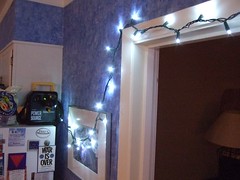
I eyeballed the Home Depot ad. The store is so close to my house it has become a part of my route. My eye was caught by a modest offering of LED Christmas lights priced at $2.95, a quarter of what they would normally go for. Festooning the outside of the house with strings of light to create a winter wonderland (and add to the utility bill by hundreds of dollars) was a feat we enjoyed vicariously courtesy of our neighbor across the street. But we did have a string of lights outlining the perimeter of a room inside the house. They created a lovely festive atmosphere for parties and were bright enough that we didn't need any other lighting for our dining purposes. LED lights required so little electricity that it occurred to me that I could power the entire room with a car battery that could then be recharged with a solar panel. I had seen a truck battery put to domestic use powering a TV at a cafe in the outbacks of Brazil. When I asked how the battery was recharged I learned that it was put back into a truck every so often. These simple technological work arounds devised by the developing world have always had enormous appeal to me because they sip, from the first world, cogent bits of technology while preserving the magnificence of the surrounding landscape and the timeless lifestyle. Such timelessness was perhaps a fantasy associated in my memory with exotic travel, but I still longed for it.


In order to get this string of lights hooked up to a car battery I would need an inverter to convert the 110 voltage and accommodate the conventional two prong plug. Traveling consultants have been using such inverters for years to power laptops from their cigarette lighter outlet while working in their car. It so happened that Pep Boys, the automotive big box store next door to Home Depot, was offering doorbuster sales of inverters. And jumpstarters. A jumpstarter is simply a mini car battery inside a portable box. It is usually used to jumpstart a dead car, but also comes with a cigarette lighter outlet. Now I was really excited.

In complete violation of my long time covenant with Buy Nothing Day, I found myself at the above big box stores at 7:30 a.m. filling a shopping cart. My guilt was somewhat mollified by another idea. I could now take this show on the road. Because all of the components for my third world workaround were available at such chain stores it could be easily replicated by others who were more mainstream than me and not quite so geeky. And by combining the festive notion of Christmas lights with the back up components normally associated with an emergency I could introduce a new paradigm. A power outage was no longer about fumbling with a flashlight waiting for a utility company to restore power; it was a festive holiday liberating the house from an unreliable centralized system. It was this kind of paradigm shift that really excited me.

The solar panel is a little pricey at  close to $90, but the point was anybody could create a mini off grid system with these off the shelf components. My solar panel was also bought, several summers ago, from an auto supply store; Frye's has them too. It comes with all the bits to connect it to a battery. No additional wiring is needed. It would recharge the jumpstarter battery in a day. Thus the whole system was self-supporting. I was able to keep my kitchen lit with a string of 200 LED lights for 3 1/2 hours before the battery needed recharging. (The lights drew 7 watts from the 8 amp hour battery.)

I took my road show to my neighborhood networking meeting and in five minutes persuaded six women of the beauty of this system. Being organizers they were already well schooled in the virtues of emergency preparation and as traveling consultants were familiar with inverters and car chargers for their mobile devices. My colleagues immediately recognized the usefulness of the jumpstarter. But I was also gratified that they made the connection with how easy it was to create and use an off grid system. 

Of course there is a bit more to a kitchen than just lights. I had my propane camp stove, barbecue and solar oven, but the achilles heel was the fridge. This led to a little side trip underground.

Musings From The Man-da Cave

I was feeling so geeky with my obsession with LED lights, that when I came across an interior design book at the library about Man Caves I realized that a piece of me had been waiting to be identified and named. I laughed with recognition at sentiments expressed in the introduction. Wives taking over the house and rendering husbands uncomfortable in their own home. College trophies, sports paraphernalia, outdoor signs, Christmas lights and beer bottle collections exiled to the basement or garage. 

I wanted a man cave of my own or perhaps more to the point, a Man-da Cave.

The real stories behind these thematically male spaces revealed a devotion to civility and a responsibility to wives and family that was quite endearing. The man of such integrity needs a man cave to get away from his responsibilities. I recognized this to be exactly why I cultivated my obsessions with expedition camping gear, alternative vehicles, off grid systems and tiny houses. These obsessions gave me a place to go to get away from an increasingly complex world. 

I did in fact already have such a space. One that wasn't considered an actual part of the house. It was already cave like. You had to be stooped over to walk around in it like cro magnon man or like the office space between floors in the movie Being John Malcovich. It was the space under the house, which being on the side of a hill, afforded more height in parts of it than the usual crawl space. 

I started taking it over when I moved in 17 years ago, because with four adults in residence at the time, we were very short on storage space. The man of the house had already stashed stuff on the shelves that had been affixed to the supporting pillars of the house. So I put in more shelves, lots more, for my boxes of love letters, and newspaper clippings from when I had my ten minutes of fame riding my unicycle to work. And collection of early hand drawn Banana Republic catalogs from when they were cool and had an old jeep in the store and actually sold vintage stuff. And stamp albums, Pride day button collection, vacation slides, a manual Olivetti typewriter, karate trophy, rolled up posters, a hood ornament I meant to make into a lamp, art projects and materials for art projects.

The floor, like most crawl spaces, was originally bare earth and got quite damp in the winter and muddy in parts. In fact I kept my worm bin down there and the worms were so happy they reproduced in amazing quantities and looked like flowing lava when I piled them up to collect the vermicompost. But I decided that the damp made the house cold, so I painstakingly leveled the dirt, laid sand over the damp part and covered it with very wide thick sheets of plastic. To protect the plastic, I lay tarpaper over it. I cut both right up to the footing for the posts using a stencil so there would be no gaps. When we got new vinyl flooring in the kitchen, I put the leftovers over the tarpaper. The white vinyl transformed the space into an actual room. Unfortunately the worms died from dehydration since I didn't realize the climate had changed so radically and didn't water their bedding enough. After that I didn't come down so often since there were no living beings to bring food to and take care of. Then it just became a storage space.


After reading the man cave book I went down to the space. I unfolded a camp chair to sit in because, in the bent over position needed to navigate this catacomb, frequent rest was warranted. I took a picture of myself in the chair sitting next to shelves of old paint and the chainsaw resting on a milk crate. Posted to flickr with the above description, it soon became my most popular shot of the quarter. Apparently others found the idea of a woman creating a man cave just as endearing.

I didn't put up any Christmas lights but I did cover the pink insulation overhead with flattened cardboard from empty boxes of Cheerios, stapled to the joists; (a client liked to save the boxes for me to recycle). It gave the place a cheery op art feel. I found pictures of Queen Elizabeth the First from a presentation I had given at a class on cultivating peace and put one up on the hatch that was the entrance to the cave. The space was already well lit with bare bulbs in old lamps. 

At Home Depot, looking at lights again, I discovered LED light bulbs. I brought one home to test in the Man-da cave. The new technology was a fine improvement over compact fluorescents. Better color, more solidly built, lasts 23 years and leaves no hazardous waste to dispose of. Also dimmable and uses less energy. I gave one to a client as a gift and she was enthralled by it.

Into my freshly swept out and spruced up Man-da Cave, I surreptitiously dragged in my latest object of interest—a diminutive chest freezer. I got it off Craigslist for $50. I wanted to see if I could make it into a low energy fridge like the guy in Australia living on the side of a mountain powered by a few solar panels. Such a workaround wouldn't suck up more power than a 100 watt bulb, he promised in his online report. You do it by plugging the freezer into an external thermometer that keeps it from turning on so much thus raising the temperature to fridge like conditions and cutting the energy used. Beer makers had discovered the same thing since chest freezers were the ideal size and shape for a beer keg. Beer making was a very man cave thing to do. This kept me from feeling too much like a survivalist nut job outfitting my bunker. 

I sat in my camp chair admiring the still unplugged freezer. Maybe next month I would buy the $60 thermometer thingie. It was time to join the family above for the holidays. (Family having now comfortably integrated Catherine's middle brother Steven as a member of the household. This would be our second Christmas together.)

Discovering Pluto

On Christmas day, during a rare period of blissful inactivity, I lay on the couch reading a book, by an astrologer, that I had requested as a gift. I discovered that my astrological chart revealed a voracious and irrational interest in acquiring knowledge. This was driven by subconscious forces on account of Pluto being so dominant in the 8th house of my chart. I was struck by this explanation. I had believed my pursuit of information was driven by feelings of inadequacy, but this explained why I never got around to actually becoming an overwhelming success. Success apparently wasn't my goal. In fact there was no actual point to my reading so much at all. I was just addicted to those ah ha moments of understanding. What a revelation. 

The author, Jessica Murray a San Francisco based astrologist, advised the mature reader to embrace the dark obsessive side of Pluto's influence, in order to transcend it and transform it. Having recently brought to light the mementos of my past, hidden in the subconscious underground of the house, I figured that, metaphorically speaking, I was getting a good start. Especially since I was augmenting the space with innovative attempts to live lightly on the planet.

The actual point of her self-published book Soul-Sick Nation: An Astrologer's View of America, was to invite readers to help transform the subconscious dark side of America's obsession with power in order to save this materialistic, over-militarized and self centered nation from destroying the planet. Her analysis of the political landscape of said nation was so right on that I fully accepted her advice and found her astrological analysis of recent U.S. history fascinating. The book had been written in 2006, but it was absolutely fitting for the portentous upcoming year of 2012. 

The End Of The World

On New Year's Eve Catherine, Steven and I watched the hollywood disaster movie 2012, just for kicks, and found it rather exhilarating to see the entire planet break up into disaster movie compendium of earthquake, flood, hurricane and what all, as the self appointed survivors (an obscure American writer and a Russian millionaire and their respective families, plus token minorities) competed with each other to board secret government arks built to weather the flood Noah style. 

The next day as the new year pealed out on a clear sunny day, it did feel different. 2012 was not so much pregnant with promise which implies certainty, but strangely giddy with the uncertainty of it; the hope and expectation that dramatic change is afoot. After all we have already ended 2011 with Occupy and the clamor for change in the United States which had for so long preferred business as usual. While on the other side of the world a mega flood had threatened my relatives in Bangkok in a year notable for excessive catastrophic climate events and earthquakes. The new year seemed positively brimming with end of the world material. 

Of course the world is not ending on the winter solstice of this year, per the predictions of the Mayan calendar (misinterpreted by an apocalypse obsessed culture), any more than Santa Claus is expected down the chimney every Christmas. But that doesn't mean we're ready to give up Santa Claus. An opportunity for cataclysmic change, especially within our collective psyche, is too good to pass up. The anticipation of it is potent with power as we climb on board the appointed year. For apocalypse or not I still believed in the potential for events of cultural consciousness to shift quite suddenly just as all those ah ha moments had flooded my mind with new, liberating, understanding. The stars were aligned for it.

Meanwhile on the other side of the earth the Buddhist calendar brings us the year 2555. This, to a Thai, must seem to be mocking them with laughter because 555 is Thai internet slang for LOL. When you say the number 5 repeatedly in Thai it sounds as if you are laughing cartoon style—ha, ha, ha.  Given all that my Thai contacts have put up with, of late, with the flood and crazy making incompetent politics, there hasn't been a lot to laugh about save for the cartoons and photos of escaped crocodiles my contacts posted of their shared dilemma. To laugh, I realized when I put the year 2555 together with 2012, was an appropriate response given the irony of governments attempting to dominate nature by investing so heavily in manmade systems only to smother the natural systems that ultimately supported life. (The Thai flood was not only caused by climate change, but made worse by deforestation and the paving over of swamp land, with industrial parks, that would have absorbed much of the water as it flowed to the sea; so much like Katrina.) Laughing was a response that affirmed my non-complicity with the craziness of it.


The world as we know it—especially the world as Americans know it and that everyone else is trying to copy—should come to an end. And if we can't wrestle our deluded leaders into addressing the situation at hand, we will just have to laugh at the absurdity of it and do what we can to wrestle free and find sanity.

Labels: , , ,

Earthworm. Get yours at bighugelabs.com