Amanda Kovattana

Middle-aged musings in interesting times

Friday, July 22, 2016

It Takes A Village To Live Tiny

In early May after my return from Canada, Catherine told me that she felt our domestic arrangement had come to an end and it was now time for her to live alone. She asked that I move out by September. She said the same to her brother Steve. I was stunned and devastated. 

"Where shall I go? What shall I do?" I wanted to say in Scarlett O'Hara fashion.

"Frankly my dear I don't give a damn," said the the Bay Area housing crisis. I gave myself a month to wring my hands and absorb this shock. I had known my living situation was without a future in the sense that we were no longer in a committed relationship, but I had put my money on the mutually beneficial arrangement of my staying which had been going so well these last two years. That with all the care the two dogs demanded and the shared meals I made, the gardening and household chores I helped with she would want me to stay especially once she returned to working full-time. It was the only option I was willing to entertain because I had been enjoying a $700 rent for so long I would be hard put to afford a room in a house in the Bay Area. Most were double that. Perhaps I should have taken a different path I lamented.

I had been told by our therapist and others that legally I did have the right even in a domestic partnership to sue for half the value of the pooled assets accrued during our 20 years together. I hadn't wanted to do it. I feared that it could get ugly and destroy our friendship. I had opted to see what would unfold if I stayed. Barring her meeting someone else she wanted to live with this seemed like a reasonable expectation. But now Catherine felt this transition period was over. It was time for her to move on, she said. I made another plea on my behalf.

I mentioned that she had, at the time of our break-up, promised to buy me a tiny house on wheels. But when she researched online and saw figures close to $90,000, she said she didn't have the money and she did not foresee selling her house anytime soon (to free up cash). I didn't pursue it since she was allowing me to stay. Maybe something else would unfold I thought.  

"I'll buy you a tiny house," she said just like that as I recalled this discussion. This stopped me mid-argument. It had indeed been my dream to live in a tiny house one day even if I had to build it myself. A very big dream that I knew I would have to do alone for Catherine did not share this vision. The tiny house concept of self sufficient living embodied all the off-grid living ideas that I had been experimenting with for the last fifteen years. To actually live in one would allow me to fully realize my passion for this life. With Catherine's offer of the tiny house my grief and shock were arrested as I remembered the full potential of this vision. And they were not, after all, as expensive as she had anticipated given what I had in mind. A shell that was unfinished inside could be had for $25,000. I accepted her offer gratefully and immediately went to Craigslist to look for such a tiny house on wheels.


My Tiny Life Education

A year ago almost to the day, I had attended a two-day workshop where I had listened to a young woman teach a roomful of would be builders how to build and live in a tiny house on wheels. The workshop was given by the Tumbleweed company formed by the original creator of tiny houses to sell plans to would be builders. The tiny house that our workshop leader lived on was parked on a property out by the coast next to a horse paddock. That she was a cello player with a degree from a university in Europe fit right into my scenario of wealthy patronage hosting such a high end tiny house. The scenario evoked all my experience of negotiating class and racial boundaries in the Bay Area. This was an elitist solution I felt, a diminutive version of a high end house with all the material wants of a Western lifestyle. It changed very little about how one lived apart from having less room to live it in. And it would still require that you had a relationship with land to park it on which implied that you had enough social equity to find a host who would be willing to let you live on their land possibly illegally given city zoning. You could not even buy land and park the house on it because there were laws against "camping" on your land. There were also laws that prevented you building normal houses small enough to afford because most towns had square footage ordinances that prevented such tiny dwellings. Zoning was how the American landscape was divided into economic apartheid. Building the house on a trailer was a way to get around building codes. 

Still I loved the idea of living in such a compact, well designed space that I could custom fit to my own habits. It was an opportunity to design a lifestyle that would incorporate my ideas of how one would live using the least amount of resources possible. In fact I so wanted to experience such a space that I decided to design and build a mock tiny house just to see how it would feel. For this experiment I chose to build a loft in my mother's one car garage which was about the same size as a tiny house being 91/2 feet by 20 feet and was a separate building made of wood resembling a 1920's board and batten cabin. I had in fact already cut holes into the walls for windows when I was enrolled in a construction class a decade ago and wanted to practice my carpentry skills. By returning to this unfinished space for this project I was able to hone my tiny house building skills, practice installing electric lights and outlets, then finish the walls and paint them the white wash I so wanted to see over the OSB strand board I put up for the walls. 

The project not only improved my building skills it honed my mind to make decisions around all the details of living in a tiny space. Intellectually I was able to investigate practical aspects of spacial design, compact storage and how to make multi-use built-in features that would cleverly transform the function of the space. I experimented with salvage materials to see what could be used that might otherwise go to landfill. Bed pillows for instance made very good insulation for walls. Over a six month period of working a couple hours every other day, I put in 230 hours and the garage was transformed from a rat infested haphazard store room into a pleasant light filled studio space with ample storage in the loft I had designed. And all using wood I had saved over the years (and stored in same garage) and what I found on craigslist mostly for free. How I loved that humble building. And how I enjoyed improving the space and adding value to my mother's property. 


Ever Tinier

In considering what size of tiny house on wheels I would choose to buy I remembered something my cello playing instructor had said when I went to visit her tiny house at the bottom of the horse paddock. If she had to build it again she would go smaller, she said, because even in this small a house of 24ft by 8ft there was still plenty of room to accumulate excess stuff. And this included a boyfriend and two dogs. She would go to 18 feet she said. So when I went to craigslist that night to look for a tiny house I was looking for the smallest I could find. And there it was. It was beautiful being all shingled in cedar and having a red door. The photograph of it was so professionally done that it looked like a magazine cover. But it cost $32,500 and that was just too much I thought for an unfinished house. A few days later I looked again and there was a lengthy description telling the story of why this house had been built. 

Apparently two dads, John who sold things and Phil who was a professional roofer, had decided to build their families a vacation cabin. It was their plan to park it on a friend's land. They put into the project the highest quality materials they could find including high end windows and a wood floor. It was fully insulated and wired with electric outlets and wall sconce lights, but was otherwise empty inside. It had taken them a year and a half to build this much, by which time the friend had sold the land and their plans to use it were moot. As I read the description of the house I could feel the love they had poured into this project and how proud they were of it. The interior was lined with reclaimed salvaged redwood fence boards that gave the interior a soft variegated look. This fooled the eyed into thinking it was bigger than it was. The ladder to the loft was built from heavy beams from an old barn and was sturdy enough for a big man. It was small, only 6 feet wide inside and 14 feet long which was perfect because I wanted a narrow profile to better fit on a narrow piece of land. I had it in mind to park it at my mother's house next to the the beloved garage where I had been building the mock tiny house. 

To express my appreciation I wrote the seller a fan letter admiring the quality of the build. Then since such a letter seemed to warrant a reason for my writing it I explained that I could not buy it because my budget was only $23,000 or so. Ten minutes later John called me and said I could have it for $26,000. This was a considerable discount. I would get back to him, I said. I showed the ad to Catherine and she agreed to buy it if it was the one I wanted. And that Saturday I went to see it taking with me my new friend Tim, a carpenter I had met by chance just before I needed help to patch the leaky roof of my mother's garage.

To make sure I had a place to put this house, I had proposed to my mother that I park it on her property. She was not enthusiastic about the idea, but her boyfriend Bill had been more encouraging. "Think of the benefits of an onsite cat sitter," he said over dinner. When I showed her the glamorous pictures of the tiny house she clearly saw how lovely it was and urged me to buy it before someone else did. In terms of home ownership it was not very much money she noted. This was all the encouragement I needed.

Tim and I drove all the way to Hollister to see it. Once I laid eyes on the tiny house in person the height of it was a little scary. It was almost the height of a two story building, but I ignored that warning feeling for it was the height that made the inside bearable since there was so much space above your head. Tim asked Phil about the methods used to strengthen the walls. All was done to the highest standards. I felt confident to mover forward and put down a deposit of $1000 then set about preparing for the arrival of the tiny house in two weeks. I went home thinking I was well on my way to living my dream, but instead I spent a sleepless night wondering how such a high profile tiny house was going to be received in the neighborhood. For much as they seem so perfect a solution to homelessness, they were not legal to live in. It was legal to park them, just as an RV is legal to park on private property, but if you were living in it and the neighbors complained you could by local ordinance be evicted from your own house. 

To quell my anxiety I decided to ask the nearest neighbor who kept an eye on my mother's house, what she thought of such an endeavor. My mother, however preempted this meeting when she called me in the morning and told me she could not allow me to park the house on her property. It was just too evocative; it would soon attract the attention of the county officials. I had to agree that she was right and so I had to choose to either give up this dream (and my deposit) or pursue it in an aggressive manner unlike my usual low key approach. I never liked to ask for anything. 

I wrote up an ad on craigslist in search of a place to park and listed what I was willing to offer in terms of a little rent ($300-$600) and a lot of skills for home maintenance, gardening and care taking. I used the same beautiful picture of the house that had caught my eye. And I posted the link to the ad to Facebook and Twitter and the Yahoo group of my colleagues. People wrote back words of encouragement and ten of my friends  posted it to their pages asking their friends if they knew of a space. I did get some very nice responses both from friends of friends and strangers, but they were in the East Bay outside of my area and far away from clients which I was not prepared to do just yet. Still I felt enormously supported and loved it kept my heart open for a favorable response.

The purchase of this house with no land to put it on would render my dream an albatross that would cost me money to store it and be impossible to sell since few who have such cash are willing to live in a shoebox. 

I went away for the weekend to a house party where I got the opinion of all those present. My closest friends agreed that this could easily go sour, but one friend who had had many adventures in buying property encouraged me to go for it, because whatever happened I would end up owning something beautiful. I might end up leaving the Bay Area to live in it, but it might be worth it and if I left the country I could put everything I owned into it and still pay the same fee for storage as I would for my stuff alone and I would have something to come back to.

That night I picked up an e-mail from an acquaintance I knew from my Buddhist meditation center with whom I had done some solar oven demonstrations. She wrote me that she had a space in her backyard that might work. This was extremely encouraging. As soon as I got back from my house party I went to see her site. It was indeed feasible and well located being only ten minutes from my present home. I envisioned some fine collaborative eco projects in this garden for we had a shared eco sensibility. The space did, however need a lot of preparation in the trimming of bushes and moving of storage units. It was a tight space with sparse room around it. It was clear I would need a temporary place to park while I finished building the interior of the tiny house. 

There was another possibility that had been appearing in the back of my mind. Only a mile away from this site was my childhood home where there was a two car garage and a driveway down a cul-de-sac that would keep the tiny house hidden from view from the street. I could see myself working from my father's workshop using his tools and workbench. Could feel him helping me though he'd been gone now for 14 years and my stepmother had inherited the house.

My father had been a complex and difficult man given to rudeness and temper tantrums in my youth and a peculiar lack of understanding of human relationships, yet he was a brilliant engineer who had built his own computer in order to stay relevant to his work. He had had in all likelihood what we would now diagnose as Asperger's. The circumstances of his long illness with throat cancer that eventually led to his death had been trying to both me and my stepmother. I had not been very patient or diplomatic in my participation in his care while my stepmother had to contend with the brunt of his anxiety and non-compliance to his doctor's orders. I could not imagine myself asking her for any favors so estranged had we become. But as it happened I had recently spent some time with her and had had a chance to renew our acquaintance. 

While I was in Thailand for my mud hut building workshop I had been in Bangkok at the same time as she was, sharing the house my father built on the family compound which he had left to both of us. She was there with her boyfriend, a doctor who was charming and friendly to everyone in the household. So much so that all the difficulties of our family relationships seemed to fall away. He was warms towards me too. As I contemplated whether or not to ask her I realized that I had for so long put her in the roll of the heavy in my life as the figure who had usurped my inheritance, that she might welcome the opportunity to be my savior if I would only ask. 

Unfortunately I couldn't call her to explain to her the situation or even what a tiny house was because she and the doctor were in Germany on holiday. Time was ticking down so I wrote to her through Facebook explaining what I wanted to do. She didn't respond at first so I wrote again giving more details of my soon to be homeless status which could end up with me living in Bangkok in the house we shared. She wrote back with her cell phone and said to call her. She was sympathetic. Her only concern was that she would be able to get her car out of the garage and that the neighbors be informed. Neither was a problem so she said yes. I was so relieved. I had asked for help from so many people to get this house that I could truly say it takes a village to live tiny.


My Tiny Adventure Begins

The day the tiny house rolled into town, the neighbors came out to see the house as it pulled up and stopped on the side of the road.

"I love your tiny house," said a woman as she drove by.

"Pull it in here, I'll make room," said the neighbor across the way. The neighbor in front of my stepmother's house came out to network with my builders.


The two men had towed the tiny house all the way from Hollister. On the pickup towing it was a ladder strapped to the truck rack. This came in handy. The overhanging trees in the driveway did not clear the roof of the house adding to the drama of its arrival. The 20ft ladder was set up to allow Phil to climb on the roof and lift the branches out of the way while the truck was pulled forward. Then another difficult maneuver to back the house into position in the driveway. Once the house was leveled with the jacks at each corner it was done. All that was left was for me to hand over the cash.

When my stepmother returned she and the doctor welcomed me by inviting me to lunch when I came to work on the house. This offering of food was very Thai and made me feel right at home. It warmed my heart to feel so welcomed. I was eager to help with the chores she asked of me in return — hauling away things mostly, much of it my father's old books and papers. Her friends who came by admired the house in the driveway.

I was buoyed up by the reception to the tiny house. My tiny house. I was suddenly a celebrity with this cute unusual big thing. Thanks to the cable TV show Tiny House Nation and a few other similar shows, the phenomena of tiny houses had captured the American imagination. The compactness of such a lifestyle was a kind of antithesis to the horrors of excessive consumerism and collecting of stuff that had made the hoarding shows so popular. It solved the problems of mortgage debt and provided the mobility needed to follow job assignments. Viewers were charmed by the idea (though most did not want to live so small). There seemed to be no end to the cleverness that could be built into them. And now I was a part of this phenomena. An early adopter of a new innovation. Housing 2.0.

I marveled at how I had gone from homelessness to tiny house ownership in a mere three weeks. The tension in my relationship with Catherine evaporated too for I no longer had to be vigilant about a living situation that was forever poised to change. We would remain friends. I came to see that there are those in your life whose role it is to make sure you fulfill your destiny when you are too comfortable or too complacent to get around to it yourself. The tiny house was my destiny now. One that unfolded so effortlessly once I was committed to it that it elevated me to a new level of manifesting my life. The next few months would completely absorb and stimulate every cell of creativity I possessed. Ideas rolled out of my head and were manifested within the week with components that just seemed to turn up. I envisioned myself giving tiny house tours and tiny house dinner parties. 

To join in with the tiny house community I started a new blog to have a record of this new phase of my life and a blow by blow account of the build with photos. It's called "Tiny Red Desk: Living The Tiny Life". (I named it after the color of my writing desk). There you can join me for the tiny house journey.


Labels: , , , , , , , ,

Monday, January 09, 2012

Happy Paradigm Shift

In which I enter the auspicious year of 2012 through various avenues of my subconscious from shopping cart to under the house storage to apocalyptic revelations.

Let There Be Little Lights

At breakfast I rarely pass up looking at the newspaper shopping ads to see what trendy new stuff people are tempted to buy that I might later have to persuade them to give away. Plus I like camping items, my category of shopping vice. Thus I found myself perusing the doorbuster ads for Black Friday; the deals were particularly vehement. Possibly the impact of Buy Nothing Day, combined as it was with the Occupy movement, had spooked the retail sector. (Buy Nothing Day is timed to coincide with Black Friday, the biggest shopping day of the year, said to put the retail sector into the black as we go into the Christmas shopping season. This is partly because it is a holiday falling as it does on the day after Thanksgiving and family members communicate what they might want for Christmas by going to the mall together.) In recent years the retail sector has fought back such anti-consumerist notions with more and more breathtaking deals on their most popular items guaranteed to lure shoppers into the mall on the day and make the evening news with some mob incidence of bad behavior. 

I eyeballed the Home Depot ad. The store is so close to my house it has become a part of my route. My eye was caught by a modest offering of LED Christmas lights priced at $2.95, a quarter of what they would normally go for. Festooning the outside of the house with strings of light to create a winter wonderland (and add to the utility bill by hundreds of dollars) was a feat we enjoyed vicariously courtesy of our neighbor across the street. But we did have a string of lights outlining the perimeter of a room inside the house. They created a lovely festive atmosphere for parties and were bright enough that we didn't need any other lighting for our dining purposes. LED lights required so little electricity that it occurred to me that I could power the entire room with a car battery that could then be recharged with a solar panel. I had seen a truck battery put to domestic use powering a TV at a cafe in the outbacks of Brazil. When I asked how the battery was recharged I learned that it was put back into a truck every so often. These simple technological work arounds devised by the developing world have always had enormous appeal to me because they sip, from the first world, cogent bits of technology while preserving the magnificence of the surrounding landscape and the timeless lifestyle. Such timelessness was perhaps a fantasy associated in my memory with exotic travel, but I still longed for it.


In order to get this string of lights hooked up to a car battery I would need an inverter to convert the 110 voltage and accommodate the conventional two prong plug. Traveling consultants have been using such inverters for years to power laptops from their cigarette lighter outlet while working in their car. It so happened that Pep Boys, the automotive big box store next door to Home Depot, was offering doorbuster sales of inverters. And jumpstarters. A jumpstarter is simply a mini car battery inside a portable box. It is usually used to jumpstart a dead car, but also comes with a cigarette lighter outlet. Now I was really excited.

In complete violation of my long time covenant with Buy Nothing Day, I found myself at the above big box stores at 7:30 a.m. filling a shopping cart. My guilt was somewhat mollified by another idea. I could now take this show on the road. Because all of the components for my third world workaround were available at such chain stores it could be easily replicated by others who were more mainstream than me and not quite so geeky. And by combining the festive notion of Christmas lights with the back up components normally associated with an emergency I could introduce a new paradigm. A power outage was no longer about fumbling with a flashlight waiting for a utility company to restore power; it was a festive holiday liberating the house from an unreliable centralized system. It was this kind of paradigm shift that really excited me.

The solar panel is a little pricey at  close to $90, but the point was anybody could create a mini off grid system with these off the shelf components. My solar panel was also bought, several summers ago, from an auto supply store; Frye's has them too. It comes with all the bits to connect it to a battery. No additional wiring is needed. It would recharge the jumpstarter battery in a day. Thus the whole system was self-supporting. I was able to keep my kitchen lit with a string of 200 LED lights for 3 1/2 hours before the battery needed recharging. (The lights drew 7 watts from the 8 amp hour battery.)

I took my road show to my neighborhood networking meeting and in five minutes persuaded six women of the beauty of this system. Being organizers they were already well schooled in the virtues of emergency preparation and as traveling consultants were familiar with inverters and car chargers for their mobile devices. My colleagues immediately recognized the usefulness of the jumpstarter. But I was also gratified that they made the connection with how easy it was to create and use an off grid system. 

Of course there is a bit more to a kitchen than just lights. I had my propane camp stove, barbecue and solar oven, but the achilles heel was the fridge. This led to a little side trip underground.

Musings From The Man-da Cave

I was feeling so geeky with my obsession with LED lights, that when I came across an interior design book at the library about Man Caves I realized that a piece of me had been waiting to be identified and named. I laughed with recognition at sentiments expressed in the introduction. Wives taking over the house and rendering husbands uncomfortable in their own home. College trophies, sports paraphernalia, outdoor signs, Christmas lights and beer bottle collections exiled to the basement or garage. 

I wanted a man cave of my own or perhaps more to the point, a Man-da Cave.

The real stories behind these thematically male spaces revealed a devotion to civility and a responsibility to wives and family that was quite endearing. The man of such integrity needs a man cave to get away from his responsibilities. I recognized this to be exactly why I cultivated my obsessions with expedition camping gear, alternative vehicles, off grid systems and tiny houses. These obsessions gave me a place to go to get away from an increasingly complex world. 

I did in fact already have such a space. One that wasn't considered an actual part of the house. It was already cave like. You had to be stooped over to walk around in it like cro magnon man or like the office space between floors in the movie Being John Malcovich. It was the space under the house, which being on the side of a hill, afforded more height in parts of it than the usual crawl space. 

I started taking it over when I moved in 17 years ago, because with four adults in residence at the time, we were very short on storage space. The man of the house had already stashed stuff on the shelves that had been affixed to the supporting pillars of the house. So I put in more shelves, lots more, for my boxes of love letters, and newspaper clippings from when I had my ten minutes of fame riding my unicycle to work. And collection of early hand drawn Banana Republic catalogs from when they were cool and had an old jeep in the store and actually sold vintage stuff. And stamp albums, Pride day button collection, vacation slides, a manual Olivetti typewriter, karate trophy, rolled up posters, a hood ornament I meant to make into a lamp, art projects and materials for art projects.

The floor, like most crawl spaces, was originally bare earth and got quite damp in the winter and muddy in parts. In fact I kept my worm bin down there and the worms were so happy they reproduced in amazing quantities and looked like flowing lava when I piled them up to collect the vermicompost. But I decided that the damp made the house cold, so I painstakingly leveled the dirt, laid sand over the damp part and covered it with very wide thick sheets of plastic. To protect the plastic, I lay tarpaper over it. I cut both right up to the footing for the posts using a stencil so there would be no gaps. When we got new vinyl flooring in the kitchen, I put the leftovers over the tarpaper. The white vinyl transformed the space into an actual room. Unfortunately the worms died from dehydration since I didn't realize the climate had changed so radically and didn't water their bedding enough. After that I didn't come down so often since there were no living beings to bring food to and take care of. Then it just became a storage space.


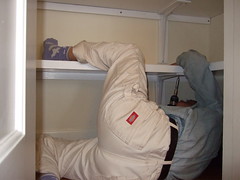
After reading the man cave book I went down to the space. I unfolded a camp chair to sit in because, in the bent over position needed to navigate this catacomb, frequent rest was warranted. I took a picture of myself in the chair sitting next to shelves of old paint and the chainsaw resting on a milk crate. Posted to flickr with the above description, it soon became my most popular shot of the quarter. Apparently others found the idea of a woman creating a man cave just as endearing.

I didn't put up any Christmas lights but I did cover the pink insulation overhead with flattened cardboard from empty boxes of Cheerios, stapled to the joists; (a client liked to save the boxes for me to recycle). It gave the place a cheery op art feel. I found pictures of Queen Elizabeth the First from a presentation I had given at a class on cultivating peace and put one up on the hatch that was the entrance to the cave. The space was already well lit with bare bulbs in old lamps. 

At Home Depot, looking at lights again, I discovered LED light bulbs. I brought one home to test in the Man-da cave. The new technology was a fine improvement over compact fluorescents. Better color, more solidly built, lasts 23 years and leaves no hazardous waste to dispose of. Also dimmable and uses less energy. I gave one to a client as a gift and she was enthralled by it.

Into my freshly swept out and spruced up Man-da Cave, I surreptitiously dragged in my latest object of interest—a diminutive chest freezer. I got it off Craigslist for $50. I wanted to see if I could make it into a low energy fridge like the guy in Australia living on the side of a mountain powered by a few solar panels. Such a workaround wouldn't suck up more power than a 100 watt bulb, he promised in his online report. You do it by plugging the freezer into an external thermometer that keeps it from turning on so much thus raising the temperature to fridge like conditions and cutting the energy used. Beer makers had discovered the same thing since chest freezers were the ideal size and shape for a beer keg. Beer making was a very man cave thing to do. This kept me from feeling too much like a survivalist nut job outfitting my bunker. 

I sat in my camp chair admiring the still unplugged freezer. Maybe next month I would buy the $60 thermometer thingie. It was time to join the family above for the holidays. (Family having now comfortably integrated Catherine's middle brother Steven as a member of the household. This would be our second Christmas together.)

Discovering Pluto

On Christmas day, during a rare period of blissful inactivity, I lay on the couch reading a book, by an astrologer, that I had requested as a gift. I discovered that my astrological chart revealed a voracious and irrational interest in acquiring knowledge. This was driven by subconscious forces on account of Pluto being so dominant in the 8th house of my chart. I was struck by this explanation. I had believed my pursuit of information was driven by feelings of inadequacy, but this explained why I never got around to actually becoming an overwhelming success. Success apparently wasn't my goal. In fact there was no actual point to my reading so much at all. I was just addicted to those ah ha moments of understanding. What a revelation. 

The author, Jessica Murray a San Francisco based astrologist, advised the mature reader to embrace the dark obsessive side of Pluto's influence, in order to transcend it and transform it. Having recently brought to light the mementos of my past, hidden in the subconscious underground of the house, I figured that, metaphorically speaking, I was getting a good start. Especially since I was augmenting the space with innovative attempts to live lightly on the planet.

The actual point of her self-published book Soul-Sick Nation: An Astrologer's View of America, was to invite readers to help transform the subconscious dark side of America's obsession with power in order to save this materialistic, over-militarized and self centered nation from destroying the planet. Her analysis of the political landscape of said nation was so right on that I fully accepted her advice and found her astrological analysis of recent U.S. history fascinating. The book had been written in 2006, but it was absolutely fitting for the portentous upcoming year of 2012. 

The End Of The World

On New Year's Eve Catherine, Steven and I watched the hollywood disaster movie 2012, just for kicks, and found it rather exhilarating to see the entire planet break up into disaster movie compendium of earthquake, flood, hurricane and what all, as the self appointed survivors (an obscure American writer and a Russian millionaire and their respective families, plus token minorities) competed with each other to board secret government arks built to weather the flood Noah style. 

The next day as the new year pealed out on a clear sunny day, it did feel different. 2012 was not so much pregnant with promise which implies certainty, but strangely giddy with the uncertainty of it; the hope and expectation that dramatic change is afoot. After all we have already ended 2011 with Occupy and the clamor for change in the United States which had for so long preferred business as usual. While on the other side of the world a mega flood had threatened my relatives in Bangkok in a year notable for excessive catastrophic climate events and earthquakes. The new year seemed positively brimming with end of the world material. 

Of course the world is not ending on the winter solstice of this year, per the predictions of the Mayan calendar (misinterpreted by an apocalypse obsessed culture), any more than Santa Claus is expected down the chimney every Christmas. But that doesn't mean we're ready to give up Santa Claus. An opportunity for cataclysmic change, especially within our collective psyche, is too good to pass up. The anticipation of it is potent with power as we climb on board the appointed year. For apocalypse or not I still believed in the potential for events of cultural consciousness to shift quite suddenly just as all those ah ha moments had flooded my mind with new, liberating, understanding. The stars were aligned for it.

Meanwhile on the other side of the earth the Buddhist calendar brings us the year 2555. This, to a Thai, must seem to be mocking them with laughter because 555 is Thai internet slang for LOL. When you say the number 5 repeatedly in Thai it sounds as if you are laughing cartoon style—ha, ha, ha.  Given all that my Thai contacts have put up with, of late, with the flood and crazy making incompetent politics, there hasn't been a lot to laugh about save for the cartoons and photos of escaped crocodiles my contacts posted of their shared dilemma. To laugh, I realized when I put the year 2555 together with 2012, was an appropriate response given the irony of governments attempting to dominate nature by investing so heavily in manmade systems only to smother the natural systems that ultimately supported life. (The Thai flood was not only caused by climate change, but made worse by deforestation and the paving over of swamp land, with industrial parks, that would have absorbed much of the water as it flowed to the sea; so much like Katrina.) Laughing was a response that affirmed my non-complicity with the craziness of it.


The world as we know it—especially the world as Americans know it and that everyone else is trying to copy—should come to an end. And if we can't wrestle our deluded leaders into addressing the situation at hand, we will just have to laugh at the absurdity of it and do what we can to wrestle free and find sanity.

Labels: , , ,

Wednesday, April 22, 2009

The Hope of Innovation

Supposedly one of the reasons that the world tolerates Americans, and indeed one of the reasons we tolerate ourselves, is because we have a reputation for innovation. As an innovator myself I can vouch for this.


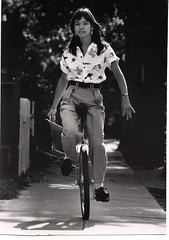
When I learned how to ride a unicycle in high school, I was assisted by a number of factors. First I was introduced to the idea while attending the Fourth of July parade in Redwood City (affectionately known as The Redneck City Parade) where I saw a drill team from Concord riding unicycles. That ordinary Americans were doing something unusual in an ordinary way made it entirely possible for me to think to do such a thing. I went to my local library and found a book devoted to unicycle riding. I was able to buy one locally at a bike shop (made by Schwin). Over a holiday weekend I mastered the thing and was much admired when I showed off my new skill at school. The following year I took it to college where it became my mode of transportation (and later elevated to my 15 minutes of fame, on the evening news, as a Green commuter).

That summer I went to Thailand and suggested to my relatives that the unicycle would be a terrific way for me to get around Bangkok. They were horrified and forbid me to think of doing such a thing.

"People will get into a car wreck trying to look at you," said one aunt, the only one who actually walked anywhere. The underlying message was that a person of my class, representing the family name as we all did, was not to perform acts of freakishness in public. There were rules about what was seemly. My grandmother, in particular, laid down the law guided by what was being done by her betters. Or not done.

In the current economic collapse scenario, innovation is again the hope that pundits are calling upon to save us rather than accept any form of downward mobility. That such downward mobility might lead to self-sufficiency is not mentioned.

I noted at an early age that my grandmother was unable to do anything for herself, though she could artfully arrange dried flowers and wrap gifts with precision. She was always calling for the maids to help her. I never saw her cook; I'm not sure she ever learned to ride a bicycle or to swim, but she had played a championship game of tennis in her youth and was an expert at ordering people about including me.

I vowed that I would not meet the same fate. I would not let wealth render me forever dependent on the skills of others. How would one travel or go on adventures like the children in my much-loved English books who spent their summers sailing?

"If not duffers won't drown," their father had said.

Most of my aunts could not swim. My relatives were of a class that had not learned to swim because only the poor, who were forced to live on the river, did so. (My British mother made sure I had swimming lessons when we joined the Sports Club.)

I loved the water. In the context of my family, I was forever aspiring to be downwardly mobile.

Poor As Four Letter Word

Few cultures aspire to be downwardly mobile. Poor is a category cloaked in shame, especially in America. Once when a roommate complained that she didn't have enough money to take a European vacation and thus wouldn't be able to go on vacation at all, I thought I was being helpful when I said, "Well there's always camping." This, to me, was a fun holiday that allowed practice of many skills of independence, in places of natural beauty, surrounded by others of like mind.

My suggestion was met with a look of horror and she walked out of the room as if I had delivered an ethnic slur. She had perceived me to be a person of wealth telling the lesser endowed how to live in a manner they could afford. This was, I realized, the height of rudeness in a land where everyone had the right to aspire to be upwardly mobile. Was the reluctance to identify as poor(er) an Achilles heel of American culture? How very Grey Gardens of us.

I learned to reframe my pursuits. Americans still valued self-sufficiency, religious practices were respected and even more so political ones; eccentricity fit right in with the cult of the individual, artistic interpretations are admired and experimentation and innovation are highly prized. As long as I didn't mention that I was also trying to be frugal, I could do whatever fun thing I wanted to do and inspire others with my stylish, politically correct, eco-sustainable example.

Skills Lost

Still, I couldn't help noticing that my peers were going the way of my grandmother. In the upward mobility and general wealth of American culture, skills of self-sufficiency had been lost over the last three decades.

I asked a number of women friends whether they could sew. Those, at least five years older than me, were almost all able to sew, but didn't anymore because clothes were so cheap to buy (imported from all the sweatshops in Asia). They were right. There was very little economic reward in sewing anymore. The only reason I sewed at all was to learn ethnic patterns and come up with my own designs. Thus the urge to design was a key to the motivation to innovate.

In college, I had come across a book called "Design Yourself". It was full of energetic cartoons of the empowering, "you can do it" kind. I loved the idea of going through life as a designer, choosing what came into my life and being encouraged to restyle it. In my home country fashion was a marker of class position so it was safest to copy and later buy already established designer clothing and accessories from the West. The same for cars, electronics and home furnishings.

The book "Design Yourself" was the text for a theater arts class on set design. Theater arts had been, for me, a microcosm of useful skills. It was while building sets at the Children's Theater that I first learned to use a hammer in 6th grade. And it was in the costume department that I learned about historical dress which in turn allowed me to innovate a unique style of my own.

As part of the stage crew, I learned how to manage ropes and pulleys, handle antique props and move things around in the dark. None of this was happening when I performed in school plays in Bangkok. There were dressmakers, stage crews and labor all from another class to take care of everything and no public library in which to research in the theater arts section.

High Tech vs. Physical Reality

As the arts give way to all things computer (funding for the arts cut from schools and all) there are fewer venues for using hand tools and devising mechanical things. My father, an electrical and mechanical engineer, fearing that he would be made obsolete by the advent of the computer, decided to build one at home so he could learn how it worked. It took him close to a year working every evening with a soldering iron. This was not a skill I was drawn to. When I did learn the computer I was, like most of the pre-computer generation, frustrated by the logic and precision demanded. It was not until icons representing reality, i.e.: a trash can, were added that computers were made "user friendly". Thus translated into human terms through symbols, we became computer literate, while a new generation was submerged in a "virtual reality".

I have been assured by academic studies that computers have not impaired the ability of the human brain to solve problems. But I fear that it has impaired the ability to struggle with the world of physical things.

My suspicions were confirmed by a biography I read of a man, my age, who had taught himself frontier skills as a teen and later started a school. He observed that the children who attended his camp lacked basic understanding of the physical laws of nature—leverage, inertia, momentum and thermodynamics. They would, for instance, attempt to walk with a bucket of water at arms length, in front of them. They had never played with simple toys, thus had no idea that a hoop could be made to spin along the road like a wheel. Their lives no longer offered these lessons.

A friend teaching at a university told me she had been a drawing teacher over a long enough time span, now, to note the deterioration in hand skills due largely to students spending less and less time on a single drawing. My friend took to assigning "time" homework to her students so they would give the time necessary to hone their drawing skills. This confirmed for me that people were not spending as much time doing things.

While women no longer sewed, men no longer fixed things. It was cheaper to buy new, again due to the global economic efficiency of far-flung sweatshops. Having attempted to fix many a discarded appliance, myself, I too, found that it wasn't worth it. Either you couldn't get the parts or the item broken was plastic and disfigured beyond repair. Then there was the circuit board. I once had an oven repaired in a rental unit I managed. I was flabbergasted to learn that it was broken because cockroaches had eaten away the circuit board and disabled the on/off function. Civilization brought down by the appetite of cockroaches! Circuit board as weak link of modern infrastructure! Circuit boards do not lend themselves to home repair. It was replaced by another from that far-flung sweatshop.

Without practice observing mechanical things, it gets harder to see how stuff works and think to struggle with something to learn how it might be made to work again. People with a high tolerance for such struggle make good plumbers and auto mechanics.


How We Learn

Commentators like to point out that diversity is the key to our strength, implying that there will always be Americans with the right skill set to solve problems as if the US were a slot machine prompted by a pull of the lever to come up with a new set of winning symbols. The actual benefit of this diversity is in the cross-pollination that is possible through people and access to information. American social boundaries are more permeable, our hierarchy more accessible. Anyone who can write a simple proposal and profess knowledge of any subject of possible interest (but not bomb making, of course) can apply to teach a class at a community college where they are immediately perceived as an "expert" in their field.

Thus our diminishing patience and skill set may be offset by our willingness to learn new things, for Americans are willing to learn from those not of their class. (But if from someone who is poor, it will probably be a monastic teaching Buddhist meditation.)
In the 70s I found a paperback at the library called "Living Poor With Style" by Earnest Callenbach. It was filled with attitude about how curtailing your need for money would allow you to be free to do more of what you wanted to do. I took this message to heart. The book went out of print, resurfacing two decades later with a different title that replaced the word "poor" with "cheaply". It was hardly worth reading having been shorn of attitude. (But you can get the original; a used copy on Amazon priced at close to a hundred dollars.)

In those intervening years, technology, particularly high tech Western technology has been telling people how to live expensively the world over. After the economic collapse in Thailand in 1998, the poor discovered that there are worse things than being poor and that is being in debt. A movement of peasant farmers quietly began to reclaim the low tech indigenous folk innovations of the peasant people and also of learned people who had perfected sustainable practices.

I was encouraged that such skills are not lost, but I have come to believe that once a culture is invested in high levels of centralized technology it will use every last breath to save that unsustainable infrastructure before turning to alternatives. There simply is too much at stake in terms of jobs, profit and stability. It looks like collapse will have to be our saving grace.

I found clues to such a future in the story of the Pueblo people, the ancient Native American culture admired for their advanced society and building techniques. They were said to have disappeared, leaving no descendants, starved out by drought causing the collapse of their food supply. On closer inspection scholars observed that they may have migrated or possibly their descendants became the plains Indians who populated the land following their demise.

The name for this ancient people is Anasazi, which is Navajo for "enemy ancestor". I was chilled by the implications of this phrase. To speak of an advanced culture, that preceded you, in such language implied that it was understood how such a lifestyle was also their folly. At the same time, I was heartened that at least they had learned and developed a culture of sustainable practices. If we are the enemy ancestors of a future people, this was a hope that our descendants will find their way regardless.

Labels: , , ,

Saturday, March 07, 2009

The Lost Art of Bodging

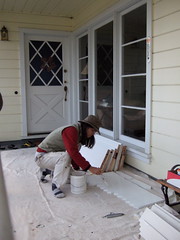
A flickr contact knowledgeable about tools introduced me to the term "bodging" when I posted a picture of myself in my ad hoc workshop on our front porch. Bodging, I was to learn, describes the act of creating things from a mish mash of available materials in a makeshift workshop. Derived from the term to bodge which specifically refers to the turning of tree branches into chair legs using a foot operated lathe.


I was thrilled with the term. Thrilled that there was even a word to describe the kind of improvisational construction that I was doing, using discarded building materials, in an onsite workshop. My flickr friend directed me to another flickr member who had posted a picture of himself in a traditional bodging workshop he had created. He, himself, was the last known chair bodger in England and had even met the Queen, presenting her with a miniature Windsor chair.

In its original use, the term implied a host of other conditions, frowned upon by society, including itinerant workers and nomadic people. Nomadic workers interfered with the move towards privatization, for unclaimed land was needed to accommodate such workers. If locals valued their traveling tinker, tailor and bodger, then they would also value retaining a commons, an area of pasture land or a wooded lot, for parking a caravan and where materials could be harvested to support the livelihood of the traveler while serving the needs of the locals. Moneyed interests favoring privatization and industrialized goods won that battle I would say.

Such free materials as a bodger might use, today, can be found in the form of recyclables left on the curb and the rapidly disappearing "big trash" day. To observe the squabbles over who owns trash and recyclables once left on the curb is to note our societies ambivalence towards providing poor people with something for free. (I've had neighbors point out that I was not allowed to lift so much as a cereal box from another neighbor's recycle bin and in Oakland fines are in order.) For those who are Internet enabled, we have a virtual commons known as "Freecycle" on which to host the giving away of materials. And for a little money, e-Bay and Craigslist will provide.

What attracted me most to the whole concept of bodging was the creativity of it. With its lowered expectations of make do-ness, hobbled together discarded parts and make-it-work utilitarian improvisation, the term freed me. Bodging was function derived, plain speaking and simple. But best of all it made use of discarded materials, something a throwaway society had in excess. I picked materials, much as an artist would, attracted by texture, line and form, but also because of its durability, strength and that it just happened to be there.

The Serendipity of Small Things

Late last year a new client asked me, during the obligatory tour of the house, if I knew anyone who would take away the six closet doors she could no longer use that were now stacked outside against the fence. She had not been able to give them away even on Freecycle. That same week I got a call requesting an organizer who installed green closets.

What passes for green closets in this world of prefab installations are the same manufactured melamine covered particle board closets seen in the slick ads, but made with "green" particle board. This means they are formaldehyde free and made from recycled wood fiber or even straw, but still using copious amounts of energy in the manufacturing process. Add to that transportation costs and a higher price for the premium of being green. Such "green" particle board is not available to me at local lumberyards. Was during a Green phase, but no more.

Would such an enlightened eco client accept the use of reclaimed materials if nicely painted with leftover low emission paint? I measured, I drew pictures and layouts, I calculated my time and delivered a bid. The client accepted the proposal, happily, as if discovering a find (plus a closet company would have charged more). The client, with the doors, gladly let me strap them to the roof of my car.

The goddess of small, serendipitous occurrences seems eager to make such matches for me, helping everyone in the process. The week I accepted my first project with doors, I found all I needed from Criag's list plus extra I didn't know I would need. And when the client asked for drawers I found an old desk on Freecycle with exactly the number of drawers I needed.

Recently, while cycling to Karate class, the plywood in old bathroom cabinets, discarded on the sidewalk, attracted my eye, a light rain having brought out the patterns of woodgrain. I picked them up the following morning and spent that afternoon building myself a rolling caddy to house my collection of scrap wood, my workshop now looking less hovel-like as a result.

I suspect that this serendipity, on a small community level scale, is a part of the bodging experience. It does not seem to work if I don't really mean it. I cannot, for instance duplicate the availability of materials if I search, during idle moments, online, with no project needing to be built.

The Freedom To Fail

While talking up my trash transforming ways, a fellow green organizer recommended the movie Garbage Warrior. Michael Reynolds, a modern day bodger, extreme recycler and builder of houses from trash, got his start in the '70s in the middle of the New Mexico dessert. He invented the earthship with its earth filled, automobile tires for walls, creating a climate controlled interior without using any outside energy inputs at all. The houses also collected rainwater and recycled wash water into an indoor garden that produced food, even bananas, while outside it was snowing.

Such a miracle of innovation did not come easily, for mistakes were made and lawsuits were filed. And soon the controlling authorities came by to enforce regulations. These regulations disallowed such notions as humans living together in community without subdivisions and roads. Building codes forbid construction that is not foolproof. The result is an inflexible, one size fits all housing option. Such housing often did not fit the land or the humans occupying it let alone allow for innovation.

"I was not allowed to fail," Michael Reynods says poignantly. It was a statement of an artist, of the needs of one who creates.

Michael Reynolds, who had been trained as an architect, commented early in the film that everything he had learned for his training was worthless. He spoke of civilization heading for a precipice in terms of resource depletion and architects having missed the opportunity to change that direction. Traditional architecture was tied to centralized systems that made humans dependent on an outside source for water, electricity, food and building materials.

It was not in the spirit of bodging to be dictated to by a centralized system. To bodge is by definition to be independent, but also connected to local community and local resources, to interact with the availability of these resources and create something needed by members of the community. This requires experimentation and testing.

Had Steve Jobs not been born in Mountain View, where he was able as a teen, to rummage through discarded Hewlett Packard computer parts sold at community college flea markets and take them home to tinker with in his bedroom, we probably would not have the personal computer today (which then led to the decentralization of knowledge through the Internet creating a high-tech commons).

The IBMs of the world are slow to innovate having already invested so much in a particular vision. Likewise manufactures of materials want people to continue to use their product. Take plywood. When I was growing up, every plan I found in a magazine or book, showing a wood building project, required the use of 3/4" plywood. I built a portfolio cabinet from such a plan. When I was finished my engineer father asked if I had built a platform for an elephant. It was so heavy it only survived one move before I gave it away.


Later my father learned the cabinetmakers skill of building a lightweight frame over which was glued thin sheets of wood. I recognized this construction in hollow core doors and realized that half the work was done for me and thus my do-it-with-doors construction was born.


The Education of a Bodger:
Being a mish mash of skills and learning


When I was enrolled in a two semester Construction Technology course, nine years ago, I was struck by how different my life would have been had I taken this class when I was 18. The act of building was enormously energizing. The use of tools empowering. The hammering and buzz of a crew working together created an uncomplicated community. My success, I was sure, would have been manifested in property ownership and rental income. But then what were the chances that I would have escaped the indoctrination of building codes and stamped out suburban housing? Not to mention the gender discrimination at large, in the trades at the time, that probably would have propelled me into another field.

My bodging education had come largely from browsing shelves at the library during the '70s where I found the books of the counterculture and learned how to make my own clothes, build knock-down nomadic furniture, live on gorp and survive adulthood. I also picked up the attitudes, relayed by those authors, that making your own stuff was more than just saving a buck. It was about independence from a system that converted people to consumers and exploited group identities to sell, to us, the homogonous products of a manufactured world, robbing our minds of creativity in the process and making us slaves to a 9-5 job so we could afford to buy such things in the first place.

My home country still had local street side craftspeople when I was growing up. They fixed the flat tire on my bike, made shoes, welded gates, lived in makeshift housing, collected scrap and recycled everything, allowing me to see how it was done. When we moved to the U.S., my father's tools and woodpile, my mother's sewing machine and box of fabrics, plus the art supplies and craft kits they gave me, along with the unstructured time to use what I found, provided me with ample learning space.

I was also steered away from professions where the closet door was tightly shut. Like many LGBT people, this drew me to the arts, but not to writing. Fiction seemed to exclude my own story and research papers excluded my own culture, thus compelling me to find a degree that didn't require any writing at all—graphic design. Here was a field of idea-making that allowed me to think conceptually. It was also one of the last fields, before the onset of the computer, that still required the use of hand tools and drafting with a pencil on graph paper.

Thus armed with an exacto knife and technical drawings skills, I designed and built my first flat-pack, slot-together, storage unit out of foamcore to organize my desk.

The Hundredth Monkey

Such an education did not suit me to corporate work. The ten years I spent in an office environment squelched my brain and rendered me in a constant state of rebellion. The bodger is at heart an entrepreneur and it is in the arena of entrepreneurs that failure is a right of passage, improvisation a necessity and storytelling a motivational force, creating, for me, a mythology. I traveled the hero's journey in which I could make a difference as well as a living.

The famous story of the hundredth monkey, based on a study of monkeys on an island in Japan, concludes that once a critical mass of a society has taken on a new habit, such as washing fruit before eating it, that innovation is transferred to the entire species in a form of telepathic evolution. This story captured the imagination of motivational speakers and new agers hoping for a harmonic convergence. Later the popular story was debunked as it was found that the monkeys could swim and some had traveled to other islands. They were nomadic.

Nomadic peoples, it turns out are essential to society. The modern urban bodger, working the art of transforming trash into something useful, carries the idea of sustainability. Likewise professional organizers and other consultants bring innovation into the homes of those in need of solutions. Thus as we travel, from house to house, we become the hundredth monkey, the seed of innovation.

Labels: , , , , ,

Earthworm. Get yours at bighugelabs.com