Amanda Kovattana

Middle-aged musings in interesting times

Monday, January 09, 2012

Happy Paradigm Shift

In which I enter the auspicious year of 2012 through various avenues of my subconscious from shopping cart to under the house storage to apocalyptic revelations.

Let There Be Little Lights

At breakfast I rarely pass up looking at the newspaper shopping ads to see what trendy new stuff people are tempted to buy that I might later have to persuade them to give away. Plus I like camping items, my category of shopping vice. Thus I found myself perusing the doorbuster ads for Black Friday; the deals were particularly vehement. Possibly the impact of Buy Nothing Day, combined as it was with the Occupy movement, had spooked the retail sector. (Buy Nothing Day is timed to coincide with Black Friday, the biggest shopping day of the year, said to put the retail sector into the black as we go into the Christmas shopping season. This is partly because it is a holiday falling as it does on the day after Thanksgiving and family members communicate what they might want for Christmas by going to the mall together.) In recent years the retail sector has fought back such anti-consumerist notions with more and more breathtaking deals on their most popular items guaranteed to lure shoppers into the mall on the day and make the evening news with some mob incidence of bad behavior. 

I eyeballed the Home Depot ad. The store is so close to my house it has become a part of my route. My eye was caught by a modest offering of LED Christmas lights priced at $2.95, a quarter of what they would normally go for. Festooning the outside of the house with strings of light to create a winter wonderland (and add to the utility bill by hundreds of dollars) was a feat we enjoyed vicariously courtesy of our neighbor across the street. But we did have a string of lights outlining the perimeter of a room inside the house. They created a lovely festive atmosphere for parties and were bright enough that we didn't need any other lighting for our dining purposes. LED lights required so little electricity that it occurred to me that I could power the entire room with a car battery that could then be recharged with a solar panel. I had seen a truck battery put to domestic use powering a TV at a cafe in the outbacks of Brazil. When I asked how the battery was recharged I learned that it was put back into a truck every so often. These simple technological work arounds devised by the developing world have always had enormous appeal to me because they sip, from the first world, cogent bits of technology while preserving the magnificence of the surrounding landscape and the timeless lifestyle. Such timelessness was perhaps a fantasy associated in my memory with exotic travel, but I still longed for it.


In order to get this string of lights hooked up to a car battery I would need an inverter to convert the 110 voltage and accommodate the conventional two prong plug. Traveling consultants have been using such inverters for years to power laptops from their cigarette lighter outlet while working in their car. It so happened that Pep Boys, the automotive big box store next door to Home Depot, was offering doorbuster sales of inverters. And jumpstarters. A jumpstarter is simply a mini car battery inside a portable box. It is usually used to jumpstart a dead car, but also comes with a cigarette lighter outlet. Now I was really excited.

In complete violation of my long time covenant with Buy Nothing Day, I found myself at the above big box stores at 7:30 a.m. filling a shopping cart. My guilt was somewhat mollified by another idea. I could now take this show on the road. Because all of the components for my third world workaround were available at such chain stores it could be easily replicated by others who were more mainstream than me and not quite so geeky. And by combining the festive notion of Christmas lights with the back up components normally associated with an emergency I could introduce a new paradigm. A power outage was no longer about fumbling with a flashlight waiting for a utility company to restore power; it was a festive holiday liberating the house from an unreliable centralized system. It was this kind of paradigm shift that really excited me.

The solar panel is a little pricey at  close to $90, but the point was anybody could create a mini off grid system with these off the shelf components. My solar panel was also bought, several summers ago, from an auto supply store; Frye's has them too. It comes with all the bits to connect it to a battery. No additional wiring is needed. It would recharge the jumpstarter battery in a day. Thus the whole system was self-supporting. I was able to keep my kitchen lit with a string of 200 LED lights for 3 1/2 hours before the battery needed recharging. (The lights drew 7 watts from the 8 amp hour battery.)

I took my road show to my neighborhood networking meeting and in five minutes persuaded six women of the beauty of this system. Being organizers they were already well schooled in the virtues of emergency preparation and as traveling consultants were familiar with inverters and car chargers for their mobile devices. My colleagues immediately recognized the usefulness of the jumpstarter. But I was also gratified that they made the connection with how easy it was to create and use an off grid system. 

Of course there is a bit more to a kitchen than just lights. I had my propane camp stove, barbecue and solar oven, but the achilles heel was the fridge. This led to a little side trip underground.

Musings From The Man-da Cave

I was feeling so geeky with my obsession with LED lights, that when I came across an interior design book at the library about Man Caves I realized that a piece of me had been waiting to be identified and named. I laughed with recognition at sentiments expressed in the introduction. Wives taking over the house and rendering husbands uncomfortable in their own home. College trophies, sports paraphernalia, outdoor signs, Christmas lights and beer bottle collections exiled to the basement or garage. 

I wanted a man cave of my own or perhaps more to the point, a Man-da Cave.

The real stories behind these thematically male spaces revealed a devotion to civility and a responsibility to wives and family that was quite endearing. The man of such integrity needs a man cave to get away from his responsibilities. I recognized this to be exactly why I cultivated my obsessions with expedition camping gear, alternative vehicles, off grid systems and tiny houses. These obsessions gave me a place to go to get away from an increasingly complex world. 

I did in fact already have such a space. One that wasn't considered an actual part of the house. It was already cave like. You had to be stooped over to walk around in it like cro magnon man or like the office space between floors in the movie Being John Malcovich. It was the space under the house, which being on the side of a hill, afforded more height in parts of it than the usual crawl space. 

I started taking it over when I moved in 17 years ago, because with four adults in residence at the time, we were very short on storage space. The man of the house had already stashed stuff on the shelves that had been affixed to the supporting pillars of the house. So I put in more shelves, lots more, for my boxes of love letters, and newspaper clippings from when I had my ten minutes of fame riding my unicycle to work. And collection of early hand drawn Banana Republic catalogs from when they were cool and had an old jeep in the store and actually sold vintage stuff. And stamp albums, Pride day button collection, vacation slides, a manual Olivetti typewriter, karate trophy, rolled up posters, a hood ornament I meant to make into a lamp, art projects and materials for art projects.

The floor, like most crawl spaces, was originally bare earth and got quite damp in the winter and muddy in parts. In fact I kept my worm bin down there and the worms were so happy they reproduced in amazing quantities and looked like flowing lava when I piled them up to collect the vermicompost. But I decided that the damp made the house cold, so I painstakingly leveled the dirt, laid sand over the damp part and covered it with very wide thick sheets of plastic. To protect the plastic, I lay tarpaper over it. I cut both right up to the footing for the posts using a stencil so there would be no gaps. When we got new vinyl flooring in the kitchen, I put the leftovers over the tarpaper. The white vinyl transformed the space into an actual room. Unfortunately the worms died from dehydration since I didn't realize the climate had changed so radically and didn't water their bedding enough. After that I didn't come down so often since there were no living beings to bring food to and take care of. Then it just became a storage space.


After reading the man cave book I went down to the space. I unfolded a camp chair to sit in because, in the bent over position needed to navigate this catacomb, frequent rest was warranted. I took a picture of myself in the chair sitting next to shelves of old paint and the chainsaw resting on a milk crate. Posted to flickr with the above description, it soon became my most popular shot of the quarter. Apparently others found the idea of a woman creating a man cave just as endearing.

I didn't put up any Christmas lights but I did cover the pink insulation overhead with flattened cardboard from empty boxes of Cheerios, stapled to the joists; (a client liked to save the boxes for me to recycle). It gave the place a cheery op art feel. I found pictures of Queen Elizabeth the First from a presentation I had given at a class on cultivating peace and put one up on the hatch that was the entrance to the cave. The space was already well lit with bare bulbs in old lamps. 

At Home Depot, looking at lights again, I discovered LED light bulbs. I brought one home to test in the Man-da cave. The new technology was a fine improvement over compact fluorescents. Better color, more solidly built, lasts 23 years and leaves no hazardous waste to dispose of. Also dimmable and uses less energy. I gave one to a client as a gift and she was enthralled by it.

Into my freshly swept out and spruced up Man-da Cave, I surreptitiously dragged in my latest object of interest—a diminutive chest freezer. I got it off Craigslist for $50. I wanted to see if I could make it into a low energy fridge like the guy in Australia living on the side of a mountain powered by a few solar panels. Such a workaround wouldn't suck up more power than a 100 watt bulb, he promised in his online report. You do it by plugging the freezer into an external thermometer that keeps it from turning on so much thus raising the temperature to fridge like conditions and cutting the energy used. Beer makers had discovered the same thing since chest freezers were the ideal size and shape for a beer keg. Beer making was a very man cave thing to do. This kept me from feeling too much like a survivalist nut job outfitting my bunker. 

I sat in my camp chair admiring the still unplugged freezer. Maybe next month I would buy the $60 thermometer thingie. It was time to join the family above for the holidays. (Family having now comfortably integrated Catherine's middle brother Steven as a member of the household. This would be our second Christmas together.)

Discovering Pluto

On Christmas day, during a rare period of blissful inactivity, I lay on the couch reading a book, by an astrologer, that I had requested as a gift. I discovered that my astrological chart revealed a voracious and irrational interest in acquiring knowledge. This was driven by subconscious forces on account of Pluto being so dominant in the 8th house of my chart. I was struck by this explanation. I had believed my pursuit of information was driven by feelings of inadequacy, but this explained why I never got around to actually becoming an overwhelming success. Success apparently wasn't my goal. In fact there was no actual point to my reading so much at all. I was just addicted to those ah ha moments of understanding. What a revelation. 

The author, Jessica Murray a San Francisco based astrologist, advised the mature reader to embrace the dark obsessive side of Pluto's influence, in order to transcend it and transform it. Having recently brought to light the mementos of my past, hidden in the subconscious underground of the house, I figured that, metaphorically speaking, I was getting a good start. Especially since I was augmenting the space with innovative attempts to live lightly on the planet.

The actual point of her self-published book Soul-Sick Nation: An Astrologer's View of America, was to invite readers to help transform the subconscious dark side of America's obsession with power in order to save this materialistic, over-militarized and self centered nation from destroying the planet. Her analysis of the political landscape of said nation was so right on that I fully accepted her advice and found her astrological analysis of recent U.S. history fascinating. The book had been written in 2006, but it was absolutely fitting for the portentous upcoming year of 2012. 

The End Of The World

On New Year's Eve Catherine, Steven and I watched the hollywood disaster movie 2012, just for kicks, and found it rather exhilarating to see the entire planet break up into disaster movie compendium of earthquake, flood, hurricane and what all, as the self appointed survivors (an obscure American writer and a Russian millionaire and their respective families, plus token minorities) competed with each other to board secret government arks built to weather the flood Noah style. 

The next day as the new year pealed out on a clear sunny day, it did feel different. 2012 was not so much pregnant with promise which implies certainty, but strangely giddy with the uncertainty of it; the hope and expectation that dramatic change is afoot. After all we have already ended 2011 with Occupy and the clamor for change in the United States which had for so long preferred business as usual. While on the other side of the world a mega flood had threatened my relatives in Bangkok in a year notable for excessive catastrophic climate events and earthquakes. The new year seemed positively brimming with end of the world material. 

Of course the world is not ending on the winter solstice of this year, per the predictions of the Mayan calendar (misinterpreted by an apocalypse obsessed culture), any more than Santa Claus is expected down the chimney every Christmas. But that doesn't mean we're ready to give up Santa Claus. An opportunity for cataclysmic change, especially within our collective psyche, is too good to pass up. The anticipation of it is potent with power as we climb on board the appointed year. For apocalypse or not I still believed in the potential for events of cultural consciousness to shift quite suddenly just as all those ah ha moments had flooded my mind with new, liberating, understanding. The stars were aligned for it.

Meanwhile on the other side of the earth the Buddhist calendar brings us the year 2555. This, to a Thai, must seem to be mocking them with laughter because 555 is Thai internet slang for LOL. When you say the number 5 repeatedly in Thai it sounds as if you are laughing cartoon style—ha, ha, ha.  Given all that my Thai contacts have put up with, of late, with the flood and crazy making incompetent politics, there hasn't been a lot to laugh about save for the cartoons and photos of escaped crocodiles my contacts posted of their shared dilemma. To laugh, I realized when I put the year 2555 together with 2012, was an appropriate response given the irony of governments attempting to dominate nature by investing so heavily in manmade systems only to smother the natural systems that ultimately supported life. (The Thai flood was not only caused by climate change, but made worse by deforestation and the paving over of swamp land, with industrial parks, that would have absorbed much of the water as it flowed to the sea; so much like Katrina.) Laughing was a response that affirmed my non-complicity with the craziness of it.


The world as we know it—especially the world as Americans know it and that everyone else is trying to copy—should come to an end. And if we can't wrestle our deluded leaders into addressing the situation at hand, we will just have to laugh at the absurdity of it and do what we can to wrestle free and find sanity.

Labels: , , ,

Saturday, May 17, 2008

Dammed, Displaced and Democratized

Part five in a series of stories from my road trip in Thailand, participating in a study tour hosted by Pun Pun farms, to visit local examples of sustainable living in the Northeast and in Chiengmai.

Self Reliance and the Earthen Building Movement

As founder of the earthen building movement in Thailand, our tour leader Jo Jandai had contributed much to the concept of living sustainably. As a farm boy he grew up believing, as others did, that his future prospects lay in getting more education and finding work in the city. His epiphany came after seven years of living in Bangkok working everyday and barely making ends meet. What kind of a life is this? he asked himself. He was not an engine. Jo then returned to his family farm with the intention of becoming self-reliant. This was a man after my own heart for I, too, thought self-reliance was preferable to dependence on money.

For me this meant being able to cook, garden, sew my own clothes and fix the house I was living in. I even enrolled in a two-semester construction technology class to learn carpentry, electricity, sheet rock installation, roofing and plumbing. Once I saw what was beneath the sheet rock, I realized that our homes were really just a clever illusion of comfort—a stage set of thin materials propped up with sticks. This badly insulated, leaky box then had to be heated using fossil fuels piped over long distances or air-conditioned with electric power at peak hours. Building materials were manufactured and trucked from far away while the building industry itself was one of the largest generators of garbage. And it was all so unnecessarily expensive. People were made slaves to their mortgage.

I was already enamored of straw bale buildings, which used local agricultural waste straw to create massive walls that would moderate interior temperatures. A few years later, I explored my interest in natural building by taking a cob building workshop, a close cousin to adobe. I collected books on tiny houses and lulled myself to sleep engineering in my mind structures made from available materials.

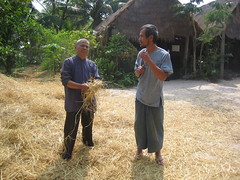
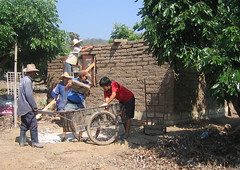
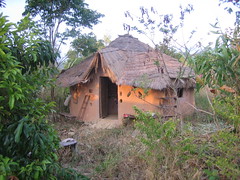
Jo had a head start building a real house on his family farm. It was made of bamboo, a readily available building material. Then, on a trip to the US, Jo happened to visit a pueblo in New Mexico and was struck by the cool temperatures inside the building relative to the hot dry climate outside. His home in Isaan had a similar climate. After studying the pueblo ruins and seeing how the adobe bricks were put together, he came back to his farm and began experimenting with building his own adobe house using a wood frame to make bricks. Transporting wood poles on his bicycle for the roof, he had a house built in three months, working only two hours a day. "This is so easy," he said to himself, marveling at this discovery of self-reliance. Better yet his house was virtually free while a concrete house, which is what his neighbors aspired to build, cost $15,000 baht. His neighbors came to watch and laugh at this folly of this crazy man building a house from mud.

The Principle of Easy

I too, was struck by how easy it was. After a week at my cob workshop pressing the mud and straw mixture together with my thumbs we only had a wall that was thigh high. With adobe bricks a house could be finished in a few days. It didn't seem right, yet it still had the same insulating qualities as cob or straw bale, was made from the surrounding earth and could be finished with sculptured decorations just like cob.

Making things easy, I realized, was the mantra of being Thai. All this time I had felt that this was our downfall—that the reason the Chinese did so well in business was because they were willing to work harder than the Thais. Challenged by the Chinese heritage of my Bangkok family, I had felt delinquent claiming to be Thai as if I were announcing that I had no plans to succeed. My American peers compounded this feeling by working hard to achieve "goals". I fended off such expectations and firmly claimed to be a Slacker. Secretly, I worked quite diligently on the projects I was interested in—hobbies they were called by others.

Jo told us, he had so much free time after learning to build his own house and grow his food organically that he started a children's group, a singles group and a library. He also had time to reflect and enjoy the beauty in life. He was not, however, considered a catch by the local village girls.

"No Thai girl would date me because I don't have a motorcycle," he said smiling. He didn't say it, but we could see that this was why he ended up dating farang girls and marrying Peggy, now sitting next to him as he told his story the first day of our study trip. Peggy had come to Thailand to work with the urban poor, but then decided to back up a bit and work with the rural poor before they ended up in the city.

"But how did you end up going to New Mexico?" I asked him in private. Poor Thai farm boys do not usually travel so far from home just to see the sites.

"My ex-wife wanted me to go because she live there," he explained. Ah yes, I nodded, "so another door opens". I did not want to pry further after the motivations of this ex-wife though I was interested in every farang's story who chose to spend time in Thailand. And besides it would be poor form with Peggy just a few yards away.

Jo's fame as an innovative builder came about in a similar circuitous way. First his neighbors had to experience the earth building for themselves. This they would do through another enterprise of self-reliance on Jo's part. After learning to make his own soap and shampoo, he organized a co-op to make and sell these products. This led to the need for a store in which to sell them in the village. Jo built the store and when customers came inside to shop they too experienced how cool it was inside the little earthen building. Soon other families ventured to make their own houses out of mud.

A Thai nun writing for a magazine discovered the adobe houses and published a story about Jo and his Baan Din, or "houses of earth". He became sought after by the public to help others build their houses. Over the course of three years he traveled all over Thailand helping to build some 300 houses for free.

Dammed, Displaced and Democratized

Half way through our two-week tour we packed our bags, loaded them onto the truck and said good-bye to Jo's family farm. Jo, Peggy and their little boy Tahn came with us to escort us to their northern home in the hills of Chiengmai, but first we would stop at a mountain community that had formed in the wake of a ten-year protest.

I had read about the protest and had been intrigued by this band of villagers that had set up camp on the lawn of the elegant parliament building in Bangkok. The villagers had lost their homes due to a large dam project (funded by the World Bank) flooding their land. The protest attracted others including displaced slum occupants, workers harmed in the workplace, prostitutes, those protesting encroachment on the forests and a large group called The Assembly of the Poor. For ten years, on and off, the groups protested until finally Thaksin, who had become Prime Minister at that time, undermined the Assembly of the Poor by giving the key leaders well paid jobs on various government committees. To those displaced by the dam he offered a piece of land that he then said they had to buy with a loan of 4 million baht from the government. Already in debt from so many years of protest, the villagers accepted the land hoping the government wouldn't come asking for the money.

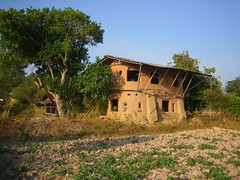
The resulting settlement was by far the most famous site of earthen houses we would visit, boasting its own road sign. Both Jo and Janell, also traveling with us, had been part of the international group that had helped the villagers build their own houses, install solar panels, build a school and another beautiful community building. Located high atop a mountain ridge, the open land of tall grass partly obscured the pink and yellow earth tones of the buildings. Mun Yeun, as it was called, had the air of a resort during the off-season. We pulled our bags off the roof of the truck and carried them to the schoolroom where we would later sleep elbow to elbow.

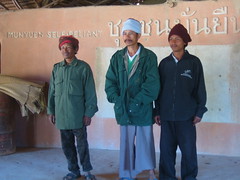
After a brief tour of the area, we assembled in the schoolhouse to hear what the three founding members of the village had to say. It soon became apparent that something was wrong with this picture. Of the 35 families that agreed to buy the land from the government, only nine were actually able to move here and only three remained. When we asked why, the men told us the families had gone to find work to pay off their debts.

So this is what democratic protest gets you, I pondered to myself, the right to protest, but not the right to be?

My fellow travelers offered suggestions, wanting to solve the problems facing the three founders. Martin, our practical minded chicken farmer, asked if they could grow cash crops. They had not been able to, they told us, but if they did they feared that the government would start asking them to pay off the 4 million baht debt.

Someone else asked if the King could step in. We knew the king to be a just man and an advocate of self-sufficiency, but no he had no such power to help them. He was only a figurehead.

"What about the government that supports self-sufficiency," asked Jen referring to the talk we had heard at the Santi Asoke center about how the government banks had wanted farmers to take the training in self-sufficiency before taking out a loan.

"No government wants self-sufficiency" I said bitterly. Jo agreed. It was all a manipulation to get poor people to work for rich people. The earlier promotion of self-sufficiency, after the financial collapse, had been an act of self-preservation to keep the banking system from going under, I realized. I was filled with despair that no one wanted these villagers where they were; they were just in the way of progress.

"Maybe they are a tourist attraction for travelers to witness the impact of globalization," I said quietly.


Jo did not translate this sentiment, just vocalized an agreement. Janell, who was sitting next to me, did not offer a sassy comeback. She was silent, possibly absorbed in her own thoughts of the project she had directed. Except for a few houses and a carport, these beautiful buildings were now largely abandoned.


Would people choose industrial progress if they knew the cost? How well I understood the need for massive dams to provide electricity to an industrialized city eager to power its consumer lifestyle. The dam in question would provide enough power for one shopping mall in Bangkok. Back home in the States ever-expanding server farms (computers supporting the Internet), were being built as close to dams as possible for the cheap electricity rates of clean hydropower. There was no end to our need for more power once started.

The villagers had been told the dam would help them irrigate their land, but that obviously was not the case as the plan was to flood their land altogether. The men implied that, had they known what was to come, they would have protested sooner.

"Ten years was a long time to protest. What kept you going?" I asked. This seemed to strike them as a silly question and they laughed at the mention of the ten years.

"There were a lot of issues needing to be discussed," one said simply.

I was trying to find the point to it all—the point of democracy and progress. This land was not theirs, it could be taken away for development into a resort for city people, the government wanted money and the land needed to be maintained to protect it from fire, but there weren't enough people to keep the fire breaks clear. The villagers had not been in agreement about the communal vision necessary to protect themselves from larger economic forces. Many had wanted to subdivide the land and go their own way with it, sell it even. I was frustrated by this failed vision and asked why they continued with it.

"They are just trying to survive," Jo explained. My thoughts were arrested midstream as I realized how bourgeois was my need for meaning and purpose. I, who could go home after a day of protest, had the luxury of righteous principle. Surviving meant continuing to try whatever might work. At the moment the three men were planting trees. They had been a forest people and even though they did not know the trees in the area, they knew how to cultivate a forest. The government officials came by, saw the plantings and did not ask for money. They just told the villagers to keep records of what they were planting. This was seen as hopeful. The villagers knew that the government were, now, wanting to grow back the forest, which would justify leaving them be. Meanwhile the protests had caused so much controversy that none of the other proposed dams were being built.

Dimly I began to understand that perhaps there was an optimum vision here. We learned more about their projects to reforest; how they were teaching their neighbors the value of leaving the land undeveloped. They were offering the investment of a cow in a sort of community supported beef supply that gave back in manure and offspring. Montaine asked what chore we could do to help them out. Thus our group spent the next morning raking manure in the cow pen into a big pile.


As we packed up to leave, a group sat down near me to sign the large guest book. Erin our Australian student was chosen to scribe since she had the best handwriting.

"What shall we write?" Sasha, our American student asked.

"Good luck," I suggested cynically, "We landless server farmers promise we won't build any more dams." Needless to say this was not considered a serious suggestion, but they acknowledged my declaration of guilt with respectful silence.

"What about this?" said Irena eagerly, "May the forest give back a hundred fold what you put into it."

"Oh that is so nice," I said sincerely, then laughed at the whiff of sarcasm I barely managed to pull back. Ah youthful optimism. The others agreed and Erin wrote it down.

Labels: , , , , ,

Saturday, March 22, 2008

Righteous Protests or Religious Fanatics?

Part four in a series of stories from my road trip in Thailand, participating in a study tour hosted by Pun Pun farms, to visit local examples of sustainable living in the Northeast and in Chiengmai.

When I mentioned the Santi Asoke Buddhist group to my Aunty Ah Padt, she expelled air through her closed lips making a sound, which I interpreted to mean "what a joke that group". I would have expected a similar reaction from a Republican upon the mention of Al Gore, but not from my Ah Padt, a practicing Buddhist. Still she was a Bangkok businesswoman and held the decidedly non-sustainable, pro-growth values of business people the world over. The Santi Asoke group had apparently gone too far.

Newsweek too, in a recent article on Buddhist political activism, characterized the Santi Asoke sect as an "ultraconservative" fundamentalist religious group that had organized political protests against the Thaksin administration. The emphasis was not on Thaksin, where it should have been, but on the potential for these religious protests to lead to violent uprisings. My fears of a perceived communist threat were outdated. I had forgotten that George W. had redefined the new threat to world peace as one that would come from religious fanatics usually identified as Muslim terrorists. Now Newsweek was comparing Buddhist protests to Muslim fundamentalists. This blatant bias irked me.


Back on our two-bench truck, our tour group of 16 Westerners in search of examples of sustainable lifestyles, drove for several hours towards the Laotian border to visit one of the largest branches of the Santi Asoke network, in the province of Ratchatani. At least the road was good. That much the government had managed to do, the better to rush raw materials and food to Bangkok.


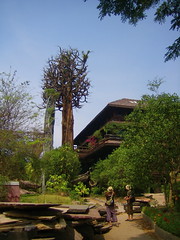
We arrived in a large park like compound where we could see, looming over us, extraordinary wooden buildings and what looked like a very tall tree with strangely twisting branches at the top forming a sphere. We hopped out, excited to explore such interesting examples of Thai architecture and were greeted by a woman with bobbed hair wearing a blue denim coat faded to a stonewashed blue.

A Santi Asoke Intentional Community


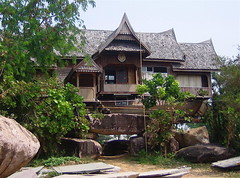
"Would you like to eat first or see the grounds first?" she asked us. Food could wait. We were eager to know the stories behind these buildings. One had the characteristic upturned roofline of Thai design, but was grafted onto a boat. This, our guide told us, was to put to use the retired rice barges that had once plied the rivers to Bangkok, but had now given way to a faster trucking system. Ah, we mused, so this was not a whimsical vision of a new spiritual order, but simply an example of creative reuse. To add to the mystical vision of airborne arc, the hybrid building was propped up into the air so high you could walk under it. This we learned later was a land that was flooded three to four months of the year.

Flooding was probably why the original plot of land had been donated to the sect. Twenty monks came to live on it, supported by food brought to them by the local farmers. Six women joined them and soon more people came seeking to live by the principles of voluntary simplicity and the communal work ethic that the group espoused. The network had also implemented some of E. F. Schumacher's ideas. Asoke sympathizers had translated the chapter on Buddhist economics from his book Small is Beautiful:Economics As If People Mattered.

Jo, acting as our translator, pointed out that the first to come were educated middle class Thais, especially teachers whose salaries were not going to cut it after the currency collapse. They were followed by farmers in debt. The economic collapse would swell their numbers to 300 members. Schools were created for the children and workshops given to the adults in self-sufficiency and organic farming.

We were served a vegetarian lunch in a large hall and shown a documentary film of the group on their giant flat screen TV. Though they did all wear the blue farmer's outfit that so reminded me of communist workers' cooperatives, they were not the extremist fundamentalists Newsweek would make them out to be. They still only followed the five precepts and ate two meals a day together, not the eight precepts as Newsweek described. And since when did abstaining from sex and eating only one meal a day constitute religious fanaticism especially in a Buddhist sect, I ask you?

While I was there, I did manage to break one of their rules by catching an afternoon nap while everyone shopped and if they had made note that I was a woman wearing shorts (but not too short) that would have been two, but these rules felt more like guidelines than fanatic beliefs. Nobody looked at me with disapproval. And when I forgot my jacket, one of the members retrieved it for me, while another asked if it was made in Thailand. Yes it was, because I am rather fond of the clever simplicity of those farmer's jackets and was wearing one that day with another short sleeve one underneath.


As we toured the center we were shown the organic vegetable garden and the recycle center where hand lettered signs in Thai and English described over twenty categories of materials including plastic bags which were washed and dried for reuse. The community made enough money from selling recyclables to fund their educational cable TV channel.


We also discovered that the intriguing three story high trees were actually sculptures, made by a local artist, from cement. The bark texture was impressively real. I asked the reason for these tree sculptures. The oddly simple answer was that they gave visitors something to see. Yes, Thai people liked to go to parks and see something manmade and the group often invited the townspeople to come to the community for special occasions such as the King's birthday. Lots of food and community made products were given away in an effort to spread their philosophy of self-sufficiency and meritism.

Protests and Engaged Buddhism

The real crime that the Santi Asoke group founder had committed, as I read later in the Christian Science Monitor, was to claim that the lax practices of the Thai monastery system had fostered materialism and corruption within. Unable to come to a resolution on this matter, the Santi Asoke leader had then formed his own sect. The military government of the day, fearing for their own relationship with the religious order most likely, had not allowed the new sect to register under the monastery system, thus reporters could later say that they were a rogue group of fundamentalist fanatics. That the group of Santi Asoke protesters chose the name the Dharma Army was an unfortunate PR choice that implied that they actually had arms and were not, as the word "dharma" would imply to a Buddhist, a group devoted to peaceful protests.

What the good liberal American reader brings to the mix is a healthy distrust of religious groups getting involved with politics. But much like the Baptist church in the American south, the Thai temple serves as a community center and is often the only place where a village can assemble and organize themselves against injustice, with the help of the most educated leaders of the community—the monks.

"But how are they related to the military," I asked Jo. After all, Thaksin had been ousted by a military coup, but I had never discovered how that came about. It had been one of my goals to find out during my trip.

"They are not related", he told me and explained to me that the Santi Asoke group had not staged a political protest. They were protesting on moral grounds, that's why it could be justified under the principles of Buddhism, which included practicing social justice. This I could understand, having discussed, among American Buddhists at home, whether anti-war protests could be considered a practice of Engaged Buddhism.

The military had stepped in fearing general unrest, he told me.

And what was their agenda? I asked.

Corruption, of course. Suddenly I saw how it worked. The military controlled government did not want the country in turmoil because that would cut into their nicely set up system of kick backs that was entrenched in an orderly, but corrupt government system. Nor would they want Thaksin privatizing everything, as prescribed by the prevailing forces of globalization, because that would take away the whole shooting match. That the Newsweek reporters could so glibly exploit the details of the Santi Asoke protest struck me as so unfair. Could it be that their issues of social justice did not fit into the story the United States was telling itself about the threat of armed revolt from People Who Hate Our Freedoms which then forces us into military intervention and everlasting war?

Everywhere in the world, grassroots movements were solidifying a response to the impact of globalization, but this trend was going unreported. Sustainability in itself was not worthy of discussion. And of course sustainable business practices, as modeled by groups like the Santi Asoke sect, was a threat to the prevailing mantra of ever more growth and profit.

We drove back into town and stopped at a store, one of the many that had been opened by the Santi Asoke group. It was about the size of a 7 Eleven and was stocked with the products made by the industrious members of the community. We filed in and perused the shampoos, herbal remedies and the implements needed to use them. I loaded up on bars of soap with exotic ingredients—radish, tamarind, tomato, garlic, ginger and citrus, plus a bottle of passion fruit juice which I downed on the spot.

The Final Analysis


When I showed my 89-year-old Aunty Lily my pictures of the tour, it transformed her opinion of me. I became someone with values that she and my grandmother, too, would have shared.

"You have done much good by going on this tour," she said, implying that I had accumulated good merit. I hadn't expected such a response just for being a witness to acts benefiting society. Aunty Lily had been a businesswoman too, in her day, but she had a sense of justice that I had come to count on. She asked me to show the pictures to her Wednesday lunch companions, a doctor and a teacher. Both knew all about the Santi Asoke group. The teacher told me she had a friend—a dentist who offered his services to the group as part of his merit making. I was relieved that they considered the Santi Asoke people to be worthwhile. After Ah Padt's reaction I was beginning to wonder if what I had seen was recognized by the general Thai population for the good they were doing or if the Thais, too, considered them inherently suspect.


The final analysis may not yet be in. Reactions to the return of Thaksin were also mixed. I was still in Thailand at the time and saw his smiling mug on the cover of magazines as he was joyfully welcomed by his supporters. Newsweek had described him as a populist leader, but his economic policies known as "Thaksinomics", which included a 3-year moratorium on farmers' debts, were not meant to encourage sustainability since he had also ordered state banks to aggressively extend more loans to the same poor farmers and villagers. His mega projects for Thailand's infrastructure would run up a bill of $50 billion, while his "populist" policies for healthcare and education were under funded. Now he would face trial for his crimes of abuse of power, tax evasion, cases of fraud, loans to Burma that indirectly benefited his telecom business and illegal bidding on a state contract involving 90 million rubber saplings (for expansion of rubber plantations to the North and Northeast—home of above farmers).

"What about democracy?" I had asked Jo. "It didn't look good to the world when the military coup took away democracy", I added. I had taken this failure of my home country to hang onto democracy as a personal slight that made Thais look backward. A military coup was just so old school.

"There is no democracy," Jo answered testily, "there is only money." I couldn't argue with that.

Also posted at energy bulletin

Labels: , , , , ,

Thursday, March 13, 2008

Healing The Farmer, Healing The Land

Part three in a series of stories from my road trip in Thailand, participating in a study tour hosted by Pun Pun farms, to visit local examples of sustainable living in the Northeast and in Chiengmai.

The Search for a Ripe Watermelon

If you eat more than one chemically grown watermelon you will get diarrhea, we learned from the organic watermelon farmer. Fourteen such melons had killed an elephant, he added. Poor thing. With such stories I was surprised that more Thai people were not making the connection. True, not all fruit were so heavy on the chemicals; none at all in bananas and coconuts, some in pineapples and oranges, but watermelons were clearly the most afflicted.

Organic produce did not yet have the market clout and high prices that were being enjoyed in the States. In fact, sales were poor because the organic watermelon had to compete with the larger, more regularly shaped conventionally grown melon and it took 10 days more to ripen.


Watermelons were a secondary crop sown after the rice crop was harvested. It was so simple to grow, a child could do it, said the teacher at the Santi Asoke training center. The problem was pests for which they recommended three strategies. 1) Avoid mono cropping and use small plots with a variety of crops. 2) Chase away the pests. 3) If pests still persist then let them eat because, after all, humans can grow food and pests cannot. This last recommendation undid any notion I might have had that fighting pests was a battle to be fought to the death and won. How enlightened. They also recommended picking the worm-infested fruit, to ferment in molasses, to make a fertilizer called EM—effective microorganisms—a method learned from the Japanese.


As we picked our way along the dikes of the rice paddies, the watermelon farmer followed our progress with a digital movie camera to show his organic farmer's co-op. Thai organic farmers were not getting a lot of attention from anyone and the gaze of Westerners would elevate their cause. There were no ripe watermelons; he had just sent a truckload to market. Finally at the third field, he found some that would do and cut two open for us on the spot.

We happily ate this clean fruit without fearing for our stomachs. It was sweet and refreshing. In fact all the food we would eat on this trip felt pure and fresh. That it was grown on the spot gave me a deep sense of connection to the land. We were traveling locavores eating within a few yards of where our food was grown. There was no need to think beyond this tidy closed loop; I felt complete and secure. I ate more fruit than I did at home—oranges, papaya, bananas and star fruit, all with no ill effects.


Walking from farm to farm in Jo's village, I gazed at the strange dry land with its grey white soil and tried to decide if it could be described as beautiful. Not at first, because I didn't know what I was looking at. Unlike an Italian countryside with its vineyards or an English one with its rolling green hills, both instantly recognizable as the stuff of travel brochures, this surreal flat, brownness had to grow on me. Height helped. There. In the next paddy. Very tall thin trees in a grid pattern with topknots of foliage like a Dr. Seuss illustration. That pleased my eye.


Back on the road our daily expeditions were punctuated by pit stops at roadside 7 Elevens, along the highway. All 16 of us would peruse the shelves of the multinational franchise and come out loaded with packaged snacks, buying enough to share with each other, the exotic tastes of peppered beef flavored potato chips made by Lay's, sweet sesame cookies made locally or the horrible fish flavored cracker that tasted like, well, fish food. I satisfied my craving for processed sugar with chocolate covered Japanese Poco sticks.

Healing The Farmer

For most of the farmers we met, it was their health that had turned them towards organic farming. At first they didn't know why they had the symptoms they did. Then it was discovered that the rat pee was toxic; rats living in the field were expelling concentrated chemicals into the waters of the field, which in turn gave the farmers intense rashes on their legs. They were also plagued by headaches and fatigue. Those who had ditched chemicals were convinced that soon every farmer would realize the connection and return to organic farming methods.

"People cannot learn without suffering," Jo said. The economic collapse had helped to create more such suffering, increasing the number of people deciding to take the healing path of self-sufficiency and organic farming.


Standing in a lush plot of edible forest, we heard the story of one such man who had owned a successful trucking company. As the economy collapsed, he found himself in extreme debt, with the bank repossessing all but one of his trucks. He came back to the country and with his remaining cash bought a two-acre piece of barren land that nobody wanted. He too had taken the training with the Santi Asoke Buddhist sect, reduced his expenses to almost nothing, and in three months was able to produce enough food on his plot to feed his family.

We ate tart fruit from his trees and listened to how he had started his garden by covering the plot with straw waist high. He then dug a hole in the straw and made compost. Into this hole he planted a banana tree surrounded by vegetables. What they didn't eat, he sold at the market. He began to grow wild vegetables that nobody had bothered to cultivate before because they had been so easy to find in the forest. Soon he was making 100 baht a week.

"But that's only about three dollars," I commented. Yes, but it was enough to pay off his debts, Jo emphasized, because he had no expenses. I was beginning to feel as though I was in an alternative universe of tiny efforts that magically managed to turn people's lives around. Now he and his tiny wife were digging wells on the plot by hand. We looked down the fifteen feet or so and marveled. The water from the well would be used to produce limes in the dry season when the price was higher. Later we met the couple helping out at another site.

As we sat before them in a covered meeting space, the two beamed at us and the farmer told us about his current project digging a rice paddy there at the demonstration plot we were visiting, also created by the Santi Asoke group. Within view was the nearby University where ag students were being taught that chemical farming was the only way to grow anything in this arid land. The ag department was, incidentally, funded by chemical companies. At the Santi Asoke plot students learned first hand what organic farming could do. Some were even living in the earthen houses they had helped to build. They were beginning to ask questions.

It was not so long ago that chemical agriculture had been introduced to Thailand. Because of the government-induced deforestation during the '70s, farmers who had previously grown their vegetables in the forest had little idea of how to feed the barren soil once the trees were cleared. Enter the chemical company reps who dazzled farmers with the benefits of manmade fertilizers. The farmer's ego swelled with pride at the greenness of his rice crop. No one informed him of the downside. Nor did the farmers calculate their costs versus profit. They simply looked at the extra cash they were making with each harvest, not realizing that every year they had to buy and apply more chemicals than they had used the year before. By the time of the economic collapse they were 95% in debt. (Insert sex trade story here for this is the region where most of the women in the Bangkok sex trade come from.) Now with the cost of fertilizer following the price of oil, more were considering going organic.

Concern for the farmer's health had also opened the door to a revival of herbal medicines and the use of antioxidants to clean the blood of pesticide residue. Off we went to visit the herbal medicine co-op. Located within the grounds of a temple, the founders had persuaded local medicine men to reveal the ingredients of their secret remedies for the common cold, ulcers, hemorrhoids, back pain, and diabetes.

Each May the network would go into the forest to collect the medicinal herbs. Realizing that the forests were fast disappearing, the temple asked their worshippers to bring tree saplings instead of the usual cellophane wrapped offering plates (full of canned foods and hand towels folded into animal shapes). They also had help from non-government organizations and were able to open a health center. Now, they had a seed saving operation. 80% of their ingredients were grown locally.


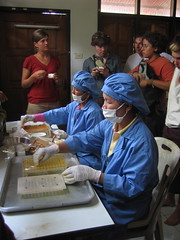
We were shown the hand press used to harvest various oils and watched as two women wearing hair coverings and latex gloves, filled capsules with turmeric powder. Medicines used to be made by rolling the ingredients into a honey ball, but because the network was working with Western trained doctors at the local hospitals, they had complied to Western standards.

This impressive whole systems approach led the network to take on the source of all the trouble and set up a fair trade rice co-op with its own mill to provide support for farmers to grow and sell organic rice as well as those transitioning to organic.

Fair Trade Closes The Loop

It was a Sunday when we visited the mill and sat under the blazing sun in plastic chairs while we awaited the arrival of the leader of the cooperative.


"Why have you come?" asked the silver haired farmer once settled on the shaded bench. "Are you farmers?" Peggy, sitting next to him, translated his challenging tone.

Having been so eagerly welcomed, elsewhere, as the auspicious farangs come to witness their humble farms, our group did not have a ready answer. We had only one farmer among us. Yes, who indeed were we, this oddly clothed, band of Westerners, traveling in the back of a truck. What impact did we hope to have on our lives by coming here? No one was going to hazard an answer. We must answer I felt. It would be impolite not to answer this village elder.

"We are eaters," I offered, taking the perspective of the book "The Omnivore's Dilemma". Peggy translated my answer and the farmer chuckled. He told us, then, how it all worked. That there were 1,000 family farms in the 17 year-old network. They sold overseas through GreenNet, a Thai organic wholesaler. After costs of running the mill, the profit was redistributed to the farmers.

"We got back what we invested, plus we made friends", the farmer told us. Now they concentrated on getting the word out through seminars at monthly meetings. The farmers in the network were also required to grow back the forest on some part of their land. With the price for organic rice rising by 5% a year, overall chemical use was decreasing in Thailand. Yay!

"Westerners brought chemicals to Thailand," he commented watching for our reaction. "Not that I'm blaming you," he added, smiling. Did we have any questions?

"Was he paid a salary to run the coop?" "Yes, but really only enough to buy laundry detergent," he replied.

"In all of his years of farming had he noticed change in the climate?" Oh, yes, yes what about that? I silently thanked Alicia for asking the question. Our nights had been cold, way too cold for Thailand. I had only packed lightweight clothes. Even wearing three shirts, two pairs of pants and a blanket wrapped around my head, that second night, sitting in the open dining area, I had not been able to feel warm. I had felt angry and betrayed by my own country. Peggy and Jo sent out for more blankets. Luckily, I had a nylon sleeping sack with me that kept me warm through the night.

"Yes," said the farmer, "sometimes we have three seasons in one day. The hot season is hotter with less rain and when the rain does come, it comes all at once. There was lightning where there hadn't been before; trees had fallen and people had been killed by lightning because they didn't expect it." We were subdued by this report of such radical change. Nobody asked about the future prospects given this report. What could anyone do about that which was unexpected? I hadn't anymore thought for the future than what was for lunch.

We were soon invited to proceed to the lunch pavilion where we were served more variations of vegetarian fare and were delighted to see omelet's. I had two helpings, not knowing that we would be offered another lunch of noodles in the village. I could hardly walk after that. My status as an "eater" had been stretched to the limit.

Also posted at energy bulletin

Labels: , , , , , , ,

Monday, November 19, 2007

Are We Green Yet?


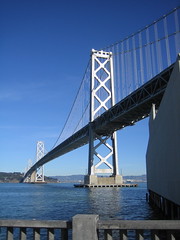
In reference to the oil spill in the San Francisco bay, two days after the collision of a freight tanker with a pier of the Bay Bridge, the Chronicle offered a one word headline: "Heartbreaking". How odd, I thought. I'd never seen a newspaper get so emotional. The picture that went with the headline showed a six column wide close-up of an oil-covered bird. The week before, the Chronicle had done a front-page article on the plastic garbage patch in the Pacific. Yay, I had shouted to Catherine. Never before had bad news looked so good to me.

It was only a little over a year ago that I had learned about the garbage patch and created my "Why Bottled Water Makes Amanda Cranky" display. In 2004, when I first wrote about global warming as a concern, it took three years for the Chronicle to take the subject seriously. Now, the knowledge gap was closing and suddenly Green was in. The CNN series, Planet in Peril, impressed us with its depth. MSNBC declared that it was now a Green station. This did evoke some skepticism. Had they just now figured out how to recycle?

Meanwhile the atmosphere at the Bioneers conference in October had been decidedly grim. Evidence of planetary woes was compounded by corporate mayhem in Burma to put in an oil pipeline, the never-ending war in the Middle East and the ever more obviously egregious conduct of the Bush administration. This should have been a time of large-scale action to reduce our carbon footprint, but instead we were in the midst of a resource war for oil, the very substance that was causing so much devastation.

The tanker that had caused the oil spill was piled high with containers thus serving as a vivid reminder of world consumption and the dramatic increase in shipping in the last few decades, inviting the inevitability of accidents along with the usual cost to the planet in pollution and fuel extraction. As this was an outgoing tanker, the containers were probably filled with bails of crushed plastic bottles and e-waste going overseas for recycling as opposed to new plastic crap, cheaply made clothing and next year's e-waste. One TV newscaster did mention that some of the containers were filled with perishable food and would need to be unloaded quickly. A fitting example of why it would be a good idea for communities to localize food sources.

It was a good week to return to the Green Festival. There, at least, we could buy something free of guilt (we hoped). Created after the pivotal protest against the World Trade Organization in Seattle, the point of the Green Festival was to show the world what fair trade, sustainably produced goods looked like. With the Gap having recently been busted for using child labor (followed by earnest statements from the CEO that this was not okay), it was a good reminder that fair trade still had far to go.


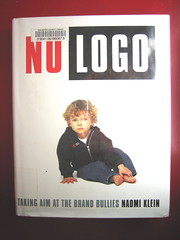
I happened to be reading Naomi Klein's first book, No Logo.

Sweatshops, I learned, were systemic and not an aberration that cropped up now and then to mar a company's image. Corporations had distanced themselves as much as possible from actually making things. They were now all about branding and slapping their label on goods made for them as cheaply as possible. Contractors competed with each other to get those everyday low prices for them. This had created what were basically indoor work camps all over Asia, enclosed in walled compounds that were protected from local taxes in an effort to lure the big name "investors". These "export processing zones" or "free trade zones" were impenetrable to outsiders and short on inspectors. The labor, usually teenage girls and young women, were kept intimidated to discourage labor unions from forming. And it wasn't' just clothes, it was everything consumers might buy.

Catherine wanted her own Kleen Kanteen, the stainless steel water bottle that had become the hallmark of environmentalists. It was made in China. I asked the sales rep about the factory that made these bottles. Were they sweatshop free? She did not have a definitive answer. They had given their contractor the sweatshop free guidelines they wanted in a factory, but they could not report having inspected the factory themselves and were continuing to seek transparency. Well, at least they had guidelines. The clothing companies I talked to were better. Their factories were registered fair trade operations. Other vendors like To Go Ware had sought out Burmese refugees on the Thai border to make their portable bamboo flatware and lunch containers and had a personal relationship with them.

At the add-on bidet booth, I wanted to tell them that all that hardware needing to be plumbed into an existing toilet was way too complex a solution just to save toilet paper (and the Boreal forest) when we could use one of our old plastic sports bottles that we now had no use for, having replaced them with the Kleen Kanteen. I had been inspired by the bidet idea last year and had come up with the sports bottle alternative, but there were too many people hovering around their hardware-bedecked toilet for me to attempt to derail them.

"I'm worried about the plastic bottle," I told the young woman at the Dr. Bronner's soap booth. The characteristic bottle, with its famous label covered with health tips and Bronnerisms, was 100% post-consumer PET, she told me, a technology the company had been a pioneer in getting started. I hadn't believed it was possible to make bottles with 100% recycled plastic; I had read that the polymers break down when reused. Good for them if they have figured that one out. They were local too, being in California. The Green Festival wasn't doing a whole lot about curtailing overseas shipping, but it was improving working conditions of workers and the environmental impact of consumers. Thus it was our annual shopping go-to event for socks, underwear, soap and hats. And food for thought.

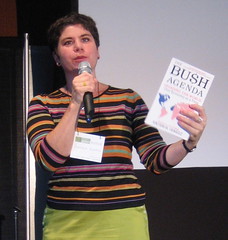
This year I was eager to hear Antonia Juhasz. Before reading her book The Bush Agenda: Invading The World One Economy At A Time, I thought of the Iraq war as a mega distraction on the part of the Bush administration, but her description of the companies profiting from the war made it clear that corporations, mainly Chevron, Bechtel, Lockheed and Halliburton, had been controlling our government long before Bush, pushing the country into policies that had made the world a more dangerous place. But how did the war connect with the green movement?


The Bush administration is not leaving Iraq until it has the oil contract it wants, Ms. Juhasz told us. Oil companies used to have control of 80% of the world's oil reserves in the past, but oil producing countries, like Iraq and Iran, had nationalized their oil, leaving oil companies with limited contracts involving production, so of course they want back in. And they want a 25-30 yr. contract that not only gives them the right to control exploration and production of the oil in Iraq, but also gives them the lion's share of the revenues, which would seriously undermine the Iraqi economy. And, what's more, this contract must be underwritten by the US government, which means that our military must remain there to make sure it is carried out. This would amount to an endless war for oil.

And, she added, the reason the administration wants to invade Iran is because the current Iranian government has been partnering with China regarding oil contracts and the only way to break up that partnership was to get rid of the government that made that contract. And I thought it was because they, like Saddam, had threatened to sell oil for Euros, which would cause the dollar to collapse. I got my chance to ask her about that during the Q and A.

She agreed that this selling of oil for Euros would indeed be disastrous for the dollar, but that it was very unlikely because the oil companies would have to agree to it and so would the Europeans (who presumably don't want to piss off the Americans). I was relieved as I have been spooked about currency collapses since the Asian Tigers went down.

It was left to someone else to ask about the green alternative. If this war was about oil, couldn't we simply transform the economy to one that used alternative energy? Her answer was that we cannot create a big enough market as long as we have an oil-dominated system and we cannot legislate alternative energy because the oil companies will outspend our best efforts to put legislation before the public. For instance Proposition 87 which would have funded research for alternative energy with a tax on oil companies as well as reduce oil consumption by 25%, lost last year because of the counter propaganda of the oil companies. They spent more on that California campaign than Kerry did for his entire campaign for president, she told us. So there it was. The oil companies were blocking the green movement altogether.

Someone else asked about boycotting oil companies. She said that such boycotts tended to drain activists and are largely ineffective because oil companies have such deep pockets they can wait us out and once you boycott one company what company are you going to buy gasoline from that isn't also involved? You can buy it from Citgo which is Venezuela owned, but they haven't got nearly enough to supply all of us. You could buy it from Valero because they are not involved with production, but then they have to buy it from someone who is.

Her proposal was that we must insist that the oil companies be broken up into smaller companies in order to break up their stranglehold on the government. And how are we little people going to do that, another person asked. She assured us that it had been done before by concerned citizens.

Yes, we are asking a lot of our citizens in these extreme times. Not only am I compelled to do an environmental impact report on the lifecycle of every item I consider buying, as well as ensure that the lives of those who make it are just, now I must call up my representatives every week and urge them to break up oil monopolies (and stop giving away our civil rights). Couldn't we just undergo a cultural shift?

Couldn't this Green culture that we are nurturing here in the Bay Area become part of our cultural pride and identity, that we then spread to the entire state of California? Take the Italians and their love of coffee. So innately informed are they about what coffee should taste like and how it should be sold, enjoyed and drunk, that Starbucks has not dared to open one store in all of Italy for fear of being immediately unmasked. Their faux old-world coffee experience exposed for the dishwater serving, fast food, buzz shops that they are. Starbucks has managed to fool the world, but they know it would only take a few Italians to call their bluff. Oil companies should't be able to outspend us into voting against a tax on them that would fund alternative energy. Their efforts should be immediately apparent for the self-serving manipulation that it is.

After my last Green presentation (during which I showed off my new Renaissance vest made from a discarded Chinese dress and invited people to check-out my hair because I was now washing it with baking soda) one of my colleagues told me I was his Green conscience. Another agreed and showed me her refillable water bottle which she had gotten after seeing my anti-bottled water presentation. "You wouldn't be telling us this stuff if you didn't really feel passionate about it," she pointed out. No, indeed, the only way I could live with myself, and continue to face the bad news, was to change the way I lived and share that journey with others.

I try to keep it light, but perhaps the Chronicle was not far off in using the headline "heartbreaking". As one activist, teaching about sacred activism, pointed out, "It is in the breaking of the heart that we truly discover what it is we feel compelled to do". There is plenty now to break our hearts, from oil sodden birds nearby to polar bears starving afar. We just have to have the courage to feel it long enough to take action, he counseled.

Also posted at energy bulletin

Labels: , ,

Monday, October 29, 2007

It's the Stupid Economy, Stupid: Big Box Thinking


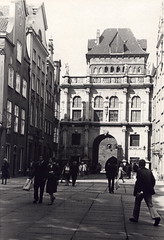
In a restaurant in Gdansk, Poland, I had a conversation with a Polish man that would stay with me long after I had forgotten his name. It was the summer of 1978 and I was on holiday with two of my aunts. At the time my Aunty Lily was the managing director of the Bangkok branch of the Polish ocean lines. When I heard that she was going to make a business trip to Poland, I begged her to take me along, as I was hugely curious about what a communist country would be like. Did they wear uniforms and practice goose-stepping? Were they brainwashed? And if not, did they secretly plot to escape?

We were hosted by four different Polish families who had lived overseas in Thailand while working for the ocean line. They would invite us for a cup of tea in their tiny apartments (where the living room converted to a master bedroom). In Gdansk, the Rudovsky family took us to a restaurant famous for its wild game. All the meat on the menu was brought in by hunters. It added diversity to what the state could offer, Mr. Rudovsky told me. The restaurant was decorated with the heads of the deer meat brought in. It made me feel at home in a medieval European sort of way. I asked Mr. Rudovsky if he would like to visit the United States. His answer both informed me and warned me.


"I don't want to visit the US for the same reason I don't want to visit the Soviet Union," he said. I was thrown for a loop just to have the two countries mentioned in the same category.

"You see, in a country that large, people have far less opportunity to be exposed to another culture," he explained. "In Poland for instance, there are not enough Polish books to read so we must read books from other countries." I immediately understood what he was saying about this monolithic way of thinking for I had experienced it as a foreigner living in the US, but the message that stayed with me was that the real danger of living in a large country was how easily a person could become isolated from outside perspectives.

Why, I would ask myself following this trip, was communism so dreaded in the United States? Couldn't we just let it be? Though McCarthyism and the red scare had been put down to an extremism of the rigid '50s, the United States of the post hippie '70s had taught me that communism was the anvil upon which our artistic souls would be crushed. The whole cold war was based on the assumption that Russia was the evil empire plotting to blow us up. Then there was the domino theory of communism taking root in South East Asia as if this icky gooey, mind controlling substance would ooze all over the peninsula into Thailand and Burma.

All of our Polish hosts were in agreement that the benefits of what the state could provide outweighed the day-to-day sacrifices they made in putting up with their tiny living space and the constant lines at government stores for necessities. (Mr. R. did have a larger house in the country that he built himself and Mrs. S. had figured out how to jump the queue by throwing down her money, taking the needed item and telling the cashier to keep the change).

There were other restrictions too. The number of students who could study art was limited by the state (because there wouldn't be enough jobs for all those that wanted to study art). But homelessness had been eradicated, people had jobs, education was free and the cost of living was kept down. Plus the streets were immaculate in stark contrast to the streets and canals of Bangkok, which were chronically trash filled and populated with maimed beggars and the poor living in shacks.


I was also surprised to see that private businesses were not forbidden. There were lots of private shops and enterprises because, as Mr. R. explained, the state couldn't be bothered to make every button, so they contracted with private factories and people were also free to sell whatever they made themselves.

In Warsaw, I came to understand the Poles feelings for the Soviets. Our hotel looked out on a dramatic building of distinctive style that towered upward to a spire and sprawled across the open plaza with shoebox shaped wings. It took up the entire block, but none of the guidebooks available to us mentioned it even though it was so obviously a historical landmark. I asked our host what it was.


"Oh," said Mrs. S dismissively, "that was a present from Stalin." It was the Palace of Culture she told me. I could see it was thriving with activity and I knew from my acting studies that Poland was world renown for its experimental theatre. Catholicism also thrived in defiance of the communist regime. As a people, the Poles thought of themselves as Europeans, not Eastern block satellites of Moscow.

My curiosity satisfied, I was in agreement with my Polish friends that having the poor taken care of was a good thing and so was free education and healthcare, but I was not won over by the drab austerity of their lives. There was something cheerless about the way they endured the oppression of Soviet rule. They did not have a say in what went down in their own country. Other European countries, particularly the Scandinavian countries and my own birth country of England had a better system—democratic socialism. But democratic socialism was not a phrase that tripped off the tongue of Americans. We were entering the era of Reaganomics and socialism had become a dirty word. Wasn't that what the Soviets had? Americans couldn't seem to tell the difference between socialism and communism.

With the fall of the Berlin wall, pundits threw out the whole discussion and claimed that clearly capitalism was the chosen economic system of the free world. Indeed, they implied, capitalism was democracy.

Capitalism may well fail us yet, I thought, but suddenly the word wasn't even used anymore. I began to hear another term bandied about, especially by colleagues armed with an MBA. The "free market" would solve our problems, they told me, because where there was a need there would be a buck to be made and solutions would be innovated to cash in on that buck. Some would make fortunes, but this was good for everyone because the money would be spent on other businesses. I was at a loss for words. What did I know? I only had an art degree, but the whole idea of trusting that people's self-interest would drive a market system that would solve all our problems, using the carrot of profit, seemed to me to be paving the way to hell faster than good intentions.

But if some boats were going to be lifted on the tides of fortunes being made, I might as well be on one. Like so many others, I invested my money in the stock market, only I put my whole obsessive focus behind it, waking up before the opening bell every weekday morning to watch the market, reading only books about making money and religiously studying my subscription to Investors Business Daily. Every story out of my mouth was about an up and coming business that showed promise for exceeding amounts of profit. I developed the emotional profile of a heroin addict waiting for the next hit, the next rush of cash. In my search for a better high, I violated nearly all my guidelines to buy only companies that matched my ethics.

I finally called it quits because, I was so bad at this counter intuitive game, my portfolio was a bloody mess of red ink. I had paid a high price to understand the beast, but I would have no illusions about it. Investors, i.e.: speculators, moved so quickly to bag their fortune that they were completely oblivious to the impact of their actions. No one would be anywhere long enough to take responsibility even on a psychic level. But money had been made and this gave people the illusion that everyone everywhere was prospering.

In 1999, a now famous, protest that took place in Seattle at a meeting of the World Trade Organization. Not a single journalist seemed to have a clue what was going on. Gradually the story came out, mostly in the alternative press, that large numbers of the world's population were being left behind by the new rules of globalization. As trade barriers were overcome, corporations were out competing local businesses with cheap imports. They exploited the resulting unemployed by not paying a living wage, while currency debasement drove prices of staples and fuel up higher. Not to mention that the environment was being trashed and the world's resources were being rapidly consumed to make disposable products for new markets. This was what protestors were on about in Seattle, from the Sierra Club to steel workers' unions, from college students to indigenous people worldwide. The media didn't show the banners of these groups, just the few people acting out and police in riot gear. The TV was doing our big box thinking for us.

What I didn't realize at the time was that communism had served as a tempering force on the way capitalism had been allowed to express itself until the fall of the Soviet Union. Like my Polish friends, many populations wanted their government to provide them with health care, education, housing, clean water, clean air, public transit and jobs that offered a living wage. As long as communism and socialism offered this social contract, capitalism had to make do with a mixed economy of government regulations, services and public works to keep the poor from fomenting a revolution based on these examples. Thus was the philosophy behind FDR's New Deal.

The agenda of Reaganomics was to convince the American public that communism and in turn socialism was a very dangerous idea, while at the same time spinning a tale, of prosperity for all, by persuading us that there were great opportunities to be had by every American smart enough to take advantage of this wonderful ride called the free market—we would be a nation of entrepreneurs and owning class citizens, a true meritocracy. Did you buy it?

Meanwhile government services would be shrunk and regulations undone, so that corporations could provide all services on their own terms and not be held accountable to any nation. Blackwater anyone?


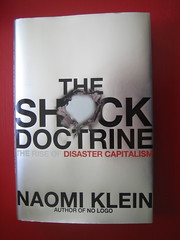
Many books on globalization and the American corporate empire have since come out and I've read plenty, but none filled me in quite like Naomi Klein's new book "The Shock Doctrine: The Rise of Disaster Capitalism". Of any single revelation that she takes pains to trace, what offered me the most emotional relief was that the free market doctrine was the extremist idea of one man—Milton Friedman. Like Darwin's "survival of the fittest" mantra, industry found it convenient to embrace this ideology. (Darwin, at least, had the integrity to retract his phrase when he saw how it was being used, while Milton Friedman's last act before his death, was to advise politicians to take advantage of the confusion of the Katrina aftermath to replace the New Orleans public school system with a voucher system.)


It struck me that this whole free market idea was a quest for an unobtainable market purity, much as eugenics was a quest for a pure race. Eugenics furthered the violence of a fascist regime. Klein's book chronicles the violence done by the US on behalf of "American interests" from South America to Post-Soviet Eastern Europe, to Mandela's Africa, to the Asian Tigers and now in Iraq. Whether, with the tools of economic subterfuge or by helping dictators "disappear" leaders of the socialist movement, vigilant populations, practicing their hard won freedom from previously oppressive governments, were terrorized into silence.

While Amnesty International hid the socialist identities of these victims (for fear of offending corporate donors) Americans could believe that we had nothing to do with these failed economies. "Corruption," cried free market advocates, blaming the individual countries. Now I can ask. What could encourage corruption more than allowing corporations to operate above the law?

We now have the economy we deserve. One that, in its own profit-seeking wisdom, has provided us with solutions it deemed necessary. The fastest growing sector of the market in recent years has been in surveillance and reconstruction, not green cars or cleaner industry, not better healthcare or education. But now I can take comfort in the realization that such an economy was not one that a democratic people chose. We were misinformed.

Labels:

Tuesday, August 21, 2007

Dressing the Eco-Feminist, Ethnic, Lesbian

The day I saw the shelves of organic cotton clothing at Country Sun health food store, I said aloud to no one in particular, thus startling another shopper, "So it's come to this, has it?"

Assessing the shapeless designs with their muted earth tone hues, I felt as though we had arrived at the door of George Orwell's 1984. "No way", I thought to myself. I would never be able to embrace these drab colors of a puritanical eco-sensibility. I was, after all, from the land of Thai silk, whose vivid hues had stunned the editor of Vogue magazine, back in the '50s when the silk was presented to her by an American named Jim Thompson.

The world needs more Americans like Jim Thompson, for he was the consummate lover of all that was beautiful and beautifully created, but not yet "discovered". Like the budding naturalist in an unruly gang of boys, he was the one who stopped and said no let's not kill it, look at how beautiful it is. At the time that he found Thai silk, it was only being woven by a few weavers for formal wear in the royal court. But rather than gathering up these weavers and putting them in a factory to produce under his boss man authority, he encouraged the cottage industry and gave the women shares in his Thai Silk Company. He also standardized the wooden looms and introduced the colorfast jewel tone dyes that so characterize modern Thai silk. (And no, I don't know if the dyes are toxic.) Only later would Thai businesswomen set up said factories to meet the production demands of the market he essentially created.

I visited one with my grandmother in the early '80s. Her old school friend owned such a factory not far from our house. The friend greeted us in the air-conditioned showroom, with its floor to ceiling teak shelves, full of the folded cloth arranged like oversize books. Each piece was a slight shade advanced from its neighbor thus creating a chromatic sequence that made a rainbow look institutional.

After I had chosen an aqua marine turquoise double weight silk for a suit I would have made by a local seamstress, the proprietor opened the door to the factory floor. There in a brightly lit white room, vented to the outside with louvered windows near the ceiling, were rows of women seated at traditional wooden looms. They were dressed in cotton sarongs and moved rhythmically, the sounds of wood on wood creating a pleasant accompaniment to the scene.


The high price of Thai silk reflected this handmade care. Thus it was with a certain reverence that my family spoke of the silk. It was associated with the best tailors and the most high holy occasions. And my, were those occasions splendid with entire ballrooms filled with such outfitted ladies, no two alike.

With that kind of upbringing woven deep into my psyche, it was no wonder that I balked at the drab offerings of the environmentally conscience clothing options I found at my local health food store, not to mention the hemp dominated Green Festival.

It was only a matter of time before I would have to reconcile my love of textiles with my eco principles. Environmental, social justice activists are not supposed to care about clothes. We are urged to protest sweatshop labor, denounce the impact of pesticide ridden, nitrate polluting cotton farming, decry fashion as the capitalist engine driving consumerism (which it is) and wear clothes that look like we've owned them for all of our adult lives.

On a day-to-day basis, I do adhere to these principles, filling my closet with khakis and travel shirts (made overseas most likely by cheap labor working long ours). Sweatshop jobs may be an improvement over even longer hours, and no pay, working for a family patriarch on the farm, but there was still the energy and water used in textile and clothing production to factor in, as well as fuel expenditure of the ocean going freighters and the portside air pollution in Los Angeles as trucks idled while loading.

My daily uniform, however, was so generic I discovered I could find the pants and shirts, used at thrift stores, in the preppie parts of town, thus lowering my eco footprint. (Given the 68 pounds of clothes that Americans donate per person per year, there is enough used clothing to bale and ship back overseas to keep most of the African continent, Eastern Europe, the former Soviet Union and parts of South Asia and South America stylishly dressed.)


There were, however, events to attend, parties and such. I first learned to dress for parties from my drag queen friend, Mark, whom I met at college. All the closets in his house had been expanded to hold double rows of vintage women's clothes, size 11 shoes and wigs. His dresser drawers were filled with gloves, purses and other treasured accessories. Throughout the school year he would display his outfits at each event, two at a time, changing midway through the evening.

This being UC Santa Cruz in the late '70s, the rest of us were a motley crew of shaggy hair in boot cut jeans, dykes in overalls and straight girls in long skirts and peasant blouses. To distinguish myself from the peasant blouse contingent, as well as the overalls, I dressed up my jeans with a red thrift store blazer, which I pretended was my prep school uniform in envy of my mother's British girls' school heritage. (I did go to a girls' prep school, but it did not outfit us with natty blazers).

What captured my imagination about my drag queen friend was that he managed to evoke a power and vulnerability that was riveting on his six-foot frame. He transcended overt objections to his gender bending, bisexuality by becoming a performance artist. I wanted this power for myself.

The first vintage dress I bought was a chic black sheath number in moiré satin, with drop shoulders circumscribed by erect geometric petals revealing the breasts encased in pale pink of the same fabric. I bought it for Mark. Before I could give it to him, a party was scheduled and I decided to dress for him instead. With my family's sewing machine (my mother was an avid home sewer and my father made his own pants), I took the dress in about three inches up the back seam and made it fit. Donning a bright red pair of stiletto sandals, the only pair I owned, I made my entrance into the dorm lounge where the party was being given. Mark, in a vintage dress, per usual, got on his knees at my feet and looked up at me admiringly, then wished upon me a nice big cock. Heh! I was accepted in the club. I was a drag queen!

To continue to generate that hands-off (but only when I want it) power that Mark had perfected, I bought a motorcycle, on my return to the Bay Area, and outfitted myself in a classic black leather jacket and black leather pants tailored for me by a German craftsman in San Francisco, Tauber Leathers. Black steel-toe boots completed my armor.

Under the leathers, I was fond of Western wear until I lived with a lover who owned horses. One day we were on a riding trip with friends in Brazil. The only man in the party (American and white) had on his blue jeans, a t-shirt and a straw hat. I think he may have even been chewing on a grass stalk. Watching him from a distance, he so cut the figure of a lone cowboy, that I was overcome with a curious, burning jealousy of both his gender and race. No matter how stylin' my Tony Lama boots, or how perfectly shaped my hat, I would never achieve that level of authenticity. Out went the cowboy shirts.

Inspired by my karate gi/uniform when I took up martial arts, I designed a Tibetan style vest from black gabardine to wear over my white pirate shirts (from Deva, an American company employing local home sewers). I had been investing in Folkwear patterns, a company that reproduced instructions for the making of traditional clothing from around the world as opposed to the ever-changing styles put forth by high fashion designers. Indigenous clothes were simple and adaptable. I had made the African pants repeatedly in printed cottons for summer wear.

To better tailor the African pants pattern to go with the vest, I put in a pleat from my hipbone to my ankle, then buttoned up the pleat down the shin with loops, not buttonholes. The overall effect of this "pantsuit" was more modern than ethnic, business like, but not corporate and masculine without identifiable male detailing.

An acquaintance was so taken by it, she begged me to make the same outfit for her. I considered charging her a lofty fee to cover my time. It would have looked great on her, too, but this "look" was so authentically me, I had to let it be uniquely mine for a while longer, so I turned down her request. The suit still stands me in good stead, today, as an alternative to the business suit.

To let loose my flamboyant Thai silk roots, I later sewed the Tibetan Panel Coat in a vivid green and gold sarong patterned silk that my grandmother had given to me. Worn with a bright yellow Ukraine shirt with trim of the same silk, it was a fabulous outfit that united me with everything I loved about the Thai sense of design. Okay, so I could really only wear it at Christmas parties.


Back to every day fashions. Was it true that lesbians were chic now? I tested the premise by picking a conservative function to wear one of my dad's narrow ties, pulled away from the neck, on a white shirt with black jeans. It was my high school reunion and my classmates were wearing floral print garden party dresses. I couldn't have looked more out of place, but I was not shunned, only welcomed with animated interest. The only person who avoided any contact with me was a teacher, clearly a butch lesbian, probably closeted.

What other looks were butch? What about the Utilikilt? Men who wore these black skirts with the cargo pockets, looked tough, but disarmingly gender bending. Would I look butch in one, or more like a Japanese schoolgirl? I didn't want to spend the $140 to order one to find out. Maybe I could make one. My search for a kilt pattern took me into the land of Renaissance Fairs and pirate costumes. Hmm, yes, my English roots. What if I made men's shirts, both historical and modern, using the highly vivid Asian prints in my collection of textiles?

The first shirt I made was an ordinary short sleeve camp shirt from a bright plaid Indian cotton that a client had given me. It took me a week to make what would probably take a factory fifteen minutes, but I loved it and wore it with great care, pairing it with a black bolero jacket from a vintage dress and my Thai hill tribe pants, to come up with a whole new outfit that still had an ethnic sensibility.


As I matched my box of salvaged fabrics with my collection of patterns, I visualized seven designs — an entire Fall Collection! It included a Chinese hip length vest cut from a red dressing gown with white piping, a Peter Max coat in a pink and yellow '60s print, a sea green vintage Chinese cheongsam dress re-cut into a sleeveless doublet, a ruffled poet's shirt of green cotton and a Renaissance style bicycle jacket made from army surplus snow camo backpack covers—white for better night time visibility. I had my work cut out for me.

The second shirt took even longer as I redesigned the pattern halfway through to include more interesting pleating details that mimicked a slashed doublet with full sleeves, also pleated. Catherine was impressed when I was done, said it looked Renaissance with an Asian twist, given the block printed dark pink fabric I had chosen. Yes, it was presentable and had a stylish look that was not exactly current, but wasn't not current either; it made me think of the '60s. I was enjoying myself.

"You know," I said to Catherine who recently joined the Slow Food movement and had made her first homemade pizza, "I think I've just invented the Slow Clothes movement."

Pithy facts provided by the book "The Travels of a T-Shirt In The Global Economy" by Pietra Rivoli. An intellignet exploration by an economist professor seeking to answer the social jutice issues raised by student activists regarding sweatshop produced clothing. She does not, however, mention environmental impact as a factor of industtry. Thus the need for more activists to raise these issues.

Labels: , , ,

Earthworm. Get yours at bighugelabs.com