Amanda Kovattana

Middle-aged musings in interesting times

Sunday, March 01, 2020

May You Live In Interesting Times


Not wishing to appear oblivious to the concerns of the coronavirus that has interwoven our global lives and been present in every country I walked upon, I start here at the intersection of my personal journey and the news of the day as it rose to meet me
Not to mention the political climate here in the States that has everyone abuzz with passionate intensity. It is indeed interesting times.


Keep Calm And Carry On

“Will you be getting any more masks?” I asked the Asian cashier at Walgreens already wearing a mask, “I’m going to Thailand next week and my relatives want me to bring some.”

“You might want to cancel your trip,” he said.

“I went to Asia during Bird Flu and SARS and I’m going to go now,” I said getting annoyed. “It’s only a 2% death rate,” It was late January and Santa Clara had just reported the first local case of 3 in the U.S. Thailand had 17 cases.

He told me a shipment was due in at 5 a.m. the next day and I should come early if I wanted a box. I did not wish to trouble myself for something so useless and was immediately annoyed at the level of panic the thought of this new pandemic was stirring. 

“Masks are useless anyway,” I told the clerk and stormed out. 

I was so mad I had to get a grip before I insulted more people after another relative messaged me to bring her a  box of 100 count 3M model 9001v masksSuch a specific request made it sound like a status item. They were nicely designed paper masks with valves. The price was rising as I searched for them online. I didn't order them as they were delayed in shipping and wouldn’t arrive in time. She expressed emoji despair and I expressed anger at her hanging her hopes on masks.

I knew my best remedy was to respond in my own way with a public post all my Thai contacts could see. I planned a satirical piece on protective gear to post to Facebook. This required that I make another visit to Walgreens the next day to buy white cotton wound care gloves and a stop at Pet Smart to buy a cone of shame (to keep the wearer from touching their face). I was very pleased to see it came in 3 fashionable shades of transparent plastic and chose the fuchsia in a medium dog size. It took me another day to take pictures and write my post which I presented at dinner time just as my Thai contacts were at breakfast. My "Dear Thailand" letter had my American friends rolling on the floor while my Thai friends acknowledged my polite assessment of their arising situation as a gesture of caring. 

Well done I thought as the fine line between gentle parody and insult across cultural boundaries was one of my biggest ongoing challenges.

I had booked my ticket four months before my trip and had gotten a decent price on my favorite airline; the one with the best food and a terrific offering of entertainment options in movies from all over the world. It routed through Taipei. I had in the past booked with the cheap Chinese airlines that had me layover in Guangzhou for hours so I was relieved that I had steered clear of those flights. They were likely cancelled now. 

My second clue that this story was going to be an international one was how quiet SFO was the night I left on February 4th. The line at baggage check was a shadow of the usual frenetic activity of Asian people struggling with oversize cardboard boxes and giant suitcases in their attempt to bring home all the tariff free goodies from the States. Security check was such a dream I forgot to collect my laptop and rushed back an hour later to get it. While trying to prove to the security foreman that it was indeed my laptop I showed him the picture of me dressed in a white hazmat suit striking a heroic pose with one foot on my duffel bag. He looked at me skeptically. He asked for something with my name on it. Luckily I found a downloaded copy of last years tax return.
Crowds keep me focused when traveling I realized and made a note to double check myself in this disorienting new environment of emptiness. It had its perks. I had a whole row of seats to myself on both flights. Taipei too was quiet with masked travelers who wore their masks quite carelessly I noted while I had winter gloves on and was became hyper aware of how much I was wanting to touch my face. But it was the emptiness of the Bangkok airport that shocked me most as I entered the huge hall for passport control. I snuck a picture of it during my short five minute wait for what would normally take over an hour to get through. Every Thai looking at that picture had the same thought. We are in for an economic meltdown (given the tourist industry that drives Thai economy). All tours from China had been stopped though individuals were still allowed in. 

My girl cousin was on time to pick me up in her family size luxury SUV. She did not have a mask on. I asked her how she felt about the Wuhun virus. 

“I don’t look at the news”, she said, “it has made me much happier”. 

“Good for you,” I said. Being a mother of two preteen boys was challenging enough without adding to their lives the burden of the world filtered through an anxious mother. 

“Do you have masks?” I asked. 

“We still have them from the last time,” she said referring to SARS and bird flu. No worries then for the wealthy. She more wanted to share with me her latest alternative health exploration and gave me her much rumpled copy of The Emotion Code. I handed over to her (once we arrived at my family compound) the magnetic bracelets she had mail ordered to my California address for me to bring. Magnets are the tool of choice for releasing stuck emotion according to this healing practice which used muscle testing to find the stuck emotion. I was intrigued.

I also had for her a fishing vest for her eldest boy who had taken up skeet shooting. A development I found intriguing and creative for a boy who has no unscheduled time at all in this world where free play is an antiquated notion. Skeet shooting was offered in Bangkok in a controlled indoor environment park-like setting. All of middle and upper middle class Bangkok conduct their lives in indoor environments. That is how one lives in a city where the air quality is constantly in the red zone of unhealthy. This was what enraged me about the panic around masks. It was for the wrong reasons I wanted to shout. 

I had myself become an aficionado of non-disposable masks and had invested quite a bit of money into finding the best fitting, vented mask with replaceable 99micron filter (available in a wide array of fashionable colors and prints) designed by a contractor. These had become my most prized gear for woodworking sawdust, California fires and the smoke of the burning season in Asia known as PM 2.5 (parts per million sized at 2.5 microns).

I duly checked that everyone on our household staff had masks. In Prayoon’s kitchen where I took my meals I saw a good quality 3M one in a storage box. No one was wearing them at home, but they had them for going out. Online my contacts were posting every update on the virus and China’s response including a video showing officials apparently shooting a man trying to escape the lockdown city. 

Commuters on the BTS (Bangkok Transit System) were almost all wearing masks and I learned from a post by an expat culture watcher that there was a social context for masks. In Europe only those who are sick wear masks to protect others. In Asia masks are worn as an act of communal cooperation and solidarity (and because the government was telling them to)I read more discussion online about why masks don’t help.

While traveling on the BTS with a mask wearing cousin (the one who wanted the 3M box of 100 count 9001v), I sneezed (due to change in air pressure) and she urged me to put my mask on. She was a doctor’s wife and was wearing the usual pleated ear loop masks so I put on mine and she took a picture of us together to post to FB urging people to be safe for both virus and PM 2.5. Killing two birds with one stone and appeasing both our mask agendas.

Prayoon’s daughter Aun ever entrepreneurial was looking at home sewing masks to sell. At night they watched the news which would calmly update the number of cases along with instructions about washing hands, not sharing utensils when eating and using hand sanitizer now available at entrances to stores and just about everywhere including the subway stations. The news is controlled by the military government so was designed to keep everyone calm and informed. No amped up CNN style coverage here to instigate chaos and possible political unrest. There was good news too. On February 3rd Thai doctors successfully treated a Chinese patient in critical condition with a cocktail of HIV and flu meds. She recovered and was delisted as having the virus. 

This news was not part of your CNN coverage. One might well wonder why. Clearly the panic element of the news cycle had far to go to keep eyeballs. A cure would dampen this interest. And besides it wasn’t a white first world male doctor who came up with this treatment so was hardly viable. The best mention was a generic “some are trying various meds, but nothing has been corroborated”. I had blamed todays increased fear factor on social media, but it was more the fault of CNN that 24/7 pipeline in constant need of news fuel with which to douse the public with whatever would keep their attention and fear was the most addictive elixer. (CNN coming on line in the late ‘80s was when parents started to put their kids on house arrest due to all the child abduction stories. We are just now beginning to come back from that with the “free range” child movement having to legislate the right to allow children to walk the streets without getting arrested.)

At the train station in Chiangmai arriving passengers on the sleeper train frequented by foreigners were greeted with welcoming smiles and hand sanitizer dispensing nurses, an infrared camera and a doctor. Once in the country side there were no masks at all. Time had stood still there. We went about our business. (Much to report in my next post on my adventures learning about a probiotic technology from Japan and what a game changer it is for animal husbandry, farming and garbage collecting.) Two weeks passed and I was once again back at the near empty airport. It was eery. The hugeness of this shopping mall airport empty on a Friday afternoon. It felt like there had been a die off. Would this be the end of globalization I wondered? Perhaps all that frenetic travel before the virus was quite unnecessary. And we could finally transform to a localized economy. I could get used to this I thought.


May You Live In Interesting Times

Upon entering the U.S. there were so few returning residents that they switched us to the visitors side as a long line of travelers from Taiwan awaited processing on the other. Why would they want to visit Trump’s anti-foreigner, anti-everyone America I wondered? I guess they got tired of wearing masks. Heh. We had all been screened at every airport with infrared cameras before boarding (to spot a fever). It would be the only reassurance I could offer to my State side family that I had not brought back the dreaded bug.

The customs officer questioned me sternly about what I was doing on my trip and what I brought back. Air freshener and kitchen utensils I said. I forgot about the 3 bags of shrimp and chili flavored Lays potato chips. I didn’t want to mention my rattles because they had seeds in them. He let me pass.

The America I returned to had shifted noticeably into a mood I hadn’t experienced—ever. A sort of collective holding of its breath as though awaiting disaster yet the weather was lovely. The streets seemed noticeably light in traffic, but the conversations both in person and online was a chaotic, noisy battle of wills. I was back to being mad again. Mad at the panic after traveling through the relatively calm territory of a people living with the epidemic. Mad at the political wrestling of the primaries and the arising horror of the “liberal” media to the specter of Bernie Sanders. The chaos of it made me wish to dispense with democracy altogether. Here in the land of “make your own reality” the battle was on for control as pundits tried desperately to mitigate the horror of an old man who represented so much change to a society so invested in incremental baby steps. Yet completely ignored the one woman who was speaking sense. I’d come home to vote for Elizabeth of the House of Warren, mother of dragons flaming Bloomberg right off his golden perch. 

My flashes of insight informed by having just returned from a country whose democracy had gone terribly wrong yet was still quite functional informed my commentary. I wondered if Americans would learn quickly enough how to handle the unrest I saw waiting to erupt. Democracy requires much of its constituents and there had always been smart, well informed politically savvy people who saw clearly what was happening, but the narrative would have to be well enough understood by those who were only reasonably and superficially informed. But here was a new challenge—the people I was used to taking my cues from—the informed classes of older white liberals who had always called the shots for us in the media and in our local leadership appeared to have overslept and missed the movement I’d been a part of and had been watching since the last election. It gave me the worse case of culture shock. I sharpened my pen on Facebook on every platform offered. Some would hear me and be so shocked it shut them up. Some in turn wanted to shout me down. I took solace in political satire—the territory of subversive, veiled opinions. It was best not to get too invested. And hold open for what could still arise in the unexpected—what unnoticed pangolin might MacGuffin us right off our righteous perches. The Black Swan of our time. Anything could happen.

As a writer the famous Chinese curse “may you live in interesting times” is my version of “surf’s up” in my taste for adventure. Though I now felt that real change (in terms of how we choose to live preferably sustainably and in harmony with the earth) was coming from outside the U.S. this is where I’m planted and by rights should bloom and have bloomed. I would be a witness either to its continuing collapse or to its passage through. 

Meanwhile I checked online for cheap tickets to elsewhere. Those empty airports had been a tonic. And this was after all a once-in-a-lifetime chance to see the world without either Americans or Chinese. Two classes of tourists so huge that without them the world would be empty and left to its own self. How cool was that? Perfectly normal things could happen. 

Labels: , , , , , , ,

Saturday, October 20, 2018

In Sight Of Land


I have waited a few months to give my report on my trip to secure a tiny farm in Northern Thailand back in July. Things had happened to me prior to that that words were failing me to contain or resolve. Somehow all available words I might have to discuss this event had been co-opted to serve a purpose that was no longer serving me. So in the end I had to wrestle the words back and make them do my bidding. I could not make it go away otherwise. A retreat from Trump's America certainly helped to clear my head. I offer that respite first.


My Thai Land

I sat down at the counter of the land transfer office to write my name carefully in Thai script conscious that the government was now under authoritarian rule since democratic elections had been shelved for some 4 years now. Massive protests had forced a corrupt prime minister to step down resulting in a power vacuum that justified a military takeover. During that time the country had been polarized into the Red shirts of the northern rural areas and the Yellow shirts of the urban population of Bangkok. When asked to come to some kind of agreement in order for governance to proceed each side insisted that only their way would do and refused to allow the other any concession. And everyone basically gave a sigh of relief when the military stepped in. 

All the officers at this Northern station had on yellow shirts as if the Yellow shirts had won, but I learned later it was because it was the King’s birthday month and his birthday was on a Monday which in Thai tradition bore the color yellow. Thai culture could be so whimsical in its cultural expression I mused. At least I knew what the colors of the days were from having gone to Thai kindergarten. I was not wearing a yellow shirt. I had on a long sleeve maroon shirt which I hoped would not mean anything. Or if it did would be in my favor.

The officer sitting across from me in her pastel yellow polo shirt watched me laboriously writing.

“Take your time,” she said. I had not expected kindness and warmed to it. We were far from Bangkok in this pleasant rural province of Mae Taeng where I was buying a farm. Behind me in the waiting area sat my farm partner Clasina holding the hand of the farmer’s daughter whom she had befriended on a previous visit. We had not sat together in case her fair haired foreign presence complicated this matter of land ownership. The old farmer himself had already been to the counter with his grandson to verify his ownership of the land I was buying.

After I had signed my form I was sent to the next officer, a man higher up the chain looking perky in his bright yellow polo shirt as if he were on vacation. He looked over the information on my form. A copy of my Thai I.D. card stapled to it showing me in a striped black shirt worn last year during the year of mourning for the beloved late King Bhumibol. Looking at it gave me a sense of continuity with my Thai heritage. The year of mourning had done much to unify the country.

“Do you live in Bangkok,” he asked me.

“Yes,” I said

“Or do you go go/come come,” he said using that cute all inclusive Thai phrase for so many of us now with a foot in the West.

“Yes,” I said nervously, but my answer seemed not to matter too much. He was not looking to strip me of my identity as the officer in Bangkok had who demanded that I produce my parents’ marriage license to prove I was indeed legitimately Thai. He verbally had me confirm my age and address and reaching the bottom of the form signed it. I was done. Grandson and I then paid our share of the transfer tax and I gave him the check for the balance of the money for the land. He did not even open the envelope to look at the check. Then we all got back into his white taxi truck which he drove as an additional source of income. I joined him in the front cab as befitting my status as investor and elder while the others rode in the back. Grandson seemed subdued though he had been quite chatty driving in. Selling land was a big deal for a farmer I suspected.

“How long does it take you to plant the rice seedlings”, I asked him for Clasina had given permission to the family to sow another season of rice on our land since we would not be using it anytime soon.

“One day with ten people,” he said, “then we help to plant rice on each of their farms.” I was floored. Wow. It was still here this barn raising Amish style community work force. Each villager beholden to each other trading their produce and time not for money, but for reciprocal gifts. How secure that would make me feel to have such a community. 

He asked me if I was going to farm organically. And I realized that he saw our venture as a form of technological advancement. The next big thing. Otherwise why would I bother with such an investment. I said yes though it was more complicated than that, but I did not have the words for food forest even though this was now a trend in Thailand, a style of agriculture that the late King had promoted. And not one that had profit as an end goal.

“Have you thought to grow organically/” I asked him

“No,” he said, “it is more expensive and we do not have a market. But you know more people,” he added implying that we would find markets he didn’t have access to. I did not ask how it was that organic farming was more expensive. I wasn’t sure I had enough Thai to understand the answer. I could see he had some regrets about having to relinquish his land as if he had somehow failed and now his son had gone to computer school and his daughter to some other career. At least the land had not been in the family for generations. I would feel bad about that.

Our farm was originally government land, part of the national forest that had been portioned out after the dam was built. Given to the farmers who had been displaced by the government built damn. The reservoir now feeding all the farm plots with cement lined ditches that bordered each plot. The stipulation of the two deeds that now bore my name was that the land could not be used for commercial purposes other than farming. Though we were permitted to build whatever housing we needed. 

I had seen it for the first time the day we arrived. Clasina and I had traveled up from Bangkok on the newly updated express sleeper train full as usual of European travelers. We were met at the Chiang Mai station the next morning by a fellow mud hut sister Jesse a Canadian expat, with whom I had built a house three years ago. She had met Clasina already as she had come by to visit our mud hut build back in January. She had listened with interest as Clasina talked about a farm she was looking at buying. When I told Jesse of our plans to collaborate in buying this land she was happy to have us stay at her house. She too had bought a rice farm paddy and put on it a refurbished traditional wooden Thai house. Jesse was the perfect person to midwife our farm project. She had familiarity with the process and asked good questions.

It was Jesse who drove us to the farm for my first viewing with me in the back of her little white pick-up feeling very farmer like sitting with a bale of hay. We turned off the highway and a dirt road brought us to the farm entrance marked by the opening in the barbed wire fencing. 


“Welcome home,” Clasina told me as she gave me a hand to help me out of the truck. Home. So many meanings that had for me.

As Clasina pointed out the markers at the corner of the rice paddy field below the road the plot seemed smaller than I had imagined until we actually walked it. For our purposes it would be fine. Across the road was the orchard dotted with lychee trees. It was on a slight incline which would be perfect for a homestead. In the distance were the mountains that Clasina had wanted when she was looking for land. They were covered in forests and were sensuous and green reminding me of Hawaii which was ironic in itself since the last time I had looked at land for a homestead was with a lover living in Hawaii. Lucky that  romance didn’t work out and I had come home instead and had this chance to secure a foothold in the land of my childhood. 

Once the deed was done this new status of owning land slowly began to fill me with a sense of a future and kinship in Thailand. I had feared that once the elders in my family had died I would have no reason to come to Thailand. Owning land was a way to make my childhood home meaningful again. It also gave me new friends.

Clasina and I had not run out of things to talk about on the train coming up and we hadn’t even touched on what kind of farm we wanted. She was so cheerful and easy going we traveled well together. With Jesse the three of us shared a congenial time delighting in each others company and lots of girl talk. Jesse in turn introduced me to other permaculture farmers — a young man from Brazil who was co-teaching a class with her, a Frenchman who had settled in Thailand with his Thai wife. I shared with them my tiny house story augmented by a Powerpoint presentation I had put together to share at my last mud hut build. There was an ease here that was restorative in the way these expats shared their perspectives. People yielded conversational ground to each other. I was pleasantly surprised. The conversational style in the US was becoming decidedly unyielding. I sorely needed this respite, for I was now living in a society that was becoming increasingly difficult for me to navigate.


A Nation Divided

Back in the U.S. a nation under a President intent on fomenting a form of white tribal nationalism I knew I would not have an easy time of it and had taken steps to buffer myself from his enraging rhetoric. Meanwhile on the Left I was trying to keep up with what was considered respectful use of another culture’s teachings or group’s symbols and what was a disrespectful appropriation that projected a hurtful stereotype. I enjoyed appropriation of all sorts of cultural dress and symbols for my own amusement just to keep people guessing my mixed race heritage. Plus I am practicing shamanism a spiritual path that may or may not be a cultural appropriation depending on what words you use to describe your spirit guides. People were so busy correcting each other that it was harder to find common ground as less ground was given and less benefit of the doubt offered. We were overcorrecting in a divisive and distracting way I felt. This self censoring restricted creative thought and the imagination when we could be creating a culture we could all inhabit.

Shortly after my 60th birthday I decided to travel to Minneapolis to visit a dear friend I hadn’t seen in five years. She was a tenured professor deeply involved with issues of climate change as part of her work as an artist. So we had much in common to discuss. I had offered to give a talk on the eco aspects of tiny house living to a group she promised would love to hear all about my composting toilet and waste water gardening. And because of our fascination with multicultural influences I added to my talk additional personal information about my background, my privileged upbringing in Thailand and my LGBT coming of age in the US just to showcase the many intersections of subcultures in my life that might have led to my choosing an off grid lifestyle. Being presented as an eco hero already set me up for judgement, but these additional details broadened this potential in untested ways I felt, but I trusted my host.

She also told me how adept the students had become in staking out their own personal identity politics. So much so that it seemed every week a student would be “triggered” by something she said and would vocally reprimand her for using a colloquial term or presentation they found offensive. It was almost a competitive thing with these students since even the mild mannered ones were just as apt to jump on this band wagon. This detail of her teaching life annoyed me intensely as it seemed to be giving students so much power over how information was delivered to them. Weren’t teachers to be respected rather than constantly corrected?

And just as I was wondering what this must be like for my friend I was given a dose of it myself. After I gave my talk to a very polite and attentive all white audience who did not laugh nearly enough for my taste, we went to dinner where my friend picked up a message from her assistant, a grad student, reprimanding her for being so insensitive as to allow me to wear an outfit bearing a symbol that was extremely offensive to her particular minority group. And she was right. In this region it was an offensive symbol.  One I had sewed onto the back of my outfit (a printed logo) in an ironic moment over a decade ago. I had completely forgotten about it and was chagrined to be the cause of my friend’s attack. It took us all evening to discuss the possible ramifications for what most would consider a rather insignificant offense. After which I concluded that she was working in a hostile environment that was becoming increasingly stressful to her whether she acknowledged it or not. And now was causing me distress.

When I got home I spent an hour writing an apology to the offended grad student choosing my words with careful humility hoping for some lenience owing to my being a stranger in a strange land and a guest. She gave me no such mercy, but was quick to give me a label that categorized me and my “people” as ones who would do harm — in effect an enemy. I had never heard this term of hers before and was undone by how it cast me into a ready made narrative. I felt as if my American citizenship had been revoked. She then added that unless I cured myself of my ignorance of the significance of this symbol I was aligning myself with white supremacists. This being now the label for racists with the added implication of intention to maintain white rule. This was a patently ridiculous claim, but the damage was already done. My sense of who I was in this country was scrambled and few hearing the details of this event could help me so intent were they on explaining to me why this person would be so “triggered” (which is why I have purposefully left out the details here. I am extricating this story as one would a splinter. In the hopes of healing). 

Upon my return to treatment my acupuncturist was alarmed by my emotional and physical condition. Not only was I leaking energy at a faster rate than he could restore it, but my confidence in my own narrative was decimated. I didn’t trust that I could convince anyone of anything I had to say or that I even had the right to say it. If students could reprimand professors with no accountability as to the appropriateness of their complaint I had no ground to stand on, no support from these peers.

I was angry, but I also understood the territory. Raising consciousness about racial bias was not a bad thing. It was progress. And though I was not granted forgiveness so I could be made whole again, I forgave my young assailant for her youth having wielded such weighty accusations at my elders myself when I was a student. 

Plus this was not the first time I had been taken down by someone speaking for a minority people in America for when you are the “model minority” you are by your very success in navigating these complex race lines demonstrating that race doesn’t matter in the land of “equal opportunity”. You have “assimilated” and made it work for you. And by your example you have made race a non issue in the eyes of white people. Yet institutionalized racism continues. You are just the exception that proves the rule. I accepted this lesson as graciously as I could. I also understood that while we might be categorized under the same People of Color umbrella, we were not necessarily friends. This made me wary. 

It’s true that as a model minority I am already ahead of the game arriving with a full set of tools and advantages. Immigration laws screen immigrants from overseas culling for the best and brightest just as my parents with their higher degrees were only allowed entry because jobs were already offered to them. The tension of being at the intersection of such class advantages paired with the presence of racial bias in America from the age of ten has shaped me and made me something of an expert on racial narratives. Not to mention being queer and female on top of it. But the Trump era has upped the ante some and racism is now being discussed much more frequently by white allies intent on raising the alarm about the agenda of “white supremacists”. Within these discussions is the hope of eradicating such an agenda. While my non-white contacts were just as apt to post blisteringly anti-white alliance statements. This just increased the tension without offering any possibility of a unifying cause. 


Gasping For Air

In Thailand nobody talked about politics even the expats and nobody asked me what all was going on in the U.S.. While I was enjoying this much needed respite within the peaceful sphere of a news media controlled military dictatorship I had to wonder if I was still up for Democracy. Was not the end result always going to be controlled by wealth stealing the show while infighting fractured the Left? I felt relieved to be in a country where I did not have to work so hard to navigate competing versions of reality. I could mind my own business relieved of responsibility for any outcomes whatsoever. The televised news was so innocuous it was not worth discussing being mostly reports about government sponsored programs around the country doing good for the people. And a good half hour spent on the selection of the day’s lottery numbers. Was this so bad? Much harder to watch democracy self-corrupt and be powerless to stop it.

Still I had to return. And in returning I would have to have a strategy. So I had armed myself with the recent book
Democracy In Chains by Nancy MacLean, something meaty to read while waiting in government offices. I felt that if I could just understand how democracy in the U.S. had been compromised I would have a firmer handle on how to engage in correcting this course and reclaim democracy. The book delivered. The history in it describing the last 50 years gave me the information to see that what was at the core of this mess was a class war being wielded by a white elite informed by a history of slavery. The intent being to take back power for the wealthy and reduce the power of the majority even further. The men responsible had worked tirelessly and persistently to manifest this agenda through controlling discourse in universities, in the news media and in the mouths of politicians. There was no real promise of equality or even a patriarchal promise to do what’s best for all the people. There was just the dangling carrot of opportunity. A premise further fueled by capitalism. This class war was so pervasive and subversive that everyone who has a chance to be upwardly mobile will likely betray those falling behind including those in their own identity group.

The history I absorbed confirmed for me that this was an old battle we could fight with an old school economic social justice approach. It was enough to give me confidence to return yet the struggle of living in Trump’s America would still get to me. The separation of children from parents at the border, white women calling the cops on innocent black people, the enraging Kavanaugh hearings. And every time I thought we might have a movement that would allow coalitions to form I saw bridges burned down by divisiveness. The Left scrambled by an impulse to persecute its own. Feminism being sacrificed just as it was getting a fresh reboot because another group’s issues seemed more just. Coalition building not on the table while everyone reviewed their privilege and challenged each others internalized biases. My dearest friends were enraging me with counter productive approaches. My favorite optimistic writers showed signs of despair. Would America save itself? Would young people vote? I had no confidence in the outcome. Now that I understood the coup that had taken place even before Trump I knew where I stood. But this knowledge did not empower me it just made me feel more helpless. How long before others would see it?


In Sight Of Land

I had been swimming while drowning for a long time. I had sighted land in a far away country that gave me solace. But here in what had been my home for 50 years I was gasping for air. Rage draining my energy. And then more rage at not being able to recover. I told people I was being treated for exhaustion as though it were an ongoing condition. Every time I thought I had my old self back someone would ask me to take sides and the energy would drain out again. I clearly needed a different philosophical interface. I did not want to just retreat from all discourse.

I would rebrand myself as a white supremacist. Not the violent exterminating kind of course, but the culturally appropriating idea bagger of all that humanity had to offer kind. Just as the English language has managed to absorb foreign words and chew down foreign concepts into their deconstructed parts I would unapologetically (with the Queen's English of my birth country) consume all ideas for my own purposes. Move chameleon like amongst every group, scarf up whatever doctrine was being served up, witness it and move on before the group think could get me. Democracy may in the end fail the U.S. but it won’t be the end of human society or even human goodness. I had seen that much.

Labels: , , ,

Saturday, May 17, 2008

Dammed, Displaced and Democratized

Part five in a series of stories from my road trip in Thailand, participating in a study tour hosted by Pun Pun farms, to visit local examples of sustainable living in the Northeast and in Chiengmai.

Self Reliance and the Earthen Building Movement

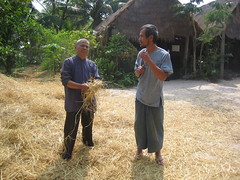
As founder of the earthen building movement in Thailand, our tour leader Jo Jandai had contributed much to the concept of living sustainably. As a farm boy he grew up believing, as others did, that his future prospects lay in getting more education and finding work in the city. His epiphany came after seven years of living in Bangkok working everyday and barely making ends meet. What kind of a life is this? he asked himself. He was not an engine. Jo then returned to his family farm with the intention of becoming self-reliant. This was a man after my own heart for I, too, thought self-reliance was preferable to dependence on money.

For me this meant being able to cook, garden, sew my own clothes and fix the house I was living in. I even enrolled in a two-semester construction technology class to learn carpentry, electricity, sheet rock installation, roofing and plumbing. Once I saw what was beneath the sheet rock, I realized that our homes were really just a clever illusion of comfort—a stage set of thin materials propped up with sticks. This badly insulated, leaky box then had to be heated using fossil fuels piped over long distances or air-conditioned with electric power at peak hours. Building materials were manufactured and trucked from far away while the building industry itself was one of the largest generators of garbage. And it was all so unnecessarily expensive. People were made slaves to their mortgage.

I was already enamored of straw bale buildings, which used local agricultural waste straw to create massive walls that would moderate interior temperatures. A few years later, I explored my interest in natural building by taking a cob building workshop, a close cousin to adobe. I collected books on tiny houses and lulled myself to sleep engineering in my mind structures made from available materials.

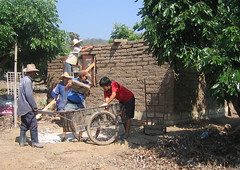
Jo had a head start building a real house on his family farm. It was made of bamboo, a readily available building material. Then, on a trip to the US, Jo happened to visit a pueblo in New Mexico and was struck by the cool temperatures inside the building relative to the hot dry climate outside. His home in Isaan had a similar climate. After studying the pueblo ruins and seeing how the adobe bricks were put together, he came back to his farm and began experimenting with building his own adobe house using a wood frame to make bricks. Transporting wood poles on his bicycle for the roof, he had a house built in three months, working only two hours a day. "This is so easy," he said to himself, marveling at this discovery of self-reliance. Better yet his house was virtually free while a concrete house, which is what his neighbors aspired to build, cost $15,000 baht. His neighbors came to watch and laugh at this folly of this crazy man building a house from mud.

The Principle of Easy

I too, was struck by how easy it was. After a week at my cob workshop pressing the mud and straw mixture together with my thumbs we only had a wall that was thigh high. With adobe bricks a house could be finished in a few days. It didn't seem right, yet it still had the same insulating qualities as cob or straw bale, was made from the surrounding earth and could be finished with sculptured decorations just like cob.

Making things easy, I realized, was the mantra of being Thai. All this time I had felt that this was our downfall—that the reason the Chinese did so well in business was because they were willing to work harder than the Thais. Challenged by the Chinese heritage of my Bangkok family, I had felt delinquent claiming to be Thai as if I were announcing that I had no plans to succeed. My American peers compounded this feeling by working hard to achieve "goals". I fended off such expectations and firmly claimed to be a Slacker. Secretly, I worked quite diligently on the projects I was interested in—hobbies they were called by others.

Jo told us, he had so much free time after learning to build his own house and grow his food organically that he started a children's group, a singles group and a library. He also had time to reflect and enjoy the beauty in life. He was not, however, considered a catch by the local village girls.

"No Thai girl would date me because I don't have a motorcycle," he said smiling. He didn't say it, but we could see that this was why he ended up dating farang girls and marrying Peggy, now sitting next to him as he told his story the first day of our study trip. Peggy had come to Thailand to work with the urban poor, but then decided to back up a bit and work with the rural poor before they ended up in the city.

"But how did you end up going to New Mexico?" I asked him in private. Poor Thai farm boys do not usually travel so far from home just to see the sites.

"My ex-wife wanted me to go because she live there," he explained. Ah yes, I nodded, "so another door opens". I did not want to pry further after the motivations of this ex-wife though I was interested in every farang's story who chose to spend time in Thailand. And besides it would be poor form with Peggy just a few yards away.

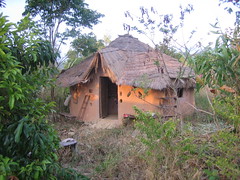
Jo's fame as an innovative builder came about in a similar circuitous way. First his neighbors had to experience the earth building for themselves. This they would do through another enterprise of self-reliance on Jo's part. After learning to make his own soap and shampoo, he organized a co-op to make and sell these products. This led to the need for a store in which to sell them in the village. Jo built the store and when customers came inside to shop they too experienced how cool it was inside the little earthen building. Soon other families ventured to make their own houses out of mud.

A Thai nun writing for a magazine discovered the adobe houses and published a story about Jo and his Baan Din, or "houses of earth". He became sought after by the public to help others build their houses. Over the course of three years he traveled all over Thailand helping to build some 300 houses for free.

Dammed, Displaced and Democratized

Half way through our two-week tour we packed our bags, loaded them onto the truck and said good-bye to Jo's family farm. Jo, Peggy and their little boy Tahn came with us to escort us to their northern home in the hills of Chiengmai, but first we would stop at a mountain community that had formed in the wake of a ten-year protest.

I had read about the protest and had been intrigued by this band of villagers that had set up camp on the lawn of the elegant parliament building in Bangkok. The villagers had lost their homes due to a large dam project (funded by the World Bank) flooding their land. The protest attracted others including displaced slum occupants, workers harmed in the workplace, prostitutes, those protesting encroachment on the forests and a large group called The Assembly of the Poor. For ten years, on and off, the groups protested until finally Thaksin, who had become Prime Minister at that time, undermined the Assembly of the Poor by giving the key leaders well paid jobs on various government committees. To those displaced by the dam he offered a piece of land that he then said they had to buy with a loan of 4 million baht from the government. Already in debt from so many years of protest, the villagers accepted the land hoping the government wouldn't come asking for the money.

The resulting settlement was by far the most famous site of earthen houses we would visit, boasting its own road sign. Both Jo and Janell, also traveling with us, had been part of the international group that had helped the villagers build their own houses, install solar panels, build a school and another beautiful community building. Located high atop a mountain ridge, the open land of tall grass partly obscured the pink and yellow earth tones of the buildings. Mun Yeun, as it was called, had the air of a resort during the off-season. We pulled our bags off the roof of the truck and carried them to the schoolroom where we would later sleep elbow to elbow.

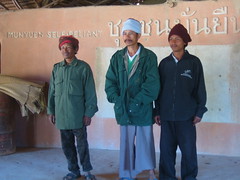
After a brief tour of the area, we assembled in the schoolhouse to hear what the three founding members of the village had to say. It soon became apparent that something was wrong with this picture. Of the 35 families that agreed to buy the land from the government, only nine were actually able to move here and only three remained. When we asked why, the men told us the families had gone to find work to pay off their debts.

So this is what democratic protest gets you, I pondered to myself, the right to protest, but not the right to be?

My fellow travelers offered suggestions, wanting to solve the problems facing the three founders. Martin, our practical minded chicken farmer, asked if they could grow cash crops. They had not been able to, they told us, but if they did they feared that the government would start asking them to pay off the 4 million baht debt.

Someone else asked if the King could step in. We knew the king to be a just man and an advocate of self-sufficiency, but no he had no such power to help them. He was only a figurehead.

"What about the government that supports self-sufficiency," asked Jen referring to the talk we had heard at the Santi Asoke center about how the government banks had wanted farmers to take the training in self-sufficiency before taking out a loan.

"No government wants self-sufficiency" I said bitterly. Jo agreed. It was all a manipulation to get poor people to work for rich people. The earlier promotion of self-sufficiency, after the financial collapse, had been an act of self-preservation to keep the banking system from going under, I realized. I was filled with despair that no one wanted these villagers where they were; they were just in the way of progress.

"Maybe they are a tourist attraction for travelers to witness the impact of globalization," I said quietly.


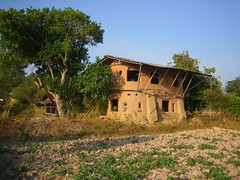
Jo did not translate this sentiment, just vocalized an agreement. Janell, who was sitting next to me, did not offer a sassy comeback. She was silent, possibly absorbed in her own thoughts of the project she had directed. Except for a few houses and a carport, these beautiful buildings were now largely abandoned.


Would people choose industrial progress if they knew the cost? How well I understood the need for massive dams to provide electricity to an industrialized city eager to power its consumer lifestyle. The dam in question would provide enough power for one shopping mall in Bangkok. Back home in the States ever-expanding server farms (computers supporting the Internet), were being built as close to dams as possible for the cheap electricity rates of clean hydropower. There was no end to our need for more power once started.

The villagers had been told the dam would help them irrigate their land, but that obviously was not the case as the plan was to flood their land altogether. The men implied that, had they known what was to come, they would have protested sooner.

"Ten years was a long time to protest. What kept you going?" I asked. This seemed to strike them as a silly question and they laughed at the mention of the ten years.

"There were a lot of issues needing to be discussed," one said simply.

I was trying to find the point to it all—the point of democracy and progress. This land was not theirs, it could be taken away for development into a resort for city people, the government wanted money and the land needed to be maintained to protect it from fire, but there weren't enough people to keep the fire breaks clear. The villagers had not been in agreement about the communal vision necessary to protect themselves from larger economic forces. Many had wanted to subdivide the land and go their own way with it, sell it even. I was frustrated by this failed vision and asked why they continued with it.

"They are just trying to survive," Jo explained. My thoughts were arrested midstream as I realized how bourgeois was my need for meaning and purpose. I, who could go home after a day of protest, had the luxury of righteous principle. Surviving meant continuing to try whatever might work. At the moment the three men were planting trees. They had been a forest people and even though they did not know the trees in the area, they knew how to cultivate a forest. The government officials came by, saw the plantings and did not ask for money. They just told the villagers to keep records of what they were planting. This was seen as hopeful. The villagers knew that the government were, now, wanting to grow back the forest, which would justify leaving them be. Meanwhile the protests had caused so much controversy that none of the other proposed dams were being built.

Dimly I began to understand that perhaps there was an optimum vision here. We learned more about their projects to reforest; how they were teaching their neighbors the value of leaving the land undeveloped. They were offering the investment of a cow in a sort of community supported beef supply that gave back in manure and offspring. Montaine asked what chore we could do to help them out. Thus our group spent the next morning raking manure in the cow pen into a big pile.


As we packed up to leave, a group sat down near me to sign the large guest book. Erin our Australian student was chosen to scribe since she had the best handwriting.

"What shall we write?" Sasha, our American student asked.

"Good luck," I suggested cynically, "We landless server farmers promise we won't build any more dams." Needless to say this was not considered a serious suggestion, but they acknowledged my declaration of guilt with respectful silence.

"What about this?" said Irena eagerly, "May the forest give back a hundred fold what you put into it."

"Oh that is so nice," I said sincerely, then laughed at the whiff of sarcasm I barely managed to pull back. Ah youthful optimism. The others agreed and Erin wrote it down.

Labels: , , , , ,

Earthworm. Get yours at bighugelabs.com