Amanda Kovattana

Middle-aged musings in interesting times

Thursday, May 27, 2021

Birth of a Resistance

Last Sunday, 60 Minutes aired a segment on “transgender health”. As reported by interviewees the original intention was to do an hour long story on young people who regret altering their body in their attempt to achieve the goal of changing their sex. Trans activists objected heavily to this story about detransitioners claiming it would endanger the lives of trans people. So the program was cut to 14 minutes and more was added from the pro-trans side to give it “balance”.

Yet a story about a young person happy with their transition cannot compete with those who regret theirs. Regret being one of the most compelling human conditions especially when the stakes are so high as to involve cutting off body parts that give you biological function  and sexual pleasure. 


Thus the add-on scenes seem scripted and the explanations by a trans therapist do nothing to clarify what this is even about, and why so many are going down this path. The guidelines cited for transitioning are too vague and the timelines too short before medical treatment is given is the only conclusion to be had. And when a medical doctor claims that puberty blockers and cross-sex hormones are not an experimental treatment no studies are offered. (I have already posted the statement from the original Dutch researchers pleading for more research on puberty blockers because they themselves knew their work was experimental.)


To ignore these detransitioner cases of regret and harm is to appear heartless to the tragic turn these lives took. But an industry that has decided to affirm and escort into medical treatment anyone who decides that their problems stem from being the wrong sex cannot afford to be wrong. 


Entire mental health institutions have set aside a hundred and sixty years of developmental psychology to bow down to the concept that humans have a soul that is gendered and those with body dysphoria must be rescued from their physical body. As if their whole body were one big birth defect for which, if not treated, the only outcome is suicide. To question this ideology is to be called transphobic and bigoted. Researchers and institutions unused to such accusations have stayed silenced.


Framing and manipulation of language by the trans ideology has kept the public confused. Defeat has been a master teacher as women from all manner of backgrounds bond over this issue, sharing information on how this is affecting so many. Medical students are being taught to negate biological sex through correct trans ideological language whereby they are told that there are women with penises (and men with vaginas) for instance. Never mind that men and women are biologically subjected to different medical issues and that this should never be overlooked as in the case of the transman who didn't know "he" was pregnant so no medical personnel at the ER thought to check this possibility in diagnosing "him" resulting in the loss of the baby.


To deny that detransitioners exist is foolhardy. Trans activists will hang themselves by their own rope in their attempt to cry foul on these detransitioning stories. 60 Minutes was unable to do much of an investigation given the politicizing of this issue, but even in the truncated time offered with only two of the four shown allowed to speak (30 actually interviewed) all the components of how this phenomenon arose are there in the details of these compelling stories. Along with their revelations about gender stereotyping. These young people who are seeking to give meaning to their messed up lives have nowhere to go, but out into the open with their stories.


In light of the recent four hour documentary on the opiate industry by HBO it is an easy leap to imagine that the opiate crisis was hardly the exception, but rather the ruling strategy when it comes to the pharmaceutical industry pushing a product. The microdosing of cross sex hormones is a concept now being marketed to lesbians suggesting that masculine-presenting women should want to use testosterone to erase their female bodies.


I had the pleasure of co-hosting a Zoom presentation on transgenderism recently. We had Scott Newgent as a guest. Scott had an article published in Newsweek stating her concerns about children undergoing sex reassignment treatment as a transman who has suffered serious medical complications from transsexual surgeries. She now defines herself as a lesbian transman who would detransition if the prospect didn't require more painful medical alterations.

Scott would be livid with the statements made on this 60 Minute program by the pro-trans side. She argues that, at 42 years old, she was not given all the information she needed to navigate her dysphoria which she now says was a mental health issue related to homophobia. She had to do all the medical treatments first to find out that modifying her body did not solve her issues. So, as she points out, how can anyone expect a teenager to understand all they need to know about it. (She has three children in this age range.)

Scott claims that 9 out 10 trans people regret their transition. Buck Angel being the only transsexual in her circle who is happy with transition. The remaining one percent wish there were things they knew regarding side effects before committing to it. Buck now answers questions as "Transpa" giving cautionary advice on a personal YouTube channel.

Scott also said that even with all that went wrong with her phalloplasty she could not find a single attorney to take her case to sue for malpractice. Every attorney explained that there is no baseline of correct procedure for such surgery because it is experimental. Buck Angel has not attempted a phalloplasty because of its terrible failure rate. 

Given the relentless overreach of transgender ideology especially in schools ever more information is being launched blog-by-blog in classic grassroots fashion. Transgender Trend in the UK was one of the first to aid parents with science-based information devoid of gender identity ideology. Individuals (some with their identities carefully hidden for fear of being called transphobic and losing their jobs) are posting compelling information they have researched. One reveals the educational material used in schools where children are being taught gender ideology. The story books for children are so creepy I could hardly watch more than a few minutes at a time. So much did the narrative suggest that children should view their body as a disassociated entity as though it could be traded in like an appliance if it didn't satisfy them. Not to mention changing one's sex as a journey of self realization as described in fairy tale fashion in the book I Am Jazz (about YouTube child star Jazz Jennings).


Recently I reviewed a parenting book focused on advising blind sided parents faced with the harrowing journey of a child suddenly announcing they are trans. The title Desist, Detrans, & Detox: Getting Your Child Out Of The Gender Cult caught my attention. It was such a statement of resistance. The author and her team also have a website offering information challenging gender ideology in the context of developmental psychology. They kindly published my review.


The collaboration gave me a chance to talk to the author about the section in the book that she called "the God part". She explained that she and her team did not want the book to be perceived as solely a Christian book, but did feel it was important to include the section challenging the idea that a child can be born "wrong" because so many Christian parents want to be pro-trans in order to atone for the sins of Rightwing Christians.

I have heard the same said by a psychologist (a gender specialist who recently resigned from the Tavistock gender clinic in the UK). He commented on the eagerness of psychotherapists to be trans affirming in order to atone for the damage done to gay people by their profession in the past. I would say that the profession has been recalibrating their assessment of gay people since 1972 when homosexuality was delisted as a disorder from the diagnostic manual of mental disorders (the DSM). They were still listing gender non-conforming presentations as a disorder, but that too was being gradually reassessed as “gender dysphoria”.

To throw away all methodology in favor of deferring to what those afflicted with body dysphoria declare is true would be to throw the baby out with the bathwater. When it comes to mental health it is still wise to have an objective person challenge your thought processes as to why you have come to a certain self-diagnostic conclusion. To allow teenagers to self diagnose and then give them body altering drugs without any attempt to question further is rash don’t you think? Yet that is what is happening with these quickie one hour assessments at Planned Parenthood which is now the leading dispenser of cross sex hormones for those 18 and over.

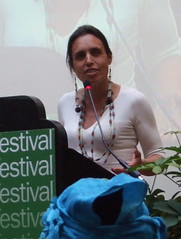
This is my first public collaboration with the resistance against transgender ideology. I am one of the few contributors to show my picture and name as other contributors are parents wishing to protect the privacy of their trans identifying child.

Luckily I do not have to navigate this territory alone. I have a friend (an adult human female) with whom to debrief, share information and construct clarifying analyses. We message each other daily with the latest discoveries and triumphs as legislation kicks in state by state in the US and in the UK where the discussion is further along. We are also in a study group with two men who are concerned about the implications of all this thought control on free speech and discussion vital to a healthy democracy. We have presented information to others hoping to encourage critical thinking rather than just going along with whatever the trans coopted LGBTQ organizations dictates must be so. 

Lesbians have long been protesting the presence of heterosexual men identifying as lesbians in our dating pool and commandeering lesbian only space. Gay men were late to the party, but are taking notice and contributing to the conversation now. One talented man with the handle Mr Menno creates witty song videos that offer in three and a half minutes what would take me lengthy carefully worded articles to parse out the same issues. 

Over the last year I have been fascinated to watch women learn that outrage must be replaced by carefully thought-out language on such a meta level that it feels like feminism and womanhood are being freshly discovered. The farther this ideology reaches and the closer it gets to thought control the more people will be drawn to question it. Discussions of psychology, philosophy, what knowledge-based learning means and what women’s experience consists of are becoming so basic that the collective discussions become a mass educational process as if the world were just being born. Movements like this become a review of the entire society. A much needed cultural audit it may be too carrying with it a great deal of energy and excitement as we realize what is at stake.


Labels: , , , , ,

Saturday, October 20, 2018

In Sight Of Land


I have waited a few months to give my report on my trip to secure a tiny farm in Northern Thailand back in July. Things had happened to me prior to that that words were failing me to contain or resolve. Somehow all available words I might have to discuss this event had been co-opted to serve a purpose that was no longer serving me. So in the end I had to wrestle the words back and make them do my bidding. I could not make it go away otherwise. A retreat from Trump's America certainly helped to clear my head. I offer that respite first.


My Thai Land

I sat down at the counter of the land transfer office to write my name carefully in Thai script conscious that the government was now under authoritarian rule since democratic elections had been shelved for some 4 years now. Massive protests had forced a corrupt prime minister to step down resulting in a power vacuum that justified a military takeover. During that time the country had been polarized into the Red shirts of the northern rural areas and the Yellow shirts of the urban population of Bangkok. When asked to come to some kind of agreement in order for governance to proceed each side insisted that only their way would do and refused to allow the other any concession. And everyone basically gave a sigh of relief when the military stepped in. 

All the officers at this Northern station had on yellow shirts as if the Yellow shirts had won, but I learned later it was because it was the King’s birthday month and his birthday was on a Monday which in Thai tradition bore the color yellow. Thai culture could be so whimsical in its cultural expression I mused. At least I knew what the colors of the days were from having gone to Thai kindergarten. I was not wearing a yellow shirt. I had on a long sleeve maroon shirt which I hoped would not mean anything. Or if it did would be in my favor.

The officer sitting across from me in her pastel yellow polo shirt watched me laboriously writing.

“Take your time,” she said. I had not expected kindness and warmed to it. We were far from Bangkok in this pleasant rural province of Mae Taeng where I was buying a farm. Behind me in the waiting area sat my farm partner Clasina holding the hand of the farmer’s daughter whom she had befriended on a previous visit. We had not sat together in case her fair haired foreign presence complicated this matter of land ownership. The old farmer himself had already been to the counter with his grandson to verify his ownership of the land I was buying.

After I had signed my form I was sent to the next officer, a man higher up the chain looking perky in his bright yellow polo shirt as if he were on vacation. He looked over the information on my form. A copy of my Thai I.D. card stapled to it showing me in a striped black shirt worn last year during the year of mourning for the beloved late King Bhumibol. Looking at it gave me a sense of continuity with my Thai heritage. The year of mourning had done much to unify the country.

“Do you live in Bangkok,” he asked me.

“Yes,” I said

“Or do you go go/come come,” he said using that cute all inclusive Thai phrase for so many of us now with a foot in the West.

“Yes,” I said nervously, but my answer seemed not to matter too much. He was not looking to strip me of my identity as the officer in Bangkok had who demanded that I produce my parents’ marriage license to prove I was indeed legitimately Thai. He verbally had me confirm my age and address and reaching the bottom of the form signed it. I was done. Grandson and I then paid our share of the transfer tax and I gave him the check for the balance of the money for the land. He did not even open the envelope to look at the check. Then we all got back into his white taxi truck which he drove as an additional source of income. I joined him in the front cab as befitting my status as investor and elder while the others rode in the back. Grandson seemed subdued though he had been quite chatty driving in. Selling land was a big deal for a farmer I suspected.

“How long does it take you to plant the rice seedlings”, I asked him for Clasina had given permission to the family to sow another season of rice on our land since we would not be using it anytime soon.

“One day with ten people,” he said, “then we help to plant rice on each of their farms.” I was floored. Wow. It was still here this barn raising Amish style community work force. Each villager beholden to each other trading their produce and time not for money, but for reciprocal gifts. How secure that would make me feel to have such a community. 

He asked me if I was going to farm organically. And I realized that he saw our venture as a form of technological advancement. The next big thing. Otherwise why would I bother with such an investment. I said yes though it was more complicated than that, but I did not have the words for food forest even though this was now a trend in Thailand, a style of agriculture that the late King had promoted. And not one that had profit as an end goal.

“Have you thought to grow organically/” I asked him

“No,” he said, “it is more expensive and we do not have a market. But you know more people,” he added implying that we would find markets he didn’t have access to. I did not ask how it was that organic farming was more expensive. I wasn’t sure I had enough Thai to understand the answer. I could see he had some regrets about having to relinquish his land as if he had somehow failed and now his son had gone to computer school and his daughter to some other career. At least the land had not been in the family for generations. I would feel bad about that.

Our farm was originally government land, part of the national forest that had been portioned out after the dam was built. Given to the farmers who had been displaced by the government built damn. The reservoir now feeding all the farm plots with cement lined ditches that bordered each plot. The stipulation of the two deeds that now bore my name was that the land could not be used for commercial purposes other than farming. Though we were permitted to build whatever housing we needed. 

I had seen it for the first time the day we arrived. Clasina and I had traveled up from Bangkok on the newly updated express sleeper train full as usual of European travelers. We were met at the Chiang Mai station the next morning by a fellow mud hut sister Jesse a Canadian expat, with whom I had built a house three years ago. She had met Clasina already as she had come by to visit our mud hut build back in January. She had listened with interest as Clasina talked about a farm she was looking at buying. When I told Jesse of our plans to collaborate in buying this land she was happy to have us stay at her house. She too had bought a rice farm paddy and put on it a refurbished traditional wooden Thai house. Jesse was the perfect person to midwife our farm project. She had familiarity with the process and asked good questions.

It was Jesse who drove us to the farm for my first viewing with me in the back of her little white pick-up feeling very farmer like sitting with a bale of hay. We turned off the highway and a dirt road brought us to the farm entrance marked by the opening in the barbed wire fencing. 


“Welcome home,” Clasina told me as she gave me a hand to help me out of the truck. Home. So many meanings that had for me.

As Clasina pointed out the markers at the corner of the rice paddy field below the road the plot seemed smaller than I had imagined until we actually walked it. For our purposes it would be fine. Across the road was the orchard dotted with lychee trees. It was on a slight incline which would be perfect for a homestead. In the distance were the mountains that Clasina had wanted when she was looking for land. They were covered in forests and were sensuous and green reminding me of Hawaii which was ironic in itself since the last time I had looked at land for a homestead was with a lover living in Hawaii. Lucky that  romance didn’t work out and I had come home instead and had this chance to secure a foothold in the land of my childhood. 

Once the deed was done this new status of owning land slowly began to fill me with a sense of a future and kinship in Thailand. I had feared that once the elders in my family had died I would have no reason to come to Thailand. Owning land was a way to make my childhood home meaningful again. It also gave me new friends.

Clasina and I had not run out of things to talk about on the train coming up and we hadn’t even touched on what kind of farm we wanted. She was so cheerful and easy going we traveled well together. With Jesse the three of us shared a congenial time delighting in each others company and lots of girl talk. Jesse in turn introduced me to other permaculture farmers — a young man from Brazil who was co-teaching a class with her, a Frenchman who had settled in Thailand with his Thai wife. I shared with them my tiny house story augmented by a Powerpoint presentation I had put together to share at my last mud hut build. There was an ease here that was restorative in the way these expats shared their perspectives. People yielded conversational ground to each other. I was pleasantly surprised. The conversational style in the US was becoming decidedly unyielding. I sorely needed this respite, for I was now living in a society that was becoming increasingly difficult for me to navigate.


A Nation Divided

Back in the U.S. a nation under a President intent on fomenting a form of white tribal nationalism I knew I would not have an easy time of it and had taken steps to buffer myself from his enraging rhetoric. Meanwhile on the Left I was trying to keep up with what was considered respectful use of another culture’s teachings or group’s symbols and what was a disrespectful appropriation that projected a hurtful stereotype. I enjoyed appropriation of all sorts of cultural dress and symbols for my own amusement just to keep people guessing my mixed race heritage. Plus I am practicing shamanism a spiritual path that may or may not be a cultural appropriation depending on what words you use to describe your spirit guides. People were so busy correcting each other that it was harder to find common ground as less ground was given and less benefit of the doubt offered. We were overcorrecting in a divisive and distracting way I felt. This self censoring restricted creative thought and the imagination when we could be creating a culture we could all inhabit.

Shortly after my 60th birthday I decided to travel to Minneapolis to visit a dear friend I hadn’t seen in five years. She was a tenured professor deeply involved with issues of climate change as part of her work as an artist. So we had much in common to discuss. I had offered to give a talk on the eco aspects of tiny house living to a group she promised would love to hear all about my composting toilet and waste water gardening. And because of our fascination with multicultural influences I added to my talk additional personal information about my background, my privileged upbringing in Thailand and my LGBT coming of age in the US just to showcase the many intersections of subcultures in my life that might have led to my choosing an off grid lifestyle. Being presented as an eco hero already set me up for judgement, but these additional details broadened this potential in untested ways I felt, but I trusted my host.

She also told me how adept the students had become in staking out their own personal identity politics. So much so that it seemed every week a student would be “triggered” by something she said and would vocally reprimand her for using a colloquial term or presentation they found offensive. It was almost a competitive thing with these students since even the mild mannered ones were just as apt to jump on this band wagon. This detail of her teaching life annoyed me intensely as it seemed to be giving students so much power over how information was delivered to them. Weren’t teachers to be respected rather than constantly corrected?

And just as I was wondering what this must be like for my friend I was given a dose of it myself. After I gave my talk to a very polite and attentive all white audience who did not laugh nearly enough for my taste, we went to dinner where my friend picked up a message from her assistant, a grad student, reprimanding her for being so insensitive as to allow me to wear an outfit bearing a symbol that was extremely offensive to her particular minority group. And she was right. In this region it was an offensive symbol.  One I had sewed onto the back of my outfit (a printed logo) in an ironic moment over a decade ago. I had completely forgotten about it and was chagrined to be the cause of my friend’s attack. It took us all evening to discuss the possible ramifications for what most would consider a rather insignificant offense. After which I concluded that she was working in a hostile environment that was becoming increasingly stressful to her whether she acknowledged it or not. And now was causing me distress.

When I got home I spent an hour writing an apology to the offended grad student choosing my words with careful humility hoping for some lenience owing to my being a stranger in a strange land and a guest. She gave me no such mercy, but was quick to give me a label that categorized me and my “people” as ones who would do harm — in effect an enemy. I had never heard this term of hers before and was undone by how it cast me into a ready made narrative. I felt as if my American citizenship had been revoked. She then added that unless I cured myself of my ignorance of the significance of this symbol I was aligning myself with white supremacists. This being now the label for racists with the added implication of intention to maintain white rule. This was a patently ridiculous claim, but the damage was already done. My sense of who I was in this country was scrambled and few hearing the details of this event could help me so intent were they on explaining to me why this person would be so “triggered” (which is why I have purposefully left out the details here. I am extricating this story as one would a splinter. In the hopes of healing). 

Upon my return to treatment my acupuncturist was alarmed by my emotional and physical condition. Not only was I leaking energy at a faster rate than he could restore it, but my confidence in my own narrative was decimated. I didn’t trust that I could convince anyone of anything I had to say or that I even had the right to say it. If students could reprimand professors with no accountability as to the appropriateness of their complaint I had no ground to stand on, no support from these peers.

I was angry, but I also understood the territory. Raising consciousness about racial bias was not a bad thing. It was progress. And though I was not granted forgiveness so I could be made whole again, I forgave my young assailant for her youth having wielded such weighty accusations at my elders myself when I was a student. 

Plus this was not the first time I had been taken down by someone speaking for a minority people in America for when you are the “model minority” you are by your very success in navigating these complex race lines demonstrating that race doesn’t matter in the land of “equal opportunity”. You have “assimilated” and made it work for you. And by your example you have made race a non issue in the eyes of white people. Yet institutionalized racism continues. You are just the exception that proves the rule. I accepted this lesson as graciously as I could. I also understood that while we might be categorized under the same People of Color umbrella, we were not necessarily friends. This made me wary. 

It’s true that as a model minority I am already ahead of the game arriving with a full set of tools and advantages. Immigration laws screen immigrants from overseas culling for the best and brightest just as my parents with their higher degrees were only allowed entry because jobs were already offered to them. The tension of being at the intersection of such class advantages paired with the presence of racial bias in America from the age of ten has shaped me and made me something of an expert on racial narratives. Not to mention being queer and female on top of it. But the Trump era has upped the ante some and racism is now being discussed much more frequently by white allies intent on raising the alarm about the agenda of “white supremacists”. Within these discussions is the hope of eradicating such an agenda. While my non-white contacts were just as apt to post blisteringly anti-white alliance statements. This just increased the tension without offering any possibility of a unifying cause. 


Gasping For Air

In Thailand nobody talked about politics even the expats and nobody asked me what all was going on in the U.S.. While I was enjoying this much needed respite within the peaceful sphere of a news media controlled military dictatorship I had to wonder if I was still up for Democracy. Was not the end result always going to be controlled by wealth stealing the show while infighting fractured the Left? I felt relieved to be in a country where I did not have to work so hard to navigate competing versions of reality. I could mind my own business relieved of responsibility for any outcomes whatsoever. The televised news was so innocuous it was not worth discussing being mostly reports about government sponsored programs around the country doing good for the people. And a good half hour spent on the selection of the day’s lottery numbers. Was this so bad? Much harder to watch democracy self-corrupt and be powerless to stop it.

Still I had to return. And in returning I would have to have a strategy. So I had armed myself with the recent book
Democracy In Chains by Nancy MacLean, something meaty to read while waiting in government offices. I felt that if I could just understand how democracy in the U.S. had been compromised I would have a firmer handle on how to engage in correcting this course and reclaim democracy. The book delivered. The history in it describing the last 50 years gave me the information to see that what was at the core of this mess was a class war being wielded by a white elite informed by a history of slavery. The intent being to take back power for the wealthy and reduce the power of the majority even further. The men responsible had worked tirelessly and persistently to manifest this agenda through controlling discourse in universities, in the news media and in the mouths of politicians. There was no real promise of equality or even a patriarchal promise to do what’s best for all the people. There was just the dangling carrot of opportunity. A premise further fueled by capitalism. This class war was so pervasive and subversive that everyone who has a chance to be upwardly mobile will likely betray those falling behind including those in their own identity group.

The history I absorbed confirmed for me that this was an old battle we could fight with an old school economic social justice approach. It was enough to give me confidence to return yet the struggle of living in Trump’s America would still get to me. The separation of children from parents at the border, white women calling the cops on innocent black people, the enraging Kavanaugh hearings. And every time I thought we might have a movement that would allow coalitions to form I saw bridges burned down by divisiveness. The Left scrambled by an impulse to persecute its own. Feminism being sacrificed just as it was getting a fresh reboot because another group’s issues seemed more just. Coalition building not on the table while everyone reviewed their privilege and challenged each others internalized biases. My dearest friends were enraging me with counter productive approaches. My favorite optimistic writers showed signs of despair. Would America save itself? Would young people vote? I had no confidence in the outcome. Now that I understood the coup that had taken place even before Trump I knew where I stood. But this knowledge did not empower me it just made me feel more helpless. How long before others would see it?


In Sight Of Land

I had been swimming while drowning for a long time. I had sighted land in a far away country that gave me solace. But here in what had been my home for 50 years I was gasping for air. Rage draining my energy. And then more rage at not being able to recover. I told people I was being treated for exhaustion as though it were an ongoing condition. Every time I thought I had my old self back someone would ask me to take sides and the energy would drain out again. I clearly needed a different philosophical interface. I did not want to just retreat from all discourse.

I would rebrand myself as a white supremacist. Not the violent exterminating kind of course, but the culturally appropriating idea bagger of all that humanity had to offer kind. Just as the English language has managed to absorb foreign words and chew down foreign concepts into their deconstructed parts I would unapologetically (with the Queen's English of my birth country) consume all ideas for my own purposes. Move chameleon like amongst every group, scarf up whatever doctrine was being served up, witness it and move on before the group think could get me. Democracy may in the end fail the U.S. but it won’t be the end of human society or even human goodness. I had seen that much.

Labels: , , ,

Monday, September 21, 2009

Return To Asia III: The Conundrum of Thailand


Having seen Singapore and Kuala Lumpur, I had a much better idea of how Bangkok fit into the context of its urban neighbors and what future it was seeking. Asian cities, I could see, were committed heart and soul to development, the kind of development that would embrace its citizens in a sort of universal standard of modern design.

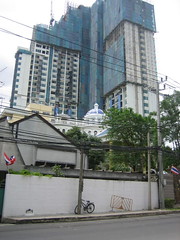
Bangkok was cleaner and more upscale than I remembered it being. The old grimy cement block shop fronts of the 50s and 60s that had sold sundries, made-to-order garments and locally made house wares had been remodeled into brightly lit modern stores—a 7/11, a copy shop, a hair salon. On my street a store front was being finished with reflection pools set between squares of granite. The glass front allowed the office to be seen with all of its artwork and black leather and chrome furniture. Soon it would sell condominiums not yet built, but slated for development on the empty lot behind the new office.

The message was clear. The old would make way for the new and it would all be good. This growth was the way to raise all boats. The endless supply of raw materials transformed into chrome and glass enclosed buildings, full of cool air and new furnishings, blended right into the better living commercials playing endlessly on the Sky Train. I was stymied by this growth driven sensibility in Asia, but here in Thailand there was a pause, as the recession ate away at this message and the political winds shifted, battering the country in civic unrest.

Protestors in Thailand had shut down the airport for a week last November, then in April a counter group supporting Thaksin, the deposed prime minister, had trashed the hotel of the ASEAN Summit meeting and shut it down. The coup, two years ago that had deposed said prime minister, still raised the question in the eyes of Western journalists of whether Thailand would hold onto democracy. When Thaksin was mentioned, in the Western press, he was described with the phrase "democratically elected populist" which ostensibly made him the good guy while his crimes of corruption were minimized. I knew about the vote buying and the empty populist promises Thaksin Shinawatra had made to the poor. His economic policies had earned the nickname Thaksinomics. His plans for massive development projects would have further robbed the poor of their land rights, sending more to seek employment in the city (and yes more girls to the sex trade). What I didn't get was why the poor spoke of Thaksin with such affection even after he was ousted from power.


I took the opportunity to ask one of my contacts in Bangkok. Teng a business owner and dentist, had opened her own clinic offering plastic surgery and other beauty enhancement services for the face. Her clientele were largely Japanese ladies traveling to Thailand for the comparatively inexpensive procedures. My mother was quite curious to see what they offered and sought out a consultation. This was easily arranged through the school friends network. Teng sent her driver the short distance to pick us up at my house. As I sat waiting in the lobby of the clinic store front I asked Teng if she supported Thaksin.

"I don't like people who cheat," she said simply. Yes, he had cheated to such an extent that the term corruption was not enough to describe the heights to which he had used his position for his own monetary gain. His people had been blatant about offering government contracts on the condition that they got half the money budgeted for any single project. Companies whose income relied on government contracts were sucked in. When the coup came, the business class was suddenly divided and individuals who would normally trust each other found they had to walk on eggshells, unsure of who was on what side until the courts sorted it out.

There were still supporters of Thaksin in Thailand, said to be the rural poor, who were behind the recent protests. I asked Teng why he was so popular with the poor. She only took a moment to answer as if something unusual had happened.

"He let people touch him," she said, "no political candidate allowed poor people to touch them before. Thaksin did like a movie star and that made him popular. Even now the leaders won't let people touch them" she added as if they should have learned something.

This explanation neatly filled my curiosity. It explained the odd sentiment I had heard reported from one senior lady when Thaksin returned to Bangkok last year for his trial. She said she loved Thaksin because he was so cute. Cute had never been a word associated with political leaders before; it just cut too deeply into class taboos.

Thaksin was still in contact with his supporters while in exile, sending them video links pleading with them to fight for his pardon; he addressed them as peers and even sang to them. His supporters wore red, an angry color that filled the streets when they protested. Having inspired them to assemble, he called in on cell phones during the rallies to egg them on. You can see it all on YouTube. Thaksin had indeed made like a movie star. The rural poor were usually loyal to the King who was extremely revered all over the country.

The counter protestors wore yellow, the King's color. They were said to be a group comprised of royalists. Western reporters could not seem to get past this term to actually discuss what they stood for. Royalists were automatically suspect as if they were plotting to bring back an absolute monarchy, which even the King did not want. A writer for the Economist railed against the law of lese majesty that forbids citizens from openly criticizing members of the royal family, claiming that this seriously hampered democratic proceedings. I was annoyed by his tone. He did not seem to know anything about what the King stands for in Thailand.

During our trip I came across a posted sign that illuminated my own feelings about the King and his relationship to Thailand. We were visiting Pattaya, a seaside resort not far from Bangkok. My family had often spent weekends there when I was a child. It had been a quiet one-hotel town full of beach houses belonging to the wealthy. Now it was a densely developed strip of shoulder-to-shoulder, high rise hotels and sleazy, pick-up bars. The beach, however was still open to the public. I remembered, as a child, that no house, no matter how wealthy the owners, was allowed to be built directly on the beach. The reason given was that the beach belonged to the King. How lovely that the King liked the beach so much, I thought, and that he let everybody use it.

While walking the boardwalk at Pattaya, that weekend, I noticed a sign posted in a police sentry box, urging people not to throw garbage or cigarette butts on the beach. The sign was in Thai and English and the words "Keep it clean for the King," caught my eye. Underneath in smaller type was added "and safe for children and wildlife". Suddenly it came to me. The King was not coming to the beach anytime soon. He was a symbol representing the commons. He supported the interests of the people so the people returned the favor and called themselves supporters of the King because he supported them. Didn't anybody get it? Did the West even have a symbol of the commons? I wondered.


I was intrigued by the return to royalist sentiments. What were they after that the King in turn would support? The royal family denied any connection with the group. The King himself was quite feeble now and did not often leave his residence in Hua Hin (another beach resort). How his successor would do and if he would garner the same respect as his father was a question on all our minds. There was some talk, said a friend, of not having a royal family at all. But that, I thought, was getting a little ahead of ourselves.

The royalists protestors were for a "reasonable society" I read in wickipedia. They wanted a nation with less consumer debt and less concern with material goods. They opposed foreign investment and privatization of state enterprises. No wonder they were a threat to the writers of the Economist. It sounded like they were against the very underpinnings of globalization.

Western democracy, as I saw it being used today, was a platform for the elected wealthy of countries like Thailand to negotiate deals with the big players of the global market while making themselves even more rich. Americans, too, have wrestled with this question of corruption. In a recent poll a majority said that they would be more likely to trust representatives that were randomly selected from the phone book than those currently in Congress now.

I knew from Nor and Raja that there was sympathy for the royalists, but it was difficult to embrace them since they were somewhat extreme. They were asking for leaders to be royally appointed in an attempt to sidestep the corruption of democratically elected officials. Their takeover of the airport was an amazing show of power that had gone unpunished. It was hard to tell where their now bolstered confidence might lead them.

I did not press Teng for any more information and instead took a picture of her. She gave me her best side then surveyed my face suggesting that one of her doctors could easily zap that large freckle off my upper cheek. Yes, it looks like some kind of cancer my mother said and there was another one nearly as big on the other cheek. Teng named her price for two freckles—only $18. Done, I said, wondering what the US might learn here about lowering the cost of medical services. (Prescription drugs, too, were half the price my mother discovered when she went to buy her blood pressure medicine.)

In the end I was left wondering how this ultra modern, luxury oriented urban population would reconcile their needs with those of the nation and the poor. My mother and I did see children and adults begging at the foot of the escalator to the Sky Train station. We saw one small boy by himself, hardly moving. In front of him a plastic water bottle cut in half for coins offered. He was still there when we returned after dark. It brought to mind the movie Slumdog Millionaire which I had liked so much because it affirmed my reality by showcasing, so unapologetically, the poverty I witnessed growing up.

These destitute, in the context of an Asian city, would easily clean up per the Asian commitment to growth. Just park them in tenements and press them for cheap labor in factories. (Factories are, of course, dependent on consumer demand and many had closed this year.)

I preferred another picture of the poor. I recently discovered the classic Foxfire series of books produced in the 70s by American high school students in the state of Georgia. In them students interviewed "old timers" who still lived in the Appalachian Mountains and survived by methods of self-sufficiency duly recorded by the students in photographs. In the context of modern life these Appalachians owned very little and nothing that could be called modern i.e.: a TV or electricity for lights. Their way of life was dependent on the land around them just as were the Thais I met last year, on my trip to visit examples of sustainable solutions in rural Thailand. Both could not live without the land. Neither had asked to be modernized. Both favored self-sufficiency.

I would not forget meeting, on that trip, three men who had joined the Assembly of the Poor to demand compensation for the drowning of their land by the Pak Man dam project. They were forest dwellers who made a living foraging and caring for the forests. I came to understand how protest follows development because access to land is stolen from the poor.


I was also taken by the Buddhist group known as the Santi Asoke who taught skills of self-sufficiency after the economic collapse of '97, to anyone who came to them. The Santi Asoke Buddhists had originally protested Thaksin on moral grounds leading to more widespread protests until finally the military stepped in to oust Thaksin, ostensibly to prevent further unrest and complete chaos. The Santi Asoke Buddhists now supported the royalists, a more well heeled version of the original group that led to the ousting of Thaksin. (Along with the royalists were members of the middle class and business elite.) I was glad to see my narrative thread had not been broken. It just needed a resolution.

Would the rich relinquish some of their hold on the resources milked from the lands of the poor? Would Thailand stand up to the destructive forces of globalization stripping resources for profit? Would it morph itself a government that could actually temper development while promoting self-sufficiency and creativity? What kind of society would come out of this grass roots activism and civil unrest? Though each bit of news from Thailand now filled me with dread I couldn't wait for the next installment.

Labels: , , , ,

Tuesday, December 30, 2008

Prop 8: The Hate That Ate California


For my last post of the year, I debrief one of the more contentious battles of 2008—gay marriage and Proposition 8. And not over yet, by half. After seeing the film Milk, which covered a lot of the same geography and time period as I lived, I was inspired to revisit my own LGBT history in search of a personal perspective on how we got here. The sentiment "may you live in interesting times" has more than ever characterized this last year. A curse or opportunity for change?

Best wishes to all for 2009.


The Closet

In high school I read The Diary of Anne Frank—twice. It was not an assigned book at any time at my all girl's school. For our civil rights education we were assigned Ralph Ellison's Invisible Man. I didn't understand what Ellison was on about because I didn't get why being invisible was bad. I read Anne Frank because she kept a diary as I did; I was the same age as she was when she wrote her first entry. I read it again in my senior year because by that time I well understood what it meant to be persecuted; to be forced to hide your self for fear of dire consequences.

After Yes On 8 passed, a black woman on the radio said that calling gay rights a civil rights issue was a slight to the black civil rights movement because black people had been killed for the color of their skin and that wasn't the case for gay people. To that sentiment I pose the question "What were your parents reaction when you told them you were black?"

The Closet is an insidious form of persecution hidden as it is within a medical model of mental illness or worse, spiritual damnation while seeming to offer a choice. I was 15 when I came to terms with it. To be cherry picked for persecution, solo like this, at so young an age, leaves scars. The line between self-hatred and liberation, a war zone littered with barbed comments and conversational landmines through which I could only scurry for cover. I was lucky that my religious background did not also damn me. The Thais believed I was paying a karmic debt from a previous life, nothing serious. In the US I knew my choices—stay hidden or risk social ostracism and likely economic exclusion. Only later would I understand that this "don't ask, don't tell" policy qualified as political oppression.

The payoff of coming early to such self knowledge was a heightening of emotion that was so focused it took you to the edge of a precipice with the excitement of it. Two others were drawn to my erotic awakening—classmates at my school. We exchanged notes—cryptic prose and Rumi poems—folded into tiny packages, handed off discreetly in class. Hidden corners of campus revealed their erotic potential as meeting places where we could exchange searching looks and a single whispered feeling. Rare sleepovers were tense with anticipation of a possible caress, always in danger of being discovered, the space between us a treacherous crossing.

The Jewish one shared her love with joy; the daughter of the Christian fundamentalist tormented me with her refusal to be the queer. It was I who was sick, she implied and told me I would not survive in the real world, not the way I was, so obviously butch like this.

Recently, while channel surfing, I caught a few minutes of a wildlife show on tigers in captivity being released into the wild. For the tiger in question it was too late for he passed his days in the wild pacing out a piece of ground the dimensions of the cage he had originally occupied in the zoo. There, I thought, is a thing of beauty that has been too long in the closet.

The Personal Is Political


I was surprised to learn later that very few lesbians of my era came out in high school, oblivious of their alien feelings until someone brought them out in college or much later after husbands and children. How could they miss something like that? I felt more affinity with gay men. My sexual tastes too, traced the erotic arc of men meeting anonymously in public places, exchanging looks, a furtive whisper, the urgency and pleasures of prominent boy parts I imagined onto my own. What was penis envy, exactly, when the power of the mind made this so accessible? I eroticized the black leather, the military uniforms, the power plays of top and bottom, the glamour of drag queens.

While San Francisco was galvanizing the gay movement by electing Harvey Milk, our first openly gay politician, a celebrity Christian was busy persecuting us with an open hatred of the act of gay sex. The public and the media did not speak out in our defense. We would duke it out on our own with the help of an underground of left leaning progressives, boycotting Florida orange juice. It worked. Anita Bryant's career was in the toilet, gay power was born (again), but the hatred was not doused.

The lesbian community was deeply immersed in the ideology of feminism. I was too much of a style queen to settle for such rigid political correctness. Where was the glamour of it? Sex was hardly mentioned. That was the realm of the men and their numbers game racking up sexual encounters. Gay men and lesbians stayed largely separate. "Fishboats" a man called me and my bisexual girlfriend, as we walked down the Castro. How culinary and picturesque.

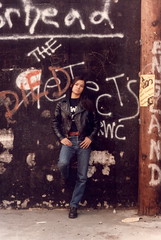
I wove into my persona a black leather jacket, zip up the side leather pants, black steel toe construction boots and a motorcycle and rode with the Dykes on Bikes in the parade in 1981. The first year we rode, the organizers put us at the middle of the parade instead of the front. It was an attempt to tone down the event of the pervert aspects of the gay community in the hopes of becoming more acceptable. This included drag queens, us and that naked guy wearing the boa constrictor. Nevertheless, I was ecstatic to be so out in the open cheered like a returning hero in a ticker-tape parade.
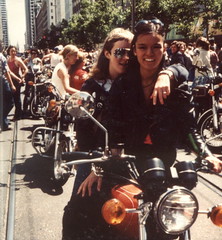

The following year we were back at the head of the parade. The notion of acceptability having been found hollow. Who were we fooling? And what of the hypocrisy of restricting our own people of the diversity of sexual expression? There was, I believed, a power in sexual energy; why else would it be taboo, unfairly suppressed by an authoritarian culture pouring cement over the expression of the divine life force. Somehow it would break through like a weed in sidewalk paving.

Soon after that we were wearing black ribbons to mark the appearance of AIDS. The hostility between the gay and lesbian community fell to the wayside. Ideology gave way to caretaking. Women gained ground in political status and leadership positions, while the men adopted healing practices and taught safe sex. Most everybody learned something about the dying process.

I visited an early display of the AIDS quilt covering a floor of the Moscone Center. A cemetery for a war, I thought afterwards, so devastating was the loss, entire squadrons of gay men shot down in their prime. There were so many ways to die of AIDS, most of them hideous. Our sexual landscape was now paired with early death by fate (as opposed to suicide). The disease infiltrated the culture with tragic love stories, nihilism, more self-hatred and finally a healing spirit as the community learned to survive. The message, like Harvey's, was again to come out, to which was added living a healthy lifestyle and working for the cause. Guidelines I would carry to environmental activism.

The Christians claimed the disease as God's punishment for the homosexual lifestyle which logically would give lesbians a free pass, but that didn't factor into their dialogue. I was getting tired of the Christians being on our case, like toxic family members, the way they were always with us, harassing us.

AIDS paved the way for the movement to take up the cause of gay marriage. Pressing issues—visiting rights at hospitals, control over a dead lover's property, protection from the hostile family members of our lovers replaced the urgency of sex. Coupling for life becoming the model of the gay community as well as the lesbian community.

Separation of Church and State?

I was glad to have domestic partnership rights. It made me feel more secure, less transitory, but gay marriage itself made me wary. I knew the Christians would take us to the mat on this, so biblical was their hatred of us. I feared a divisive abortion-issue style lock down of the political process and refused to put energy into it. Our response, I knew would suck up all our resources, monopolize the culture and ultimately co-opt our message. We would mirror the agenda of the Christians; wrestling over this into eternity. We would deserve this enemy.

All those pictures of married gay and lesbian couples beaming on TV. How wholesome we were, how much we wanted what everyone else wanted; we looked exactly like straight people. Where were the drag queens, transgender people, butch leather daddies and bisexuals? Where was the sexual fluidity and border crossing liberation from a heterosexual paradigm? Maybe I'm just old fashion—as passé as an old hippie hanging onto a faded culture of my youth.

Still, I want rights that are separate from a religious institution, inclusive of all people single or married, divorced with children, unmarried with aging parents. I want universal healthcare for all, tax breaks for multiple property owners no matter what their relationship, the right to live un-harassed no matter who we are.

My client with a gay daughter debriefed with me the week the No On 8 campaign failed. We listened to the radio show about the betrayal of the black vote.

"I worked so hard on this," he said about the campaign, "I keep thinking maybe we should have framed it differently. Was it because we called it marriage?"

"They just hate us," I said simply. He told me about a handmade sign he had seen from the opposition. "I (icon of) heart to hate."

"What difference should it make to them?" asked my mother as if their objections to gay marriage were merely a result of flawed logic.

We are the devil incarnate, I told her. My very existence as a liberated, openly gay person is as good as saying I don't believe all that crap you are spewing about sin and going to hell. You and your beliefs don't exist. Poof!

We cannot make gay marriage okay in their eyes because sex itself is a problem unless for procreation. And gay sex is the most evil of all because it is the spilled seed. Gay sex is the elephant in the middle of the room. Our culture is generally squeamish about sex, but even more so about men having sex together. How completely gratuitous. (The same could be said of lesbians, but we are relegated to porn fodder for men, harmless turn-ons, our eggs safely contained, as it were. Independent women are still a threat; they'd rather a woman be safely beholden to the authority of a man, but that would diffuse their campaign against the greater threat of gay marriage.)

No, the Christians are not rational, but queers aren't rational either. We are fabulous. As fabulous as a fruit bearing plum tree spitting its pulpy mass onto the ground. As fabulous as all manner of botanical wonders flaunting outrageous expressions of life, spilling seed every which way, every where—inside of a bird, nestled in the coat of a fox, down the drain, shrink wrapped in styrofoam—food for all comers, procreation an afterthought.

What possible scientific rational is there for queers?


I'll go with stimulating the creative juices with outrageous, bold imagery. I'll go with mediating for straight couples as the Native American berdache did. I'll go with the need for a non-dualistic perspective; heck I'll even go with nothing, after all I'm here, I'm queer. Isn't that reason enough?

The religious traditions that actually celebrate sexuality, as far as I know, are the earth-based ones. Sex as a celebration of fertility and renewal. The Priestess in the temple performing the sexual act with a ritually chosen man, for all eyes to see, so as to elevate everyone's sacred connection with the life force. Christian power sought to cut off personal access to the divine. Only priests were allowed to speak to God—a monotheistic, jealous, punishing god. All else cast into the realm of profanity. The priestess became a whore, sex the downfall of mankind, original sin licensed by marriage for procreation purposes only.

The only argument left to justify the existence of gay coupling is love. That is the argument I gave to my high school girlfriend's Christian fundamentalist mother when I was 19.

"That's not love," she spat at me thus convincing me of who was truly dangerous.

A people who will not allow others to love have something deeper at stake, possibly their entire universe. They are capable of believing that gay marriage will call out the four horses of the apocalypse. They are not going to be won over by the earnestness of normal looking gay couples. They will do whatever it takes to stop this blasphemy; this pagan weed that threatens to render them irrelevant, free the faggots, call off control of women's bodies, promote masturbation and push them down the slippery slope of theological arguments from manipulative metaphors, to misinformation, to out and out lies until their dogma poop falls into the dustbin of obsolete mythology.

Now that Prop 8 has won, we can work to separate church from state, agree that it is against our social contract, our sense of justice, to allow the constitution to be used by one group to take away the rights of another group. Some may reflect on how they will override the sex negative bias of our culture. The fundamentalists, meanwhile, deserve a backlash for having institutionalized their hate and reminding everyone of the roots of fascism. Meanwhile we queers can go back to figuring out how we can reintegrate our own diversity.

Labels: , ,

Monday, November 24, 2008

The New Visible America

How the new racial landscape of America meets the Green movement, increasing the visibility of both.

The Great Not-White Hope

The morning of the election I was filled with happiness just to have had the opportunity to vote for a black man with a white mamma. Happy that he was also a man of eloquent speech, intelligence and awareness of others. It was an unexpected elated feeling of joy at having a black candidate make it this far in a presidential election. A candidate who put a face on my own mixed race heritage. The one that exposes a love that was also once taboo—the sexual union of white and brown. These unions had been my touchstone, my proof that love between all people was possible. A sort of United Nations manifested in the bedroom.

To be the child of that kind of boundary-busting paradigm is to live with a world that always seems to want you pulled apart, when you know that working together to be whole is, not only possible, but necessary for survival. It is a path that not all who are born to it can handle well for to live it is to be constantly tested; the temptation to deny one side or the other is so strong that the grace of the middle road is forsaken.

I was going to vote for Hilary in the beginning because she had the experience and it would mean Bill would be back too, but then a kind of rigidity set in. It would be a relief to have the criminals gone from office, but having an administration that would merely govern was not enough. Experience can be sought from advisors. I wanted another layer of consciousness in the White House. Plus I had not forgiven Bill for giving away the store to transnational corporations while we had been asleep, comforted by the Democratic Party brand. Next time we would know better. Next time we would post a constant watch.


Obama connected with people in a way that inspired those who were ho-hum about politics before. This was heartening. That he became Mr. Fill-In-The-Blanks Hope was the stuff of fairy tales. I had no illusions about his message of change. He was a centrist said to be aligned with the principles of free market capitalism as offered by the Chicago School of Economics—The Shock Doctrine Mafia. This chilled me.

But nevertheless an American presidential campaign is a time of storytelling about what a great nation we are and how we will continue to be great—more mythical than reality based. My vote for Obama was a bid for how we would continue with the adventure of empire and world dominance. For continue we would, either very badly and quickly towards our demise or with a bit more grace and diplomacy. This grace offered by a man who had been a global child as I had been. One who had lived among others not in lock step with the insular American identity (and high octane lifestyle). One for whom the world had the faces of his playmates in Indonesia and Kenya. While here in his own country, he was a minority; a minority whose skin color would be overlooked if he lived up to the higher expectations demanded by his prep school education. So far so good.


Black Is The New White

What was unexpected, the night Obama won, was that it would matter so much that he was black. Witness the emotions that followed his quick decisive win. White liberals gushing with pride that racism had been overcome. Black men speechless, unbelieving. All of us, at my house, screaming at the TV then rushing outside to make a joyful noise. We hadn't dared hoped it was possible. Those in power had been expected to keep it all locked up with diabolical Diebold machines and legal loopholes, never letting any outsider in. (It also occurs to me that they needed an outsider to be left holding the bag as their failed regime stripped the assets on its way out.)

The way the liberal pundits gushed that night, I flashed on a headline for the papers the next day—"Today We Are All African Americans". That was the way to express solidarity (as in Today We Are All Americans from the European headlines following 9/11). But no that wasn't it at all. White America was too busy unpacking white guilt. The slapping on the back was out of righteousness at having done the right white thing. The day after the election Obama became white, allowed into the club. A song about him being Irish passed around on Youtube. White culture claimed him via the grandparents who raised him.

This is the white privilege part of being a mixed kid. You are already family with white people. There is no divide, no discomfort to overcome on your part. And you still have the caveat of being cool. America at large had just discovered racial coolness. My social equity went up. I was immediately more visible to strangers.

Being cool while being a person of color first made its appearance for me in the lesbian feminist community in the '80s. White feminists bent over backward to listen to women of color. And women of color mostly let them have it. This just made me feel uncomfortable. Mixed kids don't tend to use that kind of language. It is too painful. Try calling your white parent a racist. You point out white privilege somehow, but not by starting a sentence with "white people". Nuanced is a word often associated with Obama.

Meanwhile, white liberal journalists were eager to unload guilt on the black voter who had discriminated against gays—seven out of ten having voted Yes on 8, the ban on gay marriage. What to make of this?

I already knew that the black community was homophobic—part of a macho culture maybe, the church definitely and maybe a need to look down on someone who was even more of a social pariah. When I heard the news it did not make me angry in the personal sense that white homophobia makes me angry. It made me wonder if the white privilege of gay people had been properly examined. A black lesbian said as much in an editorial in the Chronicle. And that was another thing to celebrate.

For the first time in newspaper history, not one, but two black lesbians were visible, presenting two sides of the black/gay divide. My how the conversation was broadening. The social frame of mainstream media shifting wildly, sweeping the horizon for representatives of the "new" faces of America. The danger was in allowing this "black/gay divide" to divide us. Dividing us—minority against minority—has long been a tactic of the dominant (white) power.


A Movement of Inclusion


Minority leaders who cross over to a largely white community such as the environmental movement, as Van Jones had done, with his Green Collar Economy concept, learn the language of inclusion. He used it at the Green Festival less than two weeks after the election.

"All those bigots and homophobes did was drive us to suicide and divide our community," he said. He didn't have to include the gay community at an eco function, but he did. The Green movement having learned to be inclusive back when clubbing seals was the cause celebre of Greenpeace; that Greenpeace campaign having hugely impacted indigenous people economically. Thus local economies and local people were folded into the equation. The Green Festival created as an economic response to the Battle of Seattle, the first North American protest against globalization at that famous meeting of the World Trade Organization.

We lefties in our no logo clothing and hemp socks munching on fair trade chocolate; we young white people with dreadlocks, handcrafted man purses and tattoos; we were readjusting to this new feeling—of oppression slowly evaporating. Everyone wanted to hear a black man speak in this new America of Barak Obama.

Van Jones began by commending us for having the courage, all these years, to stay with our ideals when no one was supporting us.

"You held the line for peace," he said, "you stayed and you fought, you didn't leave." I got all choked up over this acknowledgment. I hadn't allowed myself to feel how much of a struggle it had been to create a parallel universe of eco ideals in the face of such a stubborn, dumb and destructive administration.

"This movement, this sustainable, green movement created the opportunity for Barak Obama to be elected," he told us. "Because he came here, to all these pockets of sustainable thinking and he saw you. He saw your boldness, your clarity and audacity."

Then he teased us about how he knew what we were thinking.

"I know you," he said, "You, with your stack of books this high on your bedside table. I know that you want to hold Obama accountable." I was puzzled. Wasn't that our job?

"The problem with this phrase," said Van Jones, "is that there's not a lot of holding involved." He gestured holding as a loving embrace. "It's more like you want to kick Obama accountable." He mimed kicking.

"The Brother President Elect has done his job of taking back America. We came this close to losing our democracy. It is your turn now to do your job which is to take America forward."

So this was what it meant to be visible in Barak Obama's America. Van Jones was certainly visible now. His book was top 10 on the bestseller list, of the business books even. Obama very likely met him when he came to visit our pocket of sanity and audacity. Van Jones did, nevertheless, stomp on Obama's inclusion of clean coal (no such thing) and geosequestration (not enough places for holes in the ground). He outlined his own three-point plan. 1) Put a price on carbon. 2) Put people to work weatherizing the nations buildings and 3) R & D to decentralize and connect the grid.


"It's our turn now," said Van Jones. "They had their turn. The bomb and torture…the drill and burn...the borrow and spend, bubble and bail out. They had their turn. They totally discredited their model. All those bigots and homophobes did was drive us to suicide and divide our community. It's our turn now."

The packed hall gave him a standing ovation for this language of inclusiveness, this prodding to create a greater movement.

In contrast, Kevin Danaher, who spoke next and had many fine suggestions to make, tossed off this techno elitist comment.

"Because of the Internet, we can all connect with every human on the planet." He meant to be encouraging about our ability to create social change, but all he did was remind me of the AIDS orphans in Africa who can't go to school for want of a uniform and a pencil.


Winona La Duke, a Native American with a white Jewish mother, came to this language of inclusion naturally, mentioning not only the gay marriage debacle, but adding this sentiment."There is no monopoly on botching things up," she said, "that's what humans do." She was asking us to be "big" people now (not infantalized consumers). She spoke of deconstructing empire and considering how much we are willing to let go that is defended by the whole system. Peak oil was on her list, too. She said the words with disdain like 'hello when are we going to learn'. As a food activist, she commented on the folly of trying to squeeze the nation's corn crop into our gas tanks, just so we could continue to drive. This continuing bias of the industrial paradigm just didn't allow that any wisdom or truth could come from outside of European thinking, she said. She then proceeded to list off the guiding principles of the Anishinaabeg people thus:

We are all related.
We are cyclical.
We should treat all things as alive.
We take only what we need and leave the rest even if it grows wild.

She spoke for the efforts of the Anishinaabeg Indians, in Northern Minnesota where they have installed four wind turbines on their reservation. They decided not to lease the land for windmills that outsiders would build, but to keep control of the energy they generated. It was what the tribal leader called "a crazy horse moment". This population, which was the poorest of the poor, had done it, which was why she was telling us their story, because if they could do it we could do it. We could generate some part of that 185,000 megawatts of power needed to run this country on renewable energy.
The Green economy has justice in it, she said. You can't have peace without justice.

The audience gave her a standing ovation too. We had our marching orders. We were being urged to get on with it. Move with this opportunity that Obama has opened for a Green economy. We had voted him in. Were we going to quit now, lay back and hold him "accountable"? Were we going to wait for the industrial paradigm to take care of things?

This was our crazy horse moment. Our turn now.

Labels: , , , ,

Earthworm. Get yours at bighugelabs.com