Amanda Kovattana

Middle-aged musings in interesting times

Friday, October 26, 2012

Returning To The Hearth of Health: Further Travels of the Thin One


In which Catherine undergoes a ritual shearing and I consult with a Buddhist Priest and my Shamanic guides regarding my diet.

The Shearing

By the third week of Catherine's Taxol chemo treatment her hair began to come out in handfuls when she showered. It was unexpected; this particular chemo wasn't supposed to cause such hair loss and she found it alarming. Though hair loss was one of the passages of the cancer journey that she had been preparing for, it still brought up so much. She had had enviable hair all her life. It fell in waves of blond tresses and looked great no matter what length she wore it. To be bald was to become unmistakably a cancer patient. But this in between stage of thinning hair was problematic as well. It never could look right.

By the third handful of hair in the shower, she put in a call to Gil, our Buddhist dharma teacher. She had already been in touch with Gil about her cancer journey and he had offered to shave her head when the time came in a ceremony that would renew her Buddhist vows much as one does when becoming a monk. 

Catherine had often spoken of a desire to retreat from her life and would ask me how I felt if she shaved her head and entered a monastery to live as a monk. In this scenario I saw myself following her to take up a position as the gardner. 

"You always wanted to be a monk," I said when she made the appointment with Gil.

I did not aspire to attain enlightenment through my meditation practice and was content to be a slacker Buddhist next to my more serious American Buddhist practitioners with whom I sat with at our meditation center. 

I had great respect for Gil and his ability to explain the concepts of the Buddhist teachings. He gave me language, in English, for a perspective on life that I had understood innately from living in Thailand and speaking Thai as a child. I found the translations invaluable for it showed me that my natural perspective was a viable one in the face of a culture that often valued just the opposite.

It was integrated into the Thai language this Buddha nature. The way we experienced time, the way we asserted ourselves or more likely did not. The way we accepted ourselves as a given in time and place, a part of something rather than striving to make something of ourselves. 

This making something of myself is how I am mocked by my adopted American culture. I continually arm myself with opinions and convictions so that I might defend who it is I am.

On the appointed Sunday, I  put on my blue Thai farmer's shirt and welcomed Gil into our home. He had on his usual jeans and a plaid shirt. I became the assistant to the event, minding the dogs while he and Catherine talked about this conundrum of being forced by serious illness to face one's death. 

Catherine had set up an altar in the sun room with her Buddha, her small brass bowl for ringing and a pink rose from our garden in a vase. Gil added a string of wooden beads and a tablet with the Buddha image in relief. Suitable for holding in the hand, he said. I joined them as they stood at the altar and began with a memorized Pali chant. 

They then reviewed the Five Precepts andTriple gem vows which includes aspects of right living and a pledge to do no harm. (It is this pledge to do no harm that prompts a vegetarian diet in a monk's life.) Catherine repeated, after him, the vows of the precepts. Then Gil invited me to tie a red string around her wrist.

And then the shearing began. Gil had brought his electric shaver with him in a plastic shopping bag. Catherine sat in a kitchen chair looking at her reflection in the window glass of the sunroom, as slowly the remaining hair came off in strips. She was moved seeing herself transformed. The effect was somehow uplifting and liberating. Gone was the worrisome hair. This was a look that was complete in itself. Nothing needed to be done with it or about it. A truly carefree style.

As Gil took his leave he told Catherine to call him anytime if she wanted to talk to him. "And you too", he said to me recognizing that the caretaker is just as much under stress. I appreciated this acknowledgement and inclusion. 

Both Steven and I were taken by Catherine's new look. She had worried about how we would react. Would we be repelled by such baldness? But the novelty of it appealed to us. It was unambiguous and thug like, but her petite head was so even and beautiful it contradicted itself. Steven took pictures with his phone to show to their other brother. I sewed her a white cap from a t-shirt and later a black one. The white one made her look like an inmate from the futuristic setting in THX1138. The black one like a drug dealer. I was startled every time I did see her naked head and was reminded again of a monk. 

Once she had taken this unambiguous step into the identity of a cancer patient, she seemed to own it, become more confident about fighting the disease. Between watching episodes of Judge Judy and the antique dealers hunting collectibles on American Pickers, she researched the promise of a cure and how to prevent a recurrence. She also continued her meditation practice daily. When she was feeling energetic (especially after the steroids from the infusions) she listened to lectures for her studies with The Diamond Approach, a spiritual inquiry practice.


The Path of Non-Harming

Shortly after this hair sheering ceremony I found myself confronting the ethical aspects of eating animals. The leftist, social activists, environmentalists and Buddhists, who were part of my context and community, heavily supported the vegetarian ethics of not killing what you ate. It felt urgent to me to answer to this ethic. 

I came across a book by a recovered vegan who laid out for me, in neat categories, all the arguments put forth by the vegetarian camp, from the moral issues to the environmental issues, to the health claims. 

I also felt betrayed by the claims that such a diet was healthy. It was not as I was finding out. It was nutrient depleting and metabolically troublesome, possibly energy draining. Plus the high heat of industrial processing all but destroyed what nutrients were left in the supposedly healthier-for-you veggie burgers and other meatless soy wonders, filled, as I found out from the book The Whole Soy Story, with secret toxins, rancid vegetable oils, mystery fillers and other dubious unknown ingredients. 

From my reading of Lierre Keith's book, The Vegetarian Myths, it became clear to me that the planet would not benefit at all from humans choosing a vegetarian diet. The very grains that would have to be grown to sustain so many vegetarians was already colonizing the land in a distinctly imperialist manner. Industrial agricultural methods rendered the land infertile, stripping the soil of nutrients which led to desertification, thus more clearing of forests and natural habitats for farmland. Factory farming of meat adding insult to this equation by pushing grains into animals. Animals that normally fed off the land itself and were designed to add to the fertility of the soil with their manure. 

I was still left with the moral concept of killing what one ate. The up close, human to animal responsibility of it. No argument could persuade those who were unable to kill. It was as immoral as the death penalty. And so it was that I took Gil up on his invitation to contact him. 

He responded right away and I met with him a few days later at the meditation center. He took me on a walk into the neighborhood leaving me to guide our talk. I offered a little of my own history with Buddhism and how it had been my home base, but more recently I had felt more drawn by a Shamanic practice. I told him, too, how I appreciated that American Buddhism was saving the dharma with the individual practitioners giving their full attention to it in the characteristic, driven, American way. But the Buddhist practice in America embraced vegetarianism in such a way that I was led to believe it was healthy. "I felt misled," I said simply. (This was understating my feelings of rage at being so misled by every sector of society concerning food plus the concern I suddenly had for the health of the people in our Buddhist community.) 

Gil gave his response. There were two reasons people became vegetarians in the '70s, he began. One was for the moral aspect and the other was for the environmental aspect. 

"We knew a vegetarian diet wasn't healthy," he said. It was a relief to hear this because no one in our Buddhist community ever discussed the health aspects. As a newcomer to the community I thought those who ate vegetarian as part of their practice were purifying their bodies to compliment their spiritual path.

Gil then told me a story about Frances Moore Lappe, my hero of the Diet For A Small Planet fame. In the '70s, Gil lived at the zen monastery in San Francisco. The monastery had invited Ms. Lappe to come to dinner and speak to them about vegetarianism. She lived in Berkeley at the time and arrived bearing a rabbit stew made from her own rabbit. This shocked them all, but she explained to them that feeding a rabbit kitchen scraps was the most ecological way to bring food to the table. The whole point of her book had not been vegetarianism, but that feeding grains to animals was wasteful.

I was thrilled by this story. She got it; she wasn't just a hippie chic proselytizing a vegetarian diet. She understood the underlying math. It was the public, then, that wanted to embrace such vegetarian deprivation to do their part. She would be repeatedly quoted for her ardent explanation of how there was enough protein in beans and rice to sustain humans and that's how we should eat on a finite planet rather than fattening cattle with food while humans starved. Too bad she wasn't able to flesh out her equation so to speak. It would take another thirty years before Novella Carpenter would write her book Farm City and reintroduce the idea of growing your own meat with her backyard farming in Oakland and her pig.

But that still left me with the ethics of killing. I confessed to Gil, that I was also the family rat killer.

"That's because you can," he said with no judgement either way, "I can't. I can't kill. If someone else goes fishing and kills a fish I will eat it, but I can't kill a fish myself. If I do need to eat meat for health reasons I eat some chicken or fish." 

He told me about killing gophers when he was a gardner at Tassajara, a zen monastery we had stayed at ourselves. There was no policy about the gophers; it was left up to the gardner to decide. Gil gave it a great deal of thought and watched the garden carefully. In the end he decided that, given how much damage the gophers did to the food crops, he would trap them for the greater good of the community. But over time he had become less able to kill. Someone else would have to catch his rats.

He hoped he had answered my questions. I offerd that it was even more complex and nuanced than I had thought. Then suggested that I might consult my spirit guides and power animals in a Shamanic journey on the topic. He encouraged me to do so and was as intrigued as I was by what they might say.


Returning to the Hearth

The crucial part of journeying to ask a question is what exactly do I ask. The wording of a question would bias the answer. I formed in my mind a nuanced request. What were the ethical considerations of eating meat? How did I reconcile killing another being in order to eat it?

I put on my ten minute drumming segment on my iPod and followed the urgent rhythms into the theta state of my mind and entered the Dream Time. I chose to go to the upper world first to meet my spirit guide Grandmother because she often gave an answer that was an overview.

When I arrived in the sky place, I found myself running across a field of grain, the imperialist colonizing kind, and I was eager to be free of its vast dry yellowness. The cottage of the Grandmother was at the edge of the field over a stone wall. She was in her garden. I entered it and went to her. She hugged me a long time before taking me into her cottage where I sat at her kitchen table and she put before me a hot bowl of bone broth soup. 

I asked her my question about the ethics of eating animals. She gave a sigh and told me that the whole purpose of my incarnating in human form was to integrate fully into my body, the cells of plant life and of animal life so that I could fully realize health in this incarnate, human form. As she mentioned plant life and animal life, I saw their essence in my mind and noted that the plant essence was by far the more powerful and intelligent.

"What about the vegetarians? I asked.

"Forget about them," she said impatiently, "that is not your path."

"What about the killing of animals for me to eat," I asked.

"You must see it as an ecstatic experience for the animal. The ecstasy of being released from the incarnate form. The birth and return home to the spirit world." 

I then ask about the slaughter of the animal.

"The faster and more skillfully it is done, the better the ecstatic release."

"Should I kill my own meat?"

"We'll talk about that when you are serious about doing so," she said, calling my bluff.

I gazed into my soup and saw chunks of liver. I was not sure about them, but I ate and contemplated her words. (Later I would read that bone broth and liver were good foods for regulating blood sugars.)

The drums began the call sequence before I could finish the soup. I got up and hugged her goodbye, sobbing a little. She comforted me and welcomed me back to health, back to the hearth of my health.


The Hunter

Comforted by her reassuring presence, I wrote my notes from the journey. Then I began another to visit the lower world to ask about the killing of animals for eating. As I descend I heard my power animal Mongoose announcing my arrival. I was dressed like Mowgli in a loin cloth. My feet bare and I am in a young body. I was also young in the upper world.

"Here she comes," says Mongoose, "the Hunter." We greet, but we do not hug. Then he does hug me, but rather stiff and formally. He was creating distance between us.

"Your task is to kill me," he said simply.

"I can't do that you're my power animal," I protest and I know that I really can't.

"Okay then you can kill my young,"  he says and there is no arguing with him. The young mongoose are clearly much smaller, more realistic in size than the god-like human size in which he has appeared to me today so I agreed to it. I manifested my own bow and quiver of arrows and followed him into the jungle.

"I will instruct you," said Mongoose when we came to a clearing. Meanwhile all the little mongoose came out into the clearing to greet me, then scampered back into hiding again.

"This reminds me of seeing Island of The Blue Dolphins when I was little," I said, I had been entranced by the girl with her bow and arrow, but then she shot the wolf. I kept watching as if my own life depended on it. Was life intrinsically cruel or not? I was much comforted when the wolf was nursed back to life and became her companion.

"That was a recognition of your path," said Mongoose. "These mongoose will also come back alive, but they must die first by your hand." I agreed to play the game and manifested a crossbow instead for better stalking. Mongoose told me how to find the mongoose. "You will need bait," he says and he handed me a cat carrier with a cobra in it. I took it to the clearing and let the snake out. At first the snake wanted to bite me, but I shoo it off. He entered the clearing and the mongoose came out to prepare to kill the cobra.

"So I am to kill the mongoose as it prepares to kill the cobra?" I asked him perplexed.

"Yes it is the same. The same ecstasy to kill or be killed," he explained.

I concentrated on making a good killing. Only one mongoose had stayed to fight the cobra. I shot it in the throat. Mongoose, my teacher, hurried to its side and caught the blood in a wooden cup which he bid me drink. "This will nourish you," he says, "And then you must skin it and roast it."

I drink from the cup. Then I cut the skin of the slain animal down the middle and down each limb to the feet and hands. Mongoose handed me a hatchet to take off the feet and hands, then helped me put the carcass on a spit. He manifested a fire and I roasted it. When it was cooked, he bid me eat of the flesh.

"It tastes like chicken," I said. Mongoose knows that I am making a joke.

"No," he says, "more like rabbit." I remember the taste of rabbit from a restaurant in San Francisco. I noticed that he did not eat of the mongoose meal. It was for me.

"You are hungry," he says, "eat before the drum calls you back." And I did, letting the juices drip down my chin. I smeared the grease on my face and body like war paint.

"You are trained to be a hunter," he says, "your are wiry and strong; don't' worry about being so thin. The meat will feed you." I ate until the call back of the drum. We walked away together. I was still holding the roasted mongoose. I handed it to him. At the mouth of the tunnel I saw Bear my other power animal. I gave him a hug and rubbed his fury chest. He hugged me back warmly and I scampered up the large tunnel, taking my leave.

The journey left me feeling exposed for my hunter nature. It was not a story I could tell easily, but at the same time I felt integrated into the cycle of life. I could now stand confidently before the meat case at the butchers counter and own my meat eating life.

Labels: , , , , , ,

Wednesday, April 22, 2009

The Hope of Innovation

Supposedly one of the reasons that the world tolerates Americans, and indeed one of the reasons we tolerate ourselves, is because we have a reputation for innovation. As an innovator myself I can vouch for this.


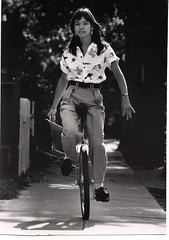
When I learned how to ride a unicycle in high school, I was assisted by a number of factors. First I was introduced to the idea while attending the Fourth of July parade in Redwood City (affectionately known as The Redneck City Parade) where I saw a drill team from Concord riding unicycles. That ordinary Americans were doing something unusual in an ordinary way made it entirely possible for me to think to do such a thing. I went to my local library and found a book devoted to unicycle riding. I was able to buy one locally at a bike shop (made by Schwin). Over a holiday weekend I mastered the thing and was much admired when I showed off my new skill at school. The following year I took it to college where it became my mode of transportation (and later elevated to my 15 minutes of fame, on the evening news, as a Green commuter).

That summer I went to Thailand and suggested to my relatives that the unicycle would be a terrific way for me to get around Bangkok. They were horrified and forbid me to think of doing such a thing.

"People will get into a car wreck trying to look at you," said one aunt, the only one who actually walked anywhere. The underlying message was that a person of my class, representing the family name as we all did, was not to perform acts of freakishness in public. There were rules about what was seemly. My grandmother, in particular, laid down the law guided by what was being done by her betters. Or not done.

In the current economic collapse scenario, innovation is again the hope that pundits are calling upon to save us rather than accept any form of downward mobility. That such downward mobility might lead to self-sufficiency is not mentioned.

I noted at an early age that my grandmother was unable to do anything for herself, though she could artfully arrange dried flowers and wrap gifts with precision. She was always calling for the maids to help her. I never saw her cook; I'm not sure she ever learned to ride a bicycle or to swim, but she had played a championship game of tennis in her youth and was an expert at ordering people about including me.

I vowed that I would not meet the same fate. I would not let wealth render me forever dependent on the skills of others. How would one travel or go on adventures like the children in my much-loved English books who spent their summers sailing?

"If not duffers won't drown," their father had said.

Most of my aunts could not swim. My relatives were of a class that had not learned to swim because only the poor, who were forced to live on the river, did so. (My British mother made sure I had swimming lessons when we joined the Sports Club.)

I loved the water. In the context of my family, I was forever aspiring to be downwardly mobile.

Poor As Four Letter Word

Few cultures aspire to be downwardly mobile. Poor is a category cloaked in shame, especially in America. Once when a roommate complained that she didn't have enough money to take a European vacation and thus wouldn't be able to go on vacation at all, I thought I was being helpful when I said, "Well there's always camping." This, to me, was a fun holiday that allowed practice of many skills of independence, in places of natural beauty, surrounded by others of like mind.

My suggestion was met with a look of horror and she walked out of the room as if I had delivered an ethnic slur. She had perceived me to be a person of wealth telling the lesser endowed how to live in a manner they could afford. This was, I realized, the height of rudeness in a land where everyone had the right to aspire to be upwardly mobile. Was the reluctance to identify as poor(er) an Achilles heel of American culture? How very Grey Gardens of us.

I learned to reframe my pursuits. Americans still valued self-sufficiency, religious practices were respected and even more so political ones; eccentricity fit right in with the cult of the individual, artistic interpretations are admired and experimentation and innovation are highly prized. As long as I didn't mention that I was also trying to be frugal, I could do whatever fun thing I wanted to do and inspire others with my stylish, politically correct, eco-sustainable example.

Skills Lost

Still, I couldn't help noticing that my peers were going the way of my grandmother. In the upward mobility and general wealth of American culture, skills of self-sufficiency had been lost over the last three decades.

I asked a number of women friends whether they could sew. Those, at least five years older than me, were almost all able to sew, but didn't anymore because clothes were so cheap to buy (imported from all the sweatshops in Asia). They were right. There was very little economic reward in sewing anymore. The only reason I sewed at all was to learn ethnic patterns and come up with my own designs. Thus the urge to design was a key to the motivation to innovate.

In college, I had come across a book called "Design Yourself". It was full of energetic cartoons of the empowering, "you can do it" kind. I loved the idea of going through life as a designer, choosing what came into my life and being encouraged to restyle it. In my home country fashion was a marker of class position so it was safest to copy and later buy already established designer clothing and accessories from the West. The same for cars, electronics and home furnishings.

The book "Design Yourself" was the text for a theater arts class on set design. Theater arts had been, for me, a microcosm of useful skills. It was while building sets at the Children's Theater that I first learned to use a hammer in 6th grade. And it was in the costume department that I learned about historical dress which in turn allowed me to innovate a unique style of my own.

As part of the stage crew, I learned how to manage ropes and pulleys, handle antique props and move things around in the dark. None of this was happening when I performed in school plays in Bangkok. There were dressmakers, stage crews and labor all from another class to take care of everything and no public library in which to research in the theater arts section.

High Tech vs. Physical Reality

As the arts give way to all things computer (funding for the arts cut from schools and all) there are fewer venues for using hand tools and devising mechanical things. My father, an electrical and mechanical engineer, fearing that he would be made obsolete by the advent of the computer, decided to build one at home so he could learn how it worked. It took him close to a year working every evening with a soldering iron. This was not a skill I was drawn to. When I did learn the computer I was, like most of the pre-computer generation, frustrated by the logic and precision demanded. It was not until icons representing reality, i.e.: a trash can, were added that computers were made "user friendly". Thus translated into human terms through symbols, we became computer literate, while a new generation was submerged in a "virtual reality".

I have been assured by academic studies that computers have not impaired the ability of the human brain to solve problems. But I fear that it has impaired the ability to struggle with the world of physical things.

My suspicions were confirmed by a biography I read of a man, my age, who had taught himself frontier skills as a teen and later started a school. He observed that the children who attended his camp lacked basic understanding of the physical laws of nature—leverage, inertia, momentum and thermodynamics. They would, for instance, attempt to walk with a bucket of water at arms length, in front of them. They had never played with simple toys, thus had no idea that a hoop could be made to spin along the road like a wheel. Their lives no longer offered these lessons.

A friend teaching at a university told me she had been a drawing teacher over a long enough time span, now, to note the deterioration in hand skills due largely to students spending less and less time on a single drawing. My friend took to assigning "time" homework to her students so they would give the time necessary to hone their drawing skills. This confirmed for me that people were not spending as much time doing things.

While women no longer sewed, men no longer fixed things. It was cheaper to buy new, again due to the global economic efficiency of far-flung sweatshops. Having attempted to fix many a discarded appliance, myself, I too, found that it wasn't worth it. Either you couldn't get the parts or the item broken was plastic and disfigured beyond repair. Then there was the circuit board. I once had an oven repaired in a rental unit I managed. I was flabbergasted to learn that it was broken because cockroaches had eaten away the circuit board and disabled the on/off function. Civilization brought down by the appetite of cockroaches! Circuit board as weak link of modern infrastructure! Circuit boards do not lend themselves to home repair. It was replaced by another from that far-flung sweatshop.

Without practice observing mechanical things, it gets harder to see how stuff works and think to struggle with something to learn how it might be made to work again. People with a high tolerance for such struggle make good plumbers and auto mechanics.


How We Learn

Commentators like to point out that diversity is the key to our strength, implying that there will always be Americans with the right skill set to solve problems as if the US were a slot machine prompted by a pull of the lever to come up with a new set of winning symbols. The actual benefit of this diversity is in the cross-pollination that is possible through people and access to information. American social boundaries are more permeable, our hierarchy more accessible. Anyone who can write a simple proposal and profess knowledge of any subject of possible interest (but not bomb making, of course) can apply to teach a class at a community college where they are immediately perceived as an "expert" in their field.

Thus our diminishing patience and skill set may be offset by our willingness to learn new things, for Americans are willing to learn from those not of their class. (But if from someone who is poor, it will probably be a monastic teaching Buddhist meditation.)
In the 70s I found a paperback at the library called "Living Poor With Style" by Earnest Callenbach. It was filled with attitude about how curtailing your need for money would allow you to be free to do more of what you wanted to do. I took this message to heart. The book went out of print, resurfacing two decades later with a different title that replaced the word "poor" with "cheaply". It was hardly worth reading having been shorn of attitude. (But you can get the original; a used copy on Amazon priced at close to a hundred dollars.)

In those intervening years, technology, particularly high tech Western technology has been telling people how to live expensively the world over. After the economic collapse in Thailand in 1998, the poor discovered that there are worse things than being poor and that is being in debt. A movement of peasant farmers quietly began to reclaim the low tech indigenous folk innovations of the peasant people and also of learned people who had perfected sustainable practices.

I was encouraged that such skills are not lost, but I have come to believe that once a culture is invested in high levels of centralized technology it will use every last breath to save that unsustainable infrastructure before turning to alternatives. There simply is too much at stake in terms of jobs, profit and stability. It looks like collapse will have to be our saving grace.

I found clues to such a future in the story of the Pueblo people, the ancient Native American culture admired for their advanced society and building techniques. They were said to have disappeared, leaving no descendants, starved out by drought causing the collapse of their food supply. On closer inspection scholars observed that they may have migrated or possibly their descendants became the plains Indians who populated the land following their demise.

The name for this ancient people is Anasazi, which is Navajo for "enemy ancestor". I was chilled by the implications of this phrase. To speak of an advanced culture, that preceded you, in such language implied that it was understood how such a lifestyle was also their folly. At the same time, I was heartened that at least they had learned and developed a culture of sustainable practices. If we are the enemy ancestors of a future people, this was a hope that our descendants will find their way regardless.

Labels: , , ,

Saturday, December 13, 2008

Apeakalypse Now

In March when I returned from Thailand, the situation with the subprime mortgages unnerved me. I had heard too many stories from Thai farmers about the impact of personal debt on their lives. How they had to dig themselves out and rebuild a new life while still paying back thousands to the old one at the rate of five dollars a week. This during a currency devaluation that halved the value of everyone's bank account and an economic slow down that halted construction jobs mid-project. Stop down was more like it.


Workers went home to their family farms. What they did next made me realize that these farmers were rich, much richer than I felt living here in the US. They had land, enough rice stored to feed everyone for some time and skills to rebuild along with a renewed sense of self-reliance. They were also committed to being sustainable in a way that actually seemed possible. The lessons of the boom and bust had taught them to rethink their wants and their dreams of wealth while their immediate needs were taken care of.
The culture shock I felt upon my return was so severe I was in a stupor for a month not knowing how to direct my life. I did not feel safe sitting in a house with a mortgage. I did not feel safe in America itself. I saw a nation of people carrying massive amounts of credit card debt and few practical skills. They had less of a safety net than a Thai farmer. How would they fare in a future that seemed to offer nothing, but apocalyptic scenarios? Peak oil, peak natural gas, peak metals, peak food, peak everything. And climate change already upon us, too. This forward tilted perspective made me feel I was slowly going mad while all around me people continued as if life was normal. Catherine wanted to remodel the bathroom.

"Do you like this tile?" she asked me showing me photographs of expensive natural stone from Italy. I suppressed a snickering chortle. What's natural about it I wanted to know, having spent ten days touring houses made from earthen bricks dug from the soil underfoot. I couldn't take a first world remodel seriously. I felt anachronistic. I used to be a designer interested in how things looked together, but now I was useless.

When world grain prices shot up Catherine let me buy two 25 pound bags of rice. I stored them under the guest room bed, then started a collection of dried beans. I sold stuff—including my father's Leica camera, a family heirloom I had used in college.

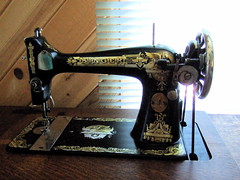
This severed me from the past and funded my survival kit—a solar panel to recharge flashlight batteries and electronics, an expedition size camp stove and a field grade water filter I had seen at the Doctors Without Borders refugee camp exhibit. The stove would come in handy during our kitchen remodel next year, I justified. (The water filter, however, was seriously over the top.) And because I had always wanted one I picked up a treadle sewing machine on Craig's List and a recumbent bicycle. Oh and a slide rule.

Catherine hired an interior designer and gave me a stern talking to about how estranged I had become. I told her of my fears. Fears of "what if things don't work out the way they are supposed to." I sounded unduly paranoid, but she was sympathetic.

"Well, at least we did the best we could," she said, sitting as she was, on 17 years of equity in the house and having scored the best interest rate possible on the most recent refi. Really what was there to worry about? Oh just a complete economic collapse.

I willed myself to be supportive of a bathroom remodel. I could see how happy it would make her not to have to look at the moldy grout and the badly set tile. It was not a well designed bathroom in the first place. I gave my opinion. Yes, on grey tile and dark wood cabinets. Yes on a glass shower and a skylight. And no on recessed ceiling lights that act as chimneys robbing the house of heat.

To please me, Catherine agreed to have the house envelope sealed and the insulation in the attic doubled. The day it was done the house was so airtight and snug it made us feel different in it. There were no more drafts. The heater only had to be turned on for ten minutes in the morning to chase the chill away. I felt better. Now I wanted a wood stove. One can always find stuff to burn, I thought, picturing the scene from Dr. Zhivago when they burned chairs in the fireplace to keep warm during the Russian revolution.

Then the stock market did its heart stopping dive. When I stopped wanting to scream, I felt downright cheerful, my fears were confirmed. My how quickly the world financial system was unraveling. It gave new, capitalist, meaning to the term Domino Theory.

The Ecology of Money

Just as the tide going out reveals an awesome array of flora and fauna living in hidden tide pools, so too did the economic crisis reveal an amazing array of creatures I had no idea existed. As writers poured explanations into articles that would have been too dry to read a few months ago, I stumbled upon a body of knowledge that constituted a major Missing Link in my quest to understand how the world works.

As the tide of bailout money flowed out of the US treasury, pulled like gravity by the weighty mass of companies too big to fail, questions tugged at me. Money doesn't grow on trees we all know, but now apparently it does. Possibly more trees than can grow on the earth. Trillions and trillions. Was money now infinite? Surely there were consequences. An online comment sent me to a site that gave me answers. Surprisingly simple answers, but so unbelievable my mind repelled the information. Money doesn't grow on trees, it grows on loans. You could say it is wished into existence.

"If wishes were horses, beggars would ride," said my English grandmother in response to my eight-year-old wishes. I was entranced by this curious answer. I had seen plenty of beggars on the streets of my home in Bangkok, but I had only seen horses at the racetrack. Why would beggars want horses unless you had to have one in order not to be a beggar? Oh, I realized, it's a word puzzle from history! About people, like me, who don't have money for things that they want. My grandmother had as good as told me that money must be earned before wishing can begin or I would be no better than a beggar.

But as it turns out, upwardly mobile beggars wishing for horses could take out loans. In the US banking system loans are a signal for money to be printed. By a privatized arm of the system—the Federal Reserve. Thus, if certain beggars make wishes, money appears and both can ride. The beggar on his horse and the money on the interest paid back. Meanwhile the loan is paid back with money exchanged for actual things produced in the physical world (or services utilizing same).

The implications of this suddenly hit me. We are under contract to fleece the planet! The fractional reserve banking system is designed so that it must keep on giving out loans just to stay solvent, but there aren't enough resources in the world to be sold for all the money that needs to be paid back.

I once had a long-winded snail mail correspondence, back in the '80s, with John Mackay, the founder of Whole Foods. He put out a newsletter then. In one he insisted that wealth was infinite. I was prompted to challenge him. Technology, he insisted, would find ways to split our resources into ever more useful bits that could only improve our productivity and efficiency. And that is probably as good an example as any of why concepts like ecological limits had little impact on my generation.


Our money system had limits once, when it was a representation of something finite and physical—gold. People borrowed money to create things that allowed them to use resources more effectively just as John Mackay was trying to tell me, but gold had limits just as the earth had limits. Wars upset the balance, for wars required unreasonable amounts of money to make things, which were then blown up, destroying more things in the process. Wars did not make society more productive. (One could say the same for disposable convenience items, MacMansions, assorted consumer addictions and planned obsolescence.) Nixon took us off the gold standard in order to pay back the foreign loans that financed the Vietnam War. Our money supply could now inflate beyond all physical limits; too much money, and not enough things available to buy, equals inflation. Fortunately for the planet, eventually the currency will destroy itself by collapsing under its own weight.

And that's what it's scheduled to do. The chart on inflation, at the Chris Martenson site, showed the now familiar hockey stick configuration that Al Gore introduced regarding emissions that lead to global warming. Here was another impossible to sustain growth factor leading to collapse. This time in the form of hyperinflation. Insert here, picture of wheelbarrow loaded up with money to buy a loaf of bread. (You'd get more caloric value from it if you burned it in my new wood burning, low emission, fireplace insert.)

Journey's End, Journey's Beginning?

How to prepare for such a kaleidoscope of possible collapsing futures? There are too many variables. We know the why, but not the when and the how or even the where or which one first. Even the next six months seem iffy. If inflation rules the day everything will become extremely expensive so you should buy what you need now. If it's deflation, because no one has any credit to buy what's out there, then stores will lower prices as we go along and big ticket items will fall in price too in which case you should sell all your assets, including your house, and buy them back later at the lower prices. Whoa doggies. I came on this journey to understand How Things Work not to have to figure out What Will Happen Next. It's against my religion. I am not Cassandra. I just read her notes.

So was this the end of my journey? Could I do nothing more than wait to see what happens?

At the Bioneers Conference in October, I was at a lost as to which workshops to attend. Should I seek inspiration in native foods, bio-mimicry, the wisdom of indigenous tribes or the social networking tools of the Internet. I kept going to one and wishing I had gone to another. Finally at the last session of the last day, I went to the one where I heard the most laughter and which had the most comfortable seats.

Inside, the theater auditorium a man named Michael Meade was telling stories and playing a drum—no PowerPoint presentation, no hockey stick charts, no data, nothing. Just this comfortingly wise, happy voice telling a story about the ancient cave of knowledge where the Old Woman of the World was weaving a most beautiful garment only to have it pulled apart by a black dog just as she was putting on the final touches. She then surveyed the destruction, picked up the threads and began intently to weave it whole again with a different, more fitting design.

Ah, I thought relieved, so the world is supposed to fall apart. This end of the world feeling was an archetypal story! I wasn't crazy after all. But maybe going a little mad was an appropriate response.

Michael continued. When the end seems near it's because the mythic sense and creative imagination are missing and we have lost track of life's meaning. To have real vision, he said, you have to have a period of despair.

"We must suffer in a way that generates meaning," he said, "Myths make meaning. The world can't end unless it runs out of stories."

Really? So stories do have a purpose. I grabbed onto this lifeline. The world would certainly not end on account of my not telling stories. Perhaps what I feared was that the story I was following was too big to fit into the humble parameters I had set for myself. (Of course, trying to explain How The World Works was not exactly a small-minded task, but I was only doing it for myself before.) My stories are already long enough as it is. But better metaphors make them digestible. And what were myths, but more efficient metaphors.


We need stories, Michael was telling us. And inside the story of the world is the story of the individual. We need mythic stories to connect our imagination to the eternal. A mythic imagination can hold the ends and beginnings together. This connection will show the path to renewal.

It sounded like a New Deal for artists. What did we have to loose? We sure needed something that would pull us together. Leaving the theater I walked through the campus to find Catherine. She was already at our meeting place smiling and eager to tell where she'd been.

"I just heard the most amazing talk. I hadn't even planned on going to it... He was this poet telling stories with a drum…"

Michael Meade is the author of The World Behind the World: Living at the Ends of Time. Also CD of his workshop The Great Dance: Finding One's Way In Troubled Times.

Labels: , , , ,

Monday, November 24, 2008

The New Visible America

How the new racial landscape of America meets the Green movement, increasing the visibility of both.

The Great Not-White Hope

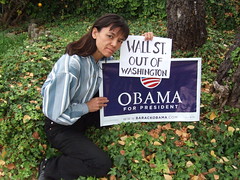
The morning of the election I was filled with happiness just to have had the opportunity to vote for a black man with a white mamma. Happy that he was also a man of eloquent speech, intelligence and awareness of others. It was an unexpected elated feeling of joy at having a black candidate make it this far in a presidential election. A candidate who put a face on my own mixed race heritage. The one that exposes a love that was also once taboo—the sexual union of white and brown. These unions had been my touchstone, my proof that love between all people was possible. A sort of United Nations manifested in the bedroom.

To be the child of that kind of boundary-busting paradigm is to live with a world that always seems to want you pulled apart, when you know that working together to be whole is, not only possible, but necessary for survival. It is a path that not all who are born to it can handle well for to live it is to be constantly tested; the temptation to deny one side or the other is so strong that the grace of the middle road is forsaken.

I was going to vote for Hilary in the beginning because she had the experience and it would mean Bill would be back too, but then a kind of rigidity set in. It would be a relief to have the criminals gone from office, but having an administration that would merely govern was not enough. Experience can be sought from advisors. I wanted another layer of consciousness in the White House. Plus I had not forgiven Bill for giving away the store to transnational corporations while we had been asleep, comforted by the Democratic Party brand. Next time we would know better. Next time we would post a constant watch.


Obama connected with people in a way that inspired those who were ho-hum about politics before. This was heartening. That he became Mr. Fill-In-The-Blanks Hope was the stuff of fairy tales. I had no illusions about his message of change. He was a centrist said to be aligned with the principles of free market capitalism as offered by the Chicago School of Economics—The Shock Doctrine Mafia. This chilled me.

But nevertheless an American presidential campaign is a time of storytelling about what a great nation we are and how we will continue to be great—more mythical than reality based. My vote for Obama was a bid for how we would continue with the adventure of empire and world dominance. For continue we would, either very badly and quickly towards our demise or with a bit more grace and diplomacy. This grace offered by a man who had been a global child as I had been. One who had lived among others not in lock step with the insular American identity (and high octane lifestyle). One for whom the world had the faces of his playmates in Indonesia and Kenya. While here in his own country, he was a minority; a minority whose skin color would be overlooked if he lived up to the higher expectations demanded by his prep school education. So far so good.


Black Is The New White

What was unexpected, the night Obama won, was that it would matter so much that he was black. Witness the emotions that followed his quick decisive win. White liberals gushing with pride that racism had been overcome. Black men speechless, unbelieving. All of us, at my house, screaming at the TV then rushing outside to make a joyful noise. We hadn't dared hoped it was possible. Those in power had been expected to keep it all locked up with diabolical Diebold machines and legal loopholes, never letting any outsider in. (It also occurs to me that they needed an outsider to be left holding the bag as their failed regime stripped the assets on its way out.)

The way the liberal pundits gushed that night, I flashed on a headline for the papers the next day—"Today We Are All African Americans". That was the way to express solidarity (as in Today We Are All Americans from the European headlines following 9/11). But no that wasn't it at all. White America was too busy unpacking white guilt. The slapping on the back was out of righteousness at having done the right white thing. The day after the election Obama became white, allowed into the club. A song about him being Irish passed around on Youtube. White culture claimed him via the grandparents who raised him.

This is the white privilege part of being a mixed kid. You are already family with white people. There is no divide, no discomfort to overcome on your part. And you still have the caveat of being cool. America at large had just discovered racial coolness. My social equity went up. I was immediately more visible to strangers.

Being cool while being a person of color first made its appearance for me in the lesbian feminist community in the '80s. White feminists bent over backward to listen to women of color. And women of color mostly let them have it. This just made me feel uncomfortable. Mixed kids don't tend to use that kind of language. It is too painful. Try calling your white parent a racist. You point out white privilege somehow, but not by starting a sentence with "white people". Nuanced is a word often associated with Obama.

Meanwhile, white liberal journalists were eager to unload guilt on the black voter who had discriminated against gays—seven out of ten having voted Yes on 8, the ban on gay marriage. What to make of this?

I already knew that the black community was homophobic—part of a macho culture maybe, the church definitely and maybe a need to look down on someone who was even more of a social pariah. When I heard the news it did not make me angry in the personal sense that white homophobia makes me angry. It made me wonder if the white privilege of gay people had been properly examined. A black lesbian said as much in an editorial in the Chronicle. And that was another thing to celebrate.

For the first time in newspaper history, not one, but two black lesbians were visible, presenting two sides of the black/gay divide. My how the conversation was broadening. The social frame of mainstream media shifting wildly, sweeping the horizon for representatives of the "new" faces of America. The danger was in allowing this "black/gay divide" to divide us. Dividing us—minority against minority—has long been a tactic of the dominant (white) power.


A Movement of Inclusion


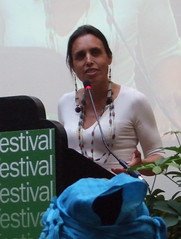
Minority leaders who cross over to a largely white community such as the environmental movement, as Van Jones had done, with his Green Collar Economy concept, learn the language of inclusion. He used it at the Green Festival less than two weeks after the election.

"All those bigots and homophobes did was drive us to suicide and divide our community," he said. He didn't have to include the gay community at an eco function, but he did. The Green movement having learned to be inclusive back when clubbing seals was the cause celebre of Greenpeace; that Greenpeace campaign having hugely impacted indigenous people economically. Thus local economies and local people were folded into the equation. The Green Festival created as an economic response to the Battle of Seattle, the first North American protest against globalization at that famous meeting of the World Trade Organization.

We lefties in our no logo clothing and hemp socks munching on fair trade chocolate; we young white people with dreadlocks, handcrafted man purses and tattoos; we were readjusting to this new feeling—of oppression slowly evaporating. Everyone wanted to hear a black man speak in this new America of Barak Obama.

Van Jones began by commending us for having the courage, all these years, to stay with our ideals when no one was supporting us.

"You held the line for peace," he said, "you stayed and you fought, you didn't leave." I got all choked up over this acknowledgment. I hadn't allowed myself to feel how much of a struggle it had been to create a parallel universe of eco ideals in the face of such a stubborn, dumb and destructive administration.

"This movement, this sustainable, green movement created the opportunity for Barak Obama to be elected," he told us. "Because he came here, to all these pockets of sustainable thinking and he saw you. He saw your boldness, your clarity and audacity."

Then he teased us about how he knew what we were thinking.

"I know you," he said, "You, with your stack of books this high on your bedside table. I know that you want to hold Obama accountable." I was puzzled. Wasn't that our job?

"The problem with this phrase," said Van Jones, "is that there's not a lot of holding involved." He gestured holding as a loving embrace. "It's more like you want to kick Obama accountable." He mimed kicking.

"The Brother President Elect has done his job of taking back America. We came this close to losing our democracy. It is your turn now to do your job which is to take America forward."

So this was what it meant to be visible in Barak Obama's America. Van Jones was certainly visible now. His book was top 10 on the bestseller list, of the business books even. Obama very likely met him when he came to visit our pocket of sanity and audacity. Van Jones did, nevertheless, stomp on Obama's inclusion of clean coal (no such thing) and geosequestration (not enough places for holes in the ground). He outlined his own three-point plan. 1) Put a price on carbon. 2) Put people to work weatherizing the nations buildings and 3) R & D to decentralize and connect the grid.


"It's our turn now," said Van Jones. "They had their turn. The bomb and torture…the drill and burn...the borrow and spend, bubble and bail out. They had their turn. They totally discredited their model. All those bigots and homophobes did was drive us to suicide and divide our community. It's our turn now."

The packed hall gave him a standing ovation for this language of inclusiveness, this prodding to create a greater movement.

In contrast, Kevin Danaher, who spoke next and had many fine suggestions to make, tossed off this techno elitist comment.

"Because of the Internet, we can all connect with every human on the planet." He meant to be encouraging about our ability to create social change, but all he did was remind me of the AIDS orphans in Africa who can't go to school for want of a uniform and a pencil.


Winona La Duke, a Native American with a white Jewish mother, came to this language of inclusion naturally, mentioning not only the gay marriage debacle, but adding this sentiment."There is no monopoly on botching things up," she said, "that's what humans do." She was asking us to be "big" people now (not infantalized consumers). She spoke of deconstructing empire and considering how much we are willing to let go that is defended by the whole system. Peak oil was on her list, too. She said the words with disdain like 'hello when are we going to learn'. As a food activist, she commented on the folly of trying to squeeze the nation's corn crop into our gas tanks, just so we could continue to drive. This continuing bias of the industrial paradigm just didn't allow that any wisdom or truth could come from outside of European thinking, she said. She then proceeded to list off the guiding principles of the Anishinaabeg people thus:

We are all related.
We are cyclical.
We should treat all things as alive.
We take only what we need and leave the rest even if it grows wild.

She spoke for the efforts of the Anishinaabeg Indians, in Northern Minnesota where they have installed four wind turbines on their reservation. They decided not to lease the land for windmills that outsiders would build, but to keep control of the energy they generated. It was what the tribal leader called "a crazy horse moment". This population, which was the poorest of the poor, had done it, which was why she was telling us their story, because if they could do it we could do it. We could generate some part of that 185,000 megawatts of power needed to run this country on renewable energy.
The Green economy has justice in it, she said. You can't have peace without justice.

The audience gave her a standing ovation too. We had our marching orders. We were being urged to get on with it. Move with this opportunity that Obama has opened for a Green economy. We had voted him in. Were we going to quit now, lay back and hold him "accountable"? Were we going to wait for the industrial paradigm to take care of things?

This was our crazy horse moment. Our turn now.

Labels: , , , ,

Sunday, August 31, 2008

Off The Grid In Colorado

My quest to seek a sustainable living example in the States takes me to the outbacks of Colorado.

Wild West Tamed

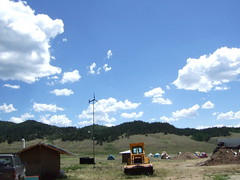
When Thai people think of America they see cowboys and Indians streaming down a mountain range onto a wide, open space devoid of modern settlements. As we drove through the Kenosha pass from Denver into a grassland basin known as a park (yes, as in South Park), I, too, envisioned the old West. Looking at the few old wooden buildings dotting the landscape here and there, I absorbed a timelessness and an isolation that could render one forgetful of an outside world or the changes wrought therein.

I was accompanied by three Thais and an American woman who ran an NGO in Nepal. We were headed for a five-day building workshop in the tiny outpost of Jefferson, Colorado. Our hosts were two schoolteachers, Kip and Kristen. Kristen's sister Peggy was married to Jo, the founder of the Thai adobe building movement. Their brother Nate, I had met already on the tour of sustainable Thailand that I had joined earlier this year.

Over the three-hour drive Peggy was filling me in on how she happened to end up making a life in Thailand beginning with a pivotal student year abroad there. Now her family had convened to build a Thai style family compound on 44 acres of land they had bought together here in Jefferson. Upon our arrival at the end of a dirt road, we jumped out to admire the chocolate brown straw bale house with its steep snow-shedding metal roof. Inside the two-bedroom house, was a modern kitchen (no dishwasher) and a full bathroom.

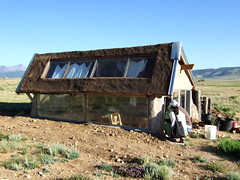
The house was off the grid, powered by 1.5 kilowatts of solar panels and 12 deep cycle batteries with a propane generator back up. The solar panels sat on the low roof of the battery hut. After a winter of high propane use, they had installed a wood burning stove to augment the radiant floor heating in the house. A windmill near the battery hut also generated energy. Kip had built the hut from leftovers from the big house covered with cob (a mix of mud and straw). It had wet his appetite for building with natural materials. The strawbale house had been constructed for their parents with the help of professionals and still maintained aspects of conventional building, but that's where the familiar ended.

Pit Toilet

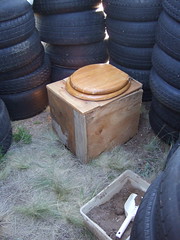
We were introduced to our own camp toilet. Jo had fashioned it from stacks of old tires creating walls around the pit toilet he had dug. A bottomless plywood box covering the hole was outfitted with a wooden toilet seat. I made note of the simplicity of this emergency style toilet which was sturdier and more comfortable than the five gallon bucket and cheap toilet seat sold online, inside of which would be packed your earthquake supplies. In three days, 18 people would fill the two and a half foot deep hole and Jo would dig another one nearby and move the tire walls. Later the family would plant a tree where the pit had been. It didn't smell or attract flies because we covered our deposits with sand. I was pleased to note that everyone seemed happy to use this makeshift toilet even the Thais.


That I was having to come to the American West to meet Thai people interested in alternative living and natural building filled me with a sense of the irony of our globalized life. Dee had remained in Seattle after college when he bought and ran his own restaurant for many years. He had sold it in preparation to return to Thailand. His girlfriend Jui's had a vision to build a green resort and spa. Jui's sister, Jick, rounded out the threesome. Jui worked for the airlines thus the family was very well traveled. It was the sisters who had been interested in Jo's work, having seen him on a Thai television show called Philosophers Who Walk The Earth. Their father had also been a building maverick using earth to build their home.

The three had greeted me with the traditional Thai greeting, the wai, and I introduced myself by my Thai name, Noo. They immediately attached the honorific appropriate to my seniority and thus I was addressed by a name filled with affectionate family connotations—Elder Rat.

In the sage covered field of this American cowboy country, we pitched our tents, kicking up the smell of lavender as we walked. Every day puffy white cumulus clouds in an intensely blue sky would go a long way to wiping the apocalyptic vision of smoke charred skies we in the Bay Area had been enduring through a summer of fires. I found the act of building comforted me when all else seemed beyond my control. To be in community with others seeking to lighten their eco footprint completed the healing. We had two masseuse, a yoga teacher, a glass blower, a self described unlicensed vagabond, an au-pair living in Paris, a college Freshman and a pair of systems engineers. Only four men, not counting the three who were our hosts.

Earthship Home

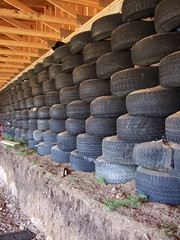
We would be helping to build a home for Kip and Kristen-a fair size three-bedroom earthship. The earthship being the invention of Americans in New Mexico who had put to use discarded automobile tires and aluminum cans in their passive solar buildings. As teachers, Kip and Kristen had plenty of time off in the summer and schoolteachers' salaries, thus the choice of the earthship. Tires were free including delivery and assembly, though arduous, required non-skilled labor; each tire was stacked and filled with earth, then packed tight by pounding with sledgehammers. It took them most of last summer to assemble the wall of 850 tires.

Inside the unfinished shell of the earthship it was dramatically cooler given the 100° temperatures that first day. The tire wall, which extended the length of the back wall, had been covered on the outside with earth sloping down to the ground. This created the thermal conditions of a cave. The front wall was all windows, traditionally framed in wood, sheathed with oriented strand board and insulated with Styrofoam. Within this shell we would build adobe walls to partition off the pantry and mudroom.


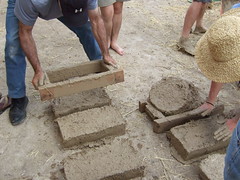
Brick making in the Western world is scientific—you test the soil, establish a recipe, take notes and generally control everything, but Jo preferred the easy Thai way. He just looked at how the ground cracked where it had been soaked. He picked up a handful and squeezed it in his hand and played with it. If it's sticky it's good, he told us. He flooded a shallow pit with water because as you pull in more earth and sand, the rocks fall to the bottom since they are heavier. This saves having to sift the soil though our feet would still find the rocks. Just as with cob building, we mixed the straw into the mud with our feet.

Once mixed, we filled five gallon buckets with the mixture and poured it into a wood mold made of 2 x 4's. The width was important-at least 8" wide. The bricks could be of any length-the longer the more unwieldy and heavy, but faster to build. Our bricks were 16" long—easy for one person to carry. Once poured we lifted the mold off immediately. The mud held its shape just like jello. The following day we would stand each brick on its side to dry. They took 3 to 4 days to dry completely.


How Corporations Steal Community Self-Reliance

Children can make adobe bricks and will do so at quite a rate, I remember Jo telling us in Thailand. This accessibility is an important concept. As I would later learn from reading Raj Patel's book "Stuffed and Starved" on food systems, the point at which a process is made into a high tech, high energy, large scale operation is the point at which large corporations take over, monopolizing an industry, jacking up the price and taking it away from local production. Thus coffee beans grown for worldwide export are controlled by giant centralized mills, as is flour for tortilla making, rice that needs threshing and soybeans that need crushing. In the building trade it is cement making that is the bottleneck, for the process requires huge kilns heated to 1500°. Incidentally, the amount of energy used to heat those kilns and the byproduct produced in the process is why cement plants account for 5% of global warming emissions.

One third of the world's population lives in earthen buildings. We don't know this because we never hear about it, Jo claimed. Adobe was considered rudimentary, I knew and the world had been sold on modern materials. One guest mentioned that a developing country had just created a building code requiring a certain percentage of cement in every new building. This was considered progress albeit for the cement industry.

The next day we built walls with the brick using mud as a mortar. It went quickly, way faster than cob building, I commented to Kip. At the cob building workshop I attended two summers ago, it had taken us the entire five days to get half as far as we were doing that day. He noted that once people discovered adobe they left cob behind; only in California was cob still popular. Hmmm. How purist and process oriented of us.

Jo showed us interlocking techniques that would insure that an adobe wall stayed put. In Colorado where there is no termite danger, there was no need for a cement foundation, yet building codes required a cement foundation below the frost line. Jo claimed that an adobe building can be allowed to float on top of the ground because it was too heavy to shift, even in earthquake country. This I would have to see to believe, but I enjoyed Jo's perspective that just because professionals said things were necessary didn't mean that it was; or even that the parameters by which professionals agreed to abide by were necessary. I envisioned floors tilting over time. Maybe he had a cure for sloping floors. I neglected to ask.

The Thirteen Dollar House

His own house on this homestead defied all kinds of rules. It didn't even have a door. To get in, you climbed into one of the windows and down a little ladder to the below ground cement floor. Not recommended for monsoon countries, like Thailand, Peggy cautioned. They called their house The Thirteen Dollar House because that's all it cost to build. One side of it was bermed with earth. The roof was plywood scraps covered with plastic, then cob. On our last day we would paint it with a beeswax and linseed oil mixture for further waterproofing. The remaining sides were faced with salvaged windows. There was a sleeping loft. Tomato plants were growing in the window. Several trays of sunflower seeds sprouted on the desk. It was a green house for sleeping in. Luckily, it was too small to be the concern of building inspectors.

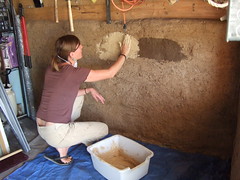
On the second day Kristen had a special task for me and Carrie who had studied interior design. We were assigned to create a coat rack using branches and a pair of horns for hooks. We attached the pieces of wood to the wall with the cob mixture. It was easy, once we worked out the design, and much more forgiving to work with than drywall. I felt miles away from the work I normally did putting up hooks with anchors and a drill—the drywall dust getting in my throat, often kicking off a respiratory infection. I pulled myself back to the job at hand and with my organizer eyes added a place to hang keys plus a doorstop. "I didn't even think of a doorstop," Kip exclaimed and Kristen was thrilled about the key rack.

Behind me an earthbag bench was being installed topped with a semi-circle of slate. Here people could sit and take off their boots. On the other side of the wall wooden shelf studs were positioned between the bricks. A set of salvaged school lockers would serve as storage.

Once an adobe wall is up it is plastered with a finer mud straw mix. We stood side by side slapping mud on the cracks between bricks. Without the noise of power tools it was a pleasant way to spend time with a group of like-minded people and I had complex conversations going on either side of me. The work went quickly leaving us all covered with mud by the end of the day. We lined up for showers and ate Thai food cooked by a crew helping Dee who was teaching us Thai cooking. We washed our dishes, Thai farmer style, outside with one washbasin and three in which to rinse. One evening we learned Thai massage from the two non-Thai masseuses, a local gal and a Scot. Friends who had met in Thailand.

On the final day we made paints with the vivid earth tones of actual mud mixed with tapioca flour that had been cooked on the stove. That you could put your hands into the paint brought home to me the advantage of natural building. There was very little on this building site that was harmful. We were often barefoot from mixing mud and when Kip came by with his baby daughter to visit and she dropped her cookie on the ground, he let her pick it up and continue eating it. My paradigms were being exploded. Food was paint. Dirt was clean. Work was play. Therefore houses were cheap.

I had come to see if the third world simplicity of Jo and Peggy's farm in Thailand could be translated to an American lifestyle. Not completely. There were distinct high tech differences in some of the materials and different building codes and aesthetics, but what was here was appropriate technology and that was the fine line we would have to learn to walk if we are to find our sustainable footprint here in the developed world. But there was more. In return we might also find a balanced life. As Jo had commented there is no difference between work and play when life is good.

Complete set of pictures here

Also posted at energy bulletin

Labels: , , ,

Thursday, March 13, 2008

Healing The Farmer, Healing The Land

Part three in a series of stories from my road trip in Thailand, participating in a study tour hosted by Pun Pun farms, to visit local examples of sustainable living in the Northeast and in Chiengmai.

The Search for a Ripe Watermelon

If you eat more than one chemically grown watermelon you will get diarrhea, we learned from the organic watermelon farmer. Fourteen such melons had killed an elephant, he added. Poor thing. With such stories I was surprised that more Thai people were not making the connection. True, not all fruit were so heavy on the chemicals; none at all in bananas and coconuts, some in pineapples and oranges, but watermelons were clearly the most afflicted.

Organic produce did not yet have the market clout and high prices that were being enjoyed in the States. In fact, sales were poor because the organic watermelon had to compete with the larger, more regularly shaped conventionally grown melon and it took 10 days more to ripen.


Watermelons were a secondary crop sown after the rice crop was harvested. It was so simple to grow, a child could do it, said the teacher at the Santi Asoke training center. The problem was pests for which they recommended three strategies. 1) Avoid mono cropping and use small plots with a variety of crops. 2) Chase away the pests. 3) If pests still persist then let them eat because, after all, humans can grow food and pests cannot. This last recommendation undid any notion I might have had that fighting pests was a battle to be fought to the death and won. How enlightened. They also recommended picking the worm-infested fruit, to ferment in molasses, to make a fertilizer called EM—effective microorganisms—a method learned from the Japanese.


As we picked our way along the dikes of the rice paddies, the watermelon farmer followed our progress with a digital movie camera to show his organic farmer's co-op. Thai organic farmers were not getting a lot of attention from anyone and the gaze of Westerners would elevate their cause. There were no ripe watermelons; he had just sent a truckload to market. Finally at the third field, he found some that would do and cut two open for us on the spot.

We happily ate this clean fruit without fearing for our stomachs. It was sweet and refreshing. In fact all the food we would eat on this trip felt pure and fresh. That it was grown on the spot gave me a deep sense of connection to the land. We were traveling locavores eating within a few yards of where our food was grown. There was no need to think beyond this tidy closed loop; I felt complete and secure. I ate more fruit than I did at home—oranges, papaya, bananas and star fruit, all with no ill effects.


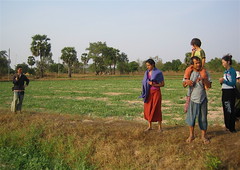
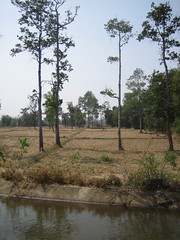
Walking from farm to farm in Jo's village, I gazed at the strange dry land with its grey white soil and tried to decide if it could be described as beautiful. Not at first, because I didn't know what I was looking at. Unlike an Italian countryside with its vineyards or an English one with its rolling green hills, both instantly recognizable as the stuff of travel brochures, this surreal flat, brownness had to grow on me. Height helped. There. In the next paddy. Very tall thin trees in a grid pattern with topknots of foliage like a Dr. Seuss illustration. That pleased my eye.


Back on the road our daily expeditions were punctuated by pit stops at roadside 7 Elevens, along the highway. All 16 of us would peruse the shelves of the multinational franchise and come out loaded with packaged snacks, buying enough to share with each other, the exotic tastes of peppered beef flavored potato chips made by Lay's, sweet sesame cookies made locally or the horrible fish flavored cracker that tasted like, well, fish food. I satisfied my craving for processed sugar with chocolate covered Japanese Poco sticks.

Healing The Farmer

For most of the farmers we met, it was their health that had turned them towards organic farming. At first they didn't know why they had the symptoms they did. Then it was discovered that the rat pee was toxic; rats living in the field were expelling concentrated chemicals into the waters of the field, which in turn gave the farmers intense rashes on their legs. They were also plagued by headaches and fatigue. Those who had ditched chemicals were convinced that soon every farmer would realize the connection and return to organic farming methods.

"People cannot learn without suffering," Jo said. The economic collapse had helped to create more such suffering, increasing the number of people deciding to take the healing path of self-sufficiency and organic farming.


Standing in a lush plot of edible forest, we heard the story of one such man who had owned a successful trucking company. As the economy collapsed, he found himself in extreme debt, with the bank repossessing all but one of his trucks. He came back to the country and with his remaining cash bought a two-acre piece of barren land that nobody wanted. He too had taken the training with the Santi Asoke Buddhist sect, reduced his expenses to almost nothing, and in three months was able to produce enough food on his plot to feed his family.

We ate tart fruit from his trees and listened to how he had started his garden by covering the plot with straw waist high. He then dug a hole in the straw and made compost. Into this hole he planted a banana tree surrounded by vegetables. What they didn't eat, he sold at the market. He began to grow wild vegetables that nobody had bothered to cultivate before because they had been so easy to find in the forest. Soon he was making 100 baht a week.

"But that's only about three dollars," I commented. Yes, but it was enough to pay off his debts, Jo emphasized, because he had no expenses. I was beginning to feel as though I was in an alternative universe of tiny efforts that magically managed to turn people's lives around. Now he and his tiny wife were digging wells on the plot by hand. We looked down the fifteen feet or so and marveled. The water from the well would be used to produce limes in the dry season when the price was higher. Later we met the couple helping out at another site.

As we sat before them in a covered meeting space, the two beamed at us and the farmer told us about his current project digging a rice paddy there at the demonstration plot we were visiting, also created by the Santi Asoke group. Within view was the nearby University where ag students were being taught that chemical farming was the only way to grow anything in this arid land. The ag department was, incidentally, funded by chemical companies. At the Santi Asoke plot students learned first hand what organic farming could do. Some were even living in the earthen houses they had helped to build. They were beginning to ask questions.

It was not so long ago that chemical agriculture had been introduced to Thailand. Because of the government-induced deforestation during the '70s, farmers who had previously grown their vegetables in the forest had little idea of how to feed the barren soil once the trees were cleared. Enter the chemical company reps who dazzled farmers with the benefits of manmade fertilizers. The farmer's ego swelled with pride at the greenness of his rice crop. No one informed him of the downside. Nor did the farmers calculate their costs versus profit. They simply looked at the extra cash they were making with each harvest, not realizing that every year they had to buy and apply more chemicals than they had used the year before. By the time of the economic collapse they were 95% in debt. (Insert sex trade story here for this is the region where most of the women in the Bangkok sex trade come from.) Now with the cost of fertilizer following the price of oil, more were considering going organic.

Concern for the farmer's health had also opened the door to a revival of herbal medicines and the use of antioxidants to clean the blood of pesticide residue. Off we went to visit the herbal medicine co-op. Located within the grounds of a temple, the founders had persuaded local medicine men to reveal the ingredients of their secret remedies for the common cold, ulcers, hemorrhoids, back pain, and diabetes.

Each May the network would go into the forest to collect the medicinal herbs. Realizing that the forests were fast disappearing, the temple asked their worshippers to bring tree saplings instead of the usual cellophane wrapped offering plates (full of canned foods and hand towels folded into animal shapes). They also had help from non-government organizations and were able to open a health center. Now, they had a seed saving operation. 80% of their ingredients were grown locally.


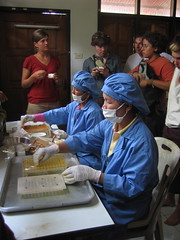
We were shown the hand press used to harvest various oils and watched as two women wearing hair coverings and latex gloves, filled capsules with turmeric powder. Medicines used to be made by rolling the ingredients into a honey ball, but because the network was working with Western trained doctors at the local hospitals, they had complied to Western standards.

This impressive whole systems approach led the network to take on the source of all the trouble and set up a fair trade rice co-op with its own mill to provide support for farmers to grow and sell organic rice as well as those transitioning to organic.

Fair Trade Closes The Loop

It was a Sunday when we visited the mill and sat under the blazing sun in plastic chairs while we awaited the arrival of the leader of the cooperative.


"Why have you come?" asked the silver haired farmer once settled on the shaded bench. "Are you farmers?" Peggy, sitting next to him, translated his challenging tone.

Having been so eagerly welcomed, elsewhere, as the auspicious farangs come to witness their humble farms, our group did not have a ready answer. We had only one farmer among us. Yes, who indeed were we, this oddly clothed, band of Westerners, traveling in the back of a truck. What impact did we hope to have on our lives by coming here? No one was going to hazard an answer. We must answer I felt. It would be impolite not to answer this village elder.

"We are eaters," I offered, taking the perspective of the book "The Omnivore's Dilemma". Peggy translated my answer and the farmer chuckled. He told us, then, how it all worked. That there were 1,000 family farms in the 17 year-old network. They sold overseas through GreenNet, a Thai organic wholesaler. After costs of running the mill, the profit was redistributed to the farmers.

"We got back what we invested, plus we made friends", the farmer told us. Now they concentrated on getting the word out through seminars at monthly meetings. The farmers in the network were also required to grow back the forest on some part of their land. With the price for organic rice rising by 5% a year, overall chemical use was decreasing in Thailand. Yay!

"Westerners brought chemicals to Thailand," he commented watching for our reaction. "Not that I'm blaming you," he added, smiling. Did we have any questions?

"Was he paid a salary to run the coop?" "Yes, but really only enough to buy laundry detergent," he replied.

"In all of his years of farming had he noticed change in the climate?" Oh, yes, yes what about that? I silently thanked Alicia for asking the question. Our nights had been cold, way too cold for Thailand. I had only packed lightweight clothes. Even wearing three shirts, two pairs of pants and a blanket wrapped around my head, that second night, sitting in the open dining area, I had not been able to feel warm. I had felt angry and betrayed by my own country. Peggy and Jo sent out for more blankets. Luckily, I had a nylon sleeping sack with me that kept me warm through the night.

"Yes," said the farmer, "sometimes we have three seasons in one day. The hot season is hotter with less rain and when the rain does come, it comes all at once. There was lightning where there hadn't been before; trees had fallen and people had been killed by lightning because they didn't expect it." We were subdued by this report of such radical change. Nobody asked about the future prospects given this report. What could anyone do about that which was unexpected? I hadn't anymore thought for the future than what was for lunch.

We were soon invited to proceed to the lunch pavilion where we were served more variations of vegetarian fare and were delighted to see omelet's. I had two helpings, not knowing that we would be offered another lunch of noodles in the village. I could hardly walk after that. My status as an "eater" had been stretched to the limit.

Also posted at energy bulletin

Labels: , , , , , , ,

Earthworm. Get yours at bighugelabs.com