Amanda Kovattana

Middle-aged musings in interesting times

Saturday, July 26, 2008

Urbanites In The Edible Forest

Part six in a series of stories from my road trip in Thailand, participating in a study tour hosted by Pun Pun farms, to visit local examples of sustainable living in the Northeast and in Chiengmai.

The Education of the Not Sustainable
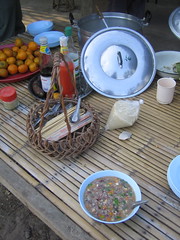
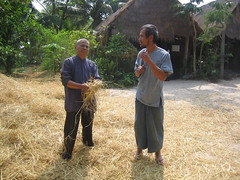
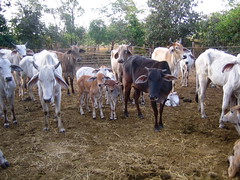
On our free day, before leaving Isaan, Jo invited us to go with him into his village. We had had our breakfast of vegetarian rice soup in soy milk and washed our dishes at the lineup of four basins, one of soapy water and three of rinse water leaving them to dry on the split bamboo drying platform. To keep the self-herding cows from wandering into the fenced off dining area, we pulled a long tree branch across the gateway. Jo walked with his 3 year-old-boy Than down the dirt road into the village. I followed close behind walking with Sasha one of the American year-abroad students studying at Chiengmai Univiersity.

"Throw that away it's dirty," Jo said to his bilingual son in Thai; Tahn had stopped to pick up a piece of plastic trash from the road. I recognized the word sockobroc meaning dirty, one of the few multi-syllable words in Thai.

"Yes it is," I replied, instinctively in Thai, remembering such conversations from my childhood. I asked Jo in English why he left his village. He told us how he had gone to Bangkok to live in the temple system and further his education at the University level. He shook his head.

"Farmers should not go to university," he said, "what is taught there is not sustainable. What good is it for a farmer to have an education if he is not taught how to be sustainable?" I glanced at Than wondering how this boy would be educated. I was certain that the American side of his family wouldn't see it that way. My own education had been a source of contention between my English mother and my Thai grandma; education was what determined the national allegiance of biracial children. I was one of the few to receive an English education. But not to aspire to higher education at all was iconoclastic for both nations. How did one become upwardly mobile without education? How did one have freedom of choice?

Yet I understood what Jo was saying. Perhaps an education was just another form of runaway consumerism training students to increase their needs and consume more resources in order to "succeed". What, indeed, was sustainable about it? What was progress for a Thai farmer if the use of modern agriculture meant endless debt and health problems from pesticide use? Those living in slums in the city would certainly be better off if they had been able to stay in the village.

"That would be like the Amish," I said. Jo didn't know about the Amish. I explained that they were farmers in America who did not educate their children beyond the 8th grade. "Hmm," he said, but did not ask me any questions.

Sasha and I began to walk faster, pulling ahead of Jo, to confide in each other that we couldn't agree with such a no higher education decree. It was too late for us. I was addicted to knowledge—to understanding how the world worked. Sasha, I would find out later, had been pre-med and after reading Michael Pollan's book, The Omnivore's Dilemma, had switched to agrobiology hoping to discover how the modern world could become sustainable. We both believed that we had to go forward in search of solutions through more education. We in the first world had gone so far into an unsustainable way of living that we had nothing to go back to; our built world of freeways and supermarkets made it impossible. I wondered if it had also made it impossible for our minds to grasp what we must do to live sustainable. So sure were we that technology would allow us to beat the limitations of natural resources.

The Pillow Village

My thoughts were interrupted with our arrival at a pillow-selling household. Jo's village made pillows, the traditional triangle pillow Thai people bought to lean against while sitting on the floor, also a popular tourist buy. A giant replica of such a pillow could be seen in the town centre. Throughout the village we had spotted individuals sitting by themselves stuffing kapok into the narrow channels of the pillow casing.
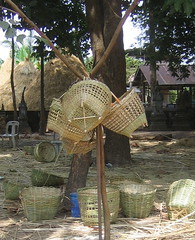
Pillows were not the only products made here. We next visited a carpenter who had built a roadside cafe in his front yard with furniture made from tree branches from fallen trees. His patrons had admired his rustic furniture so much he began selling his pieces and making more. At the local temple we came upon a group of men shaping long strips of bamboo into woven baskets to sell at an upcoming fair. There were baskets for different tasks including one for catching eel. In the days before plastic buckets, Jo explained, the villagers used latex from trees to make their baskets waterproof.

What an idyllic place to work, I noted looking up at the tall trees shading the group and the picturesque stupas in the background.

"If I lived in this village for a year do you think I could learn how to make all these baskets," I asked Jo.

"You could learn it in a month," he assured me.

Urbanites In The Edible Forest

To counter the damage left by conventional education, Jo and Peggy had, together, built a center to teach sustainable methods of farming and living to Thai people for free and to Westerners for enough money to support the endeavor. Originally envisioned as a seed saving center, the farm was named Pun Pun meaning a thousand varieties. It was just outside of Chiengmai, the northern capital of Thailand 8 hours by overnight bus from Issan.

Upon our arrival in Chiengmai, we stopped at a large local temple to eat a meal at the organic restaurant Peggy and Jo had helped start in order to create a market for the organic food they wanted to encourage farmers to grow. Surrounded by the white walls of the temple compound the local vegetarian dishes we were served were indeed heavenly—tarot root covered eggs, soups, spicy salads and flavored red rice.
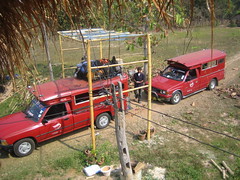
Another hour's travel by two bench pick-up truck and we arrived at Pun Pun nestled in the hills above a local village. At dinner that night it seemed as if our group had swelled to twice its size as the remaining interns joined us. My buddies and I were quiet as we took in all the new foreigners who had spent 10 weeks at the farm in the most comprehensive program Peggy and Jo had to offer.

It was through this internship that I had heard about the center several years ago. A friend of a friend had been raising funds so that she could attend their program. I was rather skeptical of the outfit, at first, and had pictured a poor village where eager young Americans would soon succumb to traveler's diarrhea. (I did not, on this trip, though we drank rain water stored in giant ceramic jars.) They had a website and over the years I watched as they developed their program. When they offered the sustainability tour I could finally fit in the time to come.

The farm had an odd effect on me. The terrain was familiar in a way that evoked my childhood yet it had a hippie flavor to it that was Western. As I walked along the dirt paths, from sleeping hut to dining pavilion, I kept wondering why I had not found such a place when I was young, but, of course, there was nothing like this offered in Thailand when I was the same age as these interns. Peggy and Jo had, themselves, only owned the land five years.

When they bought the farm, the land was rough and considered infertile having been clear cut of the original forest. Only grass and prickly weed grew there. There was no electricity or water. They lived at neighbors while developing the farm. This included digging ponds and planting banana trees for the moisture and organic matter, which they then used for mulch around fruit trees. It was two year before the bananas produced fruit. Now they were hanging in the pavilion for us to eat. They also grew papayas and melons and most of the food eaten at the farm.
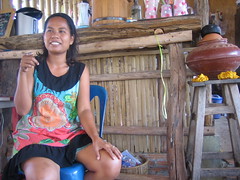
A woman named Yao, who had cooked for the farm, told us her story about how Jo hadn't given her any money to buy food to cook with and she realized that he expected her to forage for ingredients. She had had to reinvent dishes to use what vegetables were available and in season. Later she and her husband bought the land next door and she now teaches a cooking course there along with offering cheap lodgings to the backpacking crowd. She had specifically chosen to offer cheap lodgings because the clientele in this income bracket were so much friendlier and appreciative than the high-end client looking for services and amenities, she told us. The guesthouses were whimsical and charming adobe huts.

Yao had left a career in the film industry and an urban life to escape to this hilltop resort where the world would come to her in the form of travelers. I had never thought of it that way, having feared that a life in the country would isolate me. Her story told me a lot about how an urban Thai could change her stripes. The name of her guesthouse resort was You Sabai which means "stay in comfort" only the Thai word for comfort defies definition, evoking, for me, soft tropical breezes and not a care in the world. The view from the guesthouse cafe took in the lush green valley and reminded me of Kauai.

On the other side of the farm was another escapee from a conventional life. He was an American who had been a teenager when his parents brought him to Thailand to live while they took jobs teaching. Although he had not learned Thai as a teenager he had been fond enough of his experience to devise a way to come back and live here. He had persuaded 11 friends to help him buy his ten acres as a sort of timeshare. It had only taken $4,000 to get him started with Panya (means wisdom). We toured his organic garden, his building projects including a meeting hall and four composting toilets, his oversized pond that hadn't quite sealed properly and his kitchen with its cob oven. He looked like he needed a vacation. It was his ambition to develop a permaculture training center. He lived, he told us, with a sense of impermanence reflecting the changes in government policies regarding foreigners owning land in Thailand.

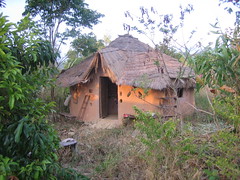
We also met Josh, from Oakland, who lived on Pun Pun part of the year and was looking for venture capital, the rest of the time, to fund his low tech water purification system. With the goal of helping local farmers filter out the incredible load of pesticides in their irrigation water, he had designed the system using readily available gravel, sand and charcoal contained in locally made cement water pipes, stacked to form tanks. The system ended with a small ultraviolet disinfection unit he had made himself. He was a chemical engineer so he knew what he was doing. I also noted that, unlike most of the interns, he kept a very tidy and organized hut. On the door was a sign posted saying it was the headquarters of Aqueous Solutions, his business name. It was the tiniest, sweetest adobe hut we had seen and had a sleeping loft under the thatched roof accessed by a ladder outside. Inside was a desk with a laptop, a chair, a bicycle and a mission. Really what more did one need?
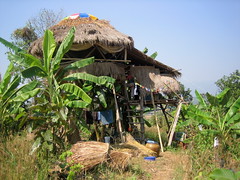
When I met the Dutch man with the feminine sounding name pronounced Michelle and spelled Michale, I had no reasonable answer when he asked me why I, too, was not living like this in Thailand. We had been invited up to his circular bamboo home, of his own design, built on stilts at the bottom of the You Sabai guesthouse land. With a colorful giant golfing umbrella covering the top of the roof, it evoked the Robinson Crusoe house at Disneyland.

Michale had also lived in the States for several years, but he found the people to be rather unenlightened and the onus of a failing empire to be cumbersome, so he had taken up his travels until he came to You Sabai and built his house. He intended to stay permanently. My mind sea-sawed between the beach hut vision of his silly house and the middle class encumbrances of mine, now equipped with a giant flat screen TV Catherine had bought the night before I left. Was I, like Jo and Peggy, going to have to have both? Our sustainable efforts in Thailand to be canceled out by the air miles to get to and from the US? What if we are frozen in one place or the other by gasoline shortages, I asked Peggy who traveled every year with Jo and Than to Colorado. She didn't have an answer.

This question of fossil fuel use plagued me. All of us had traveled many air miles to get to Pun Pun, many planned to continue traveling extensively throughout Asia, yet we were all wishing to live more sustainably. How could we justify this? Finally I came to see it this way. We, who were so privileged, had an allotment of oil accessible to us. Most would squander it before being forced to give it up. We, at least, had used it to expand our ability to envision a sustainable lifestyle. Those on the tour had lived for these 12 days in a way most travelers seldom experienced (and I haven't even reported on that contentious topic of American travelers—the toilets). I now understood in a profound way what it meant to live in harmony with the earth. It was a way that all the green effort of high tech living couldn't even begin to touch.

Next week I visit Peggy and Jo in their American home, a family compound of green buildings they have constructed themselves and will see, for myself, how their vision translates to the first world.

Also posted at the energy bulletin

Labels: , , , ,

Saturday, May 17, 2008

Dammed, Displaced and Democratized

Part five in a series of stories from my road trip in Thailand, participating in a study tour hosted by Pun Pun farms, to visit local examples of sustainable living in the Northeast and in Chiengmai.

Self Reliance and the Earthen Building Movement

As founder of the earthen building movement in Thailand, our tour leader Jo Jandai had contributed much to the concept of living sustainably. As a farm boy he grew up believing, as others did, that his future prospects lay in getting more education and finding work in the city. His epiphany came after seven years of living in Bangkok working everyday and barely making ends meet. What kind of a life is this? he asked himself. He was not an engine. Jo then returned to his family farm with the intention of becoming self-reliant. This was a man after my own heart for I, too, thought self-reliance was preferable to dependence on money.

For me this meant being able to cook, garden, sew my own clothes and fix the house I was living in. I even enrolled in a two-semester construction technology class to learn carpentry, electricity, sheet rock installation, roofing and plumbing. Once I saw what was beneath the sheet rock, I realized that our homes were really just a clever illusion of comfort—a stage set of thin materials propped up with sticks. This badly insulated, leaky box then had to be heated using fossil fuels piped over long distances or air-conditioned with electric power at peak hours. Building materials were manufactured and trucked from far away while the building industry itself was one of the largest generators of garbage. And it was all so unnecessarily expensive. People were made slaves to their mortgage.

I was already enamored of straw bale buildings, which used local agricultural waste straw to create massive walls that would moderate interior temperatures. A few years later, I explored my interest in natural building by taking a cob building workshop, a close cousin to adobe. I collected books on tiny houses and lulled myself to sleep engineering in my mind structures made from available materials.

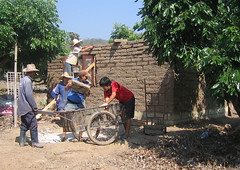
Jo had a head start building a real house on his family farm. It was made of bamboo, a readily available building material. Then, on a trip to the US, Jo happened to visit a pueblo in New Mexico and was struck by the cool temperatures inside the building relative to the hot dry climate outside. His home in Isaan had a similar climate. After studying the pueblo ruins and seeing how the adobe bricks were put together, he came back to his farm and began experimenting with building his own adobe house using a wood frame to make bricks. Transporting wood poles on his bicycle for the roof, he had a house built in three months, working only two hours a day. "This is so easy," he said to himself, marveling at this discovery of self-reliance. Better yet his house was virtually free while a concrete house, which is what his neighbors aspired to build, cost $15,000 baht. His neighbors came to watch and laugh at this folly of this crazy man building a house from mud.

The Principle of Easy

I too, was struck by how easy it was. After a week at my cob workshop pressing the mud and straw mixture together with my thumbs we only had a wall that was thigh high. With adobe bricks a house could be finished in a few days. It didn't seem right, yet it still had the same insulating qualities as cob or straw bale, was made from the surrounding earth and could be finished with sculptured decorations just like cob.

Making things easy, I realized, was the mantra of being Thai. All this time I had felt that this was our downfall—that the reason the Chinese did so well in business was because they were willing to work harder than the Thais. Challenged by the Chinese heritage of my Bangkok family, I had felt delinquent claiming to be Thai as if I were announcing that I had no plans to succeed. My American peers compounded this feeling by working hard to achieve "goals". I fended off such expectations and firmly claimed to be a Slacker. Secretly, I worked quite diligently on the projects I was interested in—hobbies they were called by others.

Jo told us, he had so much free time after learning to build his own house and grow his food organically that he started a children's group, a singles group and a library. He also had time to reflect and enjoy the beauty in life. He was not, however, considered a catch by the local village girls.

"No Thai girl would date me because I don't have a motorcycle," he said smiling. He didn't say it, but we could see that this was why he ended up dating farang girls and marrying Peggy, now sitting next to him as he told his story the first day of our study trip. Peggy had come to Thailand to work with the urban poor, but then decided to back up a bit and work with the rural poor before they ended up in the city.

"But how did you end up going to New Mexico?" I asked him in private. Poor Thai farm boys do not usually travel so far from home just to see the sites.

"My ex-wife wanted me to go because she live there," he explained. Ah yes, I nodded, "so another door opens". I did not want to pry further after the motivations of this ex-wife though I was interested in every farang's story who chose to spend time in Thailand. And besides it would be poor form with Peggy just a few yards away.

Jo's fame as an innovative builder came about in a similar circuitous way. First his neighbors had to experience the earth building for themselves. This they would do through another enterprise of self-reliance on Jo's part. After learning to make his own soap and shampoo, he organized a co-op to make and sell these products. This led to the need for a store in which to sell them in the village. Jo built the store and when customers came inside to shop they too experienced how cool it was inside the little earthen building. Soon other families ventured to make their own houses out of mud.

A Thai nun writing for a magazine discovered the adobe houses and published a story about Jo and his Baan Din, or "houses of earth". He became sought after by the public to help others build their houses. Over the course of three years he traveled all over Thailand helping to build some 300 houses for free.

Dammed, Displaced and Democratized

Half way through our two-week tour we packed our bags, loaded them onto the truck and said good-bye to Jo's family farm. Jo, Peggy and their little boy Tahn came with us to escort us to their northern home in the hills of Chiengmai, but first we would stop at a mountain community that had formed in the wake of a ten-year protest.

I had read about the protest and had been intrigued by this band of villagers that had set up camp on the lawn of the elegant parliament building in Bangkok. The villagers had lost their homes due to a large dam project (funded by the World Bank) flooding their land. The protest attracted others including displaced slum occupants, workers harmed in the workplace, prostitutes, those protesting encroachment on the forests and a large group called The Assembly of the Poor. For ten years, on and off, the groups protested until finally Thaksin, who had become Prime Minister at that time, undermined the Assembly of the Poor by giving the key leaders well paid jobs on various government committees. To those displaced by the dam he offered a piece of land that he then said they had to buy with a loan of 4 million baht from the government. Already in debt from so many years of protest, the villagers accepted the land hoping the government wouldn't come asking for the money.

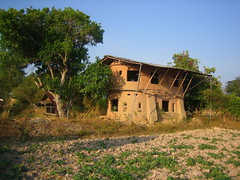
The resulting settlement was by far the most famous site of earthen houses we would visit, boasting its own road sign. Both Jo and Janell, also traveling with us, had been part of the international group that had helped the villagers build their own houses, install solar panels, build a school and another beautiful community building. Located high atop a mountain ridge, the open land of tall grass partly obscured the pink and yellow earth tones of the buildings. Mun Yeun, as it was called, had the air of a resort during the off-season. We pulled our bags off the roof of the truck and carried them to the schoolroom where we would later sleep elbow to elbow.

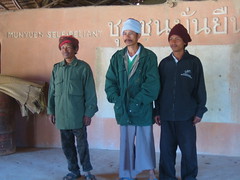
After a brief tour of the area, we assembled in the schoolhouse to hear what the three founding members of the village had to say. It soon became apparent that something was wrong with this picture. Of the 35 families that agreed to buy the land from the government, only nine were actually able to move here and only three remained. When we asked why, the men told us the families had gone to find work to pay off their debts.

So this is what democratic protest gets you, I pondered to myself, the right to protest, but not the right to be?

My fellow travelers offered suggestions, wanting to solve the problems facing the three founders. Martin, our practical minded chicken farmer, asked if they could grow cash crops. They had not been able to, they told us, but if they did they feared that the government would start asking them to pay off the 4 million baht debt.

Someone else asked if the King could step in. We knew the king to be a just man and an advocate of self-sufficiency, but no he had no such power to help them. He was only a figurehead.

"What about the government that supports self-sufficiency," asked Jen referring to the talk we had heard at the Santi Asoke center about how the government banks had wanted farmers to take the training in self-sufficiency before taking out a loan.

"No government wants self-sufficiency" I said bitterly. Jo agreed. It was all a manipulation to get poor people to work for rich people. The earlier promotion of self-sufficiency, after the financial collapse, had been an act of self-preservation to keep the banking system from going under, I realized. I was filled with despair that no one wanted these villagers where they were; they were just in the way of progress.

"Maybe they are a tourist attraction for travelers to witness the impact of globalization," I said quietly.


Jo did not translate this sentiment, just vocalized an agreement. Janell, who was sitting next to me, did not offer a sassy comeback. She was silent, possibly absorbed in her own thoughts of the project she had directed. Except for a few houses and a carport, these beautiful buildings were now largely abandoned.


Would people choose industrial progress if they knew the cost? How well I understood the need for massive dams to provide electricity to an industrialized city eager to power its consumer lifestyle. The dam in question would provide enough power for one shopping mall in Bangkok. Back home in the States ever-expanding server farms (computers supporting the Internet), were being built as close to dams as possible for the cheap electricity rates of clean hydropower. There was no end to our need for more power once started.

The villagers had been told the dam would help them irrigate their land, but that obviously was not the case as the plan was to flood their land altogether. The men implied that, had they known what was to come, they would have protested sooner.

"Ten years was a long time to protest. What kept you going?" I asked. This seemed to strike them as a silly question and they laughed at the mention of the ten years.

"There were a lot of issues needing to be discussed," one said simply.

I was trying to find the point to it all—the point of democracy and progress. This land was not theirs, it could be taken away for development into a resort for city people, the government wanted money and the land needed to be maintained to protect it from fire, but there weren't enough people to keep the fire breaks clear. The villagers had not been in agreement about the communal vision necessary to protect themselves from larger economic forces. Many had wanted to subdivide the land and go their own way with it, sell it even. I was frustrated by this failed vision and asked why they continued with it.

"They are just trying to survive," Jo explained. My thoughts were arrested midstream as I realized how bourgeois was my need for meaning and purpose. I, who could go home after a day of protest, had the luxury of righteous principle. Surviving meant continuing to try whatever might work. At the moment the three men were planting trees. They had been a forest people and even though they did not know the trees in the area, they knew how to cultivate a forest. The government officials came by, saw the plantings and did not ask for money. They just told the villagers to keep records of what they were planting. This was seen as hopeful. The villagers knew that the government were, now, wanting to grow back the forest, which would justify leaving them be. Meanwhile the protests had caused so much controversy that none of the other proposed dams were being built.

Dimly I began to understand that perhaps there was an optimum vision here. We learned more about their projects to reforest; how they were teaching their neighbors the value of leaving the land undeveloped. They were offering the investment of a cow in a sort of community supported beef supply that gave back in manure and offspring. Montaine asked what chore we could do to help them out. Thus our group spent the next morning raking manure in the cow pen into a big pile.


As we packed up to leave, a group sat down near me to sign the large guest book. Erin our Australian student was chosen to scribe since she had the best handwriting.

"What shall we write?" Sasha, our American student asked.

"Good luck," I suggested cynically, "We landless server farmers promise we won't build any more dams." Needless to say this was not considered a serious suggestion, but they acknowledged my declaration of guilt with respectful silence.

"What about this?" said Irena eagerly, "May the forest give back a hundred fold what you put into it."

"Oh that is so nice," I said sincerely, then laughed at the whiff of sarcasm I barely managed to pull back. Ah youthful optimism. The others agreed and Erin wrote it down.

Labels: , , , , ,

Saturday, March 22, 2008

Righteous Protests or Religious Fanatics?

Part four in a series of stories from my road trip in Thailand, participating in a study tour hosted by Pun Pun farms, to visit local examples of sustainable living in the Northeast and in Chiengmai.

When I mentioned the Santi Asoke Buddhist group to my Aunty Ah Padt, she expelled air through her closed lips making a sound, which I interpreted to mean "what a joke that group". I would have expected a similar reaction from a Republican upon the mention of Al Gore, but not from my Ah Padt, a practicing Buddhist. Still she was a Bangkok businesswoman and held the decidedly non-sustainable, pro-growth values of business people the world over. The Santi Asoke group had apparently gone too far.

Newsweek too, in a recent article on Buddhist political activism, characterized the Santi Asoke sect as an "ultraconservative" fundamentalist religious group that had organized political protests against the Thaksin administration. The emphasis was not on Thaksin, where it should have been, but on the potential for these religious protests to lead to violent uprisings. My fears of a perceived communist threat were outdated. I had forgotten that George W. had redefined the new threat to world peace as one that would come from religious fanatics usually identified as Muslim terrorists. Now Newsweek was comparing Buddhist protests to Muslim fundamentalists. This blatant bias irked me.


Back on our two-bench truck, our tour group of 16 Westerners in search of examples of sustainable lifestyles, drove for several hours towards the Laotian border to visit one of the largest branches of the Santi Asoke network, in the province of Ratchatani. At least the road was good. That much the government had managed to do, the better to rush raw materials and food to Bangkok.


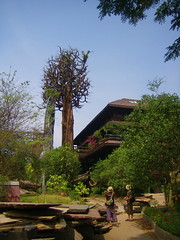
We arrived in a large park like compound where we could see, looming over us, extraordinary wooden buildings and what looked like a very tall tree with strangely twisting branches at the top forming a sphere. We hopped out, excited to explore such interesting examples of Thai architecture and were greeted by a woman with bobbed hair wearing a blue denim coat faded to a stonewashed blue.

A Santi Asoke Intentional Community


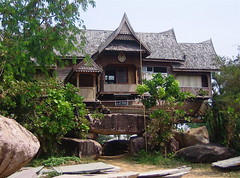
"Would you like to eat first or see the grounds first?" she asked us. Food could wait. We were eager to know the stories behind these buildings. One had the characteristic upturned roofline of Thai design, but was grafted onto a boat. This, our guide told us, was to put to use the retired rice barges that had once plied the rivers to Bangkok, but had now given way to a faster trucking system. Ah, we mused, so this was not a whimsical vision of a new spiritual order, but simply an example of creative reuse. To add to the mystical vision of airborne arc, the hybrid building was propped up into the air so high you could walk under it. This we learned later was a land that was flooded three to four months of the year.

Flooding was probably why the original plot of land had been donated to the sect. Twenty monks came to live on it, supported by food brought to them by the local farmers. Six women joined them and soon more people came seeking to live by the principles of voluntary simplicity and the communal work ethic that the group espoused. The network had also implemented some of E. F. Schumacher's ideas. Asoke sympathizers had translated the chapter on Buddhist economics from his book Small is Beautiful:Economics As If People Mattered.

Jo, acting as our translator, pointed out that the first to come were educated middle class Thais, especially teachers whose salaries were not going to cut it after the currency collapse. They were followed by farmers in debt. The economic collapse would swell their numbers to 300 members. Schools were created for the children and workshops given to the adults in self-sufficiency and organic farming.

We were served a vegetarian lunch in a large hall and shown a documentary film of the group on their giant flat screen TV. Though they did all wear the blue farmer's outfit that so reminded me of communist workers' cooperatives, they were not the extremist fundamentalists Newsweek would make them out to be. They still only followed the five precepts and ate two meals a day together, not the eight precepts as Newsweek described. And since when did abstaining from sex and eating only one meal a day constitute religious fanaticism especially in a Buddhist sect, I ask you?

While I was there, I did manage to break one of their rules by catching an afternoon nap while everyone shopped and if they had made note that I was a woman wearing shorts (but not too short) that would have been two, but these rules felt more like guidelines than fanatic beliefs. Nobody looked at me with disapproval. And when I forgot my jacket, one of the members retrieved it for me, while another asked if it was made in Thailand. Yes it was, because I am rather fond of the clever simplicity of those farmer's jackets and was wearing one that day with another short sleeve one underneath.


As we toured the center we were shown the organic vegetable garden and the recycle center where hand lettered signs in Thai and English described over twenty categories of materials including plastic bags which were washed and dried for reuse. The community made enough money from selling recyclables to fund their educational cable TV channel.


We also discovered that the intriguing three story high trees were actually sculptures, made by a local artist, from cement. The bark texture was impressively real. I asked the reason for these tree sculptures. The oddly simple answer was that they gave visitors something to see. Yes, Thai people liked to go to parks and see something manmade and the group often invited the townspeople to come to the community for special occasions such as the King's birthday. Lots of food and community made products were given away in an effort to spread their philosophy of self-sufficiency and meritism.

Protests and Engaged Buddhism

The real crime that the Santi Asoke group founder had committed, as I read later in the Christian Science Monitor, was to claim that the lax practices of the Thai monastery system had fostered materialism and corruption within. Unable to come to a resolution on this matter, the Santi Asoke leader had then formed his own sect. The military government of the day, fearing for their own relationship with the religious order most likely, had not allowed the new sect to register under the monastery system, thus reporters could later say that they were a rogue group of fundamentalist fanatics. That the group of Santi Asoke protesters chose the name the Dharma Army was an unfortunate PR choice that implied that they actually had arms and were not, as the word "dharma" would imply to a Buddhist, a group devoted to peaceful protests.

What the good liberal American reader brings to the mix is a healthy distrust of religious groups getting involved with politics. But much like the Baptist church in the American south, the Thai temple serves as a community center and is often the only place where a village can assemble and organize themselves against injustice, with the help of the most educated leaders of the community—the monks.

"But how are they related to the military," I asked Jo. After all, Thaksin had been ousted by a military coup, but I had never discovered how that came about. It had been one of my goals to find out during my trip.

"They are not related", he told me and explained to me that the Santi Asoke group had not staged a political protest. They were protesting on moral grounds, that's why it could be justified under the principles of Buddhism, which included practicing social justice. This I could understand, having discussed, among American Buddhists at home, whether anti-war protests could be considered a practice of Engaged Buddhism.

The military had stepped in fearing general unrest, he told me.

And what was their agenda? I asked.

Corruption, of course. Suddenly I saw how it worked. The military controlled government did not want the country in turmoil because that would cut into their nicely set up system of kick backs that was entrenched in an orderly, but corrupt government system. Nor would they want Thaksin privatizing everything, as prescribed by the prevailing forces of globalization, because that would take away the whole shooting match. That the Newsweek reporters could so glibly exploit the details of the Santi Asoke protest struck me as so unfair. Could it be that their issues of social justice did not fit into the story the United States was telling itself about the threat of armed revolt from People Who Hate Our Freedoms which then forces us into military intervention and everlasting war?

Everywhere in the world, grassroots movements were solidifying a response to the impact of globalization, but this trend was going unreported. Sustainability in itself was not worthy of discussion. And of course sustainable business practices, as modeled by groups like the Santi Asoke sect, was a threat to the prevailing mantra of ever more growth and profit.

We drove back into town and stopped at a store, one of the many that had been opened by the Santi Asoke group. It was about the size of a 7 Eleven and was stocked with the products made by the industrious members of the community. We filed in and perused the shampoos, herbal remedies and the implements needed to use them. I loaded up on bars of soap with exotic ingredients—radish, tamarind, tomato, garlic, ginger and citrus, plus a bottle of passion fruit juice which I downed on the spot.

The Final Analysis


When I showed my 89-year-old Aunty Lily my pictures of the tour, it transformed her opinion of me. I became someone with values that she and my grandmother, too, would have shared.

"You have done much good by going on this tour," she said, implying that I had accumulated good merit. I hadn't expected such a response just for being a witness to acts benefiting society. Aunty Lily had been a businesswoman too, in her day, but she had a sense of justice that I had come to count on. She asked me to show the pictures to her Wednesday lunch companions, a doctor and a teacher. Both knew all about the Santi Asoke group. The teacher told me she had a friend—a dentist who offered his services to the group as part of his merit making. I was relieved that they considered the Santi Asoke people to be worthwhile. After Ah Padt's reaction I was beginning to wonder if what I had seen was recognized by the general Thai population for the good they were doing or if the Thais, too, considered them inherently suspect.


The final analysis may not yet be in. Reactions to the return of Thaksin were also mixed. I was still in Thailand at the time and saw his smiling mug on the cover of magazines as he was joyfully welcomed by his supporters. Newsweek had described him as a populist leader, but his economic policies known as "Thaksinomics", which included a 3-year moratorium on farmers' debts, were not meant to encourage sustainability since he had also ordered state banks to aggressively extend more loans to the same poor farmers and villagers. His mega projects for Thailand's infrastructure would run up a bill of $50 billion, while his "populist" policies for healthcare and education were under funded. Now he would face trial for his crimes of abuse of power, tax evasion, cases of fraud, loans to Burma that indirectly benefited his telecom business and illegal bidding on a state contract involving 90 million rubber saplings (for expansion of rubber plantations to the North and Northeast—home of above farmers).

"What about democracy?" I had asked Jo. "It didn't look good to the world when the military coup took away democracy", I added. I had taken this failure of my home country to hang onto democracy as a personal slight that made Thais look backward. A military coup was just so old school.

"There is no democracy," Jo answered testily, "there is only money." I couldn't argue with that.

Also posted at energy bulletin

Labels: , , , , ,

Thursday, March 13, 2008

Healing The Farmer, Healing The Land

Part three in a series of stories from my road trip in Thailand, participating in a study tour hosted by Pun Pun farms, to visit local examples of sustainable living in the Northeast and in Chiengmai.

The Search for a Ripe Watermelon

If you eat more than one chemically grown watermelon you will get diarrhea, we learned from the organic watermelon farmer. Fourteen such melons had killed an elephant, he added. Poor thing. With such stories I was surprised that more Thai people were not making the connection. True, not all fruit were so heavy on the chemicals; none at all in bananas and coconuts, some in pineapples and oranges, but watermelons were clearly the most afflicted.

Organic produce did not yet have the market clout and high prices that were being enjoyed in the States. In fact, sales were poor because the organic watermelon had to compete with the larger, more regularly shaped conventionally grown melon and it took 10 days more to ripen.


Watermelons were a secondary crop sown after the rice crop was harvested. It was so simple to grow, a child could do it, said the teacher at the Santi Asoke training center. The problem was pests for which they recommended three strategies. 1) Avoid mono cropping and use small plots with a variety of crops. 2) Chase away the pests. 3) If pests still persist then let them eat because, after all, humans can grow food and pests cannot. This last recommendation undid any notion I might have had that fighting pests was a battle to be fought to the death and won. How enlightened. They also recommended picking the worm-infested fruit, to ferment in molasses, to make a fertilizer called EM—effective microorganisms—a method learned from the Japanese.


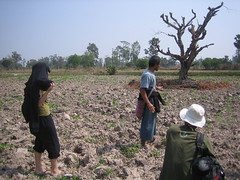
As we picked our way along the dikes of the rice paddies, the watermelon farmer followed our progress with a digital movie camera to show his organic farmer's co-op. Thai organic farmers were not getting a lot of attention from anyone and the gaze of Westerners would elevate their cause. There were no ripe watermelons; he had just sent a truckload to market. Finally at the third field, he found some that would do and cut two open for us on the spot.

We happily ate this clean fruit without fearing for our stomachs. It was sweet and refreshing. In fact all the food we would eat on this trip felt pure and fresh. That it was grown on the spot gave me a deep sense of connection to the land. We were traveling locavores eating within a few yards of where our food was grown. There was no need to think beyond this tidy closed loop; I felt complete and secure. I ate more fruit than I did at home—oranges, papaya, bananas and star fruit, all with no ill effects.


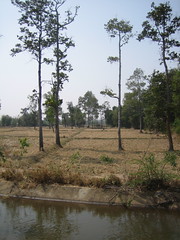
Walking from farm to farm in Jo's village, I gazed at the strange dry land with its grey white soil and tried to decide if it could be described as beautiful. Not at first, because I didn't know what I was looking at. Unlike an Italian countryside with its vineyards or an English one with its rolling green hills, both instantly recognizable as the stuff of travel brochures, this surreal flat, brownness had to grow on me. Height helped. There. In the next paddy. Very tall thin trees in a grid pattern with topknots of foliage like a Dr. Seuss illustration. That pleased my eye.


Back on the road our daily expeditions were punctuated by pit stops at roadside 7 Elevens, along the highway. All 16 of us would peruse the shelves of the multinational franchise and come out loaded with packaged snacks, buying enough to share with each other, the exotic tastes of peppered beef flavored potato chips made by Lay's, sweet sesame cookies made locally or the horrible fish flavored cracker that tasted like, well, fish food. I satisfied my craving for processed sugar with chocolate covered Japanese Poco sticks.

Healing The Farmer

For most of the farmers we met, it was their health that had turned them towards organic farming. At first they didn't know why they had the symptoms they did. Then it was discovered that the rat pee was toxic; rats living in the field were expelling concentrated chemicals into the waters of the field, which in turn gave the farmers intense rashes on their legs. They were also plagued by headaches and fatigue. Those who had ditched chemicals were convinced that soon every farmer would realize the connection and return to organic farming methods.

"People cannot learn without suffering," Jo said. The economic collapse had helped to create more such suffering, increasing the number of people deciding to take the healing path of self-sufficiency and organic farming.


Standing in a lush plot of edible forest, we heard the story of one such man who had owned a successful trucking company. As the economy collapsed, he found himself in extreme debt, with the bank repossessing all but one of his trucks. He came back to the country and with his remaining cash bought a two-acre piece of barren land that nobody wanted. He too had taken the training with the Santi Asoke Buddhist sect, reduced his expenses to almost nothing, and in three months was able to produce enough food on his plot to feed his family.

We ate tart fruit from his trees and listened to how he had started his garden by covering the plot with straw waist high. He then dug a hole in the straw and made compost. Into this hole he planted a banana tree surrounded by vegetables. What they didn't eat, he sold at the market. He began to grow wild vegetables that nobody had bothered to cultivate before because they had been so easy to find in the forest. Soon he was making 100 baht a week.

"But that's only about three dollars," I commented. Yes, but it was enough to pay off his debts, Jo emphasized, because he had no expenses. I was beginning to feel as though I was in an alternative universe of tiny efforts that magically managed to turn people's lives around. Now he and his tiny wife were digging wells on the plot by hand. We looked down the fifteen feet or so and marveled. The water from the well would be used to produce limes in the dry season when the price was higher. Later we met the couple helping out at another site.

As we sat before them in a covered meeting space, the two beamed at us and the farmer told us about his current project digging a rice paddy there at the demonstration plot we were visiting, also created by the Santi Asoke group. Within view was the nearby University where ag students were being taught that chemical farming was the only way to grow anything in this arid land. The ag department was, incidentally, funded by chemical companies. At the Santi Asoke plot students learned first hand what organic farming could do. Some were even living in the earthen houses they had helped to build. They were beginning to ask questions.

It was not so long ago that chemical agriculture had been introduced to Thailand. Because of the government-induced deforestation during the '70s, farmers who had previously grown their vegetables in the forest had little idea of how to feed the barren soil once the trees were cleared. Enter the chemical company reps who dazzled farmers with the benefits of manmade fertilizers. The farmer's ego swelled with pride at the greenness of his rice crop. No one informed him of the downside. Nor did the farmers calculate their costs versus profit. They simply looked at the extra cash they were making with each harvest, not realizing that every year they had to buy and apply more chemicals than they had used the year before. By the time of the economic collapse they were 95% in debt. (Insert sex trade story here for this is the region where most of the women in the Bangkok sex trade come from.) Now with the cost of fertilizer following the price of oil, more were considering going organic.

Concern for the farmer's health had also opened the door to a revival of herbal medicines and the use of antioxidants to clean the blood of pesticide residue. Off we went to visit the herbal medicine co-op. Located within the grounds of a temple, the founders had persuaded local medicine men to reveal the ingredients of their secret remedies for the common cold, ulcers, hemorrhoids, back pain, and diabetes.

Each May the network would go into the forest to collect the medicinal herbs. Realizing that the forests were fast disappearing, the temple asked their worshippers to bring tree saplings instead of the usual cellophane wrapped offering plates (full of canned foods and hand towels folded into animal shapes). They also had help from non-government organizations and were able to open a health center. Now, they had a seed saving operation. 80% of their ingredients were grown locally.


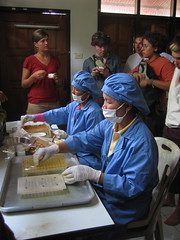
We were shown the hand press used to harvest various oils and watched as two women wearing hair coverings and latex gloves, filled capsules with turmeric powder. Medicines used to be made by rolling the ingredients into a honey ball, but because the network was working with Western trained doctors at the local hospitals, they had complied to Western standards.

This impressive whole systems approach led the network to take on the source of all the trouble and set up a fair trade rice co-op with its own mill to provide support for farmers to grow and sell organic rice as well as those transitioning to organic.

Fair Trade Closes The Loop

It was a Sunday when we visited the mill and sat under the blazing sun in plastic chairs while we awaited the arrival of the leader of the cooperative.


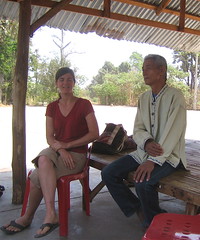
"Why have you come?" asked the silver haired farmer once settled on the shaded bench. "Are you farmers?" Peggy, sitting next to him, translated his challenging tone.

Having been so eagerly welcomed, elsewhere, as the auspicious farangs come to witness their humble farms, our group did not have a ready answer. We had only one farmer among us. Yes, who indeed were we, this oddly clothed, band of Westerners, traveling in the back of a truck. What impact did we hope to have on our lives by coming here? No one was going to hazard an answer. We must answer I felt. It would be impolite not to answer this village elder.

"We are eaters," I offered, taking the perspective of the book "The Omnivore's Dilemma". Peggy translated my answer and the farmer chuckled. He told us, then, how it all worked. That there were 1,000 family farms in the 17 year-old network. They sold overseas through GreenNet, a Thai organic wholesaler. After costs of running the mill, the profit was redistributed to the farmers.

"We got back what we invested, plus we made friends", the farmer told us. Now they concentrated on getting the word out through seminars at monthly meetings. The farmers in the network were also required to grow back the forest on some part of their land. With the price for organic rice rising by 5% a year, overall chemical use was decreasing in Thailand. Yay!

"Westerners brought chemicals to Thailand," he commented watching for our reaction. "Not that I'm blaming you," he added, smiling. Did we have any questions?

"Was he paid a salary to run the coop?" "Yes, but really only enough to buy laundry detergent," he replied.

"In all of his years of farming had he noticed change in the climate?" Oh, yes, yes what about that? I silently thanked Alicia for asking the question. Our nights had been cold, way too cold for Thailand. I had only packed lightweight clothes. Even wearing three shirts, two pairs of pants and a blanket wrapped around my head, that second night, sitting in the open dining area, I had not been able to feel warm. I had felt angry and betrayed by my own country. Peggy and Jo sent out for more blankets. Luckily, I had a nylon sleeping sack with me that kept me warm through the night.

"Yes," said the farmer, "sometimes we have three seasons in one day. The hot season is hotter with less rain and when the rain does come, it comes all at once. There was lightning where there hadn't been before; trees had fallen and people had been killed by lightning because they didn't expect it." We were subdued by this report of such radical change. Nobody asked about the future prospects given this report. What could anyone do about that which was unexpected? I hadn't anymore thought for the future than what was for lunch.

We were soon invited to proceed to the lunch pavilion where we were served more variations of vegetarian fare and were delighted to see omelet's. I had two helpings, not knowing that we would be offered another lunch of noodles in the village. I could hardly walk after that. My status as an "eater" had been stretched to the limit.

Also posted at energy bulletin

Labels: , , , , , , ,

Friday, March 07, 2008

Last Economy Standing

Part two in a series of stories from my road trip in Thailand, participating in a study tour hosted by Pun Pun farms, to visit local examples of sustainable living in the Northeast and in Chiengmai.

"So how did you fall so far from the mainstream consumerist path?" I asked Irena on our long bus ride. She told me how she had, as a child, lived on a farm that her family had tried to start, but it was too hard to make a living farming organically.

"Oh so they were part of the back-to-the-land movement," I said. She agreed. We were talking second generation here. Her parents had already chosen an alternative to the consumerist lifestyle.

As I met others on the tour from the youngest college students, including Sasha who was doing her year abroad at Chiengmai University, to the gray haired man in the floral print pants, named Montaine, whom I quickly realized was gay, I would find that each had their own story of how they had veered from the consumerist lifestyle and now found themselves on a similar quest to heal the world through sustainable living practices. The tour was, after all, called simply the Sustainability Tour.

Since we had arrived so late, we got the last two sleeping spaces. I chose to settle on the back porch of one of the larger adobe houses where a pink mosquito net and futon mat awaited me. Martin who was sharing the space with me, reminded me that we had already chatted on the internet when I was searching for a traveling companion. I was comforted by this previous allegiance. He was from Belgium and was the only actual farmer among us. He invited me to share his roll of toilet paper.

At three in the morning I was woken by what sounded like an amplified band of street musicians singing a ballad. It was a mysterious sound that seemed to move as if on the back of a pickup truck, but never came any closer. Having changed time zones by 15 hours, I felt alert and awake and used the time to write. After an hour or so there was the sound of temple bells and then quiet. At dawn I looked through the twin arched windows of the adobe wall and saw the sun rising over a large lily covered pond.

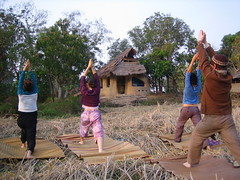
The house, I was staying in, was built along the back edge of a dry rice paddy. I picked my way over the cut brown stalks to the road and walked to the dining pavilion. Just beyond the pavilion, in another rice paddy, we would assemble on mats for a yoga session. This was definitely not Thai—this yoga, on mats, facing another earthen house. This one was more hobbit like with an assortment of asymmetrical windows and a shaggy thatched roof of long dry leaves. The roof was Thai—coconut palms possibly.


At the back corner of the field were Thai people milling about doing chores under a large tin roof, preparing breakfast for us I realized later. I felt them being amused by the funny postures we were assuming. Peggy, the American wife of Jo who owned the farm, was leading a brisk session followed by a brief meditation. Breakfast wasn't exactly Thai either—these boiled yams eaten in a bowl of blue gray soy milk, but eat it I did.

Martin stood beside me making coffee from hot water dispensed from a large insulated thermos. I asked what kind of farming he did. He said picturesquely, "I have man chicken and woman chicken on the same floor and they fertilize the egg, then I sell egg to the hatchery." At every farm we visited he would kneel at the edge of the rice paddy, pick up a handful of soil and sniff it. So I did the same. The soil in this dry landscape was nearly white and did not smell of much in the way of organic matter.

"It's so sandy," I commented to Peggy.

"It's terrible soil," she said laughing.

This is the soil of land cleared of trees. In the 50s, the government had feared that communist insurgents from nearby Laos and Vietnam were hiding in the forest so they had offered the locals titles to the forest land if they promised to clear it and cultivate it. Cash crops ensued and more land was cleared. And, of course, the teak trees were also a cash crop.

The Joys of Subsistent Farming

The region was so dry it only produced one crop of rice a year instead of three, just enough to feed the family with a little left over to sell. This was what we, in the West, call subsistent farming. Jo didn't seem to think there was anything wrong with that. The way he told it this was the land of abundance. Heck, you only had to work for two months of the year to bring the rice in and the rest of the time was your own, he told us. Compare that to 8 hours a day, seven days a week in the congestion and pollution of Bangkok just to make room and board. The land gave you everything you needed. It had taken him seven years to realize this and return to his 9 acre family farm.


In one paddy he had a smorgasbord of vegetables and melons where the seeds had been simply broadcast and tilled into the earth as the cut rice plants were plowed under. This was his green manure crop. He didn't even have to water it because the water lay so close to the earth under that dry sandiness. Okay, if you say so, I thought. I looked at it skeptically, but I knew from my readings on permaculture that the soil was the best place to store water. All you had to do was dig a basin to catch it during the rainy season. These sunken paddies would flood then.

We walked along the dikes that separated one from another. Here and there would be tucked a pineapple plant or a skinny papaya tree. He did have, by the kitchen, what we would recognize as a vegetable garden with leafy greens, irrigated by blue plastic hoses and sprinkler heads. The water was pumped up from a small pond. This, he pointed out was not strictly adhering to the rules of permaculture as it was envisioned by the Australian who had first come up with the permaculture method.

Jo felt that these rules were too inflexible. It was much easier to catch water run-off if the pond was at the bottom of the land rather than at the top. It was true that he then couldn't use gravity to flow the water to where he needed it and had to use an electric pump, but his pond didn't need a liner which was expensive. And there were fish in his pond. They had arrived there during the rainy season as they jumped over the dikes of the rice paddy from other, bigger ponds. He fed the fish with a large mound of straw and cow dung at one side of the pond. As the fish pulled at the straw at the bottom, the mound would slowly slide further into the water. I marveled at this combination of natural phenomena and a little planning and was happy to eat the fried fish cooked up for us.

After hearing the story of Jo's return to the farm, we piled into the back of a large truck with parallel benches facing each other. A canvas roof covered the metal framework arching over the truck bed. This was typical transport for country folk. Middle class Thais in sedans would laugh when they saw all the farangs traveling country style. We hung on to the support posts and shouted our conversation over the noise of the wind and hum of the engine. After some hours we arrived in Ubon Ratchatani, near the Laotian border, where we picked up a couple of late comers. I liked them immediately. They had style and were from Vancouver. Xaaq with his rakish cap of his own design and Alicia who had on black Japanese fisherman's boots and was a hair stylist.

Waking Up From the Dream

We continued to our first stop at Suan Sang Fun an intentional community. The name translated meant "waking from dream". We were warmly greeted by Thais wearing blue farmer jackets and pants and were served a vegetarian lunch that I recognized as Thai plus some added unfamiliar dishes—a creamy corn and rice dish, a tofu paste with spring onions. After we ate we washed our own dishes in a line up of five wash basins; a system I would find everywhere we went.


Assembling on the linoleum in the school area, we listened to a leader of the community speak. His name, Mai Horm, meant aromatic wood. He told us how the community operated by sharing everything and working together. Buddhism was their common bond and each individual was required to follow the five precepts of lay people (as opposed to 8 for monks). These are to refrain from killing, stealing, lying, having sex outside of a committed relationship and to abstain from addictive substances including coffee. Decisions were made by a committee with guidance from monks if no decision could be reached. There was a fund to care for the sick, provide clothes and buy land. Appropriate technology was emphasized and education should add to the knowledge base and pertain to local needs, not be about the Grand Canyon say. We laughed.


"We are fleeing capitalism," he told us as Jo translated, "because capitalism makes slaves of the poor." I am gratified that nobody even flinches at this anti-capitalist statement. No trickle down theorists here. He talks about how they picked simple clothing because it cut down on the social competition and money spent on adornment.

"When you stop competing with society you have more enjoyment of life," he said wisely. Their outfits are all navy blue and look like a regimented uniform. This crossed a line for me. I felt compelled to ask a question.

"People will say that this is communism with a Buddhist twist," I comment. "What is the argument against that?" I ask.

"Maybe they don't need one," says the comely, East Indian, biracial, woman, Jenell, sitting directly across from me. An American, she is a teacher of natural building techniques and has spent much time helping with building projects in Thailand. I look at her, but stand my ground. I need an answer. I haven't suffered the Domino Theory all these years not to ask the communist question. This was, after all, the reason given for the Vietnam War, to protect the whole of Southeast Asia from falling to communism. Jo translates my question.

"This is a voluntary system," said Mai Horm, "communism is a government system that forces people to conform via laws." I mull this over and decide that, because of the Buddhist precepts, this communal entity would not be read as a Marxist threat. The group is, however, associated with a larger movement, the Santi Asoke Buddhist sect founded some 30 years ago by a former popular singer from Bangkok who ordained as a monk. He established some new ideas about an economy based on meritism that did not go down well within the Thai temple system so he formed his own sect.

Last Economy Standing

Meritism is the system of earning brownie points to improve one's spiritual life and, as I learned as a child, to improve ones circumstances in the next life as well. The Santi Asoke group had a set of rules for business that was more gift economy than trade. One's first duty was to feed oneself and family, then the needy in the community. Only then was any surplus sold at below market prices. If a profit was made, it should not be too much. What cash was collected went into improving the community.


They also taught self sufficiency and gave workshops on organic farming and natural health care as well as how to ferment EM (effective microorganisms) for fertilizer and make shampoo and other products that could be sold. A jar full of holes was used to demonstrate what happens when you are trying to pay off debts and are still spending money. You simply aren't able to fill the jar no matter how much water you put in it.


After the economic collapse of 1997-99, those living under the Santi Asoke system were the only group thriving. This got the attention of the Thai government who sent their people to study this economic phenomena. Not wishing any more defaults on loans to farmers from the government supported Farmer's bank, they made it a contingency of any future loans that the recipient train with the Santi Asoke group. Chances were, after they learned the principles of self sufficiency, the farmer would decide he didn't need a loan. And if he still wanted one, his new knowledge was a better guarantee that he would pay off the loan. Since then 100,000 people have taken the training and a quiet movement to self sufficiency was slowly infusing the land.

Labels: , , , ,

Earthworm. Get yours at bighugelabs.com