Amanda Kovattana

Middle-aged musings in interesting times

Saturday, July 26, 2008

Urbanites In The Edible Forest

Part six in a series of stories from my road trip in Thailand, participating in a study tour hosted by Pun Pun farms, to visit local examples of sustainable living in the Northeast and in Chiengmai.

The Education of the Not Sustainable
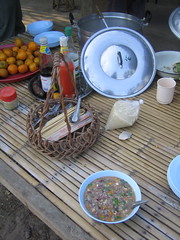
On our free day, before leaving Isaan, Jo invited us to go with him into his village. We had had our breakfast of vegetarian rice soup in soy milk and washed our dishes at the lineup of four basins, one of soapy water and three of rinse water leaving them to dry on the split bamboo drying platform. To keep the self-herding cows from wandering into the fenced off dining area, we pulled a long tree branch across the gateway. Jo walked with his 3 year-old-boy Than down the dirt road into the village. I followed close behind walking with Sasha one of the American year-abroad students studying at Chiengmai Univiersity.

"Throw that away it's dirty," Jo said to his bilingual son in Thai; Tahn had stopped to pick up a piece of plastic trash from the road. I recognized the word sockobroc meaning dirty, one of the few multi-syllable words in Thai.

"Yes it is," I replied, instinctively in Thai, remembering such conversations from my childhood. I asked Jo in English why he left his village. He told us how he had gone to Bangkok to live in the temple system and further his education at the University level. He shook his head.

"Farmers should not go to university," he said, "what is taught there is not sustainable. What good is it for a farmer to have an education if he is not taught how to be sustainable?" I glanced at Than wondering how this boy would be educated. I was certain that the American side of his family wouldn't see it that way. My own education had been a source of contention between my English mother and my Thai grandma; education was what determined the national allegiance of biracial children. I was one of the few to receive an English education. But not to aspire to higher education at all was iconoclastic for both nations. How did one become upwardly mobile without education? How did one have freedom of choice?

Yet I understood what Jo was saying. Perhaps an education was just another form of runaway consumerism training students to increase their needs and consume more resources in order to "succeed". What, indeed, was sustainable about it? What was progress for a Thai farmer if the use of modern agriculture meant endless debt and health problems from pesticide use? Those living in slums in the city would certainly be better off if they had been able to stay in the village.

"That would be like the Amish," I said. Jo didn't know about the Amish. I explained that they were farmers in America who did not educate their children beyond the 8th grade. "Hmm," he said, but did not ask me any questions.

Sasha and I began to walk faster, pulling ahead of Jo, to confide in each other that we couldn't agree with such a no higher education decree. It was too late for us. I was addicted to knowledge—to understanding how the world worked. Sasha, I would find out later, had been pre-med and after reading Michael Pollan's book, The Omnivore's Dilemma, had switched to agrobiology hoping to discover how the modern world could become sustainable. We both believed that we had to go forward in search of solutions through more education. We in the first world had gone so far into an unsustainable way of living that we had nothing to go back to; our built world of freeways and supermarkets made it impossible. I wondered if it had also made it impossible for our minds to grasp what we must do to live sustainable. So sure were we that technology would allow us to beat the limitations of natural resources.

The Pillow Village

My thoughts were interrupted with our arrival at a pillow-selling household. Jo's village made pillows, the traditional triangle pillow Thai people bought to lean against while sitting on the floor, also a popular tourist buy. A giant replica of such a pillow could be seen in the town centre. Throughout the village we had spotted individuals sitting by themselves stuffing kapok into the narrow channels of the pillow casing.
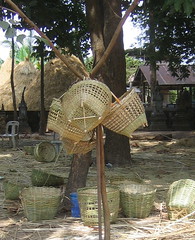
Pillows were not the only products made here. We next visited a carpenter who had built a roadside cafe in his front yard with furniture made from tree branches from fallen trees. His patrons had admired his rustic furniture so much he began selling his pieces and making more. At the local temple we came upon a group of men shaping long strips of bamboo into woven baskets to sell at an upcoming fair. There were baskets for different tasks including one for catching eel. In the days before plastic buckets, Jo explained, the villagers used latex from trees to make their baskets waterproof.

What an idyllic place to work, I noted looking up at the tall trees shading the group and the picturesque stupas in the background.

"If I lived in this village for a year do you think I could learn how to make all these baskets," I asked Jo.

"You could learn it in a month," he assured me.

Urbanites In The Edible Forest

To counter the damage left by conventional education, Jo and Peggy had, together, built a center to teach sustainable methods of farming and living to Thai people for free and to Westerners for enough money to support the endeavor. Originally envisioned as a seed saving center, the farm was named Pun Pun meaning a thousand varieties. It was just outside of Chiengmai, the northern capital of Thailand 8 hours by overnight bus from Issan.

Upon our arrival in Chiengmai, we stopped at a large local temple to eat a meal at the organic restaurant Peggy and Jo had helped start in order to create a market for the organic food they wanted to encourage farmers to grow. Surrounded by the white walls of the temple compound the local vegetarian dishes we were served were indeed heavenly—tarot root covered eggs, soups, spicy salads and flavored red rice.
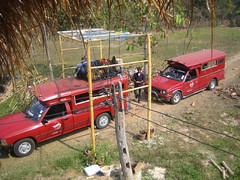
Another hour's travel by two bench pick-up truck and we arrived at Pun Pun nestled in the hills above a local village. At dinner that night it seemed as if our group had swelled to twice its size as the remaining interns joined us. My buddies and I were quiet as we took in all the new foreigners who had spent 10 weeks at the farm in the most comprehensive program Peggy and Jo had to offer.

It was through this internship that I had heard about the center several years ago. A friend of a friend had been raising funds so that she could attend their program. I was rather skeptical of the outfit, at first, and had pictured a poor village where eager young Americans would soon succumb to traveler's diarrhea. (I did not, on this trip, though we drank rain water stored in giant ceramic jars.) They had a website and over the years I watched as they developed their program. When they offered the sustainability tour I could finally fit in the time to come.

The farm had an odd effect on me. The terrain was familiar in a way that evoked my childhood yet it had a hippie flavor to it that was Western. As I walked along the dirt paths, from sleeping hut to dining pavilion, I kept wondering why I had not found such a place when I was young, but, of course, there was nothing like this offered in Thailand when I was the same age as these interns. Peggy and Jo had, themselves, only owned the land five years.

When they bought the farm, the land was rough and considered infertile having been clear cut of the original forest. Only grass and prickly weed grew there. There was no electricity or water. They lived at neighbors while developing the farm. This included digging ponds and planting banana trees for the moisture and organic matter, which they then used for mulch around fruit trees. It was two year before the bananas produced fruit. Now they were hanging in the pavilion for us to eat. They also grew papayas and melons and most of the food eaten at the farm.
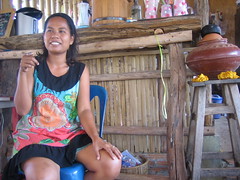
A woman named Yao, who had cooked for the farm, told us her story about how Jo hadn't given her any money to buy food to cook with and she realized that he expected her to forage for ingredients. She had had to reinvent dishes to use what vegetables were available and in season. Later she and her husband bought the land next door and she now teaches a cooking course there along with offering cheap lodgings to the backpacking crowd. She had specifically chosen to offer cheap lodgings because the clientele in this income bracket were so much friendlier and appreciative than the high-end client looking for services and amenities, she told us. The guesthouses were whimsical and charming adobe huts.

Yao had left a career in the film industry and an urban life to escape to this hilltop resort where the world would come to her in the form of travelers. I had never thought of it that way, having feared that a life in the country would isolate me. Her story told me a lot about how an urban Thai could change her stripes. The name of her guesthouse resort was You Sabai which means "stay in comfort" only the Thai word for comfort defies definition, evoking, for me, soft tropical breezes and not a care in the world. The view from the guesthouse cafe took in the lush green valley and reminded me of Kauai.

On the other side of the farm was another escapee from a conventional life. He was an American who had been a teenager when his parents brought him to Thailand to live while they took jobs teaching. Although he had not learned Thai as a teenager he had been fond enough of his experience to devise a way to come back and live here. He had persuaded 11 friends to help him buy his ten acres as a sort of timeshare. It had only taken $4,000 to get him started with Panya (means wisdom). We toured his organic garden, his building projects including a meeting hall and four composting toilets, his oversized pond that hadn't quite sealed properly and his kitchen with its cob oven. He looked like he needed a vacation. It was his ambition to develop a permaculture training center. He lived, he told us, with a sense of impermanence reflecting the changes in government policies regarding foreigners owning land in Thailand.

We also met Josh, from Oakland, who lived on Pun Pun part of the year and was looking for venture capital, the rest of the time, to fund his low tech water purification system. With the goal of helping local farmers filter out the incredible load of pesticides in their irrigation water, he had designed the system using readily available gravel, sand and charcoal contained in locally made cement water pipes, stacked to form tanks. The system ended with a small ultraviolet disinfection unit he had made himself. He was a chemical engineer so he knew what he was doing. I also noted that, unlike most of the interns, he kept a very tidy and organized hut. On the door was a sign posted saying it was the headquarters of Aqueous Solutions, his business name. It was the tiniest, sweetest adobe hut we had seen and had a sleeping loft under the thatched roof accessed by a ladder outside. Inside was a desk with a laptop, a chair, a bicycle and a mission. Really what more did one need?
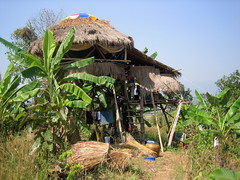
When I met the Dutch man with the feminine sounding name pronounced Michelle and spelled Michale, I had no reasonable answer when he asked me why I, too, was not living like this in Thailand. We had been invited up to his circular bamboo home, of his own design, built on stilts at the bottom of the You Sabai guesthouse land. With a colorful giant golfing umbrella covering the top of the roof, it evoked the Robinson Crusoe house at Disneyland.

Michale had also lived in the States for several years, but he found the people to be rather unenlightened and the onus of a failing empire to be cumbersome, so he had taken up his travels until he came to You Sabai and built his house. He intended to stay permanently. My mind sea-sawed between the beach hut vision of his silly house and the middle class encumbrances of mine, now equipped with a giant flat screen TV Catherine had bought the night before I left. Was I, like Jo and Peggy, going to have to have both? Our sustainable efforts in Thailand to be canceled out by the air miles to get to and from the US? What if we are frozen in one place or the other by gasoline shortages, I asked Peggy who traveled every year with Jo and Than to Colorado. She didn't have an answer.

This question of fossil fuel use plagued me. All of us had traveled many air miles to get to Pun Pun, many planned to continue traveling extensively throughout Asia, yet we were all wishing to live more sustainably. How could we justify this? Finally I came to see it this way. We, who were so privileged, had an allotment of oil accessible to us. Most would squander it before being forced to give it up. We, at least, had used it to expand our ability to envision a sustainable lifestyle. Those on the tour had lived for these 12 days in a way most travelers seldom experienced (and I haven't even reported on that contentious topic of American travelers—the toilets). I now understood in a profound way what it meant to live in harmony with the earth. It was a way that all the green effort of high tech living couldn't even begin to touch.

Next week I visit Peggy and Jo in their American home, a family compound of green buildings they have constructed themselves and will see, for myself, how their vision translates to the first world.

Also posted at the energy bulletin

Labels: , , , ,

Wednesday, January 17, 2007

My Compact Year

About 5 months into the Compact, I dreamt that I was at Crate & Barrel buying lamps and furnishings I didn't need, paying for them and walking out the door. At which point I thought to myself, "Oh no, I'm going to have to confess my purchases to the Compact Group." Thankfully I woke up.

I joined the Compact when the San Francisco Chronicle published the first article on the group, a month after the original "yuppies" conceived the idea of not buying anything new for a whole year. I joined because I, too, had made a similar New Year's resolution. The publicized group also had the allure of a movement and it was local to the Bay Area so I felt a kinship to the founders.

I followed the groups' criteria to the letter for half the year, before finding a loophole to exploit and late in the game I fell off the wagon entirely for a toaster oven. Yes, a mundane kitchen appliance. The Compact, however, was much more than not buying new stuff. It was about rethinking our consumer habits.

I also challenged the premises of the Compact. For instance did the rules forbid going to see a first run movie? No one answered that question, but a few days later someone did talk about being an avid user of Netflix. So renting movies was supported over buying DVDs, but first run movies were sort of a gray zone. Despite being a resource intensive, consumer driven industry, it was not, after all, a physical item.


The permitted new items included underwear and socks (utilitarian and not taken to excess), as well as household cleaning supplies, consumable sundries and safety items. Locally made artisanal items were permitted. We could also keep our magazine subscriptions, but not buy single magazines. The loophole I exploited was the category of health and safety items, under which I could justify bike lights, a pair of bike gloves, wrist friendly handlebars, a specialized backpack to "safely" transport my sparing gear to karate class by bike, sunglasses, reading glasses, a first aid kit and earthquake supply items that I decided to stock up on, including, yes, possibly, an excess of LED flashlights and a battery operated lantern.

I also made some shady exchanges by deciding to discontinue two of my magazine subscriptions, but buying 6 magazines over the year and 6 new books from independent publishers and Kepler's, our last, local independent bookstore.

My main motivation for joining the Compact was that I was spending a substantial amount of time, many evenings a week shopping online. Buying clothes and products was not even the time wasting part; it was the looking at stuff. Even if I couldn't afford or didn't want a new Timbuk2 bag, I still wanted to look at it just to keep up with the product line. Suitcases, too, attracted me. So much so, that I carry a tape measure and a list of the measurements of all the suitcases I own just so I don't spend too much time sizing up a suitcase in a store. It was likely to be exactly the same size as one I already own.

Joining the Compact put an instant stop to this constant hunting. The time I spent not shopping I replaced with time spent reading postings by Compact members and following up on links and resources. But it was a worthwhile exchange. Many of the posters were already experienced Compactors who were familiar with pioneer skills, had books to recommend, recipes to share, and in general, reinforced values that embodied a holistic eco awareness I craved.

These values and ideas were already taking the Compact beyond the vision of the original group. We were not, for instance, required to make our own cleaning supplies, but doing so was a source of much discussion. I was eager to try it, but then I realized I would have to go out and buy a bevy of plastic squirt bottles to put my concoctions in, when I already had a years supply of bulk cleaning spray at home.

What I did do was make my own shampoo using a baking soda paste followed by a rinse with apple cider vinegar diluted in water. The results were remarkable. My hair was squeaky clean, shiny and befitting of a TV commercial. What's more, I did not need to wash my hair nearly as often as I did before, only once a week in fact. This was a revelation to me. Shampoo companies had basically brain washed the public into thinking that its product is not only essential, but desirable for everyday use.

As it is a detergent, shampoo stimulates your scalp to produce grease in order to stave off the drying effect of the detergent. Thus shampoo creates the very conditions it was advertised to combat. What a scam. And then you have to switch shampoos after a while because the build-up renders it less effective. It is no wonder that when I organize a client's bathroom, I am likely to find six banker's boxes worth of sundries, most of which are hair and skin products. I also learned that petroleum based products, like baby oil are not absorbed by the skin, but sit on top, clogging the pores. Now I just rub on olive oil, after a shower, and have noticed much less drying of my skin.

The toothpaste industry, too, had suffered a misguided redirection in purpose. Where once toothpastes were meant to clean and disinfect the teeth, mouth and gums, a difference of opinion among dentist, over a new antibacterial ingredient, caused the dental association to change the requirements of toothpaste from "decontaminating of pathogenic bacterial biofilms" to merely "aid in removing food particles". As a result, the toothpaste industry changed its focus from effective cleaning of the teeth to enhancing the appearance of the teeth, thus opening the door to whiteners that actually dissolve enamel, plus sugar that makes the toothpaste taste better. Ugh.

But Compactors had a solution with another baking soda recipe. This time mixed with glycerin and a pinch of salt, made palatable by a few drops of mint. I was eager to try it, particularly since I had just learned that my favorite, family owned, natural ingredients toothpaste, Tom's of Maine, had been sold to the corporate behemoth Colgate.

The toothpaste recipe took a little getting used to because of the salty taste, but the graininess of the baking soda and salt made my teeth feel like they had been polished. Plus the baking soda, when dissolved in a solution, kills all "motile microorganisms" on contact, while the glycerin halts the "motility" of said organisms. After six months use, I couldn't wait to see what my dentist would say. Her only concern was that my recipe did not contain fluoride, but otherwise she felt that the cleaning job I was doing was so effective, she wouldn't want to change anything. Score another Compactor lifestyle coup.

When it came to gifts during my Compact year, I had the brilliant idea of introducing my friends to my Compact lifestyle by putting together gift baskets with samples of the toothpaste, ingredients for the shampoo and accompanying recipes that included using baking soda as a deodorant. Nor could I buy birthday cards, so I made my own, using photographs of each friend taken earlier that year. The results were not only personalized, but unexpectedly more personal in the message I ended up writing.

Following the Compactor regime allowed me to think more consistently in terms of ecological impact. For instance, sewing had long fallen by the wayside for many home sewers because clothes could be bought so cheaply now (due to lowcost labor overseas) that it wasn't worth the time. Now, I could justify the time I spent sewing because I was saving on the transportation and manufacturing costs to the environment of buying new clothes that were then shipped to me. And because I was at the thrift store, more often now, I got lucky and found some attractive fabric another sewer had donated, thus saving it from going to landfill. Sewing my own pair of pants added a unique item to my wardrobe and made me think about other things I could make from salvage material, instead of other things I wanted to shop for.

When I started coming home from the thrift shops with nice shirts and nearly new items, such as a thermos bottle just like the ones selling at Starbucks, Catherine wanted to come with me to buy clothes for her niece. After an hour at Savers, I looked for her and found she had filled a shopping cart full of clothes for herself as well.

"I had a revelation in there," she reported later. She had been intently studying her financial health and had realized that where she might normally drop several hundred dollars on clothes for work at Nordstrom's, here at the thrift store, she had spent a little over $50 for a cart full of clothes that included several wearable work items. Considering all the perfectly good clothes I had helped clients haul away to the Goodwill, it wasn't surprising that there would be clothes there that looked better than what was in our own closets.

Not only that, but there was no packaging in the presentation of items sold at thrift stores, apart from the occasional generic plastic bag for small items grouped together. (So why, one might ask, did I fall for a toaster oven, complete with Styrofoam packaging and giant cardboard box? I don't know exactly, but I was in Mervyns shopping for bras and I saw the small convection toaster oven for a very low price. I had long wanted one because they use less energy than conventional ovens. Once I bought it, I was going to take it back, but I kept taking it out of the box just to try it one more time. Finally I realized that using it would mean I could dispense with the microwave as I had become convinced that microwaves deplete the nutritious value of foods, especially the very foods that are supposed to be good for you, like broccoli.)

When the Christmas season loomed, Catherine and I decided we didn't want to buy a tree, because they were sprayed with so much pesticide. Then we made the radical decision not to buy each other any gifts to go under the non-existent tree. This was a category in which we tended to go overboard. Catherine warned all her work people that she had decided to eschew the material traditions of the season and would not be buying gifts.


We watched ourselves as our stress level dropped and we decided to host a party, on Christmas Eve, to fill the house with friends and food. On the day of Christmas itself, Catherine and I slept in and then sat in bed reading our books. Around ten a.m., I turned to her and said "Happy Christmas". We looked at each other for a delicious moment, then congratulated ourselves for having the audacity to convey our love without the aid of a single material object.

As the anniversary of the Compact approached, articles were published, in all kinds of publications, following up on how we had done. Apart from some specialty hardware items, the Compactors interviewed had largely stuck to it and we're renewing their vows. Inspired by the example of these first year Compactors, membership jumped from the 1,000, that had pulled the group along for most of the year, to over 7,500. It sure was looking like a movement, and an international one at that.

Published concurrently at energy bulletin

Labels: , ,

Earthworm. Get yours at bighugelabs.com