Amanda Kovattana

Middle-aged musings in interesting times

Wednesday, September 08, 2010

Food Frugality Freedom

In which I jump on the bandwagon of three word titles and embody worldly travels with meaning fueled by eating, spiritual reflection and a search.

FOOD

I am not a foodie, but I am very good at eating. Put a hamburger and plate of fries in front of me and I am an eating machine. I eat mostly for the satisfaction of not having to eat again for another four hours. This, as one of my writing teachers suggested, is how a dog views food, bypassing all the delights of the human senses for the sake of a satisfied stomach.

She was attempting to point out something about noticing details through our senses. She asked me what my tropical childhood home smelled like. After a moment of intense remembering, via my nose, I said, "wet cement". She made a face and I saw that I simply had not evoked the fantasy of the tropics her Austrian mountain home had projected for her. But it was, nevertheless, my truth. Wet cement was the smell of my hometown on the eve of globalization. And the satisfaction of having eaten is how I mostly view food.

Food For The Road

Half way up the steep gravel road to our Angel Island campsite, pushing my bike fully loaded with all my gear, my feet were slipping and I calculated that my bike, together with the gear weighed nearly 100 lbs and I may have been a bit cavalier about packing. Would I actually be able to get this bike up the hill? I was strong enough certainly, but I didn't have the leverage. I had only about 15lbs on the loaded bike and I was a meal short calorie wise, having only had a minor lunch of a few slices of bread, salami and cheese, a home baked oatmeal cookie and a handful of chocolate almonds. Breakfast before that was light too, just a bowl of steel cut oatmeal (with raisins, yogurt, nuts and wheat germ). I had not had my usual second breakfast—an English muffin with butter and that condiment of the British Empire—Marmite. The second breakfast is what carries me through to lunch. Stopped on this hill, I was wishing that the baked potato and sausages we would have for dinner were already eaten.

A memory came to me of a meal that got me through an entire afternoon and some of the evening, all the way through my 90 minute martial art class. A friend had treated me to lunch at a French restaurant. I ordered the croque monsieur because I had heard the name before and it sounded very traditional.

"Is it good?" I asked my friend. He said it was, but added cautiously. "It's just a lot of calories." It was massive.

I looked back down the hill at Stacy, my camping buddy, pushing her bike which was not quite as loaded as mine, being absent a 10lb tent and carrying a cooler a third the size of mine. The memory of the croque monsieur fortified me. I aimed my bike to traverse the hill and thus regained my footing. One more steep bit after a curve and we reached the frontage road and were able to ride all the way to the campsite.

The whole point of camping is to test one's self-sufficiency, which for me came down to how to feed myself for seven meals straight. Feeding myself is the food challenge of my American life. Home, to me, is where they have to feed you.

My Thai father, who had been through the transition from a home staffed with a cook, to an indifferent college cafeteria, an English one at that, understood what I would face and took it upon himself to teach me to cook the summer before I left for college. I still, to this day, make his salt and pepper fried chicken and can quickly serve an omelet over rice cooked using the joint of the index finger to measure water level. (Even in this age of rice cookers, I still prefer this method.) I have, however, progressed beyond using ketchup and soy sauce to make spaghetti sauce.

Being a foodie is not a prerequisite to teaching oneself to cook. I cook more like a carpenter measuring carefully and following a plan. I am differently inspired—by ideas of self-sufficiency, social justice and alternative tools. On my bookshelf, between Jackknife Cookery and Cooking With the Sun (for solar oven recipes), my most widely cooked from books are Diet From A Small Planet, Sunset's Vegetarian Cooking and The 99 Cents A Meal Cookbook by self-sufficiency advocate Bill Kaysing.

I am not a vegetarian (too limiting for an opportunistic eater), but I prefer to cook vegetarian fare. When in season, vegetables are plentiful and cheap, while grains are good for long lasting fuel. For our expedition, I made vegetable soup, snipping some basil leaves from the garden for it. Eating from a kitchen garden is not just self-sufficient. It delights my eye to watch plants transform and present something edible. To pop this thing into my mouth directly is magical. And the taste of such fresh food wakes up even my senses.

FRUGALITY

Frugality is tolerated in a recession, but it is not something our consumer culture teaches us to aspire to. The word implies deprivation and in a land where we buy into the dream that we can have everything, a frugal life is seen as one diminished in possibilities.

My clients, who call themselves frugal, are often operating from a place of deprivation and may have experienced deprivation at one time, both emotional and material. They fill their houses with stuff, free stuff, things on sale they don't need now, packaging, plastic bags, slightly used paper napkins, take-out packets of condiments, things people gave them that they didn't have a use for either.

"Free stuff isn't free" I tell them. There are storage costs, costs to your time to manage so much stuff, the cost to the environment of producing said stuff that is going unused, the cost of turning your expensive living space into a storage unit, the health cost of living in a hazardous environment. It is harder to clean around piles of stuff I politely decline from mentioning, as I dust my way through the piles.

True frugality is mindful of limits, the limits of time, space, money and resources. The limits of ones body, the planetary body, the lives of others. The frugal life is one that is lived consciously in a spiritual sense. I don't believe that we can have it all or that a high-octane life is available to everyone who wants it. Because somewhere someone is going to pay, already is paying, for all these lives lived without consciousness of limits.
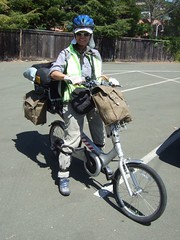

Camping is a test of these limits. A symphony of give and take between how much you can carry and how comfortable you can be once you arrive. A trade-off between the time needed to feed yourself, house yourself and the part you would actually call a vacation. It is often done close to home. (If not it's called an expedition, usually involves extreme terrain and is no longer inexpensive.)

At $30 a night plus boat and train fare, camping on Angel Island isn't exactly cheap by camping standards, but we didn't have to go far to get there. I came up to San Francisco by train, met Stacy and we carpooled across the Golden Gate to catch the ferry in Tiburon (where parking and access is preferable).


FREEDOM

Frugality helps keep my overhead low, as does self-sufficiency in that I can clothes myself stylishly for very little money, eat well by cooking from scratch and use tools to fix or make things. But it is for freedom that I strive or rather I strive to stay free. The freedom to have time to reflect, question, read, find stimulating conversation and participate in the world through my writing. In a culture that trades entertainment for reflection, staying free takes conscious effort.

The bicycle is an apt symbol of such freedom. I just get on it and I am traveling at the fastest, most efficiently possible human speed (plus I am far less likely to be ticketed). I am using no fossil fuels and have no ties to an energy generating system other than my own body. This off grid freedom allows my mind to relax and enjoy the ride. The gyroscopic motion of balancing and moving at the same time fills me with a kinetic, effortless awe. On this trip the heavy load challenges me a bit, but I am happy that I can ride it at all.

The ferry is much easier to board by bike than the train and we arrive at Angel Island cove in about twelve minutes surrounded by Sunday visitors and moored sailboats. The day is sunny, beautifully clear and just cool enough to be pleasant. As we ride up the perimeter road we stop to admire the view.
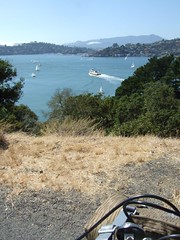

"It sure is purrty," I drawl watching the returning ferry and the tiny sailboats dotting the deep blue green water between the landmasses of Tiburon. It brought to mind the islands of Hawaii.

"Yes it's good to be reminded of it," Stacy replied.

"No wonder we're a world class tourist destination," I said (for technically speaking we hadn't left home being still in the Bay Area). No wonder all the best and the brightest wanted to live here. (Our housing prices had hardly dropped at all compared to other parts of the state.) Those who managed to stay didn't give up easily. I had watched colleagues (and clients too), take the downtime of the recession to reinvent themselves. No idle dreaming here. We would reinvent ourselves until there was nothing left to reinvent with. (And after that we will really find out what we're made of.)

Once we arrived at our campsite I set up house. With Stacy's help it took all of five minutes.

"It's looking quite vintage this tent," I commented. My 3 person tent is now some 20 years old and has faded to a pale greenish blue. The rest of my gear is also old, improvised or used.

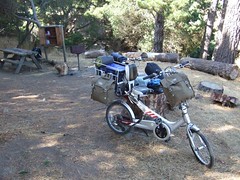
The carrier on my semi-recumbent commuter bike has a section of metal shelving bolted to it. To this platform I had bungeed a metal basket that looks like it came from a fridge. The panniers hanging from the side of the basket are German army surplus bags. The canvas bags came with vinyl liners. I cut them out to make more room inside then saw that the liners would make perfect wash basins if the sides were rolled down, thus I had packed even the kitchen sink!


After the last ferry left, we had the island to ourselves apart from a handful of fellow campers who didn't have bikes. The early evening light allowed us to ride around the island and stop at the historical buildings as if we were touring our own private estate. The 360° views of the city skylines were all familiar sites, yet seen from a perspective so unexpected I felt inside out and had to re-orient myself.

I knew all these cities, had clients and friends in many of them and long ago memories lingered, including a trip with my father to Angel Island itself some 37 years ago. Stacy and I made note of the sites where guns had once been installed to protect the Bay from enemies beginning with the Civil War and ending with the Cold War, but no enemies ever came. It is easy to feel now that we live in a bubble and no harm will come to us.

Returning to camp after sunset, the first night, I find that a gang of raccoons had gotten into my cooler and stolen the loaf of Acme bread plus a packet of Halva cheese. Naughty beasts. Now I was one meal down, but luckily the eatery at the cove was open for lunch even though the state cutbacks had closed most of the buildings two of the days we were there.
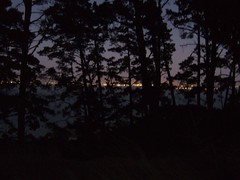

At night the lights of the shoreline could be seen through the trees against a deep purple sky just beyond the black silhouette of pine trees. All night the engines of ships and the relentless dinging of a buoy narrated this busy-ness. Luckily Stacy brought earplugs.
On our last day, the fog finally cleared enough to see San Francisco. Looking head on like this, she appeared as a woman lying down. The Twin Peaks tower adorning her head like a tiara. Her right arm the Golden Gate Bridge. Her left the Bay Bridge. Her body draped in a filmy wisp of fog.

On the return trip home, I took the ferry directly to the city, took a seat and remembered the comfort of upholstery.

Labels: , , , , ,

Wednesday, January 17, 2007

My Compact Year

About 5 months into the Compact, I dreamt that I was at Crate & Barrel buying lamps and furnishings I didn't need, paying for them and walking out the door. At which point I thought to myself, "Oh no, I'm going to have to confess my purchases to the Compact Group." Thankfully I woke up.

I joined the Compact when the San Francisco Chronicle published the first article on the group, a month after the original "yuppies" conceived the idea of not buying anything new for a whole year. I joined because I, too, had made a similar New Year's resolution. The publicized group also had the allure of a movement and it was local to the Bay Area so I felt a kinship to the founders.

I followed the groups' criteria to the letter for half the year, before finding a loophole to exploit and late in the game I fell off the wagon entirely for a toaster oven. Yes, a mundane kitchen appliance. The Compact, however, was much more than not buying new stuff. It was about rethinking our consumer habits.

I also challenged the premises of the Compact. For instance did the rules forbid going to see a first run movie? No one answered that question, but a few days later someone did talk about being an avid user of Netflix. So renting movies was supported over buying DVDs, but first run movies were sort of a gray zone. Despite being a resource intensive, consumer driven industry, it was not, after all, a physical item.


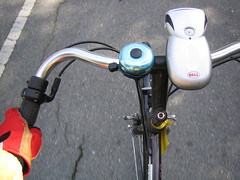
The permitted new items included underwear and socks (utilitarian and not taken to excess), as well as household cleaning supplies, consumable sundries and safety items. Locally made artisanal items were permitted. We could also keep our magazine subscriptions, but not buy single magazines. The loophole I exploited was the category of health and safety items, under which I could justify bike lights, a pair of bike gloves, wrist friendly handlebars, a specialized backpack to "safely" transport my sparing gear to karate class by bike, sunglasses, reading glasses, a first aid kit and earthquake supply items that I decided to stock up on, including, yes, possibly, an excess of LED flashlights and a battery operated lantern.

I also made some shady exchanges by deciding to discontinue two of my magazine subscriptions, but buying 6 magazines over the year and 6 new books from independent publishers and Kepler's, our last, local independent bookstore.

My main motivation for joining the Compact was that I was spending a substantial amount of time, many evenings a week shopping online. Buying clothes and products was not even the time wasting part; it was the looking at stuff. Even if I couldn't afford or didn't want a new Timbuk2 bag, I still wanted to look at it just to keep up with the product line. Suitcases, too, attracted me. So much so, that I carry a tape measure and a list of the measurements of all the suitcases I own just so I don't spend too much time sizing up a suitcase in a store. It was likely to be exactly the same size as one I already own.

Joining the Compact put an instant stop to this constant hunting. The time I spent not shopping I replaced with time spent reading postings by Compact members and following up on links and resources. But it was a worthwhile exchange. Many of the posters were already experienced Compactors who were familiar with pioneer skills, had books to recommend, recipes to share, and in general, reinforced values that embodied a holistic eco awareness I craved.

These values and ideas were already taking the Compact beyond the vision of the original group. We were not, for instance, required to make our own cleaning supplies, but doing so was a source of much discussion. I was eager to try it, but then I realized I would have to go out and buy a bevy of plastic squirt bottles to put my concoctions in, when I already had a years supply of bulk cleaning spray at home.

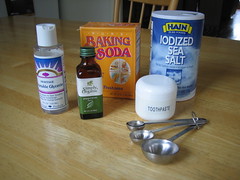
What I did do was make my own shampoo using a baking soda paste followed by a rinse with apple cider vinegar diluted in water. The results were remarkable. My hair was squeaky clean, shiny and befitting of a TV commercial. What's more, I did not need to wash my hair nearly as often as I did before, only once a week in fact. This was a revelation to me. Shampoo companies had basically brain washed the public into thinking that its product is not only essential, but desirable for everyday use.

As it is a detergent, shampoo stimulates your scalp to produce grease in order to stave off the drying effect of the detergent. Thus shampoo creates the very conditions it was advertised to combat. What a scam. And then you have to switch shampoos after a while because the build-up renders it less effective. It is no wonder that when I organize a client's bathroom, I am likely to find six banker's boxes worth of sundries, most of which are hair and skin products. I also learned that petroleum based products, like baby oil are not absorbed by the skin, but sit on top, clogging the pores. Now I just rub on olive oil, after a shower, and have noticed much less drying of my skin.

The toothpaste industry, too, had suffered a misguided redirection in purpose. Where once toothpastes were meant to clean and disinfect the teeth, mouth and gums, a difference of opinion among dentist, over a new antibacterial ingredient, caused the dental association to change the requirements of toothpaste from "decontaminating of pathogenic bacterial biofilms" to merely "aid in removing food particles". As a result, the toothpaste industry changed its focus from effective cleaning of the teeth to enhancing the appearance of the teeth, thus opening the door to whiteners that actually dissolve enamel, plus sugar that makes the toothpaste taste better. Ugh.

But Compactors had a solution with another baking soda recipe. This time mixed with glycerin and a pinch of salt, made palatable by a few drops of mint. I was eager to try it, particularly since I had just learned that my favorite, family owned, natural ingredients toothpaste, Tom's of Maine, had been sold to the corporate behemoth Colgate.

The toothpaste recipe took a little getting used to because of the salty taste, but the graininess of the baking soda and salt made my teeth feel like they had been polished. Plus the baking soda, when dissolved in a solution, kills all "motile microorganisms" on contact, while the glycerin halts the "motility" of said organisms. After six months use, I couldn't wait to see what my dentist would say. Her only concern was that my recipe did not contain fluoride, but otherwise she felt that the cleaning job I was doing was so effective, she wouldn't want to change anything. Score another Compactor lifestyle coup.

When it came to gifts during my Compact year, I had the brilliant idea of introducing my friends to my Compact lifestyle by putting together gift baskets with samples of the toothpaste, ingredients for the shampoo and accompanying recipes that included using baking soda as a deodorant. Nor could I buy birthday cards, so I made my own, using photographs of each friend taken earlier that year. The results were not only personalized, but unexpectedly more personal in the message I ended up writing.

Following the Compactor regime allowed me to think more consistently in terms of ecological impact. For instance, sewing had long fallen by the wayside for many home sewers because clothes could be bought so cheaply now (due to lowcost labor overseas) that it wasn't worth the time. Now, I could justify the time I spent sewing because I was saving on the transportation and manufacturing costs to the environment of buying new clothes that were then shipped to me. And because I was at the thrift store, more often now, I got lucky and found some attractive fabric another sewer had donated, thus saving it from going to landfill. Sewing my own pair of pants added a unique item to my wardrobe and made me think about other things I could make from salvage material, instead of other things I wanted to shop for.

When I started coming home from the thrift shops with nice shirts and nearly new items, such as a thermos bottle just like the ones selling at Starbucks, Catherine wanted to come with me to buy clothes for her niece. After an hour at Savers, I looked for her and found she had filled a shopping cart full of clothes for herself as well.

"I had a revelation in there," she reported later. She had been intently studying her financial health and had realized that where she might normally drop several hundred dollars on clothes for work at Nordstrom's, here at the thrift store, she had spent a little over $50 for a cart full of clothes that included several wearable work items. Considering all the perfectly good clothes I had helped clients haul away to the Goodwill, it wasn't surprising that there would be clothes there that looked better than what was in our own closets.

Not only that, but there was no packaging in the presentation of items sold at thrift stores, apart from the occasional generic plastic bag for small items grouped together. (So why, one might ask, did I fall for a toaster oven, complete with Styrofoam packaging and giant cardboard box? I don't know exactly, but I was in Mervyns shopping for bras and I saw the small convection toaster oven for a very low price. I had long wanted one because they use less energy than conventional ovens. Once I bought it, I was going to take it back, but I kept taking it out of the box just to try it one more time. Finally I realized that using it would mean I could dispense with the microwave as I had become convinced that microwaves deplete the nutritious value of foods, especially the very foods that are supposed to be good for you, like broccoli.)

When the Christmas season loomed, Catherine and I decided we didn't want to buy a tree, because they were sprayed with so much pesticide. Then we made the radical decision not to buy each other any gifts to go under the non-existent tree. This was a category in which we tended to go overboard. Catherine warned all her work people that she had decided to eschew the material traditions of the season and would not be buying gifts.


We watched ourselves as our stress level dropped and we decided to host a party, on Christmas Eve, to fill the house with friends and food. On the day of Christmas itself, Catherine and I slept in and then sat in bed reading our books. Around ten a.m., I turned to her and said "Happy Christmas". We looked at each other for a delicious moment, then congratulated ourselves for having the audacity to convey our love without the aid of a single material object.

As the anniversary of the Compact approached, articles were published, in all kinds of publications, following up on how we had done. Apart from some specialty hardware items, the Compactors interviewed had largely stuck to it and we're renewing their vows. Inspired by the example of these first year Compactors, membership jumped from the 1,000, that had pulled the group along for most of the year, to over 7,500. It sure was looking like a movement, and an international one at that.

Published concurrently at energy bulletin

Labels: , ,

Earthworm. Get yours at bighugelabs.com