Amanda Kovattana

Middle-aged musings in interesting times

Wednesday, September 08, 2010

Food Frugality Freedom

In which I jump on the bandwagon of three word titles and embody worldly travels with meaning fueled by eating, spiritual reflection and a search.

FOOD

I am not a foodie, but I am very good at eating. Put a hamburger and plate of fries in front of me and I am an eating machine. I eat mostly for the satisfaction of not having to eat again for another four hours. This, as one of my writing teachers suggested, is how a dog views food, bypassing all the delights of the human senses for the sake of a satisfied stomach.

She was attempting to point out something about noticing details through our senses. She asked me what my tropical childhood home smelled like. After a moment of intense remembering, via my nose, I said, "wet cement". She made a face and I saw that I simply had not evoked the fantasy of the tropics her Austrian mountain home had projected for her. But it was, nevertheless, my truth. Wet cement was the smell of my hometown on the eve of globalization. And the satisfaction of having eaten is how I mostly view food.

Food For The Road

Half way up the steep gravel road to our Angel Island campsite, pushing my bike fully loaded with all my gear, my feet were slipping and I calculated that my bike, together with the gear weighed nearly 100 lbs and I may have been a bit cavalier about packing. Would I actually be able to get this bike up the hill? I was strong enough certainly, but I didn't have the leverage. I had only about 15lbs on the loaded bike and I was a meal short calorie wise, having only had a minor lunch of a few slices of bread, salami and cheese, a home baked oatmeal cookie and a handful of chocolate almonds. Breakfast before that was light too, just a bowl of steel cut oatmeal (with raisins, yogurt, nuts and wheat germ). I had not had my usual second breakfast—an English muffin with butter and that condiment of the British Empire—Marmite. The second breakfast is what carries me through to lunch. Stopped on this hill, I was wishing that the baked potato and sausages we would have for dinner were already eaten.

A memory came to me of a meal that got me through an entire afternoon and some of the evening, all the way through my 90 minute martial art class. A friend had treated me to lunch at a French restaurant. I ordered the croque monsieur because I had heard the name before and it sounded very traditional.

"Is it good?" I asked my friend. He said it was, but added cautiously. "It's just a lot of calories." It was massive.

I looked back down the hill at Stacy, my camping buddy, pushing her bike which was not quite as loaded as mine, being absent a 10lb tent and carrying a cooler a third the size of mine. The memory of the croque monsieur fortified me. I aimed my bike to traverse the hill and thus regained my footing. One more steep bit after a curve and we reached the frontage road and were able to ride all the way to the campsite.

The whole point of camping is to test one's self-sufficiency, which for me came down to how to feed myself for seven meals straight. Feeding myself is the food challenge of my American life. Home, to me, is where they have to feed you.

My Thai father, who had been through the transition from a home staffed with a cook, to an indifferent college cafeteria, an English one at that, understood what I would face and took it upon himself to teach me to cook the summer before I left for college. I still, to this day, make his salt and pepper fried chicken and can quickly serve an omelet over rice cooked using the joint of the index finger to measure water level. (Even in this age of rice cookers, I still prefer this method.) I have, however, progressed beyond using ketchup and soy sauce to make spaghetti sauce.

Being a foodie is not a prerequisite to teaching oneself to cook. I cook more like a carpenter measuring carefully and following a plan. I am differently inspired—by ideas of self-sufficiency, social justice and alternative tools. On my bookshelf, between Jackknife Cookery and Cooking With the Sun (for solar oven recipes), my most widely cooked from books are Diet From A Small Planet, Sunset's Vegetarian Cooking and The 99 Cents A Meal Cookbook by self-sufficiency advocate Bill Kaysing.

I am not a vegetarian (too limiting for an opportunistic eater), but I prefer to cook vegetarian fare. When in season, vegetables are plentiful and cheap, while grains are good for long lasting fuel. For our expedition, I made vegetable soup, snipping some basil leaves from the garden for it. Eating from a kitchen garden is not just self-sufficient. It delights my eye to watch plants transform and present something edible. To pop this thing into my mouth directly is magical. And the taste of such fresh food wakes up even my senses.

FRUGALITY

Frugality is tolerated in a recession, but it is not something our consumer culture teaches us to aspire to. The word implies deprivation and in a land where we buy into the dream that we can have everything, a frugal life is seen as one diminished in possibilities.

My clients, who call themselves frugal, are often operating from a place of deprivation and may have experienced deprivation at one time, both emotional and material. They fill their houses with stuff, free stuff, things on sale they don't need now, packaging, plastic bags, slightly used paper napkins, take-out packets of condiments, things people gave them that they didn't have a use for either.

"Free stuff isn't free" I tell them. There are storage costs, costs to your time to manage so much stuff, the cost to the environment of producing said stuff that is going unused, the cost of turning your expensive living space into a storage unit, the health cost of living in a hazardous environment. It is harder to clean around piles of stuff I politely decline from mentioning, as I dust my way through the piles.

True frugality is mindful of limits, the limits of time, space, money and resources. The limits of ones body, the planetary body, the lives of others. The frugal life is one that is lived consciously in a spiritual sense. I don't believe that we can have it all or that a high-octane life is available to everyone who wants it. Because somewhere someone is going to pay, already is paying, for all these lives lived without consciousness of limits.

Camping is a test of these limits. A symphony of give and take between how much you can carry and how comfortable you can be once you arrive. A trade-off between the time needed to feed yourself, house yourself and the part you would actually call a vacation. It is often done close to home. (If not it's called an expedition, usually involves extreme terrain and is no longer inexpensive.)

At $30 a night plus boat and train fare, camping on Angel Island isn't exactly cheap by camping standards, but we didn't have to go far to get there. I came up to San Francisco by train, met Stacy and we carpooled across the Golden Gate to catch the ferry in Tiburon (where parking and access is preferable).


FREEDOM

Frugality helps keep my overhead low, as does self-sufficiency in that I can clothes myself stylishly for very little money, eat well by cooking from scratch and use tools to fix or make things. But it is for freedom that I strive or rather I strive to stay free. The freedom to have time to reflect, question, read, find stimulating conversation and participate in the world through my writing. In a culture that trades entertainment for reflection, staying free takes conscious effort.

The bicycle is an apt symbol of such freedom. I just get on it and I am traveling at the fastest, most efficiently possible human speed (plus I am far less likely to be ticketed). I am using no fossil fuels and have no ties to an energy generating system other than my own body. This off grid freedom allows my mind to relax and enjoy the ride. The gyroscopic motion of balancing and moving at the same time fills me with a kinetic, effortless awe. On this trip the heavy load challenges me a bit, but I am happy that I can ride it at all.

The ferry is much easier to board by bike than the train and we arrive at Angel Island cove in about twelve minutes surrounded by Sunday visitors and moored sailboats. The day is sunny, beautifully clear and just cool enough to be pleasant. As we ride up the perimeter road we stop to admire the view.
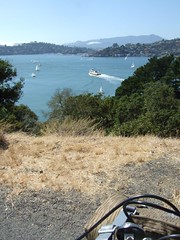

"It sure is purrty," I drawl watching the returning ferry and the tiny sailboats dotting the deep blue green water between the landmasses of Tiburon. It brought to mind the islands of Hawaii.

"Yes it's good to be reminded of it," Stacy replied.

"No wonder we're a world class tourist destination," I said (for technically speaking we hadn't left home being still in the Bay Area). No wonder all the best and the brightest wanted to live here. (Our housing prices had hardly dropped at all compared to other parts of the state.) Those who managed to stay didn't give up easily. I had watched colleagues (and clients too), take the downtime of the recession to reinvent themselves. No idle dreaming here. We would reinvent ourselves until there was nothing left to reinvent with. (And after that we will really find out what we're made of.)

Once we arrived at our campsite I set up house. With Stacy's help it took all of five minutes.

"It's looking quite vintage this tent," I commented. My 3 person tent is now some 20 years old and has faded to a pale greenish blue. The rest of my gear is also old, improvised or used.

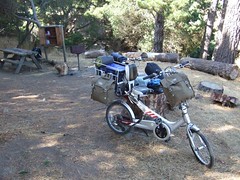
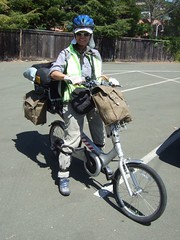
The carrier on my semi-recumbent commuter bike has a section of metal shelving bolted to it. To this platform I had bungeed a metal basket that looks like it came from a fridge. The panniers hanging from the side of the basket are German army surplus bags. The canvas bags came with vinyl liners. I cut them out to make more room inside then saw that the liners would make perfect wash basins if the sides were rolled down, thus I had packed even the kitchen sink!


After the last ferry left, we had the island to ourselves apart from a handful of fellow campers who didn't have bikes. The early evening light allowed us to ride around the island and stop at the historical buildings as if we were touring our own private estate. The 360° views of the city skylines were all familiar sites, yet seen from a perspective so unexpected I felt inside out and had to re-orient myself.

I knew all these cities, had clients and friends in many of them and long ago memories lingered, including a trip with my father to Angel Island itself some 37 years ago. Stacy and I made note of the sites where guns had once been installed to protect the Bay from enemies beginning with the Civil War and ending with the Cold War, but no enemies ever came. It is easy to feel now that we live in a bubble and no harm will come to us.

Returning to camp after sunset, the first night, I find that a gang of raccoons had gotten into my cooler and stolen the loaf of Acme bread plus a packet of Halva cheese. Naughty beasts. Now I was one meal down, but luckily the eatery at the cove was open for lunch even though the state cutbacks had closed most of the buildings two of the days we were there.
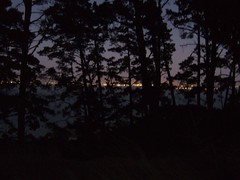

At night the lights of the shoreline could be seen through the trees against a deep purple sky just beyond the black silhouette of pine trees. All night the engines of ships and the relentless dinging of a buoy narrated this busy-ness. Luckily Stacy brought earplugs.
On our last day, the fog finally cleared enough to see San Francisco. Looking head on like this, she appeared as a woman lying down. The Twin Peaks tower adorning her head like a tiara. Her right arm the Golden Gate Bridge. Her left the Bay Bridge. Her body draped in a filmy wisp of fog.

On the return trip home, I took the ferry directly to the city, took a seat and remembered the comfort of upholstery.

Labels: , , , , ,

Wednesday, May 27, 2009

A Boat Of One's Own

Dimitry Orlov, my favorite collapse commentator, posted a piece about how the economic downturn had caused people to abandon what were considered luxury items ie: yachts and horses, the very things that would be helpful when fuel ran short. He mentioned horses for farming and sail for transport.

Maybe not just yet I mused; I was more thinking of the bargains made available by this fire sale.

I used to live in the very horsy town of Woodside with a woman who had two horses housed in a barn at the bottom of the driveway. We could saddle up and ride for miles through open space preserves linked by throughways on private property. Sometimes, on long rides, we did talk about horses as transport should the usual means shut down in an earthquake, say. I was confident, though, that we will not be seeing any abandoned horses in Woodside. The population is too wealthy and insulated with assets. If they manage to hang on to their land, horses are as easy to keep as dogs and one more wouldn't hurt.

As for sailboats, a quick look on Craigslist, showed that boats were for sale in abundance quite a bit below their value. If I were in need of a home it would be possible to live aboard a sailboat, as Orlov did (with his wife and cat), but I wasn't and I didn't want to pay slip fees either. Catherine was intrigued by the idea, though, and so was another friend, just to have a boat to escape to.

I had fond memories of teen years spent on my parents sailboat sailing the Bay. In the summer we invited a friend or two and were on the water nearly every weekend. My father skippered and my mother entertained. At the end of the day the wind would pick up and we would enjoy some real sailing. Any snacks remaining would fly across the deck, a cherry tomato squished against the white fiberglass, yellow chips littering the cockpit and once wine spilt a purple streak; it was all part of the fun and easy to wash up with a hose afterwards. I hadn't thought about those years at all until now and nostalgically recalled a carefree sensibility and an optimistic outlook for the future along with the salt spray and sunshine for I had escaped, temporarily, my only worry—homework.


Though I had been second mate and was handy with the jib, I had never learned to sail solo. Something about that tugged at me. I didn't want the responsibility of a big boat, but I did want a small one to call my own.

Orlov argued that even a small boat could be useful and a guest writer mentioned folding boats and fishing. Now I was really intrigued. How come I had never heard of a folding boat before? A folding boat could be kept at home in a space little bigger than one needed to house a surfboard. It could be tied to the roof of the car, unfolded in ten minutes and be both rowed and motored. You could even get a sail kit for it. I found one for sale on Craigslist—the Porta-Bote. This seemed too serendipitous and I started to obsess over it, spending hours online researching—secretly—as though visiting a mistress. Catherine frowned upon any large thing coming into the garage. I would have to find a place to stash it unobtrusively.

So heavily did I fall into this obsession that I had to ask myself what was up with this boat thing. Was it a mid-life crisis or what? I was experiencing an unfamiliar emptiness that was both freeing and left me feeling unanchored. My 50th year had been filled with a sense of accomplishment at having got my book out. I was now wondering what the second half of my life would be about or if it had to be about anything. I had no goals, no visions to aspire to, no long-term projects and for a week or so no clients. As I finished out my 50th year, my trip meter seemed to turn over to zero. I felt like a teenager facing the beginning of summer listlessly looking around for something to do—something to affect or try on. Colleagues who were also seeing empty days organized their own closets or took up crochet. Some had their meds adjusted.

For me a boat easily fit into my collection of human powered vehicles, yet was something new that I hadn't tried before as an adult. And here it was entering my consciousness as a post-collapse survival tool, the context by which I justified my investments of time and money. But was a boat a survival tool or an expensive new toy? It was not as though I could commute in a boat as I would on a bicycle.

Orlov spoke of a future of nomadic sailing farmers migrating between one source of food and another as they tended to permaculture plots planted in different climate zones to hedge their bets against the impact of global warming. This vision raised the hair on the back of my neck. I did not like having to work so hard for my food and then have it threatened by such uncertainty. It was enough just to tend to one garden. Our recent double-digging project to amend our clay based soil with sand and compost had taken three weekends. (But, oh, how it is paying off.)

Much as I had studied the twin forces of fossil fuel depletion and ecological devastation, it was seldom real to me in a visceral sense. It comforted me to know what was coming, but for all practical purposes was more a game I played as one would play at being explorers as a kid. It gave me a context for my low tech hobbies and helped me overcome the fears that did seep into my comfortable life.

It was also a tool of resistance to the constant pressure of technological life, requiring us to learn yet one more computer based networking system, software or hand held, electronic gadget. Playing at collapse in order to hone survival skills was my emotional hedge against the superiority of techno-geeks who at any given time seemed to have more up to date information to reach more clients, do things faster, and make better money—all with an iPhone.

But fishing meant killing something with your bare hands. I skipped that vision until I read an article about how Russians, looking for free food, would catch crayfish from local waters and keep them in the bathtub. The crayfish would try to escape. This made me laugh. Well maybe I would learn to boil crayfish and learn to fish too.

A boat of one's own, I concluded, was a sort of think tank vessel for a future that would transcend our immersion in electronic technology; be it a future that called for finding food, fetching cargo from a bigger boat, getting around in a flood after extreme storms or to cope once sea levels rose. It was also a hands-on activity not found much in my media intense leisure pursuits—hours of first run movies, TV and youtube clips.

I knew when the boat obsession still surfaced no matter how many hours I trolled youtube for music videos of girls kissing (and all the lesbian scenes from three season's of Grey's Anatomy), that I had best allow this boat thing to follow its course.

Exploring an aspect of our physical geography that was largely ignored by the combustion engine populace barreling down 101, suddenly had a great deal of appeal to me. It had been a long time since I had been to the water's edge and that seemed odd when we were surrounded by water. In a parallel universe sort of way our waterways were a secret world.

One Saturday morning, I drove down to Shoreline Lake where REI, the sporting goods store, was having a kayak demo day. I went early, was given brief instruction on how to get in a kayak and hold the paddle, tried out several different boats and had a good time for an hour and a half for free. (It is always best if obsessions remain free; that way it doesn't become all about shopping.) The physicality of being in the water focused me. I could smell the Bay and see the Santa Cruz mountain range at the same time. Kayaks though were pricey things like carbon fiber bicycles.


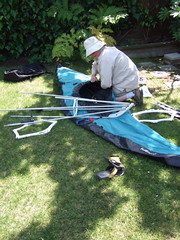
My friend Bart, a fellow collapsnik (and my editor at the Energy Bulletin), upon hearing of my boat fetish told me about his two folding kayaks. I invited him to lunch and we put one together in the garden. Called a Featherweight, it was an ingenious tent like structure made in Canada. The kayak, I was told at the REI demo, is something you wear as opposed to a canoe, which you get into. Bart's turquoise kayak lent itself well to boat as outfit and I was amused by the concept of dressing up in a long narrow tube and lowering yourself into a watery canal in order to experience a physical journey that would not be interrupted until it was completed. Bart was animated and happy as he told me about his kayaking experience, and invited me to come with him.

"I get tired of always thinking of what we must avoid in order to save the world," he commented as we packed up the kayak. "I'd rather have people pursue something that brings them joy." His advice reminded me that there was no harm in doing something simply for pleasure.

Meanwhile for a boat of my own, I was still drawn to something you get into and sail. The Porta-Bote on Craigslist, slipped from my grasp as did the next one and the next. The competition was indeed stiff for the older ones, so cheap were they at under $500. When a buyer beat me to a 6 a.m. listing I responded to at 7 a.m., I realized it was hopeless. They must be using specialized search software.

I searched for other folding boats, discovering a detailed photo blog belonging to a man who had built his own from a plan available online. It was adorable and even had a sail. I was poised to buy the plan (for $22.50, half price!). Then I realized it had taken the guy six months to build his and would probably take me two years. Maybe I should first try my hand at building a non-folding boat. It surely would be easier. Happily, this led me to a whole subculture of amateur boat builders enamored of small wooden boats built from plywood. Known as "instant boats" they were put together with tape and glue or "stitched and glued" with epoxy and wire. Or just plain nails and glue, which seemed more my speed, resembling as it did, a bookcase construction.

The most instant of these boats, built from a single sheet of plywood, could be made in a couple of weekends. Even children were building them, supervised by parents attempting to provide an alternative activity to video games. So popular was this challenge of using only one sheet of plywood to build a boat that it had its own discussion groups. Plans for the "one sheet skiff" were being shared for free. But I still couldn't quite grasp how it was done. What the heck was a chine or a gunwale?


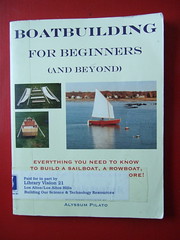
I visited all my libraries searching for books on building these "instant boats". There were two, both over 20 years old. I joined another library in another county because it had new boat building books in abundance. Each one had a sticker pasted across it informing me that it had been paid for by an entity concerned with "building our science and technology resources". I was tickled that here in Los Altos, a bedroom community of Silicon Valley, boatbuilding was considered a concern of science and technology. Might someone else be worried that high tech was blotting out skills we might need someday? What next? Blacksmithing?

As more boats eluded me on Craigslist, including an El Toro sailing dinghy, I realized that building a boat myself would actually be the better journey, not to mention costing very little. The skills I would learn would extend my knowledge to a new set of building parameters, as well as fulfill my sailing urge. I had already learned to read the one sheet skiff plans and could pick out the easy ones from the difficult. I lulled myself to sleep at night visualizing how the pieces would go together. And if the boat didn't fit in my garage I could always sell it on Craigslist. I had, after all, proven that the market was there.

Labels: , , ,

Earthworm. Get yours at bighugelabs.com