Amanda Kovattana

Middle-aged musings in interesting times

Sunday, April 05, 2020

Is This The Apocalypse I’ve Been Waiting For?


I am used to writing from my own bubble attempting to entertain with my slightly absurd minimalist approach to life, but it’s hard to write anything now without a coronavirus context. We are all in this together and I am even more aware of how my writings might fit into the temperature of the times. I want to tell you about the organic farming workshop I went to in Thailand, but I’m compelled to insert my report between stories of the coronavirus like the sandwich of the day. But maybe my off continent, off kilter perspective has something useful to offer. Or at least entertain. I hope you are all well and coping optimally.
Is This The Apocalypse I’ve Been Waiting For?

We’ve never experienced anything quite like this in the U.S. So you too might have asked yourself some of the questions that crossed my mind as we went into this pandemic. Ok maybe not in such depth. You have probably not waited quite so eagerly as I have for the collapse of American civilization. (My obsession due largely to my disgust at our consumer excess and as a psychological gambit that allowed me to maintain my sanity while living in such a complex society.) As a long time collapsnik I’ve been reading and entertaining myself with various scenarios of societal and systems collapse. 

My tiny house design incorporating much of what I learned. Electric grid gone down? Solar on board with battery bank. Earthquake ready? Of course I’m a Californian. Contamination of our water supply—field grade Berkey water filter already long in use. Interruption of water supply? 330 gallon water catchment system installed. Air quality at unhealthy 2.5 PPM due to fires? Got my RZ N99 reusable mask in fetching fashion print. (All sold out now.) Economic collapse? Expenses minimized and rent reduced to $500 and a work/trade agreement. Also debt free. Very important. Go bag? Stocked. Nuclear attack? Saw the movie. Not worth prepping for. Unless to take the cyanide route. Pandemic? Hmmm. Too big to scale. Definitely not my apocalypse.

I sat back and watched feeling I had little to offer other than a sense of expectation born of all my study. But then came the Toilet Paper Apocalypse. No toilet paper to be had in seven counties. All hoarded away by the early rush. I did not care about toilet paper any more than my countrymen in Thailand who were not hoarding anything least of all toilet paper. So why this sudden need to stash away a year’s worth of this mundane commodity? 

Psychologists speculated. Toilet paper is a low risk buy when people want a sense of control. You know you’ll always need it so why not have more on hand? It’s less of an investment than 50 cans of tuna fish that you might end up throwing out. Then others see the empty shelves and jump in too thinking if everyone’s doing it it must be the right thing to do. Add to this a sense of consumer competition to spur on the hunt. Also the packages are big and give a sense of having come away with a big haul. Yes makes sense. But the explanation I liked best was offered by a shamanic counselor who explained that the instinctive center is located at the base of the spine very near the anus. When people are frightened their instinctive center opens up. And having to poop when you’re out and having to look for a bathroom causes anxiety. But once a bathroom is found that anxiety is relieved and prompts a victorious sense of accomplishment. Everything is under control and all potential mess properly wiped away. Toilet paper thus became the iconic purchase of uncertain times—the means by which people could gain control of the situation.

I started to tease people online about their tree consuming ways. Long time readers of my essays may remember that I had learned to dispense with toilet paper for pee by employing a squeezable plastic water bottle with a sport top to squirt water at my nether regions and drip drying afterwards. Any drips absorbed by my thick cotton underwear. I did not mind admitting this personal habit even though I did not seem to persuade anyone else to follow suit.

As the Toilet Paper Apocalypse continued with more and more posts on the topic I became bolder and offered my experience with the ubiquitous bum gun installed all over Thailand and fitted next to the toilet. Basically a hand held trigger nozzle connected to the toilet water supply faucet and used to wash your bum. Called a shower bidet if you were to order one. The Thai ones look like the trigger spray attachment on a sink. 

A colleague posted a picture of a makeshift one made from a garden hose trigger nozzle as a joke. When another colleague commented that such a device would be a disaster spraying pathogens everywhere I pulled up a link to a traveler’s guide on how to finesse  the use of a bum gun while in Thailand. Toilet paper in Thailand was largely used for drying off. The real action lay in actually washing with water. The Thais do not feel clean unless they can use water. Why push poop around with paper like polish on a piece of furniture. I mean really? Such an unhygienic habit.

Paper had only become a commodity under the influence of Westerners and global trade. In a land of hardwood teak and mahogany paper had long been a precious commodity. As a child I would see paper bags made from the pages of Western magazines. And it is still wise when going out, especially outside of Bangkok, to carry toilet paper with you or buy it from a vendor. From my readings on the history of toilets I had learned that toilet paper was not a commodity used by most of the world and felt justified.  

“Two thirds of the world don’t use toilet paper you tree consuming Western colonial imperialists,” I admonished in a comment. My educated friends thought this accusation of imperialism by toilet paper was hilarious. Nobody would take me seriously because American fecophobia was such an assumed premise thought to be shared the world over. 

“Don’t Americans know how to wash their bums?” I asked. Still no answer. Look I’m really not a backward third world person I wanted to say. I’m British and if you were confronted with mid-century British toilet paper as a child you would have a highly perverted view of toilet paper too I countered. As late as the ‘70s the British stocked their public toilets with single sheets of slick glassine paper that worked only to provide a barrier from moisture, was full of sharp edges and scraped away poo like a spatula. 

In a week Americans began to consider toilet paper alternatives. The bidet toilet add-on was selling out fast on Amazon and a former Peace Corps volunteer friend offered his experience being taught to use water in Africa by a fellow American accustomed to America’s cultural disgust to help them get over the hump of washing poop from their bums with bare hands. My friend showed a bottle top device that would convert a plastic water bottle into a squeezable bidet. This too had to be mail ordered. “A bowl of water will do,” I commented remembering the ornately worked silver bowls sitting next to the large earthenware pots of water in the bathrooms of my childhood.

In 2001 when I learned about our sewer system in my construction technology class I was horrified that a first world system would actually allow poop to overflow their massive tanks given a good rainstorm. These liberated turds would then sail away into the bay. Why did anyone think it was a good idea to use good drinking water to give a turd a ride to a centralized plant anyway? Humanure was an organic and useful material in its proper context. With a centralized water treatment system chemicals have to be used to render the water safe for flushing out to the nearest water source. Such a river or lake was the same water source that would be siphoned up again for human use. And the sludge at the bottom of the tank that remained to be disposed of was toxic waste not because of the poop, but because it was now all mixed up wth industrial waste full of heavy metals and chemicals that companies are allowed to send down the same sewer system.

I was sure there would come a time when such a system would be severely compromised while environmentally such a centralized non-organic method was just wrong. So I devoted my life to the pursuit of a home with a composting toilet. My fascination blossoming at a recent workshop on effective microorganisms which included alternative technologies for poop disposal.


Effective Microorganisms

For my trip to Thailand in February my farm partner Clasina suggested we go to an organic farming workshop on effective microorganism technology. I was excited to attend this workshop because converting my composting toilet to an EM set-up had been a game changer for me. I also wanted to share my personal experience of the method and offered to give a powerpoint presentation to this august body.

Upon arrival at the International Kyusei Nature Farming Center in Saraburi just an hour and a half from Bangkok we were duly impressed by this university level facility with its modern buildings and extensive campus. Clasina was particularly impressed by the sparkling clean bathrooms. The program was created in collaboration with the Japanese EM industry (so they would not be teaching us how to make EM ourselves, just how to use it as much as possible so they could sell product). Indeed the Japanese EM technology was being quietly introduced to all of Asia through such outreach while being offered to the public through spas, hotels and wellness centers with EM fertilized organic food, lush gardens and EM disinfectants and cleaners. It was through such a wellness center in Hawaii that a friend had heard about it. The same friend who insisted that I trade out my traditional composting toilet method for this superior (and faster) EM technology. Instead of waiting a year to season a humanure composting pile, the EM process only took 2 to 3 weeks to reach a pathogen free state.

EM was a disinfectant we learned. It was spritzed into the air daily to fell harmful bacteria. It was made into non-toxic household cleaners and hand sanitizers. From the first day we were given our choice to use EM hand sanitizer or the usual alcohol based ones to fend off the virus.

The center was part of the Asia Pacific Natural Agricultural Network and our workshop was attended by a huge group from Malaysia, but also Myanmar and Japan along with one other woman from South Africa and me the lone representative of the U.S. Lectures were given in English with detailed powerpoint presentations in the air conditioned fully technical lecture hall. In the afternoons we boarded a people carrier much like a an amusement park train to tour the working farm. Students showed us how mushrooms were cultivated and served vegetable roll snacks. We saw how biochar was infused with EM to make a more potent fertilizer. We toured the lush fields of vegetables and the chicken and pig houses. I was bowled over by the use of EM technology in animal husbandry. There was no odor at all not even in the pig pens. 

EM was also added to the animal feed as a probiotic supplement. The EM infused feed kept them healthier and they grew bigger than with conventional methods. Every time their pens were sluiced down the pigs came running to slurp up the EM infused waster. Their waste was washed away into large concrete pits where the mixture became fertilizer (just as my own poop did inside my three gallon bucket). What a game changer alternative. Imagine such a solution putting an end to those problematic lagoons of manure that stink for miles and sometimes blow up like a geyser or overflow into waterways choking fish with algae blooms. EM worked in the same way I understood my composting toilet to work. The effective microorganisms ate all the harmful bacteria and were then eaten themselves in a probiotic fermenting process that ate up all the pathogens. This process was given the Japanese word bokashi. “Bokashi!” we shouted in every group photo.

We also saw how food scraps were treated with EM in 50 gallon drums from which the liquid was collected for use as a plant feed. This you can do at home too in smaller buckets. Hands-on demonstrations had us shoveling and mixing together ingredients so the EM infused bran could ferment the compost. The following day we returned to find that the piles were so hot they would turn our hands red and I wondered aloud if I could heat my tiny house with such piles or at least heat water. For fisheries EM could be made into softball size balls and thrown into the ponds to keep them clean. We had great fun seeing how far we could throw when we were all offered a turn. The EM balls reduced sludge at the bottom and had other applications including the clean up of latrines. In shrimp farming the shrimp poop is food for the microorganisms so EM made the water clear and cut down the stench. The meat of cows raised with EM technology was lower in fat and higher in vitamins.

We concluded our workshop with a visit to a recycling plant in Bangkok. Here the use of EM cut down on the biggest neighborhood complaint—the smell. Plus they were able to make toilet cleaner and dishwashing products from fermented rice water and other captured waste products. No harsh chemicals were used at all in this recycling and green waste processing. EM technology had also been introduced to the Thai military and was adopted as a method for large scale clean-ups. In the city it was offered as a drain cleaner in one of my friends apartment building. All of these projects had support from the Thai government which gave grants for outreach into the community to teach people how to make organic fertilizer from their kitchen waste. And because the late King Bhumipol had long been an advocate of a self sufficient economy and had been voicing his concerns about global warming since 1989, the reduction of carbon in the air through the use of EM technology and the concept of zero waste was considered a project of the King. This had enormous appeal for the Thais giving them not only a shared mission, but a way to further implement the King’s legacy for the good of the country.

In the evenings of our 4 day workshop participants representing EM companies made their presentations touting the benefits of their product while farmers showed their agricultural projects. I gave my tiny house presentation on the second night. I had rehearsed all my jokes and had enough pictures to show the whole tiny house trend to an audience unfamiliar with this American phenomena and its California origin. They loved it. Having sufficiently explained why such a house needed to process their own waste, they had no questions about my EM methods so I was clearly doing it right. But the look of incredulity on the face of a Japanese woman who represented a health supplement company told me how out there I was. None of these professional EM distributors had thought of such an application. They did not know about the pet waste disposal system I was able to purchase in the States and asked how much I had paid for the kit. ($100). Like any other first world society it had never occurred to them to dispense with the flush toilet. Nor were they about to. Some teased me about it later, but I was happy that I had earned my place in the EM technological revolution. Pictures of the workshop on my flickr site

It was in this context that I realized my aversion to toilet paper. As a connoisseur of composting toilets I was a compost purist. I did not like seeing toilet paper in my compost plus it would fill up the bucket faster though it was perfectly ok to add toilet paper to the mix. It would compost just as well. But why buy this chemically produced tree product at all given the Thai option of washing my bum while squatting over my poo bucket and gently pouring water from a bowl with my right hand. Getting poo on my hand (the left one as is traditional in bum washing countries) was not inherently dangerous. Or we wouldn’t allow babies to sit in soiled diapers. People do wash baby’s bums don’t they? How much had we just been taught that it was abhorrent to have contact with one’s own poo? And by whom? TP makers? Why would frugal Americans give up the pages of the Sears catalog for such a wasteful product? There was no real reason I concluded. Just an industrialized country’s status marker. I just wash my hands super well afterwards. More than I had ever bothered to before. More than most toilet paper using Americans given the reports of fecal matter on touch screens everywhere. heh. 


Lockdown

Returning to the states the virus was just making its appearance. On the day of the Bay Area lockdown I saw on TV at Catherine’s house the local mayors and health officers each taking their turn to voice their support of the decision. I was heartened by their concern for the people, for us. They were actually going to do this unprecedented move to protect us from the overwhelm the Italians were experiencing with their health care system. It was rare to experience such concern from local government. This was the town where the rich had their way and tech companies called the shots. The housing crisis and mobile homelessness in the RV population bearing witness to the priority to keep expanding jobs, but not housing.

The Friday before the lockdown Catherine and I had gone out to dinner to celebrate her getting a job with a tech company in San Francisco. And now she was crazy busy on boarding on line with everyone else who was able to work from home. Such fortuitous timing to at least have a job during this time. While I kept one shut-in weekly client. My mother and her partner Bill and my immediate circle were all ok too, but for those colleagues who faced economic devastation their stories foreshadow a vaster crisis that may very well not garner the same sympathy. As a nation we would far rather root for life over death than for equity for the poor. My thoughts went to every small businesses I relied on from acupuncture to karate that were now closed

Some with the most to lose financially were posting that the death statistics of COVID-19 were wrong, that the virus was overhyped and there was no reason for a shutdown of the economy. Just look at Sweden. Well we shall see if their argument holds. The virus was bringing forth everyone’s belief system like nothing else had. Low grade conspiracy theories (as opposed to those with a kernel of truth) were popping up all over. Humans live on stories. And would die by them too I could see. Witness misguided vigilante types buying out the supply of guns and ammo to protect themselves from the supposed government plot to control their freedoms. I made it my coronavirus job to challenge such stories as they crossed my feed and comforted myself with the relative calm of Asia handling the virus with a more prepared system of  tracking and isolation that didn’t require a lock down. Plus public education and free masks. The economic price of our lockdown would, however, have serious consequences. One that did not bode well and concerned me more than the virus.

Having seen Thailand process through the currency collapse and economic fallout when the Asian Tiger countries went down in 1998 I am hopeful. I saw the seeds of self-sufficiency blossom during that time and can now participate in the positive movement towards a more sustainable and self-sufficient Thailand. And still more heartening I have seen people of my own wealth class change for the better. It was not the easiest of transitions given the contentious political unrest that happened along the way, but the lessons were learned. The vulnerable in society can no longer be ignored.

I returned to my tiny house for the duration of the lock down and felt blessed by the beauty of my location and the hiking trails that would take me high into the hills so I could clear my head. My studies of the collapse of society had prepared me for societal failure. Useful for witnessing Trump express the full GOP agenda of minimizing aid from the federal government and telling the states they were on their own. I was reminded of the balkanization of the Soviet Union into separate states that took place prior to the collapse of the USSR. What kind of a United States will we become after this crisis? That Asia could take this pandemic in stride made the virus here look like a mosquito felling a giant. I highly recommend the daily newsletter of Heather Cox Richardson an American history professor deconstructing the news from a historical long view saving me much time and reassuring me with historical moments when the U.S. overcame similar crisis. 

 I’m just glad I’m in California especially in the Bay Area where intellect is the dominant influence. Given the political leadership initiating the nation’s first lockdown, I can now envision our wealthy Bay Area community turning an eye towards the self sufficiency of our state for the safety of its people possibly even allowing taxes to be raised. Tech based companies are already moving towards securing their supply lines in the event of global hotspots, with more technological eyes on those sources and more labor at home to manage home grown supplies. What technology that has come out of Silicon Valley of late has been all over the map in terms of having good and bad affects on society worldwide, exploiting addictive behavior and fanning consumer appetite. Perhaps we just needed a life threatening crisis to remind us to lean more towards security for all and be less about individual wealth accumulation. Just as the virus had given us a knife to cut away all the non-essentials we thought were so necessary to our lives so may it give us a mission. One closer to home. May it be so.

Labels: , , , , , ,

Monday, March 28, 2011

On Watching Japan

An astonishingly short piece. Written, as usual to save own life, but in this instance I have help.

On the way to visiting my family in Thailand, I often travel on Japan Airlines and stop at Narita airport. Thus Japan is a part of going home for me. In studying Asian culture and modern development, I have read much about life in Japan so felt a kinship with her people. I had respect for their education system, public healthcare system (the best in the world) and the high quality of public transportation was enviable. So to watch such organization and well thought out systems turn to piles of splinters filled me with compassion. Astonishing really to see such an exemplary example of modern living so easily destroyed. Yet how familiar it was to the precariousness of my home in earthquake country here in the Bay Area.

Natural disasters will strike. We know that. We also know that the human population is such that we are densely packed everywhere especially in coastal regions. We know that these densely packed regions are built to resist nature not flow with it, but there is only so much resistance we can build into concrete structures. When natural forces overcome them, the washing away of entire cities has the haunting inevitability of a Greek tragedy. Add to that the even greater hubris of nuclear power plants sitting on unstable fault lines and it is all too clear what a folly our manmade systems are. Thus I felt that Japan was bearing such suffering for all of us really.

When the shelter in place orders were given for those within 20 miles of the broken nuclear power plant, I felt trapped. Looking around the house I wondered if we would have enough food for the length of time it was going to take for the Japanese people to weather this ordeal. Would they have clean water? Clean food? Not likely. What was this karma Japan had with radiation? I felt this power plant disaster would render the country a closed nation. We would want nothing to do with Japan if that would keep the disaster from affecting our lives. These thoughts haunted me for days.

I searched the faces of others in my day to day travels looking for the shell shocked gravity I felt at this folding up of a country. I couldn't quite trust myself not to break into a rant at the slightest opening, with clients, with other Asian faces. I tried to hold the story lightly, but it only made me feel more isolated. At home my partner and brother-in-law, tuned into CNN kept me updated with breaking news. I joined them sparingly subjecting myself to the fever of impending nuclear meltdown. Where was the transformation in this story? Would this just be another terror of the week and then we go back to what we were doing?

Nearly a week after the tsunami, a contact passed along a letter from an American woman in Sendai describing how the people were coping. It was such a beautiful picture of cooperation and neighborly kindness that I took to heart this little bit of humanity in the face of such overwhelming devastation. The writer reported all the things people were doing to make sure everyone had food and water; how she found food left on her doorstep when she came home; how men in green caps walked around checking that everyone was safe; how people said this was just like the old days when everyone helped each other.

That Japan was still able to remember its humanity and the old way of doing things comforted me greatly. In a BBC account of old people sheltering in a school where there were inadequate supplies, an elderly man said "We're okay. We sit together and talk or read. Everyone has the same as everyone else now. Nothing." I was very moved by those sentiments.

The American woman's letter soon popped up elsewhere, on Facebook, passed along in e-mails and now Ode magazine hosts her ongoing letters on their blog, so much do her accounts help to heal the overwhelm. (Look for her name in the byline: Anne Thomas.) She spoke so directly and so articulately to my search for transformation that I offer her words, from the closing paragraph of her first letter, rather than paraphrase her:

"Somehow at this time I realize from direct experience that there is indeed an enormous Cosmic evolutionary step that is occurring all over the world right at this moment. And somehow as I experience the events happening now in Japan, I can feel my heart opening very wide. My brother asked me if I felt so small because of all that is happening. I don't. Rather, I feel as part of something happening that is much larger than myself. This wave of birthing (worldwide) is hard, and yet magnificent."

How amazing that she spoke of a Cosmic shift, a worldwide birthing. I knew nothing about this woman, why she was living in Japan, what her life was about, yet she seemed to have tapped into exactly the same vein of thought that I had just discovered using almost the same words. And she was describing her days with such a vulnerability and simple power, that I found not only her words to be a balm and a comfort, but the very idea of words themselves to be a comfort. Here just one woman offering her own experience and observation was enough to bring comfort to so many; it poured into me an intense appreciation for the power of words.


I went about my day looking for places where I could work similar magic with words—to comfort a friend who was having a hard time, or to further a message of compassion, humor or mutual experience. This woman who had become an accidental writer for so many, filling in a needed void, had made my own meandering writer's life meaningful, had reminded me that the observations of one person could be just exactly the medicine the world was looking for. And, that what we did mattered, whether in the simple kindnesses of the events she described or the witnessing and reporting of it.


I took comfort in this cosmic evolution of one corner of the world. When I woke from sleeping, even if just a nap, I felt such a sweetness at still being alive and safe that every day became a gift.

Then I went out to buy cans of food to stock our emergency supplies box.

Labels: , ,

Saturday, March 12, 2011

What Color Is Your Prophecy?

In light of the unfolding disaster in Japan, it seems in bad taste to speak of prophecies (too much like those endtime blogs). This piece was intended to be a light-hearted chapter of my personal journey at a 2012 event two weeks ago. That being said, the lens I was gazing through does have an uncanny perspective on such catastrophic disasters.


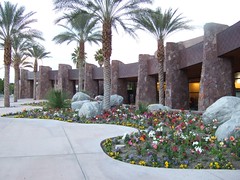
As I entered the Fred Flinstone structure that characterizes the convention center in Palm Springs, I was intensely curious about what kind of people would come to The Prophet's Conference on 2012. It was odd enough that I was there. Such an expedition into the high dessert for a weekend of lectures by speakers dispensing insight into the Mayan prophecy required serious wu wu credentials.

I did have a journalist's curiosity and, having reported mostly from the doomer's corner concerning planetary demise, I thought there might be interesting parallels in the prophecy corner.

I discovered the event because a teacher I was following was speaking at the conference—Alberto Villoldo. (How serendipitous that it wasn't far away; I could make it a business trip and visit our renters.) Catherine had introduced me to Villoldo with his book "The Four Insights: Wisdom, Power, and Grace of the Earthkeepers". Since she had not managed to make a Buddhist scholar of me, she decided I should follow a spiritual path of some sort so we would have something heart based to talk about. She thought a path of shamanism might do. The book did indeed resonate with my pagan leanings and introduced to me the Shamanic path of co-creation with the universe.

I had abhorred other "create your own reality" books, especially "The Secret", which had dumbed down the message into a materialistic 24/7 cosmic shopping channel. Villoldo's book reached beyond wants and goals to a place where I could find an underlying motivation that had meaning for me. His techniques took the co-creation part far from vision boards and affirmations on post-it notes. He allowed me to tell my own story, not only in terms of the present, but into the future. I found this approach to be a powerful focusing tool.


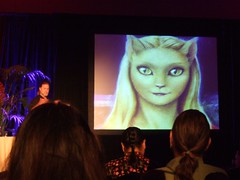
It was the other less academic speakers who gave the conference a particularly wu wu flavor. One, James Gililand, would be presenting information about his contact with extra terrestrials, UFOs and other paranormal appearances. There was also Little Grandmother, a young white woman who had garnered a following via the internet with youtube videos of herself dressed in buckskin sitting with her Tribe of Many Colors and delivering a prophecy that she claimed was being told to her by spirits. I found her presentation strangely compelling.

"We were not going to be allowed to destroy the planet", she told her viewers. Spirits of the ancients from the Other Side and extra terrestrials were standing by to help. To invite this help she was asking us to shift into our intuitive feminine nature and make our decisions from our heart and not our minds. We would then recognize the proper helping spirits. (If not we would presumably be sloughed off like so much head lice.)

These were the speakers who would get me into trouble with my reality-based community. Having built my reputation on a scientific, fact based approach to generating solutions to our planetary problems, this sudden switch to such fantastical material appears a bit psychotic. Plus a group of Native Americans were quite unhappy with the borrowing of their ceremonial traditions and misrepresentation of their teachings in Little Grandmother's presentation, adding a decidedly politically incorrect component to the event I was supporting with my money.

The friend who alerted me to these cultural complaints had sent me a link denouncing Little Grandmother as a fraud. We had a heated discussion in which he told me that to entertain such dubious material was as addictive as drugs, possibly resulting in permanent loss of sanity as had happened to a friend of his when he was young.

I was 52 not 22. The bigger danger for my soul was to become so skeptical that I could no longer believe in anything at all.

All that my study of known reality had done for me was root me in despair that the momentum of our exploitative social and financial systems would doom the human race while our attempts to save ourselves with our brains would continue to bury us in technological hubris. I wanted to believe in something else for a change. Or everything. Believing in everything would at least cover all the possibilities. 2012 would soon be upon us; this would be my last chance to entertain any of the 2012 prophecies and wonder what to make of it.

Plus my mother wanted to know.


Family Prophecies

Readers of my memoir of Thailand are familiar with my family story of a psychic American friend who would spend the evening summoning spirits to entertain my parents. My mother had seen her own coffee table move across the room—and back—during one such session. It left a lifetime impression that tempted her beyond her science based education. She was fond of books describing alternate narratives i.e. Chariots of the Gods (evidence of aliens helping us build civilization). We both read the Shirley Maclaine books. As a family, one of the few movies we saw together was 2001: A Space Odyssey.

Every so often, she would recount the story of the coffee table to new friends. One of the spirits had predicted that my family would emigrate to the United States and since we did end up here, it added punch to the story.

My father being Thai had no reason to discount any of the spirit information and neither would I, having been similarly raised with a family fortune teller, a healthy respect for spirits and a personal history explained by past lives that outranked any psychological explanations when it came to sexual preference. Reincarnation was a given throughout my life though it had faded from view somewhat in the face of Western culture and Western Buddhists who had stripped such "faith-based" belief from the teachings. (Nor did I protest too much this borrowing and neutering of my native traditions once I realized that American Buddhism was what was keeping it alive.)


2012: The Optimist's Club

I came late to the party. The first time I heard about 2012 was only 4 years ago. An intense young Canadian traveling with me through Northeast Thailand on a tour of sustainable, organic farms showed me a hefty book called "Return of Quetzalcoatl". The book was driving the decisions he was making in his life (for the better). Thus I came to sense that an increasing number of young people were taking 2012 seriously.

Apocalypse type stories had no appeal to me, but I was to discover through Alberto Villoldo that there were teachers who took 2012 seriously as a passage of transformation, of rebirthing.

The first time I heard the concept of a cultural paradigm shift was from Joanna Macy, a well respected American Buddhist teacher whom I had seen giving a presentation, alongside peak oil guru Richard Heinberg, on preparing for peak oil on a psychological level. She was convinced that the culture had already made significant strides towards The Great Turning, as she called it, as more people than ever were aware of how our lifestyles impacted the planet and had jumped on board the path to sustainable technology.

The teachers speaking at The Prophet's Conference were doing the same positive transformation work, some more certain than others that the 2012 paradigm shift would include extra curricular events on the actual date. Most thought the prophecy was already underway.

Geoff Stray, a Brit who spoke the first day of the conference, spent an hour reeling off a couple dozen prophecies both ancient and modern. Not only the Mayan calendar, but the Hopi, South African, Maori, Hindu and Tibetan all had 2012 prophecies. So did the Judeo Christian Islamic religions; he showed how the date was calculated. He also described the contemporary reports of individuals who had undergone near death experiences, drug induced shamanic journeys, out of body experiences, remote viewing, lucid dreaming and alien abductions all naming 2012 as the time of their prophecy, completely unaware of the date before.

There was the prophesy about the reversing of the earth's polarity causing serious planetary catastrophe that I'd already heard described on the history channel episode on 2012, plus increased earthquakes and disasters. More fun was the simultaneous triggering of a dormant enzyme in every human brain caused by a reduction of the geomagnetic field brought on by increased solar flares. Also predicted was increased psychic ability. (I could have seen that coming.) And for the UFO crowd, the switching on of alien implants in previously abducted humans. I bought his pocket guide to keep track of them all.

Geoff's presentation was tempered by Daniel Pinchbeck, a journalist and author of Return of Queztacoatl (the book my traveling companion was hauling around). Daniel was a thirty something journalist, who found his path through the use of hallucinogenic plants guided by South American shamans. He slouched deeply into his chair and habitually cocked his head to one side when standing at the podium. I nicknamed him The Pinchbeck of 2012, but his cerebral intensity was comforting. He was my bridge between the peak oil and climate change doomers and these intuitive based Paradigm Shifters.

Pinchbeck claimed that a balance between head and heart was the best approach for helping to shift the physical world from destructive, monolithic systems to sustainable, local, regenerative ones. His 2012 movie interviewed innovators I had already heard at Bioneers. He said we were undergoing a wisdom revolution. The agriculture revolution had taken 3,000 years, the industrial one 300 years, the information revolution only 30 years so it was entirely possible that a wisdom revolution would take a mere 3 years. I was totally behind this idea given the Internet and social networking. He was working on a social networking site to connect people to planet saving projects and invited us to join it.


Of the nearly 200 attendees, most were middle-aged women not social networking sorts. They were on the shy side, but friendly enough when approached; many women friends together, many lesbians. As a way of chatting people up, I asked individual attendees which speaker had brought them to the conference. I made friends with a Pinchbeck fan sitting near me, intently reading a 2012 book. Many said they came for Keisha Crowther the young woman prophet who had been given the name Little Grandmother by a Native American shaman (though he turned out not to have permission from the proper authorities). When I posted my pictures to flickr her picture got the most hits by a large margin; clearly she was the celebrity of the 2012 party.


She barely made it to the stage. I was afraid she might collapse like Sissy Spacek playing Loretta Lynn in Coal Miner's Daughter. But Keisha stayed upright, gaining strength as the connection with the audience poured energy into her. She talked about being violently ill that morning as a result of being the target of hatred. (A small group of Native American protestors had greeted us that morning.) She explained the misunderstanding surrounding her initiation as a shaman, how it had tested her ego (and helped her dispense with ego), how she had agreed not to do any more Native American ceremonies. There is a statement to this affect on her website. (She also shut down her Tribe of Many Colors online forum the day before this appearance.)


Stripped of the buckskin and ceremonial paraphernalia, Keisha appeared in chinos and an argyle sweater vest. She was still passionate about saving "our mother earth" and inspiring others to do so. Her vulnerability was genuine and I had no reason to doubt that she was internally driven and was speaking from an intuitive based knowledge though she emphasized that she was just an ordinary person like us. Apart from earnestly telling us to love ourselves first, and how wrong it was to hate people just for whom they loved (no wonder she had a lesbian following), she added a little extra bit.

"You know those hunches you have about things, that you then talk yourselves out of. Stop doing that," she said. I put that in my pocket.

I would meet other intuitive based people as I continued to make eye contact and ask people questions. One told me she was a grief counselor; When I asked her what kinds of therapies she used, she told me about sound therapy. How a crystal bowl played close to the solar plexus really opened her clients up to working with her. She pointed to one about the right size that was sitting on the display stand of the crystal bowls booth. She thought sound therapy would totally work with hoarders and urged me to try it. There I thought; I just justified my continuing education deduction.

Another, a lesbian Rabi, told me how her guides had directed her to take a certain workshop over another, thus normalizing for me the use of personal spirit guides. When I told her I wrote reports of my journey to my readers, she asked me if they were real people. Oh yes I assured her. Some even write back.

The Visionary Road

On Sunday Barbara Marx Hubbard, a veteran New Age thinker since 1966, described a scenario that I had already begun to formulate. This would be a media generated phenomena since so many of us are globally connected by instant access to breaking news. Witnessing a catastrophe such as might be prompted by a natural disaster or act of injustice, would create a moment of shared global pain leading to mass empathy, mass revelation and mass introspection which would then open our collective eyes. We would see that we weren't alone and that would create receptivity for a simultaneous, synchronization of technology and social systems that work.

I had felt that way about the Arizona shooting of Gabrielle Glifford and others. Glifford was such an attractive woman and rational, someone we could relate to. An archived news interview of her went viral; it showed her cheerful determination to continue the work of democracy despite threats of violence from Palin supporters. This quickly made her into a symbol of democracy. As the story continued with the moment-by-moment coverage of her recovery, her character achieved heroic proportions. The morning she was moved to the rehabilitation center the newsmedia followed with helicopter shots of the lengthy motorcade accompanying her ambulance. The message was clear—we are not letting anything else happen to this woman or to our fragile democracy. We will not let the country be run by thugs directed by vitriolic talking heads. Glenn Beck lost a million viewers that month.


Barbara called the newsmedia our collective nervous system raising our sense of connectivity and our vibration quotient and offering a feedback loop for our awakening. Thus she saw 2012 as reason for celebration of a birthday of this new sensibility. The name of the conference "2013: Day One" reflected this invitation. She warned us that crisis precedes innovation, that there would be no awakening to the desire to create a higher order without a period of disorder. She pointed out that it was easy to see everything that was wrong with the world, but much harder to see the emerging New Paradigm because it has never existed before. Hmmm. Seeing the positive emerging paradigm was actually a subversive act! It was in defiance of the dominant doomer perspective.

I took notes furiously. The material from these speakers was so dense that I was glad to have Swami Beyondananda simplify it for me.

"The Shift is hitting the fan," he punned. "You may be asking why is this Shift happening to me, but Shift happens." In his more serious incarnation as Steve Bahrain, he explained that because people have not connected to the divine it had allowed the 3Ms to take over—money, materialism and machines (and Monsanto). Pinchbeck, too, had said that because we had no cosmology we hung onto ego. Now he was witnessing a lifting of the veils with so many mystery schools opened and ancient systems liberated from secrecy. In order to develop this evolutionary awareness, he advised, we had to be aware of both the old story and the new and program in the new.

At the end of the day, several speakers assembled for a panel to discuss alien intervention. James talked about how, as more people became able to receive help from extraterrestrials, the ETs would reveal themselves. His videos showed the lights of UFOs flying in; one had seemed to greet the camera with a flashing of their high beams and two had a playful crossing. He said that he had told newsmedia when to come to photograph them and the UFOs had indeed shown up. People came to his ranch to learn how to meditate and put out good vibrations to invite the ETs to show themselves. (The friendly ones sensitive to good vibrations.) Alberto said he and his indigenous friends had seen UFOs but his friends said they were waiting for the ones that didn't come in "buses". Barbara (who had no experience of UFOs) agreed that it made sense that in order to welcome ETs we had to give off a friendly vibration. All agreed that a critical mass of aware people creating receptivity would allow ETs (and other helping spirits) to penetrate our neo-sphere, the thinking layer of the earth.


Before I left the conference I stopped to talk to Freddy Silva (a crop circle expert), who had given an amazing slide show of ancient sites and power spots all over the world, showing how they created electromagnetic forces with the placement of their pillars or their placement of stones on power spots. This archeological technology of the ancients was designed to enhance human potential, he said; a heightened psychic or creative ability say. I was terrifically drawn to this Feng Shui on steroids and the relationship between these temples.

He was leading a tour of Stonehenge and other sites near Glastonbury in July. I asked him if I would be able to touch the stones at Stonehenge. (They are roped off 100 feet out.) He assured me that we would have complete access to the site for our sunset visit. That alone was worth the price of admission, he added. I was sorely tempted. I hadn't been to England in 20 years and I had been looking for a good excuse.

As I drove out of Palm Springs, I felt the fog of doubt burn from my mind and my normal equanimity replaced by an emotion I rarely felt—impatience, impatience with my own lack of narrative with no particular goal (no prophecy of my own) pulling me. All I needed was a good story. I could see myself creating the new paradigm, now, just from what I could observe and intuit.
Contemplating such a reality made me feel slightly unstable and giddy as though I should carry a warning label:
"Caution I am making this Shift up."
I had, however, tasted a new sensibility and was eager to see how I could make it stick.

Also posted to the Energy Bulletin

Labels: , , , ,

Wednesday, May 27, 2009

A Boat Of One's Own

Dimitry Orlov, my favorite collapse commentator, posted a piece about how the economic downturn had caused people to abandon what were considered luxury items ie: yachts and horses, the very things that would be helpful when fuel ran short. He mentioned horses for farming and sail for transport.

Maybe not just yet I mused; I was more thinking of the bargains made available by this fire sale.

I used to live in the very horsy town of Woodside with a woman who had two horses housed in a barn at the bottom of the driveway. We could saddle up and ride for miles through open space preserves linked by throughways on private property. Sometimes, on long rides, we did talk about horses as transport should the usual means shut down in an earthquake, say. I was confident, though, that we will not be seeing any abandoned horses in Woodside. The population is too wealthy and insulated with assets. If they manage to hang on to their land, horses are as easy to keep as dogs and one more wouldn't hurt.

As for sailboats, a quick look on Craigslist, showed that boats were for sale in abundance quite a bit below their value. If I were in need of a home it would be possible to live aboard a sailboat, as Orlov did (with his wife and cat), but I wasn't and I didn't want to pay slip fees either. Catherine was intrigued by the idea, though, and so was another friend, just to have a boat to escape to.

I had fond memories of teen years spent on my parents sailboat sailing the Bay. In the summer we invited a friend or two and were on the water nearly every weekend. My father skippered and my mother entertained. At the end of the day the wind would pick up and we would enjoy some real sailing. Any snacks remaining would fly across the deck, a cherry tomato squished against the white fiberglass, yellow chips littering the cockpit and once wine spilt a purple streak; it was all part of the fun and easy to wash up with a hose afterwards. I hadn't thought about those years at all until now and nostalgically recalled a carefree sensibility and an optimistic outlook for the future along with the salt spray and sunshine for I had escaped, temporarily, my only worry—homework.


Though I had been second mate and was handy with the jib, I had never learned to sail solo. Something about that tugged at me. I didn't want the responsibility of a big boat, but I did want a small one to call my own.

Orlov argued that even a small boat could be useful and a guest writer mentioned folding boats and fishing. Now I was really intrigued. How come I had never heard of a folding boat before? A folding boat could be kept at home in a space little bigger than one needed to house a surfboard. It could be tied to the roof of the car, unfolded in ten minutes and be both rowed and motored. You could even get a sail kit for it. I found one for sale on Craigslist—the Porta-Bote. This seemed too serendipitous and I started to obsess over it, spending hours online researching—secretly—as though visiting a mistress. Catherine frowned upon any large thing coming into the garage. I would have to find a place to stash it unobtrusively.

So heavily did I fall into this obsession that I had to ask myself what was up with this boat thing. Was it a mid-life crisis or what? I was experiencing an unfamiliar emptiness that was both freeing and left me feeling unanchored. My 50th year had been filled with a sense of accomplishment at having got my book out. I was now wondering what the second half of my life would be about or if it had to be about anything. I had no goals, no visions to aspire to, no long-term projects and for a week or so no clients. As I finished out my 50th year, my trip meter seemed to turn over to zero. I felt like a teenager facing the beginning of summer listlessly looking around for something to do—something to affect or try on. Colleagues who were also seeing empty days organized their own closets or took up crochet. Some had their meds adjusted.

For me a boat easily fit into my collection of human powered vehicles, yet was something new that I hadn't tried before as an adult. And here it was entering my consciousness as a post-collapse survival tool, the context by which I justified my investments of time and money. But was a boat a survival tool or an expensive new toy? It was not as though I could commute in a boat as I would on a bicycle.

Orlov spoke of a future of nomadic sailing farmers migrating between one source of food and another as they tended to permaculture plots planted in different climate zones to hedge their bets against the impact of global warming. This vision raised the hair on the back of my neck. I did not like having to work so hard for my food and then have it threatened by such uncertainty. It was enough just to tend to one garden. Our recent double-digging project to amend our clay based soil with sand and compost had taken three weekends. (But, oh, how it is paying off.)

Much as I had studied the twin forces of fossil fuel depletion and ecological devastation, it was seldom real to me in a visceral sense. It comforted me to know what was coming, but for all practical purposes was more a game I played as one would play at being explorers as a kid. It gave me a context for my low tech hobbies and helped me overcome the fears that did seep into my comfortable life.

It was also a tool of resistance to the constant pressure of technological life, requiring us to learn yet one more computer based networking system, software or hand held, electronic gadget. Playing at collapse in order to hone survival skills was my emotional hedge against the superiority of techno-geeks who at any given time seemed to have more up to date information to reach more clients, do things faster, and make better money—all with an iPhone.

But fishing meant killing something with your bare hands. I skipped that vision until I read an article about how Russians, looking for free food, would catch crayfish from local waters and keep them in the bathtub. The crayfish would try to escape. This made me laugh. Well maybe I would learn to boil crayfish and learn to fish too.

A boat of one's own, I concluded, was a sort of think tank vessel for a future that would transcend our immersion in electronic technology; be it a future that called for finding food, fetching cargo from a bigger boat, getting around in a flood after extreme storms or to cope once sea levels rose. It was also a hands-on activity not found much in my media intense leisure pursuits—hours of first run movies, TV and youtube clips.

I knew when the boat obsession still surfaced no matter how many hours I trolled youtube for music videos of girls kissing (and all the lesbian scenes from three season's of Grey's Anatomy), that I had best allow this boat thing to follow its course.

Exploring an aspect of our physical geography that was largely ignored by the combustion engine populace barreling down 101, suddenly had a great deal of appeal to me. It had been a long time since I had been to the water's edge and that seemed odd when we were surrounded by water. In a parallel universe sort of way our waterways were a secret world.

One Saturday morning, I drove down to Shoreline Lake where REI, the sporting goods store, was having a kayak demo day. I went early, was given brief instruction on how to get in a kayak and hold the paddle, tried out several different boats and had a good time for an hour and a half for free. (It is always best if obsessions remain free; that way it doesn't become all about shopping.) The physicality of being in the water focused me. I could smell the Bay and see the Santa Cruz mountain range at the same time. Kayaks though were pricey things like carbon fiber bicycles.


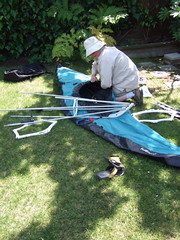
My friend Bart, a fellow collapsnik (and my editor at the Energy Bulletin), upon hearing of my boat fetish told me about his two folding kayaks. I invited him to lunch and we put one together in the garden. Called a Featherweight, it was an ingenious tent like structure made in Canada. The kayak, I was told at the REI demo, is something you wear as opposed to a canoe, which you get into. Bart's turquoise kayak lent itself well to boat as outfit and I was amused by the concept of dressing up in a long narrow tube and lowering yourself into a watery canal in order to experience a physical journey that would not be interrupted until it was completed. Bart was animated and happy as he told me about his kayaking experience, and invited me to come with him.

"I get tired of always thinking of what we must avoid in order to save the world," he commented as we packed up the kayak. "I'd rather have people pursue something that brings them joy." His advice reminded me that there was no harm in doing something simply for pleasure.

Meanwhile for a boat of my own, I was still drawn to something you get into and sail. The Porta-Bote on Craigslist, slipped from my grasp as did the next one and the next. The competition was indeed stiff for the older ones, so cheap were they at under $500. When a buyer beat me to a 6 a.m. listing I responded to at 7 a.m., I realized it was hopeless. They must be using specialized search software.

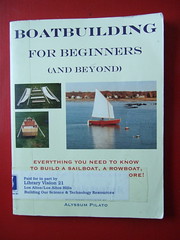
I searched for other folding boats, discovering a detailed photo blog belonging to a man who had built his own from a plan available online. It was adorable and even had a sail. I was poised to buy the plan (for $22.50, half price!). Then I realized it had taken the guy six months to build his and would probably take me two years. Maybe I should first try my hand at building a non-folding boat. It surely would be easier. Happily, this led me to a whole subculture of amateur boat builders enamored of small wooden boats built from plywood. Known as "instant boats" they were put together with tape and glue or "stitched and glued" with epoxy and wire. Or just plain nails and glue, which seemed more my speed, resembling as it did, a bookcase construction.

The most instant of these boats, built from a single sheet of plywood, could be made in a couple of weekends. Even children were building them, supervised by parents attempting to provide an alternative activity to video games. So popular was this challenge of using only one sheet of plywood to build a boat that it had its own discussion groups. Plans for the "one sheet skiff" were being shared for free. But I still couldn't quite grasp how it was done. What the heck was a chine or a gunwale?


I visited all my libraries searching for books on building these "instant boats". There were two, both over 20 years old. I joined another library in another county because it had new boat building books in abundance. Each one had a sticker pasted across it informing me that it had been paid for by an entity concerned with "building our science and technology resources". I was tickled that here in Los Altos, a bedroom community of Silicon Valley, boatbuilding was considered a concern of science and technology. Might someone else be worried that high tech was blotting out skills we might need someday? What next? Blacksmithing?

As more boats eluded me on Craigslist, including an El Toro sailing dinghy, I realized that building a boat myself would actually be the better journey, not to mention costing very little. The skills I would learn would extend my knowledge to a new set of building parameters, as well as fulfill my sailing urge. I had already learned to read the one sheet skiff plans and could pick out the easy ones from the difficult. I lulled myself to sleep at night visualizing how the pieces would go together. And if the boat didn't fit in my garage I could always sell it on Craigslist. I had, after all, proven that the market was there.

Labels: , , ,

Wednesday, April 22, 2009

The Hope of Innovation

Supposedly one of the reasons that the world tolerates Americans, and indeed one of the reasons we tolerate ourselves, is because we have a reputation for innovation. As an innovator myself I can vouch for this.


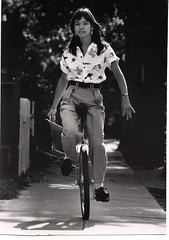
When I learned how to ride a unicycle in high school, I was assisted by a number of factors. First I was introduced to the idea while attending the Fourth of July parade in Redwood City (affectionately known as The Redneck City Parade) where I saw a drill team from Concord riding unicycles. That ordinary Americans were doing something unusual in an ordinary way made it entirely possible for me to think to do such a thing. I went to my local library and found a book devoted to unicycle riding. I was able to buy one locally at a bike shop (made by Schwin). Over a holiday weekend I mastered the thing and was much admired when I showed off my new skill at school. The following year I took it to college where it became my mode of transportation (and later elevated to my 15 minutes of fame, on the evening news, as a Green commuter).

That summer I went to Thailand and suggested to my relatives that the unicycle would be a terrific way for me to get around Bangkok. They were horrified and forbid me to think of doing such a thing.

"People will get into a car wreck trying to look at you," said one aunt, the only one who actually walked anywhere. The underlying message was that a person of my class, representing the family name as we all did, was not to perform acts of freakishness in public. There were rules about what was seemly. My grandmother, in particular, laid down the law guided by what was being done by her betters. Or not done.

In the current economic collapse scenario, innovation is again the hope that pundits are calling upon to save us rather than accept any form of downward mobility. That such downward mobility might lead to self-sufficiency is not mentioned.

I noted at an early age that my grandmother was unable to do anything for herself, though she could artfully arrange dried flowers and wrap gifts with precision. She was always calling for the maids to help her. I never saw her cook; I'm not sure she ever learned to ride a bicycle or to swim, but she had played a championship game of tennis in her youth and was an expert at ordering people about including me.

I vowed that I would not meet the same fate. I would not let wealth render me forever dependent on the skills of others. How would one travel or go on adventures like the children in my much-loved English books who spent their summers sailing?

"If not duffers won't drown," their father had said.

Most of my aunts could not swim. My relatives were of a class that had not learned to swim because only the poor, who were forced to live on the river, did so. (My British mother made sure I had swimming lessons when we joined the Sports Club.)

I loved the water. In the context of my family, I was forever aspiring to be downwardly mobile.

Poor As Four Letter Word

Few cultures aspire to be downwardly mobile. Poor is a category cloaked in shame, especially in America. Once when a roommate complained that she didn't have enough money to take a European vacation and thus wouldn't be able to go on vacation at all, I thought I was being helpful when I said, "Well there's always camping." This, to me, was a fun holiday that allowed practice of many skills of independence, in places of natural beauty, surrounded by others of like mind.

My suggestion was met with a look of horror and she walked out of the room as if I had delivered an ethnic slur. She had perceived me to be a person of wealth telling the lesser endowed how to live in a manner they could afford. This was, I realized, the height of rudeness in a land where everyone had the right to aspire to be upwardly mobile. Was the reluctance to identify as poor(er) an Achilles heel of American culture? How very Grey Gardens of us.

I learned to reframe my pursuits. Americans still valued self-sufficiency, religious practices were respected and even more so political ones; eccentricity fit right in with the cult of the individual, artistic interpretations are admired and experimentation and innovation are highly prized. As long as I didn't mention that I was also trying to be frugal, I could do whatever fun thing I wanted to do and inspire others with my stylish, politically correct, eco-sustainable example.

Skills Lost

Still, I couldn't help noticing that my peers were going the way of my grandmother. In the upward mobility and general wealth of American culture, skills of self-sufficiency had been lost over the last three decades.

I asked a number of women friends whether they could sew. Those, at least five years older than me, were almost all able to sew, but didn't anymore because clothes were so cheap to buy (imported from all the sweatshops in Asia). They were right. There was very little economic reward in sewing anymore. The only reason I sewed at all was to learn ethnic patterns and come up with my own designs. Thus the urge to design was a key to the motivation to innovate.

In college, I had come across a book called "Design Yourself". It was full of energetic cartoons of the empowering, "you can do it" kind. I loved the idea of going through life as a designer, choosing what came into my life and being encouraged to restyle it. In my home country fashion was a marker of class position so it was safest to copy and later buy already established designer clothing and accessories from the West. The same for cars, electronics and home furnishings.

The book "Design Yourself" was the text for a theater arts class on set design. Theater arts had been, for me, a microcosm of useful skills. It was while building sets at the Children's Theater that I first learned to use a hammer in 6th grade. And it was in the costume department that I learned about historical dress which in turn allowed me to innovate a unique style of my own.

As part of the stage crew, I learned how to manage ropes and pulleys, handle antique props and move things around in the dark. None of this was happening when I performed in school plays in Bangkok. There were dressmakers, stage crews and labor all from another class to take care of everything and no public library in which to research in the theater arts section.

High Tech vs. Physical Reality

As the arts give way to all things computer (funding for the arts cut from schools and all) there are fewer venues for using hand tools and devising mechanical things. My father, an electrical and mechanical engineer, fearing that he would be made obsolete by the advent of the computer, decided to build one at home so he could learn how it worked. It took him close to a year working every evening with a soldering iron. This was not a skill I was drawn to. When I did learn the computer I was, like most of the pre-computer generation, frustrated by the logic and precision demanded. It was not until icons representing reality, i.e.: a trash can, were added that computers were made "user friendly". Thus translated into human terms through symbols, we became computer literate, while a new generation was submerged in a "virtual reality".

I have been assured by academic studies that computers have not impaired the ability of the human brain to solve problems. But I fear that it has impaired the ability to struggle with the world of physical things.

My suspicions were confirmed by a biography I read of a man, my age, who had taught himself frontier skills as a teen and later started a school. He observed that the children who attended his camp lacked basic understanding of the physical laws of nature—leverage, inertia, momentum and thermodynamics. They would, for instance, attempt to walk with a bucket of water at arms length, in front of them. They had never played with simple toys, thus had no idea that a hoop could be made to spin along the road like a wheel. Their lives no longer offered these lessons.

A friend teaching at a university told me she had been a drawing teacher over a long enough time span, now, to note the deterioration in hand skills due largely to students spending less and less time on a single drawing. My friend took to assigning "time" homework to her students so they would give the time necessary to hone their drawing skills. This confirmed for me that people were not spending as much time doing things.

While women no longer sewed, men no longer fixed things. It was cheaper to buy new, again due to the global economic efficiency of far-flung sweatshops. Having attempted to fix many a discarded appliance, myself, I too, found that it wasn't worth it. Either you couldn't get the parts or the item broken was plastic and disfigured beyond repair. Then there was the circuit board. I once had an oven repaired in a rental unit I managed. I was flabbergasted to learn that it was broken because cockroaches had eaten away the circuit board and disabled the on/off function. Civilization brought down by the appetite of cockroaches! Circuit board as weak link of modern infrastructure! Circuit boards do not lend themselves to home repair. It was replaced by another from that far-flung sweatshop.

Without practice observing mechanical things, it gets harder to see how stuff works and think to struggle with something to learn how it might be made to work again. People with a high tolerance for such struggle make good plumbers and auto mechanics.


How We Learn

Commentators like to point out that diversity is the key to our strength, implying that there will always be Americans with the right skill set to solve problems as if the US were a slot machine prompted by a pull of the lever to come up with a new set of winning symbols. The actual benefit of this diversity is in the cross-pollination that is possible through people and access to information. American social boundaries are more permeable, our hierarchy more accessible. Anyone who can write a simple proposal and profess knowledge of any subject of possible interest (but not bomb making, of course) can apply to teach a class at a community college where they are immediately perceived as an "expert" in their field.

Thus our diminishing patience and skill set may be offset by our willingness to learn new things, for Americans are willing to learn from those not of their class. (But if from someone who is poor, it will probably be a monastic teaching Buddhist meditation.)
In the 70s I found a paperback at the library called "Living Poor With Style" by Earnest Callenbach. It was filled with attitude about how curtailing your need for money would allow you to be free to do more of what you wanted to do. I took this message to heart. The book went out of print, resurfacing two decades later with a different title that replaced the word "poor" with "cheaply". It was hardly worth reading having been shorn of attitude. (But you can get the original; a used copy on Amazon priced at close to a hundred dollars.)

In those intervening years, technology, particularly high tech Western technology has been telling people how to live expensively the world over. After the economic collapse in Thailand in 1998, the poor discovered that there are worse things than being poor and that is being in debt. A movement of peasant farmers quietly began to reclaim the low tech indigenous folk innovations of the peasant people and also of learned people who had perfected sustainable practices.

I was encouraged that such skills are not lost, but I have come to believe that once a culture is invested in high levels of centralized technology it will use every last breath to save that unsustainable infrastructure before turning to alternatives. There simply is too much at stake in terms of jobs, profit and stability. It looks like collapse will have to be our saving grace.

I found clues to such a future in the story of the Pueblo people, the ancient Native American culture admired for their advanced society and building techniques. They were said to have disappeared, leaving no descendants, starved out by drought causing the collapse of their food supply. On closer inspection scholars observed that they may have migrated or possibly their descendants became the plains Indians who populated the land following their demise.

The name for this ancient people is Anasazi, which is Navajo for "enemy ancestor". I was chilled by the implications of this phrase. To speak of an advanced culture, that preceded you, in such language implied that it was understood how such a lifestyle was also their folly. At the same time, I was heartened that at least they had learned and developed a culture of sustainable practices. If we are the enemy ancestors of a future people, this was a hope that our descendants will find their way regardless.

Labels: , , ,

Earthworm. Get yours at bighugelabs.com