Amanda Kovattana

Middle-aged musings in interesting times

Tuesday, June 02, 2020

Black Lives Matter — Redwood City Courthouse

Following the death of George Floyd at the hands of a police officer in Minneapolis on May 25th the citizens sprang into action with a march the following day. I saw that a close friend (a white woman and a community leader) who lived in Minneapolis had attended it. A week later rallies had erupted all over town and when I saw a man I knew from my karate class (a Black musician and teacher) posting about one that was happening that day in Redwood City I decided to go even though I still considered myself to be in quarantine. I just made sure to wear a mask. I didn't make a sign and it was too hot to wear black, but I took my camera and was ready to capture what signs I saw.

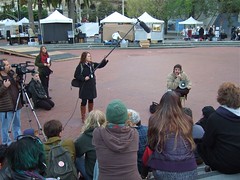
The crowd was overwhelmingly white, all in masks and keeping a comfortable distance from each other. I was pleased that there was such a nice turnout by white citizens of all ages and quite a number of young people.
 The speakers who were Black were up on the courthouse steps obscured by the crowd. My karate friend was one of them, but I couldn't see anyone from where I stood. And it was hard to make out what was being said unless they shouted as they did during the kneeling and chanting of George Floyd's name.

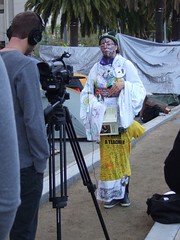
 I walked towards the sounds of a drum. I had also heard from my drumming group that there was a rally and thought they might be the source of the drumming, but it turned out to be a Native man in full regalia striking his drum when applause broke out.


At the back of the crowd I found a non-white contingent and was touched at their expressions of solidarity in their signs.


And I was especially pleased to see that an Asian man had given a lot of thought to his sign. "To my fellow Asian Americans" it said and then a quote from Desomond Tutu, "If you are neutral in situations of injustice you have chosen the side of the oppressor". In his basket he had bottled water to give out to people. I was glad to see where I could fit in in this new-to-me terrain of protest.

There was a police presence, but not a hostile one. All the windows of businesses were boarded up because apparently from a statement on the flyer requesting that attendees not take out their anger on small businesses it was assumed that they would take out their anger by trashing large businesses.


On my way out I got a second alert on my phone that there was going to be a curfew for two days presumably to make sure that things didn't get out of control. It seemed like a good time to leave.

This post is backdated to reflect my post to Facebook.

Labels: , ,

Wednesday, November 16, 2011

Occupying Myself


Sometime last year I read an article by a psychologist about the historical impact of a recession job market on college graduates and how the government needed to do something about jobs now because otherwise we would create a whole generation of young people who would break off from the mainstream and stop believing in the system. My first thought was "Why on earth do we want yet another batch of young people who believe in the system when things are so bad already. This, after all, is the exploitive, growth oriented system that was fleecing us all for every last dollar and natural resource."

Then I realized, with a flash of recognition, that I was in college during one of the worse recession years of the'70s and the slim pickings in jobs was something I would never forget. Here then, was an explanation for why I grew up to be such a malcontent!

Of course, there was more to it for me, my birthright and sexual orientation having landed me in a precarious geography of amorphous identity. There were, however, two distinct and conflicting sentiments that led to my awakening. The first was the idea that a college education would match my appetite for knowledge with meaningful work that would result in a respectful career as a professional of some sort and a respectable income. This was how it had happened for my parents. The problem was that I didn't believe in most of what was being taught in school even at the very liberal, no grades campus of U.C. Santa Cruz. All I could discern was that each discipline held a narrow view of the world and not one of those world views had a place for a cross cultural, non-Western, gender bending, female empowered perspective. The knowledge I was being exposed to simply wasn't relevant to me.

So I asked my mother why did I even need to get a college degree?

"So, you can live in the manner to which you have become accustomed," she said pleased to quote this witty truism.

My mother's answer led to my second revelation. Obviously I needed to become accustomed to a lifestyle that was a whole lot less pricey. My parents worked hard in their fields. Too hard I felt. We also worked hard at the leisure end of it too, driving to the mountains in the winter for the rush of downhill skiing, maintaining a boat so we could sail in the summer, keeping the pool and the house clean so we could entertain at our own home. I didn't want to work that hard just to get to the point of working harder, especially since none of those professions looked kindly on homosexuals in their ranks. And the closeted ones already there were trading self-oppression for privileges. I had already spent three years in the closet in high school and the constant vigilance at so young an age made me long for freedom. Freedom from these Faustian bargains. I dropped out of college.

(I did eventually finish a college degree, a queer friendly one in graphic design; one I could afford on my own at a state university, while working nights at a movie theatre and living at home. I didn't want to be branded a loser just for not finishing school.)

If It's Already Broken...

For the crop of students who have now become a phenomenal people's movement called Occupy Wall Street, the above psychologist's warning was quite prophetic. When OWS burst on the scene in a way that could no longer be ignored, it confounded the mainstream media. What were these privileged kids on about? I too wondered. Was it just about jobs, given those crippling college loans? But too many jobs were Faustian bargains with the environment.


From early articles about what OWS, I was pleased to see how quickly they were learning to be an inclusive movement. On Facebook, contacts began to post edifying charts and graphics about who were the 1% and who were the 99% and how it got that way. (Wow our gap between rich and poor is bigger than nearly everyone in the world!) In a matter of weeks all the old lefty radicals were coming out of the closet, daring to voice anti-capitalist sentiments that had long been suppressed for the sake of corporate funding to their pet environmental and social justice non-profits. Our top speakers and writers paid visits to New York to give teach-ins through the human megaphone. Every lefty cause jumped on the Occupy wagon with its agenda; we all understood that the system was broken. That no serious demands could be addressed through the usual democratic process. Obama had been our hope, but he too, was completely beholden to moneyed interests (just as Clinton had been).

"I told you that people needed to get in the streets," said Catherine. Yes we'd been needing to get in the streets forever, but had long been too comfortable and too amused by our many toys. The planet being destroyed wasn't enough. Polar bear starvation and whales tortured by sonic discharges not enough. Islands of plastic in the ocean not enough (and still largely a well kept secret). Entire villages in the developing world poisoned by corporate pollution not enough. Jobs sent overseas to exploited cheap labor not enough. Healthcare only for the healthy not enough. Poisoned food not enough. Tap water made flammable by frakking not enough. Oil spills not enough. Unjust wars not enough. Just plain moral outrage not enough.

And besides marching didn't seem to do anything. It was just a way to show the international community that we weren't all asleep. It never occurred to me that we would have to camp out. We weren't homeless. But here we had a group of largely white, middle-class, college graduates fed up enough to live in tents. I never in my wildest hopes saw it coming. I believed that such youth lived in the safety of a virtual world, were too absorbed to go outside, let alone sleep in it. They were digital natives as one colleague calls them.

Camp Occupy

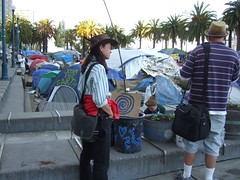
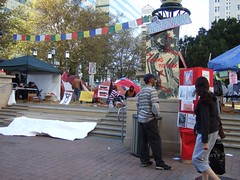
As an aficionado of urban camping, I had to see how it was being done. I contacted, Stacy, my fellow camper and we zipped downtown on Muni. As we entered the Justin Herman Park near downtown San Francisco, a man in a motorcycle jacket came out of his sizable tent to greet us. He was a troubadour he told us and it was his aim to be of benefit to the celebratory atmosphere of the camp, entertain tourists and add to the general bonhomie, he said. As Stacy humored him I stood watching a man in a polo shirt and chinos, pulling a rolling suitcase. He asked me if I knew who Geng was. I had no idea, naturally, and pointed to campers he could ask—white guys like him, but dressed as though for combat at a music festival.


Stacy and I took a circuit of the camp, We noted the many porta potties reeking of pinesol, the garden of vegetable plants and the catering tent busy with volunteers. Outside a white board offered classes in making sauerkraut and chinese noodles. I was particularly heartened by the talk on urban homesteading. A dog sat on a white pouf outside a tent; inside his mistress lay reading a hardback book. Rounding the corner we came upon a man listening to tunes from his laptop with portable speakers. He told us about the lamppost where you could plug into an outlet. We explored the communication tent that supported the camp's website and Facebook page. Inside sat a bearded man at a laptop. Next to him an Asian man peddling the bicycle powered generator connected to a sealed lead acid battery. As we left I saw the newcomer, his rolling suitcase in the care of a handsome multi-racial man with long black hair. They were working their way to a tent bearing a sign that said "bag check".

As we walked back up Market Street to catch the bus, we came upon the original Occupy encampment in front of the Federal Reserve building and noted the many political placards in the planter boxes. "Living Unsustainably is Self-Destruction", said one. "Tax the Rich," said another.

Two days later I had a client in Oakland. My client and her partner were pleased to report having been part of the march two days ago. After finishing my work for the day, I took the opportunity to visit Oakland Occupy, now famous for their run-in with police followed by the very successful general strike and the aforementioned march.

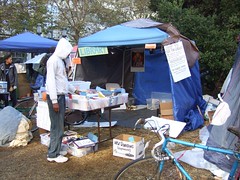
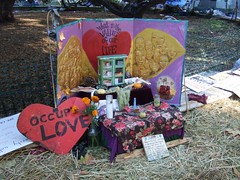
I emerged from the BART station a block from Frank Ogawa plaza. The entrance was marked by an altar to the marine who lay in the hospital following the blow to his head from a canister thrown by police, the night of the recent raid. At the front of the camp sat several white guys next to a sign that read "Tobacco donations here". I stopped at a pop-up shelter at the entrance to the plaza and spoke to two women, one black one white, sitting at a table under a sign that encouraged people to volunteer for services. Apparently no services were in demand, but something of an educational or self-care nature was encouraged. They offered me a free paper from an organization working for housing and racial justice.


As I walked into the camp on the newly laid hay (the original lawn having turned to mud), I noted the very different atmosphere from Occupy SF. Where SF had a familiar Green Festival atmosphere, Oakland had something fresh and edgy about it as if a village had sprung up of newly empowered people who were now busy helping themselves. I walked past a group of black men putting up a tent. At the library tent a white board had a long list of requested lefty authors. In the back corner, someone had built a hexayurt, a structure popular at Burning Man festivals, made from insulation board taped together with extra wide strapping tape. A sign on it said it was "A Red Tent" to honor the sacred feminine. A white woman in a sweater and boots stepped out of it. She invited me to come inside explaining that it was a woman only space; she showed me her pile of bedding. She had been there a week, was likely homeless before; she was accompanied by her chihuahua Elvis. I did not ask why Elvis was permitted in a woman-only space.

On the other side of the camp was a childcare tent where two children and their mother played with the toys laid out on a living room size rug. A gender-bending musician sang to a small crowd at a PA system on the steps of the city hall. Down the stairs on the right, a kitchen crew was busy preparing food for a line that was already forming. Before I left I stopped at a table loaded with donated clothes. A white woman in a bicycle helmet was busy folding and putting the clothes into categories. I stopped to lend a hand, wanting to participate in some way. She told me she lived nearby and came everyday because it was such a happening place. Yes it was magical in a Brigadoon sort of way, for the threat of eviction was a constant tension at the Occupy camps.


Oakland police had a recent history of acting rashly in a city fraught with problems and starved for cash. Later I would read that desirable public space in Oakland and other cities was now in the control of absentee corporate real estate interests. These interests feed the city with a specialized tax money earmarked to maintain a downtown area conducive to business. They were also given the power to specify how that tax money was used. (Don't we all wish we had that right?) And now they were demanding the police clear the camp. They also had the power to hire private security forces called Block by Block, a sort of Blackwater force for urban security. Mayor Quan was taking the blame for weak leadership. She may have supported Occupy, but her hands were already tied.

Change In The Air

For Americans the Occupy Movement has transformed the national dialogue dramatically. No longer will the notion of lowering taxes on the rich to raise all boats be the accepted wisdom. But the biggest crime of our financial system is still to be understood. For it is not just that the 1% refuses to share their wealth with the other 99%, it is that they have created a financial system that gives the illusion that there is so much wealth to be had in the first place. So focused are we on the power of invested money to make money that our financial system has completely lost touch with reality—with the actual physical world.

Societies used to survive hard times—wars, famine, et al—by setting aside enough grain to feed the population for the duration. The appetite of investors for real world resources has taken such food reserves, through international treaties like GATT, and thrown them on the table to play with. As with other "commodities" like forests, oil and clean water, all are bid up and made into trash as fast as possible with no sense of how long it takes to renew those resources (if they are renewable) and no back-up plan if they aren't. And that is scary. Not only are we leaving nothing for future generations, we don't even know if we are leaving enough for ourselves.

We have a system with no feedback loop to warn us when we are doing irrevocable harm to the planet. Investors are positively rewarded by rising prices to buy until a bubble bursts. And when the bubble does burst we have more of something than we know what to do with. (I know I help people throw it away. And bigger stuff like the empty condos in Bangkok that I saw on my last trip.) This overproduction of everything, making trash out of resources as fast as the market will bear, plus the pollution and carbon footprint it took to produce these items, is planned obsolescence on a planet threatening scale.


As the Occupy camps are evicted, the movement has declared that they are an idea whose time has come. Indeed there is astrological precedence for such a vetting of corporations, government, and other patriarchal institutions. The last time the planets and stars were aligned thus was during that other era of protest—the Sixties. Already the comparisons are being made. Occupy has set a mood for stripping away falsehoods and testing the viability of all our social system. There is no end to the things we could examine. I can hardly wait.

Labels: , ,

Saturday, May 17, 2008

Dammed, Displaced and Democratized

Part five in a series of stories from my road trip in Thailand, participating in a study tour hosted by Pun Pun farms, to visit local examples of sustainable living in the Northeast and in Chiengmai.

Self Reliance and the Earthen Building Movement

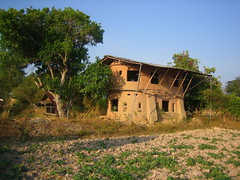
As founder of the earthen building movement in Thailand, our tour leader Jo Jandai had contributed much to the concept of living sustainably. As a farm boy he grew up believing, as others did, that his future prospects lay in getting more education and finding work in the city. His epiphany came after seven years of living in Bangkok working everyday and barely making ends meet. What kind of a life is this? he asked himself. He was not an engine. Jo then returned to his family farm with the intention of becoming self-reliant. This was a man after my own heart for I, too, thought self-reliance was preferable to dependence on money.

For me this meant being able to cook, garden, sew my own clothes and fix the house I was living in. I even enrolled in a two-semester construction technology class to learn carpentry, electricity, sheet rock installation, roofing and plumbing. Once I saw what was beneath the sheet rock, I realized that our homes were really just a clever illusion of comfort—a stage set of thin materials propped up with sticks. This badly insulated, leaky box then had to be heated using fossil fuels piped over long distances or air-conditioned with electric power at peak hours. Building materials were manufactured and trucked from far away while the building industry itself was one of the largest generators of garbage. And it was all so unnecessarily expensive. People were made slaves to their mortgage.

I was already enamored of straw bale buildings, which used local agricultural waste straw to create massive walls that would moderate interior temperatures. A few years later, I explored my interest in natural building by taking a cob building workshop, a close cousin to adobe. I collected books on tiny houses and lulled myself to sleep engineering in my mind structures made from available materials.

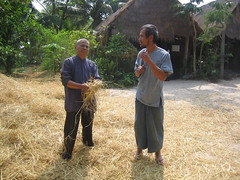
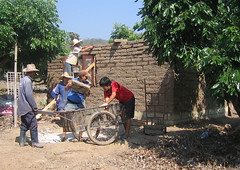
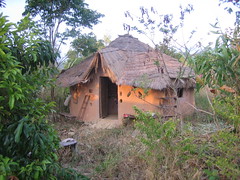
Jo had a head start building a real house on his family farm. It was made of bamboo, a readily available building material. Then, on a trip to the US, Jo happened to visit a pueblo in New Mexico and was struck by the cool temperatures inside the building relative to the hot dry climate outside. His home in Isaan had a similar climate. After studying the pueblo ruins and seeing how the adobe bricks were put together, he came back to his farm and began experimenting with building his own adobe house using a wood frame to make bricks. Transporting wood poles on his bicycle for the roof, he had a house built in three months, working only two hours a day. "This is so easy," he said to himself, marveling at this discovery of self-reliance. Better yet his house was virtually free while a concrete house, which is what his neighbors aspired to build, cost $15,000 baht. His neighbors came to watch and laugh at this folly of this crazy man building a house from mud.

The Principle of Easy

I too, was struck by how easy it was. After a week at my cob workshop pressing the mud and straw mixture together with my thumbs we only had a wall that was thigh high. With adobe bricks a house could be finished in a few days. It didn't seem right, yet it still had the same insulating qualities as cob or straw bale, was made from the surrounding earth and could be finished with sculptured decorations just like cob.

Making things easy, I realized, was the mantra of being Thai. All this time I had felt that this was our downfall—that the reason the Chinese did so well in business was because they were willing to work harder than the Thais. Challenged by the Chinese heritage of my Bangkok family, I had felt delinquent claiming to be Thai as if I were announcing that I had no plans to succeed. My American peers compounded this feeling by working hard to achieve "goals". I fended off such expectations and firmly claimed to be a Slacker. Secretly, I worked quite diligently on the projects I was interested in—hobbies they were called by others.

Jo told us, he had so much free time after learning to build his own house and grow his food organically that he started a children's group, a singles group and a library. He also had time to reflect and enjoy the beauty in life. He was not, however, considered a catch by the local village girls.

"No Thai girl would date me because I don't have a motorcycle," he said smiling. He didn't say it, but we could see that this was why he ended up dating farang girls and marrying Peggy, now sitting next to him as he told his story the first day of our study trip. Peggy had come to Thailand to work with the urban poor, but then decided to back up a bit and work with the rural poor before they ended up in the city.

"But how did you end up going to New Mexico?" I asked him in private. Poor Thai farm boys do not usually travel so far from home just to see the sites.

"My ex-wife wanted me to go because she live there," he explained. Ah yes, I nodded, "so another door opens". I did not want to pry further after the motivations of this ex-wife though I was interested in every farang's story who chose to spend time in Thailand. And besides it would be poor form with Peggy just a few yards away.

Jo's fame as an innovative builder came about in a similar circuitous way. First his neighbors had to experience the earth building for themselves. This they would do through another enterprise of self-reliance on Jo's part. After learning to make his own soap and shampoo, he organized a co-op to make and sell these products. This led to the need for a store in which to sell them in the village. Jo built the store and when customers came inside to shop they too experienced how cool it was inside the little earthen building. Soon other families ventured to make their own houses out of mud.

A Thai nun writing for a magazine discovered the adobe houses and published a story about Jo and his Baan Din, or "houses of earth". He became sought after by the public to help others build their houses. Over the course of three years he traveled all over Thailand helping to build some 300 houses for free.

Dammed, Displaced and Democratized

Half way through our two-week tour we packed our bags, loaded them onto the truck and said good-bye to Jo's family farm. Jo, Peggy and their little boy Tahn came with us to escort us to their northern home in the hills of Chiengmai, but first we would stop at a mountain community that had formed in the wake of a ten-year protest.

I had read about the protest and had been intrigued by this band of villagers that had set up camp on the lawn of the elegant parliament building in Bangkok. The villagers had lost their homes due to a large dam project (funded by the World Bank) flooding their land. The protest attracted others including displaced slum occupants, workers harmed in the workplace, prostitutes, those protesting encroachment on the forests and a large group called The Assembly of the Poor. For ten years, on and off, the groups protested until finally Thaksin, who had become Prime Minister at that time, undermined the Assembly of the Poor by giving the key leaders well paid jobs on various government committees. To those displaced by the dam he offered a piece of land that he then said they had to buy with a loan of 4 million baht from the government. Already in debt from so many years of protest, the villagers accepted the land hoping the government wouldn't come asking for the money.

The resulting settlement was by far the most famous site of earthen houses we would visit, boasting its own road sign. Both Jo and Janell, also traveling with us, had been part of the international group that had helped the villagers build their own houses, install solar panels, build a school and another beautiful community building. Located high atop a mountain ridge, the open land of tall grass partly obscured the pink and yellow earth tones of the buildings. Mun Yeun, as it was called, had the air of a resort during the off-season. We pulled our bags off the roof of the truck and carried them to the schoolroom where we would later sleep elbow to elbow.
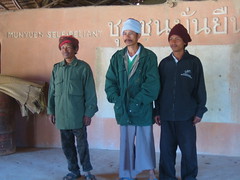
After a brief tour of the area, we assembled in the schoolhouse to hear what the three founding members of the village had to say. It soon became apparent that something was wrong with this picture. Of the 35 families that agreed to buy the land from the government, only nine were actually able to move here and only three remained. When we asked why, the men told us the families had gone to find work to pay off their debts.

So this is what democratic protest gets you, I pondered to myself, the right to protest, but not the right to be?

My fellow travelers offered suggestions, wanting to solve the problems facing the three founders. Martin, our practical minded chicken farmer, asked if they could grow cash crops. They had not been able to, they told us, but if they did they feared that the government would start asking them to pay off the 4 million baht debt.

Someone else asked if the King could step in. We knew the king to be a just man and an advocate of self-sufficiency, but no he had no such power to help them. He was only a figurehead.

"What about the government that supports self-sufficiency," asked Jen referring to the talk we had heard at the Santi Asoke center about how the government banks had wanted farmers to take the training in self-sufficiency before taking out a loan.

"No government wants self-sufficiency" I said bitterly. Jo agreed. It was all a manipulation to get poor people to work for rich people. The earlier promotion of self-sufficiency, after the financial collapse, had been an act of self-preservation to keep the banking system from going under, I realized. I was filled with despair that no one wanted these villagers where they were; they were just in the way of progress.

"Maybe they are a tourist attraction for travelers to witness the impact of globalization," I said quietly.


Jo did not translate this sentiment, just vocalized an agreement. Janell, who was sitting next to me, did not offer a sassy comeback. She was silent, possibly absorbed in her own thoughts of the project she had directed. Except for a few houses and a carport, these beautiful buildings were now largely abandoned.


Would people choose industrial progress if they knew the cost? How well I understood the need for massive dams to provide electricity to an industrialized city eager to power its consumer lifestyle. The dam in question would provide enough power for one shopping mall in Bangkok. Back home in the States ever-expanding server farms (computers supporting the Internet), were being built as close to dams as possible for the cheap electricity rates of clean hydropower. There was no end to our need for more power once started.

The villagers had been told the dam would help them irrigate their land, but that obviously was not the case as the plan was to flood their land altogether. The men implied that, had they known what was to come, they would have protested sooner.

"Ten years was a long time to protest. What kept you going?" I asked. This seemed to strike them as a silly question and they laughed at the mention of the ten years.

"There were a lot of issues needing to be discussed," one said simply.

I was trying to find the point to it all—the point of democracy and progress. This land was not theirs, it could be taken away for development into a resort for city people, the government wanted money and the land needed to be maintained to protect it from fire, but there weren't enough people to keep the fire breaks clear. The villagers had not been in agreement about the communal vision necessary to protect themselves from larger economic forces. Many had wanted to subdivide the land and go their own way with it, sell it even. I was frustrated by this failed vision and asked why they continued with it.

"They are just trying to survive," Jo explained. My thoughts were arrested midstream as I realized how bourgeois was my need for meaning and purpose. I, who could go home after a day of protest, had the luxury of righteous principle. Surviving meant continuing to try whatever might work. At the moment the three men were planting trees. They had been a forest people and even though they did not know the trees in the area, they knew how to cultivate a forest. The government officials came by, saw the plantings and did not ask for money. They just told the villagers to keep records of what they were planting. This was seen as hopeful. The villagers knew that the government were, now, wanting to grow back the forest, which would justify leaving them be. Meanwhile the protests had caused so much controversy that none of the other proposed dams were being built.
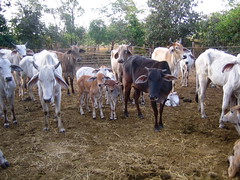
Dimly I began to understand that perhaps there was an optimum vision here. We learned more about their projects to reforest; how they were teaching their neighbors the value of leaving the land undeveloped. They were offering the investment of a cow in a sort of community supported beef supply that gave back in manure and offspring. Montaine asked what chore we could do to help them out. Thus our group spent the next morning raking manure in the cow pen into a big pile.


As we packed up to leave, a group sat down near me to sign the large guest book. Erin our Australian student was chosen to scribe since she had the best handwriting.

"What shall we write?" Sasha, our American student asked.

"Good luck," I suggested cynically, "We landless server farmers promise we won't build any more dams." Needless to say this was not considered a serious suggestion, but they acknowledged my declaration of guilt with respectful silence.

"What about this?" said Irena eagerly, "May the forest give back a hundred fold what you put into it."

"Oh that is so nice," I said sincerely, then laughed at the whiff of sarcasm I barely managed to pull back. Ah youthful optimism. The others agreed and Erin wrote it down.

Labels: , , , , ,

Earthworm. Get yours at bighugelabs.com